
Is Modern Politics More Vicious than Ever?
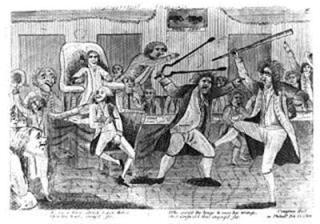
Woodcut of Lyon-Griswold House Floor Brawl, 1798 (Courtesy: Smithsonian Institution)
What spurred me to write about this topic was a recent Facebook discussion I had with an old and respected friend, who opined that he thought political leaders over the past twenty years or so were subjected to more slanderous accusations, ridicule and disrespect than at any time in our history. I might have dismissed that comment, except it seems to be a popular sentiment these days. Whether the cries to denounce comparisons to “Nazis” after Rep. Gabrielle Giffords was shot, complaints by members of Congress regarding ethnic and racial slurs used against them, or statements by people like my friend, there seems to be an overriding sense that politics today has become far too personal. Popular sentiment is that unlike our history, we’re a nation more polarized and more willing to use the most vicious ad hominem attacks in place of reasoned debate than ever before.
Such sentiment may be popular, but it is incorrect. Defaming public figures is an American tradition that is older than the Republic – one can find newspaper articles and pamphlets pre-dating the Revolution that disparage, often in the most personal terms, some of the most famous Americans in history. Thomas Jefferson wrote of “the putrid state into which our newspapers have passed, and the malignity, the vulgarity, and mendacious spirit of those who write for them.” 1 Although Jefferson wrote those words in 1814, the reality is vulgarity and mendacity were hardly new to politics, even at that young age for the nation. As an example, in 1798 Alexander Hamilton published the pamphlet Letter from Alexander Hamilton, Concerning the Public Conduct and Character of John Adams, Esq. In it, Hamilton not only defames Adams’ character (among other things, he asserts that Adams is “a drunkard, the type for whom sound judgement <sic> deserts at the first drop of whiskey.”2). Of course, six years later Secretary of the Treasury Hamilton would be killed by Vice President Aaron Burr – a duel sparked by Hamilton’s characterization of Burr as, among other things, corrupt and treasonous; even going so far as to actually recommend assassination should Burr win the Federalist Party nomination for President.
The election of 1824 gave rise to “The Corrupt Bargain,” but was nothing compared to the vindictiveness and nastiness exhibited in 1828. Andrew Jackson was portrayed by John Quincy Adams as an adulterous murderer(and you thought Bill Clinton had it tough), while Jackson and his camp gleefully heaped charges of prostitution, elitism and corruption on Adams. The slander reached levels not seen since, as the “Coffin Handbills” were widely distributed and Jackson’s wife was accused of bigamy. The attacks were so vicious that Mrs. Jackson fell ill and later died as a result. In 1840, the winning campaign of William Harrison completely avoided the issues of the day (including the worst financial crisis in the nation’s history, to that date), focusing instead on comparing the personalities of Harrison and Martin Van Buren. (Although Van Buren tried to make an issue of Harrison’s age, it went nowhere. The nation should have listened – Harrison served the shortest term in history after falling ill during his Inauguration.) And of course, Abraham Lincoln faced the worst kind of personal attack when ½ the country decided they would rather secede than accept him as President.
Personal attacks haven’t always been limited to the Executive Branch, either. Indeed the mudslinging on the floors of the Congress and Senate have even occasionally led to outright brawls. The first occurred in 1798, between Roger Griswold (Ct.) and Matthew Lyon (Vt.). Griswold, upset about charges of cowardice from Lyon, took it upon himself to whack Lyon with his hickory walking stick. Of course, it should be noted that Lyon didn’t help calm the situation when he spat at Griswold. Both men were later censured by the House. In 1856, Andrew Sumner (Ma.) took the floor to deliver a diatribe against Preston Brooks’ (SC) father-in-law. In a scathing bit of oratory, Sumner alleged Brooks’ in-law kept a mistress “who, though ugly to others, is always lovely to him.” 3 The result was less brawl than mugging: Brooks beat Sumner to within an inch of his life, using his cane; as other members of the Senate attempted to aid Sumner, Laurence Keitt (SC) bayed them at pistol-point. Keitt was hardly a stranger to fisticuffs on the House floor. Two years later, he took exception to Galusha Grow’s (Pa.) calling him a “negro driver” and attempted to strangle Grow – on the House floor. The result was the largest melee ever seen in Congress, involving at least 50 Representatives.
These are just some of the more outrageous examples of how political slander has been a part of our discourse since the days of the Founding Fathers. In fact, you can argue that if anything, politicians today face less derision than their predecessors. The next time somebody you know complains about our leaders being treated like Rodney Dangerfield, feel free to whip out one of these juicy tidbits – and invite them to pay more attention in history class.
- Excerpted from “The Writings of Thomas Jefferson,” edited by Lipscomb & Bergh, published 1903. The excerpt is from a letter written to Walter Jones in 1814.
- As excepted in the Philadelphia Aurora, June 12, 1800.
- Detailed in “The Caning of Senator Charles Sumner“, Senate Historical Office, US Senate.
Why the Electoral College Matters

Belushi: An Electoral College Attendee?
One of those arcane topics that makes its way into political conversation is the Electoral College. Despite the fact that it should be treated as a pretty technical subject, it is usually given the same bumper-sticker treatment that serves as political discussion these days. Popular sentiment boils down to, the will of the people is ignored by the Electoral College and it should be reformed or replaced to more directly represent the popular vote.
Hey, great idea, right? Who could possibly be against the will of the people and the popular vote? And besides, isn’t the Electoral College some arcane leftover from the 18th century? Wasn’t it devised by a bunch of fuddy-duddies who were after maintaining power for the privileged few? Like most bumper sticker ideas, these are all exploded rather easily once you actually examine things.
First of all, the founders created the Electoral College expressly to prevent the type of insane power brokering that happens when somebody is incapable of winning the popular vote. Having experienced the shortcomings of parliamentary elections first-hand as British subjects, they were determined that Presidential elections should have a clear winner. Further, they were determined that each state would have a fair say in determining the winner. As odd as it may seem to people without a solid grounding in American history, our nation has always had regional differences in culture, along with the attendant political differences that arise from them. Although we love to dismiss many of their ideas as outdated and irrelevant in modern society, the Founders understood that direct elections bring with them tremendous peril for functioning government.
Were they right in their assumptions and fears? That anyone of voting age could think otherwise demonstrates either the inability to comprehend civics – or do some basic math. Currently, there is a proposal going around calling for each state to amend their constitutions to allow for direct apportionment of their Electors. The Republican Party is similarly apportioning their votes in the 2012 primary process. The result, based on the fact no candidate can seem to muster more than 40% of the vote and the front runners routinely poll in the mid-20’s, is likely to be a brokered convention. For those of you wondering what one of those looks like, I refer you to the 1968 Democratic Convention. Most people only know it for the chaos in the streets of Chicago – forgetting the chaos inside the convention itself. Before finally settling on Eugene McCarthy as the party’s candidate, the convention floor was raucous while party leaders haggled behind closed doors for days.
But could such an outcome be the result of states directly apportioning Electors? Consider three elections in our recent history:
2000: This is the election most cite in wanting to do away with the Electoral College. Neither major party candidate achieved 50% of the popular vote, but thanks to the Constitution George W. Bush garnered 279 electoral votes, 9 more than needed for victory, despite trailing Al Gore 48.4% to 47.9% in the popular vote. But had the electors been decided by the direct apportionment method, the electoral votes would have tallied as Bush 259, Gore 258, Ralph Nader 17, Pat Buchanan 4. Nader would have been a kingmaker in that scenario, as he could have pledged his votes to either major party candidate. The result would be what we witness in countries with otherwise weak minor parties – a leader forced to try and hold a coalition together, held at whim by the minor party’s demands.
1996: Bill Clinton swept to re-election with 379 electoral votes (despite only garnering 49.2% of the popular vote), but direct apportionment would have yielded a much different outcome. The tally would have been Clinton 263, Bob Dole 222, Ross Perot 53. Perot’s nascent Reform Party would have had the power to change history, but that possibility is dwarfed by the results from…
1992: This is the granddaddy of all examples as to why the Electoral College works. Perot garnered nearly 20 million votes nationwide, finishing second in Utah and Vermont (and falling short of winning Utah by less than 12,000 votes). It was the most successful third party candidacy in history, with Perot capturing 18.9% of the total popular vote. Yet, he won no electoral votes since he didn’t carry a single state. Bill Clinton won the electoral vote, 379-159 over George H.W. Bush, despite only capturing 43% of the popular vote. Under direct apportionment, the result would have been grim, indeed. Clinton would have managed only 229 electoral votes, Bush 201 – and Perot 108. Try to imagine the type of havoc Perot could – and would – have created had electors been directly apportioned. Constitutional crisis only begins to describe it.
That’s three elections within the past 20 years that would have been turned upside down, without a clear winner or any semblance of legitimacy for the eventual President. Except that the Electoral College was there to sort through the debris and declare a new President. So, before signing on to do away with the Electoral College or make dramatic changes to its structure, remember that those aging fuddy-duddies who wrote the Constitution knew a thing or two. As usual, we would be well advised to stop and think about the how and why they created the structures of our government before casting them aside.
 Political Baseballs