Musings on Sports, Politics and Life in general

Latest

Help a Jarhead (or maybe a million)


Two Marines affected by contaminated Lejeune water

Undoubtedly, most of you have heard about Love Canal, NY. But what would you say if I told you there was a place where contamination levels were worse, with a population 500 times greater? And what would you say if that place was owned by your government? And that while acknowledging the contamination since 1984, the government has done nothing in the intervening 28 years to assist those affected by it?

This is the situation for the more than 1 million Marines and sailors who served aboard Camp Lejeune, NC between 1957 and 1987. During that time, the wells used for drinking water at the base were contaminated by more than 200 known toxic substances. Nobody can say with any certainty what the effects of ingesting this many poisons, in the volumes and combinations by anyone who lived on the base for any length of time, might be. What is known that there has been a rash of strange diseases in people who lived and worked on the base: male breast cancers, digestive diseases and cancers, brain diseases and cancers. While they cannot be 100% conclusively linked to the contaminated wells and ground water, the unusual rate of incidence of these diseases certainly suggests more than  a casual causal probability. In some cases, the incidences are more than 1000x what is found in the general population!

But the government understands that actually taking care of the men, women and children who ingested these chemicals is an expensive proposition. And so, rather than live up to the Marine Corps motto of “Semper Fidelis,” your government has seen fit to lie, obfuscate and deny assistance to them. Rather than display faith and fidelity to the Marines who were assigned to duty at Camp Lejeune, the government has decided it better suits their needs to shun us and pray we all die off before they need to do anything. The Obama administration has decided that rather than lend a hand, more study is required. Congress has allowed legislation aimed at helping  languish in committee, despite having bipartisan support and 42 co-sponsors.

There is something you can do to help, though. First, sign the petition to let the President and Congress know that you, the taxpayer and citizen, support the Marines fighting what may be the most desperate battle of our lives.

Second, the Janey Ensminger Act would classify any Marine or sailor, or their dependents, who lived at Lejuene as having a 100% service-connected disability. That would allow them to receive free, lifetime medical care through the Veteran’s Health Administration.  As mentioned above, the bill is currently stuck in the Veterans Affairs Committee. The committee rules allow the committee chairman, Rep. Jeff Miller (R-FL 1), to pass the bill out of committee without a vote. So, write Rep. Miller and urge him to send the bill to the full House of Representatives for a vote. You can also message him through Facebook.

Let’s get it done, people. When duty calls, the Marines are the first to answer. Now it’s your turn to do the same for them.

A Soldier Died Today (Orig. posted Memorial Day, 2011)


Thanks to my friend and fellow Marine Howard Cooper for passing this along. Neither of us know who the author is, so I can’t properly attribute this poem. But while everyone else is still nursing hangovers or trying to get back in the flow of normal life, there are some of us who will not forget…

He was getting old and paunchy and his hair was falling fast,
And he sat around the Legion, telling stories of the past
Of a war that he had fought in and the deeds that he had done,
In his exploits with his buddies; they were heroes, every one.

And tho’ sometimes, to his neighbors, his tales became a joke,
All his Legion buddies listened, for they knew whereof he spoke. But we’ll hear his tales no longer for old Bill has passed away, And the world’s a little poorer, for a soldier died today.

He will not be mourned by many, just his children and his wife,
For he lived an ordinary and quite uneventful life. Held a job and raised a family, quietly going his own way, And the world won’t note his passing, though a soldier died today.

When politicians leave this earth, their bodies lie in state,
While thousands note their passing and proclaim that they were great. Papers tell their whole life stories, from the time that they were young, But the passing of a soldier goes unnoticed and unsung.

Is the greatest contribution to the welfare of our land
A guy who breaks his promises and cons his fellow man?
Or the ordinary fellow who, in times of war and strife,
Goes off to serve his Country and offers up his life?

A politician’s stipend and the style in which he lives Are sometimes disproportionate to the service that he gives.
While the ordinary soldier, who offered up his all,
Is paid off with a medal and perhaps, a pension small.

It’s so easy to forget them for it was so long ago, That the old Bills of our Country went to battle, but we know It was not the politicians, with their compromise and ploys, Who won for us the freedom that our Country now enjoys.

Should you find yourself in danger, with your enemies at hand,
Would you want a politician with his ever-shifting stand?
Or would you prefer a soldier, who has sworn to defend
His home, his kin and Country and would fight until the end?

He was just a common soldier and his ranks are growing thin,
But his presence should remind us we may need his like again.
For when countries are in conflict, then we find the soldier’s part Is to clean up all the troubles that the politicians start.

If we cannot do him honor while he’s here to hear the praise,
Then at least let’s give him homage at the ending of his days.
Perhaps just a simple headline in a paper that would say,
Our Country is in mourning, for a soldier died today.

I Shed a Tear (orig. posted Memorial Day, 2010)


I originally posted this on Memorial Day, 2010, but the sentiment is the same. As you head out to the beach, the barbecue or the ballgame today, please take a moment to remember why you have this particular Monday off from school or work.

And although it’s been two years since I originally wrote this and the little boy at the end is now not quite so little, I still want to thank him and his parents. Whenever I need affirmation that this nation still has good and just people, I think of them.

I awoke this morning to thoughts of old friends who left us too soon. It’s not an unusual occurrence; most mornings I wake thinking of the same men. When they died, they did not give in to fear; cowardice was not these men’s forte. Some died in battle, some preparing for battle. Two very good friends of mine died not in battle, but the wounds they sustained in defense of liberty hastened their untimely departure from our world. One man was known simply as Tank. He was a large man, but in his later years his body had been ravaged by the effects of two bullet wounds and prolonged exposure to Agent Orange during his two tours of duty in Vietnam. Today, I celebrate not only Memorial Day but the tenth anniversary of his passing. Although Tank never spoke of it, he was awarded a Bronze Star during his second tour. It wasn’t until his funeral that I learned how as a 23 year old platoon sergeant he ran back onto a hot LZ, taking a bullet in the back and one in the shoulder, in order to pull one of his men to the relative safety of a tree line. But anyone who knew the man wasn’t surprised to hear of his courage under fire.

This morning, as I thought of him, I shed a tear.

The other day, I watched my town’s annual Memorial Day parade. In addition to the Korean War and Vietnam vets, a detachment from the local Marine Corps reserve unit marched. As I looked at their eager young faces, I realized that most of those kids weren’t born when I earned my EGA in 1983. In fact, most of them hadn’t been born when I mustered out. Realizing that most of these young men will be shipped to Iraq or Afghanistan, I reflected on my own service. I joined to fight Communism, and like most of the world, I rejoiced when the Berlin War crashed to the ground. I truly thought my service had proven, in some small way, invaluable to the defense of the American way of life. Yet here I was, watching a new generation of Marines preparing to fight a new enemy. Had my service not been as valuable as I once thought? Had the men I had known during my service, men who had fought and died in battles around the world – had they died in vain? I decided that no, our service – their service – had been as important in our time as these brave young men’s service is today. And then I realized that none of those young men will return from their combat tours the same. Even if not scarred on the outside, even if they survive to return home physically intact, they will carry the memories of what they see and feel and endure for the rest of their lives.

And as I watched, I shed a tear.

Last night I watched the National Memorial Day Concert, broadcast from the National Mall on PBS. I listened as Gary Sinise and Dennis Haysbert recounted the final moments of Charlie Johnson’s life. I watched as a new generation of war widows were celebrated. I enjoyed the stylings of Brad Paisley. Like plenty of others, I rose to attention and sang the Marine Corps hymn during the Salute to the Services, and I rose to attention and sang again during “America the Beautiful.”

But many times during the concert, I stopped to shed a tear.

And I wondered, as I prepared to try and sleep, will anyone awake on Tuesday and remember the sacrifices of the men who have fought and died to preserve the United States? It’s terrific that we have a day set aside to pay tribute to those men. And I don’t mind that we celebrate by doing uniquely American things – backyard barbecues, trips to the beach, baseball games. But I wondered, when Tuesday comes will my fellow countrymen remember those who ensured that the backyard barbecues could continue?

A little earlier today, I went to the neighborhood bodega. It was a routine trip to pick up a few items needed for my own backyard barbecue. Like many veterans, I have a “Pride Hat.” You may have seen one perched on a veteran’s head – a military baseball cap on which are pinned his campaign ribbons. Mine is nearing retirement. It’s 14 years of service are evidenced by its faded color and the only thing keeping it together are years of starch used to block it. As a result, I only wear it on special occasions. Today being one of those occasions, I wore it on my walk to the bodega. On my return trip, a neighborhood kid – maybe 6 or 7 years old – stopped me and said, “Were you really in the Army?” I smiled and said, no, I am a Marine and we’re better than the Army. The little boy sat on his bike for a minute, seeming to take in this bit of information. The he stood, and said “Thank you” before pedaling off down the street.

I shed a tear. In fact, I’m still shedding a few as write this. Because I have my answer. For as long as children like this can find my service honorable, they will keep the flame of liberty alive. In so doing, the most important thing we can do as Americans is to remember and honor the sacrifices that so many brave men have and  will endure. We will continue to live as Americans, preserving our republic as the beacon of freedom and liberty for the rest of the world.

Divide and Conquer


“Increasingly, the Democratic Party feels the need to match the Republican right in stridency and hardball tactics. I am convinced that whenever we exaggerate or demonize, oversimplify or overstate our case, we lose.” – Barack Obama, The Audacity of Hope.
“Elections have consequences. And at the end of the day, I won.” – Barack Obama (discussing economic policy with Eric Cantor), January 23, 2009.

One of the things my liberal friends have trouble digesting is Barack Obama’s inability to sustain the “Hope and Change” ideology of the 2008 campaign during his Presidency. I would invite them to ponder those two quotes above the next time they try to figure it out.

Obama campaigned, beginning with his convention speech in 2004, as being a new, “post-partisan” politician. A politician who would put his party aside for the sake of compromise, a man whose principle ambition was “to get things done.” He won, by and large, because he convinced large numbers of people who had no prior electoral experience of that narrative. This was despite the fact that in his brief time as a sitting representative, he didn’t have one example of a compromise solution he had worked on. He did have one bipartisan bill he worked on with Sen. Tom Coburn – S. 2590, the Federal Funding Accountability and Transparency Act of 2006. But that particular piece of legislation passed the Senate 98-2, and Obama was one of 47 co-sponsors. It wasn’t a compromise, none was needed to pass. Coburn noted during the 2008 election, in discussing this one example of post-partisanship, that “It’s easy to work across the aisle on consensus items. It’s when you demonstrate that you’ll stand in between — in no man’s land between the two trenches of the Democratic and Republican base, and you’ll take the heat. We haven’t seen that from Barack. As much as I like him, he’s not ever rejected anything of his party to be able to stand in the middle.”

More than anything else, this is the reason Obama cannot mobilize the people who propelled him to victory in 2008. The carefully crafted image of a post-partisan politician was with one move after assuming office, destroyed forever. Obama, the man who convinced millions who distrusted politicians and the political system that he was somehow different, revealed himself to be as partisan as anyone who’s ever held elective office. He tried to recapture that theme after the 2010 midterms, but quickly reverted to being a partisan hack. The evolution has left those millions who were cynical about the political process before his candidacy even more cynical in the aftermath.

The genie is out of the bottle and it won’t go back in, just as those millions won’t be coming back to support the President this time around. This realization that Obama can’t reclaim the throne of preeminent post-partisan is well understood by Campaign Obama and they’ve gone to the only option the President’s words and actions have left them: divide and conquer. They’re praying they can mobilize enough of the left wing to win reelection. But to do that, they need to abandon all pretense of being anything other than the highly partisan; they need to attack and denigrate any position not in line with leftist theology.

That this type of campaign will accentuate the differences in the nation, polarizing us more than any time since the Civil War, is of little consequence. The only thing that matters is that Barack Obama wins – even if the nation loses.

The Narcissistic Liar-in-Chief


It doesn’t come as a surprise to readers of this blog that I am not a fan of Barack Obama. I never have been. I’ve never seen in him the things the media generally transposes onto the Obama persona. I’ve always seen him as nothing more than another cold, calculating politician. Just another in a long line of despotic Chicago politicians; a man after whom Bill Daley would find more in common than the typical working stiffs that populate the Windy City. And like all politicians, I always figured he was more than a bit narcissistic.

But then today came word that the Obama White House is attempting to actually rewrite history, to include one Barack Hussein Obama in some of our country’s greatest Presidential moments. If you’ve heard about this already, then it was probably the rewrite of the Reagan Presidency that got your attention:

“In a June 28, 1985 speech Reagan called for a fairer tax code, one where a multi-millionaire did not have a lower tax rate than his secretary. Today, President Obama is calling for the same with the Buffett Rule.”

Reagan speaking at Northside HS, 6/6/1985

It’s actually beyond narcissistic to rewrite this bit of history. Reagan was not arguing for higher tax rates on anyone, as Obama contends with his historical rewrite. Rather, the Gipper was proposing a complete revamping of the tax code – lowering rates for everyone and eliminating loopholes. You can read the full text of the speech here, but I figured I would give you the portions where he talks about the need for a simpler, fairer tax code. Keep in mind, this speech was given at the commencement for Northside High School in Atlanta. The main thrust of the speech was celebrating the students achievement in turning their once failing school into one of the ten-best in the nation, while also lauding the nation’s economic turnaround. Neither of these are accomplishments that the Obama administration can even hope to match.

“We’ve already come a long way. Just 5 years ago, when some of you were in junior high, America was in bad shape, mostly bad economic shape. Rising prices were making it harder for your parents to buy essentials like food and clothing, and unemployment was rising; there were no jobs for seniors in high school and college to graduate into. It was as if opportunity had just dried up, and people weren’t feeling the old hope Americans had always felt. And that was terrible because hope was always the fuel that kept America going and kept our society together.

Just a few years later everything’s changed. You and your parents are finally getting a breather from inflation. And if you graduate and go out into the work force in June, there will be jobs waiting for you. Hope has returned, and America’s working again.

Now, you know how all this came about, how we cut tax rates and trimmed Federal spending and got interest rates down. But what’s really important is what inspired us to do these things. What’s really important is the philosophy that guided us. The whole thing could be boiled down to a few words—freedom, freedom, and more freedom. It’s a philosophy that isn’t limited to guiding government policy. It’s a philosophy you can live by; in fact, I hope you do…

As you know, that last week I unveiled our proposal to make the Federal tax system fairer, clearer, and less burdensome for all Americans. Now, someone might say it’s odd to talk about tax policy with young people in their teens. But I don’t think so. You not only understand what taxes are, what effect they have in the average person’s life, but if you don’t understand, you will pretty soon when you get your first job. I know some of you already have part-time jobs, and I know you keep your eye on the part of the check that shows what Uncle Sam is taking out.

What we’re trying to do is change some of those numbers. We want the part of your check that shows Federal withholding to have fewer digits on it. And we want the part that shows your salary to have more digits on it. We’re trying to take less money from you and less from your parents…

We’re going to close the unproductive tax loopholes that have allowed some of the truly wealthy to avoid paying their fair share. In theory, some of those loopholes were understandable, but in practice they sometimes made it possible for millionaires to pay nothing, while a bus driver was paying 10 percent of his salary, and that’s crazy. It’s time we stopped it.”

Of course, Warren Buffet was already a successful investor by the time President Reagan assumed office in 1981. And he was one of those millionaires Reagan was referring to, the ones who were paying nothing while bus drivers were paying 10% of their salary. The only difference is now, Warren Buffet still pays nothing, but that bus driver (assuming he’s still employed) is paying over 1/3 of his salary in taxes. And do you know who was at the forefront, leading the charge against the type of tax reform Reagan advocated? Yep, the same Warren Buffet who today is still against tax reform – instead opting for the Obama option of the “Buffet Rule.” And the reason for that is as simple as can be. Today, there are even more loopholes in the tax code than there were in 1985. Guys like Warren Buffet will still pay nothing. Note the difference in approaches: Reagan supported eliminating loopholes to equalize the tax rates. Obama just wants to raise rates.

So, yes, Warren Buffet is being disingenuous with his chicanery. But Barack Obama is, once again, flat-out lying to the American people – and all to make his ego feel better.

UPDATE: GDP Growth IS a result of government spending


I’ve heard from some of you, insisting I MUST have my facts wrong. After all, government spending has gone down over the past 3 years – not up. You know this because the esteemed Paul Krugman drills on this in every other column he writes and blogs about it daily. Besides, The Annointed One of 1600 Pennsylvania Avenue would NEVER LIE!!!

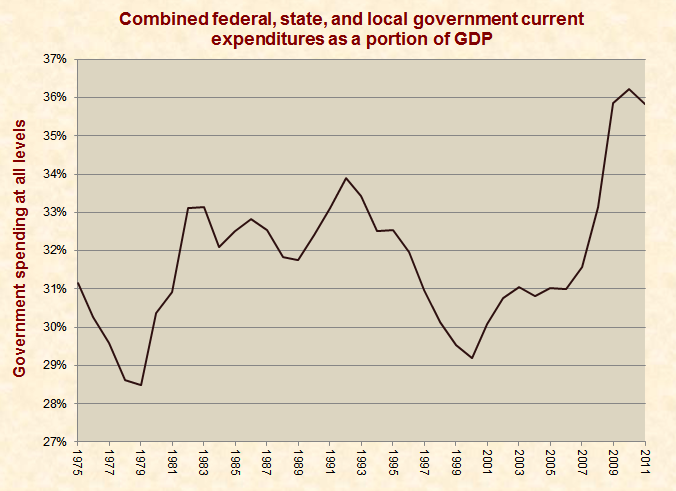
Funny, but I think those of you following that line of thinking are either (a) hoodwinked by the President or (b) Obama sycophants. The chart below was compiled by the Federal Reserve, and like most FEBR data, excludes inflation. But you’ll note that the increase in government spending as a share of GDP (and therefore, the commensurate reduction in GNP) eerily match the curve I developed.

So…..phhhhbbt. Stop listening to the liar-in-chief and his apologists. Learn how to do a little basic research on your own, people.

Oh, my…this IS the reason the economy hasn’t recovered!

GDP Growth & Government Spending


Obama’s Economic Hero

There are many things that puzzle me. For instance, why is the cold water tap always on the right-hand side of the faucet? It’s as if the guy who invented indoor plumbing arbitrarily decided to that cold water should come from the right and everyone since has followed suit. There’s no real reason for it. We could just as easily have cold water coming from the left and nobody would be any wiser for it.

A similar thought process seems to have occurred in regards to including government spending as part of a nation’s economic health, currently expressed as GDP. Once upon a time, we didn’t calculate GDP. We calculated GNP; the gross national product. That figure didn’t include government spending – because economists were interested in determining the productivity of a country’s economy. Governments simply do not produce anything; no goods, no services. In fact, government spending used to be regarded as a negative economic indicator. After all, the more governments spent, the more they had to raise revenue by confiscation (and yes, taxation is still confiscation – just with a prettier name). That pulled capital from the real economy – which lowers a nation’s GNP.

GNP remained the way the government and most economists measured economic output until 1993. The Clinton administration, swept to power on the mantra of “It’s the economy, stupid” was looking for a way to juice up the headlines. By switching from GNP to GDP, they found their way to reinforce the perception that the economy was improving. It didn’t matter that actual economic output barely increased from 1992 to 1993. By including government spending in the measure of the nation’ economic health, it seemed as if the economy had rebounded.

The Obama administration is relying on similar hocus-pocus to fool the American public in 2012. Yes, GDP is growing – but only because government consumes more of the national economy than at any time in history. Yes, more than during the New Deal of the 1930’s, more than the war spending of the 1940’s and more than during the profligate 80’s. In 2011, the US Treasury spent in excess of $6 trillion dollars and accounted for 41% of all economic activity recorded in the US GDP. By comparison, at the peak of World War II spending in 1944, the Treasury only accounted for 28% of GDP. Even at the height of the last major recession in 1983, the Reagan treasury only accounted for 36% of GDP. Yet, during the Obama administration, we’ve jumped from 36% in 2008 to 40% in 2009 – and haven’t fallen below that mark since.

Of course, there’s a flip-side to this coin: if government spending is what is driving perceived economic expansion, the reality must be that the real economy is shrinking. And after adjusting for inflation, that’s exactly the case: in 2008, GNP totaled $9.1 trillion dollars (that represented a $31 billion drop from 2007). But economic activity has continued to decline under the current administration’s tutelage. In 2009, GNP totaled $8.9 trillion and it has continued to drop since, all the way to $8.4 trillion in 2011.

This is the principle reason why job growth remains a real negative. The Obama team loves to pat itself on the back for “creating 4 million jobs over the past 18 months.” The sad truth is that the economy should have produced about 4.3 million jobs over the past 18 months just to keep pace with population growth. But the jobs picture makes sense when you compare it to actual economic growth. As the economy continues to contract, the demand for workers continues to decline. The only difference between 2012 and 2008 is that businesses don’t need to lay off workers to accommodate the reduced demand. They just simply don’t hire new employees.

I can summarize this with a very simple statement: if it seems to you that the recovery we hear so much about hasn’t ended the Great Recession, that’s because it hasn’t. There hasn’t been a recovery, except for those with direct ties to government spending. That’s the one component of GDP that has increased: by over $1 trillion over the past three years.

So, the next time you see a GDP number that trumpets economic growth, remember to dig into the numbers a bit. And remember, this is White House that replaced managing economic growth with managing spin.

Dreams of Julia


Yep, that’s what he thinks of you, America.

If you’re a political wonk (or wannabe wonk), odds are you are already intimately aware of the mythical Julia. For the rest of you, “Julia” is an Obama campaign creation; a mythical middle-class woman who cannot survive without the government largesse championed by the President and the modern Democratic Party. (You can catch her life story here).

It’s a good bit of salesmanship. In one tidy slideshow, the President and his minions manage to tie together the themes of his candidacy. It defends the classic socialist cradle-to-grave view of patriarchal government as the only answer to the nation’s ills not by explaining how such policies work, but by fear-mongering. And it frames the defense by portraying Republicans as determined to wage war on (liberal) women.

That fully half of the show is dedicated to defending Obamacare is purely inconsequential, I suppose. That the Supreme Court now seems certain to rule the PPACA unconstitutional in June will undoubtedly have major political ramifications, not the least of which is that attacking Republicans for wanting to repeal it will simply be a moot point. I mean, the President and his henchmen could try to mount some sort of defense of an unconstitutional law – but that would certainly seem to point up Republican claims that the President is willing to take extra-constitutional measures, if that’s what it takes to pass his agenda.

The real question is how the Republicans in general, and Mitt Romney in particular, will respond to Julia. The Democrats have opened with the classic, neo-progressive view of a patriarchal cradle-to-grave government. Not pure socialism, but close enough. They haven’t mentioned how, in an era of runaway deficits and national debt figures that exceed the total wealth of the nation, this vision of government-centric society is paid for. And they’ve laid any alternative view as the bogeyman. A smart strategist would explain how a government that’s large enough to decide when and where you go to school, when you can marry, when (and how many) children you can have, when you can go to the doctor, what food you eat, what professions you can pursue – even when you’re too sick to live, is essentially the Chinese model of democracy.

The problem for the Republicans is their view isn’t terribly different than the President’s. And the chosen standard-bearer is as much a statist as Obama. Remember, this is the guy who created RomneyCare. The only real difference between the two candidates is not whether they favor government power over liberty or even whether they favor Wall Street and K Street over Main Street. Their only point of contention, really, is which side of Wall Street they prefer to walk down, the left or the right.

And America, that’s just not a good enough choice.

The Little Red Hen


In case you’re wondering why so many Americans are dependent on the government for subsistence today, I thought returning to our childhood might be a good place to start. When I was a wee lad, I was told the story of the Little Red Hen. It goes something like this:

*****

Once upon a time, there was a little red hen who lived on a farm with her friends, the dog, the cat and the duck. One day when she was scavenging for food (for that’s what hens do), she found some seeds laying on the ground. Being a bright hen, she had an idea. She would plant the seeds and see what grew.

“Who will help me plant these seeds?” asked the little red hen.

“Not I” said the dog. “Not I” said the cat. “Not I” quacked the duck.

So, the little red hen tilled the ground and planted the seeds by herself. But she knew from watching the farmer that the seeds needed to be watered.

“Who will help me water the seeds?” asked the little red hen.

“Not I” said the dog. “Not I” said the cat. “Not I” quacked the duck.

So, every day the little red hen watered the seeds by herself. Soon, she had big stalks of wheat ready for harvest.

“Who will help me harvest the wheat?” asked the little red hen.

“Not I” said the dog. “Not I” said the cat. “Not I” quacked the duck.

So, the little red hen harvested all the wheat by herself. She was tired, but proud that her hard work had paid off with such a handsome harvest. But what to do with the wheat? The little red hen thought she could grind the wheat into flour.

“Who will help me grind this wheat into flour?” she asked.

“Not I” said the dog. “Not I” said the cat. “Not I” quacked the duck.

So, the little red hen ground the wheat into flour. It was wonderful flour, pure and white, perfect for baking a cake. The little red hen, being hungry from all of her hard work, decided to do just that.

“Who will help me bake the cake?” asked the little red hen.

“Not I” said the dog. “Not I” said the cat. “Not I” quacked the duck.

So, the little red hen baked the cake. When it was done, it smelled soooo good that the little red hen decided to eat the cake.

“Who will help me eat the cake?” asked the little red hen.

“Oh, I will” barked the dog. “Yes, I will, too!” purred the cat. “I will eat the cake” said the duck.

The little red hen looked at her friends in amazement. “When I asked your help in planting the wheat, none of you would” she said. “When I asked your help to tend and harvest the grain, none of you would. When I asked for your help to grind the wheat into flour and to bake the cake, none of you would. So, I will give each of you as much cake as you have earned.”

And with that, the little red hen sat down and ate the whole cake by herself.

*****

Today, I see a lot of people acting like the dog, cat and duck in the story, but very few little red hens. Once upon a time, this was the American ethos. But the dual ideals expressed in the “Little Red Hen” are apostasy to many of our countrymen these days. The ideals of earning you own way in the world, and the that diligence in your labors enable greater gains in the future. Rather, today the story is seen as an example of greed and avarice: how dare that little red hen keep that cake all to herself when those around here are asking for their “fair share?”

How old is the story of the little red hen and her barnmates? Nobody knows for sure, or even knows the origin. Some say it began in Russia, others in Germany. What we do know is that the principles exhibited by the characters and the results of their work (or lack  thereof) are found in texts that predate the Persian Empire. In the Bible, the Book of Proverbs (also known as the Wise Sayings of King Solomon) has several passages that refer to laziness. Among them is Proverbs 10:4, “He becometh poor that dealeth [with] a slack hand: but the hand of the diligent maketh rich” and Proverbs 19:15, “Slothfulness casteth into a deep sleep; and an idle soul shall suffer hunger.” The current idea that your “fair share” is determined by need, not effort is a relatively new phenomenon, first expressed by Karl Marx. You know, “from each according to his ability, to each according to his need.”

I often wonder if the folks protesting at OWS encampments are aware of the story of the Little Red Hen. I’ve no doubt they’re aware of the Marx quote (although I would be willing to wager a small sum that most would confuse its origin). If we want to fix what’s wrong with the country, perhaps we should return to teaching more “Little Red Hen” and less “Critique of the Gotha Program.”

And Now a Word about Gas Prices


Remember when "Sticker Shock" meant getting screwed by a car dealer?

Remember when "Sticker Shock" meant getting screwed by a car dealer?

Face it, you just went to fill up your tank this morning and discovered that it cost you $2 more this week than last to put 12 gallons into the tank. Last week, it was $1.80 more than the week before. And so on, all the way back to the first week in January.

You complain. You gripe. Your neighbors are equally disgusted. One of your coworkers seems to bring up the topic of exploding gas prices every day. In the meantime, you noticed that your wife spent $30 more on groceries this week but brought home less food. She’s half-heartedly joking that at this rate, it will be PB&J for dinner by summertime.

Everyone seems to be talking about the way prices are skyrocketing, but nobody seems to be doing anything about it. And I’m going to let you in on a little secret: there isn’t anything anyone can do about it.

The reason prices are taking off is the dirtiest word in economics: inflation (okay, maybe the second dirtiest word after recession). Why? People automatically assume inflation means rising prices. But rising prices are the symptom, not the problem. Inflation occurs when the money supply outgrows the demand for that money. It is classical, John Smith economics at work in its most basic form: supply and demand. When supply outstrips demand, prices fall. That’s true of any product. Build more cars than the public wants and the price of cars drops. Grow more wheat than you can sell and you slash the price to where you’re virtually giving it away. In those cases, the fix is relatively simple but usually takes time to implement. Build fewer cars. Grow less wheat. Of course, you’ll need to wait a full manufacturing cycle for production to drop to a point where the supply of cars matches the demand. You need to wait an entire year before wheat prices correct.

But what happens when you print too much money? Well, basically the same thing: you shrink the availability of money. You raise interest rates on the purchase of new capital, to make it less palatable to prospective buyers. You restrict international trade of currency. You can also do things to tinker around the edges, like demand banks hold more cash in reserve and prevent corporations from dumping cash into the market. But the reality is all of these things take time to work – a lot of time. In the meantime, the hangover effect of inflation – raising prices – hits everyone hard.

And again, the reason is simple. Wages are tied to productivity, not the price of money. In fact, inflationary periods result in reduced wage pressure because as money sloshes around in the economy, productivity declines. Not because people are working less (they’re usually working more, and harder) but because the value of work is declining along with the value of the currency. The net result is you work harder to bring home the same amount of money you were before – but that money has reduced purchasing power.

Now here’s why nothing can be done about inflation in the near term: the inflationary bubble was created between 2008 and 2010 and we’re just now beginning to feel the effects. Picture the way a tsunami moves – if you’re out on the ocean, you’ll hardly notice a ripple. As you get closer to shore, the pressure builds. Enough of a wave will swamp everything for miles inland once it reaches shore. Inflation is similar in that the pressure is created much further away than when the effects are felt – and like a tsunami, there is no way to stop the momentum once it’s put into motion. We created the current inflationary bubble when we decided to print money in order to escape the Great Recession. Most Keynesian economists (guys like Paul Krugman and Robert Reich) cheered on the printing presses and have been vocal in their calls for cranking them up even faster. They’ve pointed to the short-term pain felt throughout economies that chose to choke down on the money supply while disregarding the damage to our economy rampant inflation will cause. In short, they’ve forgotten the lessons of the 1970’s in the US and the 1990’s in Japan.

Under ordinary circumstances, their calls for greater government borrowing would make sense – given the insanely low current interest rates. But they either ignore or fail to understand how that borrowing is financed. In ordinary times, governments issue bonds which guarantee a certain return on the initial investment. Private markets purchase those bonds and new money is generated (i.e., printed) to cover the interest earned on the bonds. So long as the increase in the money supply roughly matches real growth in the economy, inflation is kept minimal. But the current spending spree ignored those basic rules of supply and demand. First, The US Treasury dumped about $3 trillion of the $5 trillion borrowed over that time directly into the finance sector. Besides the bank bailouts in 2008 and 09, there wasn’t enough demand for US Treasuries to absorb all of the new bond that were floated. So the Federal Reserve purchased them and then resold them through two round of “quantitative easing.” That direct infusion of currency outpaced real GDP growth by 5.6% alone. It doesn’t factor in the interest owed on those bonds or the effects of the nearly $2 trillion in cash the Federal Reserve created on its own. When you add all of it up, the economy now has roughly $2.5 trillion more in cash than needed to meet demand. That equates to 17% inflation – 17% more money supply than demand would allow.

This isn’t to say that we’ll actually see 17% inflation before all is said and done – there are other things that could keep the number lower. For instance, if the world’s other major currencies remain weak then the dollar will retain a semblance of strength and that would mitigate the effects of inflation. At the same time, a country with a relatively weak currency that holds large reserves of dollars (say, China) could decide they need to strengthen their currency’s relative strength against the dollar and start dumping our currency.

But until then we can conserve, or drill, or do some combination. While it will have a short-term effect of mitigating the price at the pump, the end result will be the same: gas (along with everything else) will cost more this time next year than it does today. The problem with gas prices is not supply (we have more than at any time in the past 40 years) or demand (the world is using less gasoline than at any time in the past decade). In fact, the cost per gallon of gas has actually decreased, relative to actual dollar value, over the past 5 years. But because the cost hasn’t dropped as fast as inflation has risen, the price continues to move upwards.

THAT is the dirty little secret no politician in either party wants to tell you.