Musings on Sports, Politics and Life in general

Latest

Is This It for Mitt?


Will this say "Romney Defeats Obama"?

Super Tuesday came and went, only it wasn’t quite so super. If anything, the results only served to muddle the outcome further in what was an already muddled Republican primary. If you listen to the MSM, Mitt Romney solidified his role as front-runner after expanding his lead in delegates.

Ah, if only it were so simple. But nothing about this primary season has been simple. The principle reason for quagmire is that the Republicans decided this year to change things up and award delegates proportionally, but left it to the individual states to decide how the apportionment would work. State party bosses, being state party bosses, largely decided that the popular votes wouldn’t matter and state political conventions would ultimately decide how many delegates each candidate would receive. Craziest of all these is Missouri, which held a non-binding primary last month and will hold non-binding caucuses next week. It’s a system only Boss Hogg would appreciate.

The net result of all this inside horse-trading (aside from having only a relative few delegates actually apportioned) is the current morass. If, as in the ancient past (read: 2008) delegates were awarded on a winner take all basis, Romney would have commitments from 513 delegates, Rick Santorum 197 and Newt Gingrich 101. Instead, we have estimated delegate counts. Depending on the source, Romney has between 379 (CBS News’ count) and 430 (Fox News) delegates. My own personal count gives Romney 386 delegates. Regardless of which count you take, there are only two I’ve seen that give the front-runner more than 50% of the delegates contested thus far.

And that brings us to the current problem for the GOP. It is becoming increasingly possible that they will arrive at their convention without a candidate who has amassed 50% of the delegates needed to secure the nomination. Not necessarily probable, but possible. After all, there are three winner-take-all states (New York, California and New Jersey) that profile favorably for Romney and they combine for 317 delegates. If combined with his current total, that would mean he would need to win about 40% of the remaining delegates in the other states not yet voted, in order to reach the 1,144 required. It should be a doable task for establishment’s preferred choice.

Only, therein lies the problem for Romney and the establishment. They want the primary season over so they can focus on the general election. New Jersey doesn’t vote until June 5th – and if Romney hasn’t secured the nomination by then, it will mean enough of the party isn’t supporting the eventual nominee to signal significant weakness to the nation. A comparison can be drawn to 1948, the year Harry Truman became the original “comeback kid” (sorry, Bill Clinton). By all normal election standards, Truman should have been walloped that year: unemployment was rising, the economy faltering, the Soviets detonated their first atomic weapon and Winston Churchill’s infamous “Iron Curtain” was now a reality Americans faced with fear and trepidation. But the Republican nominee, Thomas Dewey, was about as inspiring as dry toast and succeeded in snatching defeat from the jaws of victory. Not unlike Romney, Dewey was perceived by many fellow Republicans as aloof and calculating – a politician’s politician. Also not unlike Romney, Dewey was disliked by the conservative wing of his party (who preferred Ohio Senator Robert Taft). The intra-party fight lasted into the convention, where it took three ballots to nominate Dewey.

Some 64 years later, the Republican Party seems to be repeating history. Certainly, the political calendar isn’t favorable to Romney. What he needs is a convincing win outside of New England to demonstrate he can bring the party together and he seems to be pouring money into Kansas, in the hope he can get it there. But after Kansas comes Alabama, Mississippi and Missouri, three states that do not favor Romney. Since it’s also highly likely that Santorum and Gingrich will split the lion’s share of delegates from these four states, one or both will probably close the gap with the Romney. The GOP nightmare scenario gets that much closer at that point. If the voting holds as it has thus far, with southern and evangelical voters opting for anyone but Romney, the current front-runner can’t cross the 1,144 threshold before New Jersey’s June 5th primary.

But there are two other pitfalls Romney will need to avoid if he wants to secure the nomination, even at that late date. First, he’ll need to ensure that those party conventions are stoked to vote for him (far from a sure thing at this point). Second, he needs to wrap up as many of the uncommitted delegates as possible. There are currently 93 of them; current projections indicate there may be as many 255 by the convention. That will be a powerful voting bloc, one as capable of tying up the 2012 Republican Convention as those of Earl Warren (yes, the man who later became Chief Justice of the Supreme Court) and Harold Stassen in 1948.

So, Romney still seems best positioned to become the Republican nominee. But party fratricide seems even more certain to deliver him as weak and badly wounded nominee. In 1948, the Republicans thought they could take on an unpopular incumbent presiding over a moribund economy and uncertainty on the world stage with an unpopular candidate and win. Will 2012 prove to be a repeat of that disastrous strategy?

ENOUGH!


How Politicians View You

We should be ashamed of ourselves.

15,000,000,000,000
56,650,000,000,000
22,000,000
187,000,000,000,000
4,700,000,000,000
20,000,000,000,000

Do you recognize those numbers? In order, they are the current federal debt, the current total US debt, the number of Americans who aren’t gainfully employed, the sum of unfunded federal liabilities, the current fiscal years’s proposed budget and the Obama administration’s estimated federal debt on January 20, 2016.

In addition, we have the gradual erosion of Constitutional rights, the looming specter of uncontrolled inflation (which is now running 8%), a quagmire in Afghanistan, a pending war with Iran, Europe back in recession, the potential for a “Russian Spring,” and border security still hasn’t been effectively solved.

These are real crises. Real problems that we should be focused on and demanding that the politcal leadership focus on. But if you dropped in from Mars, here’s what you would think were the problems facing the country:

How promiscuous are Georgetown law students?
Is there a Massive Government Conspiracy to assassinate bloggers?
Why are NFL players paid to hurt other players?
A washed up pop-star drowns in the bathtub after overdosing on painkillers!

I could continue, but you get the point (I hope). In ancient Rome, it was said Nero fiddled as the city burned. Today, we’re the fiddlers. Blame the politicians for the mess we’re in all you want, but I’m about to hit you with some cold, hard reality. We are the reason politicians are avoiding the real problems. Every time you lose your focus and begin worrying about some silly “culture war” diversion, the media applauds and a politicians from both parties smile. Why? The vast majority of politicians are not idiots. They know the real problems we face – and they know the only solutions are neither popular nor easy. But rather than debate them honestly, it is far easier for them to divert our attention with “issues” that really have no effect on how you or I conduct our daily lives. They prefer debates over things they all know governments have virtually no control over, and should have no control over, then coming to the American people and telling us the truth about things. It is much easier to build brand loyalty for a political party over culture issues (Republicans, please step to the right; Democrats to the left). It is nigh near impossible to do when facing the real problems we face.

But we still live in a representative republic. We, the people, still have the ultimate power. But we have to exercise it. That is the ultimate solution to our nation’s ills. But doing so involves two skill sets we’ve not demonstrated in years: perseverance and determination. We – me, you, everyone – needs to demand our political leaders face the real problems and work on solutions. And we need to let them know that if they don’t, another election is right around the corner and we’ll vote for someone who will.

Don’t let them distract you with another bogus news story about a trivial issue; another “he said, she said” item or another nonsensical quote from a would-be candidate. Keep your focus on what really matters. Or, go ahead and keep thinking that cultural issues are the defining item of our time.

Just don’t come crying to me when the country turns into another Greece.

Dear Rick Santorum:


I won’t make this very long. This message is too important to be left open to interpretation (which you demonstrate time and again to be horrible at).

Actually, I can sum up the message in pretty short order: GET OUT OF THE PRESIDENTIAL RACE.

It’s not that I think you’re necessarily a bad guy. I believe you genuinely care about America’s blue-collar majority, probably quite a bit more than Mitt Romney or Newt Gingrich. Unlike the current resident of 1600 Pennsylvania Avenue, I also believe that you’re a man of conviction whose word is as good as any signed contract. In fact, I think you’re probably not unlike many people I know personally. Your politics, however, are better suited to running Pakistan than the USA.

Numerous independent and non-partisan economists have reviewed your spending proposals. All of them agree that of the proposals currently out there, yours is the most fiscally irresponsible. We’re enduring a Presidency in which the federal debt will double in 4 years. Somehow, doubling it again by 2016 doesn’t strike me as either responsible or *ahem* conservative.

But more alarming than that is your commitment to theocracy as an overriding governing principle. That anyone can as flippantly dismiss the separation of church and state as you have, and still be considered a major candidate, speaks volumes about the mess the Nation has become. That you seem to read meaning into the 1st Amendment that isn’t there doesn’t speak very well of your professors at Dickinson. That you seem certain that people of faith are excluded from providing input into government affairs is either the result of extreme bigotry or extreme blindness on your part. If it’s the former, then nobody but another bigot could want you for President. If the latter, you’re too stupid to be President.

I’m writing this as man of deep religious faith, but also an American citizen. I’m fine with you practicing Catholicism openly. But I doubt you feel the same about the millions of your countrymen who are equally faithful regarding other religions. You’ve made it abundantly clear that you certainly do not respect the rights of millions of more to not practice any faith. I’m not going to pretend to know everything there is to know about Catholicism, but surely you were taught the Golden Rule at some point (some version of it seems to be the underpinning of every Christian religion I’ve encountered). Anyway, that’s what makes the 1st Amendment unique among the laws of men: we actually codified the idea that if you respect everyone’s else right to speak, write and pray as they like, they’ll respect yours to do the same. You know, the whole Do Unto Others thing – the part of your faith you seem to have left at the altar of politics.

The longer you stay in the race, the longer the press will be obligated to publicize you and the moronic things you say. But if you drop out now, you can still go on speaking tours of every KoC hall in America. You can still write op-eds for the weekend newspapers. You’ll still have the same right as every other citizen to weigh in on the important topics of the day. But those of us who really don’t want have your misguided opinions shoved down our throats won’t be forced to listen to you every morning, noon and night – to the exclusion of the real problems facing us.

See, there are people in America who actually care about fixing the country – and not turning us into a broke, corrupt and contemptible nation. I know, I talk to them every day of the week. And with you out of the way, the public discourse can return to matters of substance. If you love your country as much as you profess, than do us a favor Rick. Get out.

“Uncommon Valor was a Common Virtue”


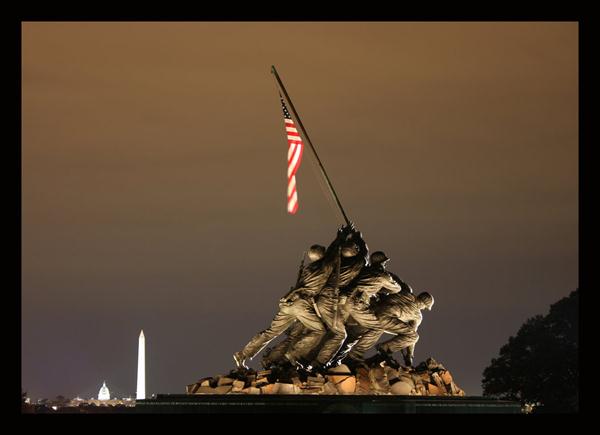
Iwo Jima Memorial at night, Arlington, VA

At 9:00am on February 19, 1945 Marines of the 3rd, 4th and 5th Marine Divisions landed on the volcanic Pacific island of Iwo Jima. Despite having grown accustomed to ferocious Japanese resistance as they island-hopped from one battle to the next, the Marines landing that day had no idea of the Hell they were about to enter. The Japanese General in charge of the island’s defenses, rather than meet the invading Marines on the beaches, had decided to marshal his forces further inland. As a result, Marines who landed that morning were unable to move forward, pinned down by heavy machine gun, mortar and artillery fire while sustaining heavy casualties. At the same time, the US Navy was taking fire at a rate unseen since the Battle of the Coral Sea nearly three years earlier. Before the battle was over, the Navy would suffer over 850 casualties and lose 18 ships, including the escort carrier USS Bismarck Sea and the heavy carrier USS Saratoga.

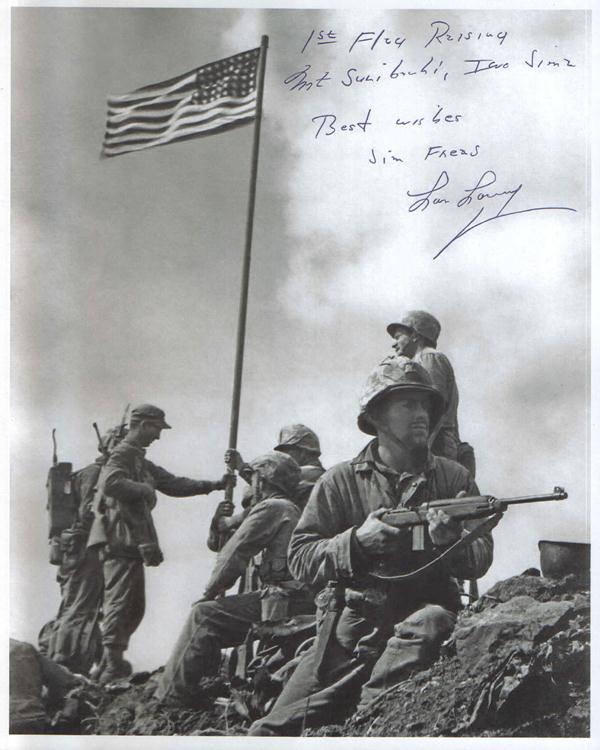
Still, the Marines pressed on. By the morning of February 23, the Marines of “E” 2/28 (E Company, 2nd Battalion, 28th Regiment) had taken the summit of the island’s most prominent height, Mount Suribachi. Led by 1st Lt. Harold Schrier, the 40 Marine strong patrol arrived at the volcanic crater and raised a small American flag at 10:20 that morning – the first time a foreign flag ever flew over Japanese soil. Marine Sergeant Lou Lowery captured the flag raising on film, despite having to dodge a Japanese grenade attack.

The immediate lift to the morale of the Marines fighting all over the island was resounding and noticed by Secretary of the Navy James Forrestal, who immediately ordered a larger flag be flown in the original’s place. That flag raising, forever immortalized by AP photographer Joe Rosenthal, became one of the iconic images in American history. Today, the photo is immortalized in the Iwo Jima Memorial, a giant bronze statue at Arlington National Cemetery that stands as a tribute to all Marines who died in battle.

The Battle for Iwo Jima continued for another month, becoming the bloodiest battle in US history. The Marines suffered over 26,000 casualties; of the over 20,000 Japanese defenders, fewer than 1100 survived. 27 Marines were awarded the Congressional Medal of Honor at Iwo Jima, more than any other battle in history. Marines who fought on that small volcanic rock 67 years ago can still regale you with stories that leave even modern Marines incredulous at their sacrifice and determination. Fleet Admiral Chester Nimitz summed up the horror endured and gallantry of the men who lived and died on “sulfur island” when he said:

“By their victory, the 3rd, 4th and 5th Marine Divisions and other units of the Fifth Amphibious Corps have made an accounting to their country which only history will be able to value fully. Among the Americans serving on Iwo island, uncommon valor was a common virtue.”

On today, the 67th anniversary of the Flag raising on Suribachi, this Marine is proud to stand and salute those men still alive and give a heartfelt, “Semper Fi! Job well done!”

Original Iwo Jima Flag Raising, 23Feb1945, as captured by Lou Lowery

The Education Crisis


One of the truest things in politics is that facts are easily obscured by perceptions, especially in cases where children are involved. Such is the case with the state of education in this country. There are problems with both the primary and secondary education systems, but the issues get clouded by how the public views both.

I’m not claiming any great insights on this. But I understand parents’ concerns, since I am one. I understand teachers and professors concerns; I have close friends who chose those professions. I understand administrators concerns; a substantial part of my professional life revolves around addressing them. I understand taxpayer concerns; like you a hefty portion of my tax bill goes towards education. I understand student concerns. I’ve been one. I understand employer concerns – I am one.

There are, in my experience, two central reasons that improving education in this country has become nearly impossible. The most crucial is perception. Once you get past teacher’s unions, tenure, and all of those bugaboo topics, the underlying cause for the distrust between the public and the schools is perception. The second is the exponential increase in federal involvement in education over the past 32 years. And we’ll never get around to addressing the second until we address the first.

As mentioned above, I’ve developed personal and professional relationships with educators over the years. The vast majority – regardless of whether they’re involved in primary or secondary education, at public or private institutions – are dedicated. I do not mean they are primarily dedicated to their unions or schools (although many are). No, I mean that well over 95% of the education professionals I know are dedicated to the idea of helping young minds grow, learn and achieve. Most are probably underpaid, most are disrespected and yet they trudge off to their classrooms and lecture halls every day because they believe if they make a difference in one student’s life it was a good day.

As I mentioned, most are disrespected, unappreciated and underpaid. Many parents look at teachers as little more than high-salaried day care workers. Worse, as new stories of public corruption and felony criminal conduct in school administrations, local school boards and public universities take hold, many parents now look at their local educators with a distrusting eye. Every time a story gets published about how American school children lag behind other nations in math or science achievement, the public view bends further to the belief that our children are being taught by people who don’t care – or don’t know their jobs and don’t care.

Of course, teachers unions and school administrators are partly to blame behind the perception. Every time a criminal teacher winds up in a “rubber room” for a decade, it sheds a bad light on the entire profession. Rather than working with the public to identify and quickly remove the 5% that are bad apples, they allow them to fester. While it is understandable that a community that feels under siege is loathe to admit there could be problems within its ranks, the approach they’ve adopted has done little to end the perceived siege.

In the meantime, the common misperceptions continue. The public remains wary of their educators, the educators remain wary of the public. I often wonder why anyone who isn’t misogynistic would enter the profession willingly.  As a result, reforms that could work – or at least worthy of a try – or jettisoned before they ever get a chance. Instead, we get the sort of acrimony seen in New York, DC and LA. And of course, New Jersey – where the governor has built national notoriety by bashing the NJEA.

What all of this acrimony and recrimination has concealed is the horrible effects that the federal government in general, and Congress and the Department of Education in particular, have had on the education of American schoolchildren over the past three decades.

In 1979, the Office of Education was a subset of the (now defunct) Department of Housing, Education and Welfare. It had 3,000 employees and an annual budget of $1.2 billion. When the Department of Education began operation in 1980, Congress appropriated $14.2 billion and staffing increased to 17,000. By 2011, DoE funding had increased to $113 billion, outstripping inflation by $74 billion. Most of that growth has come 2002, when the budget was $46 billion – a direct result of the past two administrations pet education programs. I’m talking, of course about No Child Left Behind and The Race to the Top.

Aside from additional layers of bureaucracy, what has all of that growth accomplished? Not much, actually. In 2002, the United States ranked 15th worldwide in reading, with an average score of 504 on the PISA assessment. We ranked 24th in mathematics (score: 483) and 21st in science literacy (score: 487). By 2010, those ranking had dropped to 17th, 31st and 23rd. Scores dropped in reading, to 500, held steady in math but did improve in science – to 502.

What the feds have succeeded in doing is making life harder for America’s educators. New regulations and requirements have taken resources from the classroom and redirected them to administration offices. Often, I work with administrators who spend more time ensuring federal requirements are met than actually looking after students. The other effect, whether intended or not, has been to stifle the individual creativity of educators. The great laboratories that were once America’s classrooms – where teachers were relatively unencumbered in their pursuit of instructing students – now more often resemble the efficiency of Bell Labs. Don’t get me wrong – Bell Labs came up with some great products, and today’s schools still produce some great scholars. But top-down oriented research proved a model that was unsustainable; the same is the inevitable result of  top-down oriented education.

But we can’t focus on ridding our local schools of undue federal intervention until we get past the mistrust that now permeates our conversations regarding education. How we get there isn’t as hard as it may sound. It starts with parents actually taking time to talk to educators; it takes community members actually showing up at school board meetings to do more than complain about school taxes or school closures. It takes parents willing to take more than a token interest in their youngsters education. It takes educators not dismissing community concerns out of hand. Parents, educators and administrators shouldn’t allow schools to become political footballs. So long as we treat them as such, we’ll keep falling behind the rest of the world in achievement. That’s something that should scare every single person in the country.

Clarification (Because you asked!)


Yesterday, I posted The Republican Dilemma. I thank all of you for taking the time to read it, but one reader pointed out that they were a little confused by the terminology I used in that post. I can understand that, as anyone who wasn’t paying attention to politics prior to 1980, or who only reads liberal publications (Huffington Post, Salon, New Republic, etc.) might think all conservatives are alike. So I’m taking a few moments to identify each group I wrote about.

  • Rockefeller Republicans: These conservatives have formed the backbone of the Republican Party since the end of the Civil War. They prefer a laissez faire approach to governmental involvement in business affairs, but also believe a proper role for government is to administer social justice – if only to absolve business of the need. These folks like social government programs such as Medicaid, Medicare, Social Security and the like. Most don’t necessarily think there is anything wrong with the Obama administration’s Health Care Law, other than President Obama and the Democratic Party passed it.
  • Social Conservatives: Often the most vocal component of the conservative movement, people who identify as social conservatives think governments primary role should be to maintain a type of social stability based on Judeo-Christian ethics while preserving a WASP heritage. These are the folks who get most excised over gay marriage, abortion and immigration. They believe that government programs that work to those ends are money well spent, regardless of cost.
  • Reagan Democrats: I realize this sounds like an oxymoron, but this represents a group that prior to 1980 was closely identified with Democratic Party. These are middle-class, ethnically white voters that hail from the “Rust Belt.” Many of them are members, or have close family ties, to trade unions. They believe government’s role is to promote fair trade (not the same as the open trade preferred by their Rockefeller cousins) and generally like most government programs. They can get worried about economic issues such as trade imbalances and federal debt when the economy tanks, but mostly they prefer that the government remain activist – just not activist enough to promote racial or social equality.
  • Goldwater Conservatives: This group came to the fore with former Arizona Senator Barry Goldwater’s bid for the Presidency in 1964. This group is most often identified today as “fiscal conservatives,” although the reality is this group is after a more federalist model of government, with delineation of authority between federal and state governments. Generally speaking, they prefer a smaller federal government with less spending and authority.

President Reagan, as noted yesterday, was able to knit these disparate views into a cohesive political force by drawing on their commonalities. For instance, there is an obvious link between social conservatives, Rockefeller republicans and Reagan Democrats; all three share a desire for social stability. But he was also able to weave in the Goldwater faction (of which he was a card-carrying founding member) by telling the other three groups that their aims could be met – but by shifting many federal responsibilities to the states. (The reforms that followed to medicaid, the semi-privatization of medicare and the Social Security rework in the 1980s are all examples).

The Republican Dilemma


Webster’s defines a “dilemma” as

“a situation involving an undesirable or unpleasant choice.”

Given that definition, the GOP may want to reconsider changing its name to the “Grand Dilemma Party.” The reasons can be found in what can only be described as the tepid response the party’s rank-and-file have demonstrated towards the party’s Presidential aspirants.

Much column space has been devoted to the vagaries of the Republican Presidential Primary season. The topsy-turvy nature of polls; the fact no candidate can seem to muster more than 40% of the electorate for longer than a week; the inability of any candidate to sustain momentum. The commentariat is busy trying to fit round pegs into square holes, though. They’ve completely missed the boat on what’s actually happening this year, having spent the majority of their professional lives ensconced in the daily trivialities of DC politics.

The narrative thus far runs something like this: there is a natural back-lash against establishment candidates, as represented most wholly by Mitt Romney. Each time a new “anti-Romney” rises (currently, that’s back to Rick Santorum) the electorate looks more closely at said candidate and decides he’s a bit too establishment for their tastes. The anti-Romney of the moment fades back, allowing Romney to capture a few states. The cycle then renews, but in the end the establishment candidate (Romney) wins because he will have the backing of the party machinery. The general GOP membership is resigned to this outcome, even if they aren’t happy about it, and so they’re largely staying home this cycle.

I think something more fundamental is at work within the party. To understand it, you have to return to 1980 and Ronald Reagan’s shock win over Jimmy Carter. (Yes, despite Carter’s bungling of the job, nobody really gave Reagan a legitimate chance of winning that November). Reagan’s magic was in forging a new Republican coalition. He began with the limited government Goldwater wing, mixed in the once strongly Democratic constituency of social conservatives from the Bible Belt, added in the anti-communist/strong defense types (who had fled the Republicans after Nixon’s pursuit of détente) and completed the soup with the Rockefeller Republicans. Most seem to forget now, but Reagan spoke often about his pursuit of a Republican Party “Big Tent” approach – the idea of bringing disparate groups together to work towards a common goal. In 1980, that goal was reinvigorating the American economy through (then radical) changes to monetary and fiscal policy, reducing the size of government while increasing America’s defense capabilities, reasserting American dominance in foreign affairs and direct confrontation with Communism and bringing back the traditional American themes of faith, family and hard work. The new groups in his coalition were referred to as “Reagan Democrats.” These were the people, generally blue-collar types from the South and Midwest, who President Obama derided during the 2008 election as “clinging to their guns and Bibles.”

The dilemma facing the Republican Party is that coalition is fracturing. The former Reagan Democrats and Goldwater Republicans that formed the backbone of that coalition are looking at their choices and felling less than satisfied. Moreover, they sense the Party has moved past them. There are either Rockefeller types (Romney and Gingrich) or aspirants to Jerry Falwell’s throne (Santorum), while the one candidate who hews closest Goldwater’s federalist view is also the one who is the antithesis of a strong US on the world stage (Paul). This leaves those two groups, who desperately want a return to the type of leadership exhibited by President Reagan, without a horse in the race. The result is each candidate has partially captured one constituency, but their individual flaws prevent them from fully claiming it. Romney has the Rockefeller wing for the most part, but it is a small part of the party base (in terms of numbers, not money). Santorum has the inside edge among Reagan Democrats (note his success in the Midwest); although his extreme views on using government to coerce, or even force, his moral code leaves many cold. Paul has captured perhaps half of the Goldwater wing, but his personal character issues and documented degradation of minorities limits his success there.

Can they recapture the coalition? They managed to pull things together enough to get George W. Bush elected in 2000 and re-elected in 2004. They lost a fair number of the small –government types, as was represented by the suppressed turn-out numbers in both years: neither party was putting forward a candidate that met that constituency’s desired goal, although both have been paying lip-service to that goal for 15 years now. The fact that constituency voted en masse for Ross Perot in 1992 and 1996 undoubtedly cost the Republican Party the Presidency in both of those elections. But unlike 1992 or 1996, there isn’t a strong 3rd Party candidate who is advocating both a federalist view of government and strong foreign policy, and unlike 1980, there isn’t a defining vision of the future allocuted by any of the candidates to rally the disparate groups within the tent. That would seem to kick in the Republican electoral formula from 2000 – run a social conservative/Rockefeller hybrid and allow suppressed turn-out to allow him to win. The problem is this year, that ploy may not work. For starters, the Goldwater wing is particularly resurgent this cycle. Consider how the TEA Party, which is largely comprised of Goldwater types, pushed the Party into power in the 112th Congress and that Paul is polling at better than twice his career norms (this is his third try for the Republican nomination).

While the Rockefeller and social conservatives will likely unite behind either Romney or Santorum come the convention, they currently run the risk of alienating as much as 40% of the party’s base with such a decision. If they do, President Obama will win a tough election in November – and the Republican Party as we’ve known it for 32 years will cease to exist. What will be interesting to watch is what takes it place. Will there be three major political parties, the Democrats (absorbing what’s left of the Rockefeller wing), the Social Conservatives and the Fiscal Conservatives? Or will the big-spending social conservative and Rockefeller wing end up absorbed in the current Democratic Party, while the Republicans re-align around federalists principles? And can the current Democratic constituency accept the social conservatives again? After all, the reason Reagan was able to capture them in the first place was that the Democratic Party began purging them during Lyndon Johnson’s Presidency. Regardless, the outcome of this year’s Presidential election promises more change than perhaps anyone bargained for.

What Would Jesus Do?


Does he really believe in the symbolism?

Does he really believe in the symbolism?

I generally try to leave religion out of this blog. Religion is a deeply personal matter and I’ve always tried to respect that. While I make no attempts to hide the fact that I am a Christian, I also realize that our great nation has people of many faiths (and some with no faith, although I find that puzzling) and not everyone shares identical beliefs. My original intent here was to discuss politics and sports. It has since evolved primarily a political blog (I still blog about sports; you can catch my writing at Zell’s) and one aimed at policy matters. But as you may be aware, I recently suffered a setback in my battle with Crohn’s Disease and spent some time in the hospital. Such stays allow you a chance to reflect on things more deeply than you might otherwise, and as a result of that reflection I decided I cannot stay silent on the sudden intrusion (and misrepresentation of Scripture) in political discourse.

One of the tag lines that liberals love to toss around is “what would Jesus do?” The intent, of course, is to paint conservative thought as mean, bullying and anti-Christian. In a world where Scripture is often used to further political ends, conservatives are just as guilty as liberals, of course. But the sad reality is that the archetype of liberal thought loves to use misguided perceptions of Christ’s teachings in an attempt to show conservatives as hypocritical.. Two recent events are incredible examples of just how liberal political use of Scripture has perverted its lessons and meaning.

The first was the President’s invocation of Luke 12:48 in his National Prayer Breakfast speech on February 2. He said,

“I think to myself, if I’m willing to give something up as somebody who’s been extraordinarily blessed, and give up some of the tax breaks that I enjoy, I actually think that’s going to make economic sense. But for me as a Christian, it also coincides with Jesus’s teaching that ‘for unto whom much is given, much shall be required.'”

This gave me pause at the time. The President claims to be a Christian, yet used this particular verse to justify raising taxes in the name of charity? There are plenty of verses regarding the concept of charity. 1 Timothy 1:5 is an excellent example of the Christian view of charity, “Now the end of the commandment is charity out of a pure heart, and of good conscience, and of faith unfeigned.” But since the verse is a description of charity not mandated by government but rather as a demonstration of faith, it hardly fit the political bill.

See the reason the particular verse cited by the President made me sit up and take particular notice is that it has nothing do with charity or taxation. It is part of a parable Christ was telling the disciples regarding the types of punishment that would be meted out during the Second Coming. The parable begins in verse 42, in response to a question from Peter. Jesus had just told the disciples the parable of the Thief in the Night, which he used to describe the timing of the Second Coming, and Peter asks in 12:41 if Jesus is only telling this parable to believers or to all people. Christ then describes how Christians are held to a higher standard than non-believers. While all men will be held accountable for their sins on Judgment Day, believers who purposely misled the unfaithful through their actions will receive a special punishment. That is what he is referring to in 12:47-8, “And that servant, which knew his lord’s will, and prepared not himself, neither did according to his will, shall be beaten with many stripes. But he that knew not, and did commit things worthy of stripes, shall be beaten with few stripes. For unto whomsoever much is given, of him shall be much required: and to whom men have committed much, of him they will ask the more.”

I was, and remain, deeply puzzled by the President’s misuse of this piece of Scripture. There are only two possibilities for him to use it in the context he did. Either he is not a Christian, or he has been seriously misinformed regarding one of the most important passages in the Bible. If the former, so be it – but he shouldn’t suggest he understands the meaning behind words that hold no particular relevance to him. If the latter, he should seek a new church, one that actually hews to Scripture and do so immediately.

The other odd policy decision regarding faith that made headlines was the President’s seemingly insane attempt at forcing Catholics and others to accept mandated birth control, in direct contravention to their doctrine. I am not Catholic – many of their teachings I cannot find Scriptural reference for (such as the veneration of saints). Yet, I still found the method he arrived at the decision to be puzzling. Catholics believe contraception to be a sin and there is a Scriptural basis for this doctrine (Geneses 1:28 and Leviticus 15:16, in particular). So why was it so difficult for the President to make the exception he made on Friday part of the original HHS decree, especially when the Catholics in his administration warned him beforehand that such move would essentially be sticking his thumb in the eyes of all people of faith? Again, the only answer I can come up with is that the President, his protestation to the contrary, is either not a man of faith or has received seriously deficient spiritual counsel.

This brings me back to the beginning of my post. What would Jesus do? Jesus was not apolitical – the Romans would have cared less about him if he were. No doubt, Jesus would have been fired up at the President for misrepresenting his teaching. Given that Christ was first given to instruction of those who should know better, he would have asked the President to define how he could simultaneously claim to be a man of faith, and in the same moment blaspheme? That would have been very akin to his questioning of the Pharisees over their hypocrisy (Matthew 23:41-46).

So, I’ll now sit back and wait to hear replies, either from the President or his liberal supporters. I suspect, that much as the Pharisees were unable to answer Jesus, I won’t hear a peep from the liberal masses.

Nevada: Still the Land of Make-Believe


With apologies to the Walt Disney Corporation, Nevada has always been America’s “Land of Make-Believe.” After all, the state’s economy depends on making ordinarily sane Americans think they can show up with $500 in their pocket and leave with a cool million. But after yesterday’s Republican Presidential Caucus, it seems seems as if the state (and national) party sprinkled fairy dust on the nation’s journalists. Why? Because they’re all pretending as if yesterday’s vote is actually significant.

The Real FairyTale Land in NJ

Ssshhh. Don’t wake the sleeping beauties in Las Vegas, but what they’re full of is usually found in a septic tank. But if you’re not afraid of being turned into a toad, here are three things to keep in mind before following the national media in their hallucination…

Point One: It looks as if only 35,000 or so people bothered to vote in the caucus. That’s roughly 1.5% of the state’s population. You could also, for comparison’s sake, note that this is about the same number of people as live in my hometown of Manahawkin. To pretend that Mitt Romney won a “resounding” or “decisive” or even “big” with minscule turnout like that is being more than a bit disingenuous.

Point Two: Of course Mitt won. Everyone expected him to win the state easily, given the inherent advantages he enjoyed. He won in 2008, one of the few states he did win that year. Then there’s the large number of Mormons that inhabit Nevada (I know, it seems incongruous that Sin City and the LDS co-habitate), giving Mitt a natural organizing advantage. It’s hardly surprising that Mitt won the percentage of the vote he did. It might be more surprising if he doesn’t capture 50% of the final tally. (Point 2A – people in Nevada might be able to count cards, but they have hard time counting votes. As of 2pm today, only 71% of the votes were counted.)

Point Three: Ron Paul seems equally caught up in the fairy tale being spun off the Vegas strip. The only candidate other than Romney to actively compete for Nevada, Paul’s third-place finish and fewer than 5,000 votes wouldn’t seem to be something anyone could put a positive spin on. But there was Paul this morning on ABC’s “This Week” program, doing his best to pretend his campaign is actually viable. The reality is that at best he’ll garner 4 of Nevada’s delegates, which would run his total to 8. If he wants to pretend having a campaign that rivals Rick Santorum’s for futility is viable, that’s fine. But he shouldn’t expect those of who aren’t insane to join him in his fantasies.

Don’t Bury Newt Yet


Florida Results Map

In the wake of the Florida primary, the general consensus among political commentators is that Newt Gingrich’s campaign is like a zombie – dead, but still walking around.

Not so fast.

Those pundits are basing their opinions on the headline numbers, which make Mitt Romney’s victory look far more impressive than it really is. Yes, Romney beat Gingrich by 14%; the split between women and men was decisive (4:1, according to exit polling). Romney carried every significant demographic group, except white men. He won among voters who decided early on in the campaign – some 40% of the electorate said they decided who to vote for last year, and Romney won 83% of those votes. Most importantly, Romney takes all 50 delegates from Florida, a significant coup at this early stage of the campaign. Further, Gingrich cannot reasonably expect to do more than tread water during February. Of the six states holding nominating contests this month, four should be easy wins for Romney (Nevada, Maine, Michigan and Minnesota), one seemingly leans his way (Colorado) and only one seems competitive (Arizona).

But here’s what the pundits are missing: underneath the headline numbers, Gingrich actually acquitted himself quite well in preparing for a Super Tuesday showdown. To understand why, first; consider the way the election has proceeded thus far; second, take a closer look at the election return map from Florida.

Each candidate has demonstrated an ability to attract a certain type of voter. Romney has found core support among moderate and establishment Republicans. Gingrich’s support has come from the Tea Party and those that describe themselves as staunch conservatives. Rick Santorum is the choice of social conservatives and Ron Paul of the very young. Those characterizations were borne out in the three contests leading up to Florida – and when you look into the results, there as well. The moderate region in the southeast corner of the state (Miami/Ft. Lauderdale/Palm Beach) and the I-4 corridor primarily fueled Romney’s win. Romney’s margin of victory was around 241,000 votes; he outpointed Gingrich by 123,000 in the five counties that best define the area (Dade, Broward, Palm Beach, Orange and Hillsborough). Gingrich, on the other hand, easily won the conservative area of the state, loosely defined as the northeast corner and panhandle. In this, each replicated their wins in earlier contests – Gingrich in South Carolina, Romney in New Hampshire.

The best way to look at Florida is that it didn’t really settle anything. The deluge of advertising by Romney was able to firm up his support among his natural constituency but didn’t sway Gingrich’s base. Likewise, Gingrich’s attacks on Romney failed to persuade those who were predisposed to vote for the latter. The Republican Party has settled into two distinct factions, establishment and anti-establishment. As odd as it may be, the anti-establishment camp has settled on Newt Gingrich as their standard-bearer. And that doesn’t bode well for Mitt.

Why? Assuming some type of political bomb doesn’t explode between now and March 6th, Gingrich could conceivably wake up on March 7th with the lead in delegates. The math isn’t terribly difficult. There are 6 nominating contests in February, but they are relatively small states. Most are caucus states and all apportion their delegates, 183 in total for all 6. For good measure, both Paul and Santorum are going to campaign hard for delegates in the caucus states – those states represent a firewall for those candidates and their best opportunity to make a mark. So, assuming Romney wins 100 delegates in February (not far-fetched), that would give him 169 heading into Super Tuesday to Gingrich’s 80. But 11 states vote on March 6th, for a combined 466 delegates. What should trouble the Romney campaign (and by extension, the Republican establishment) is that of those 11 states, 7 of them have electorates that profile favorably for Gingrich. Those states combine for 293 delegates. Only two profile favorably for Romney, combining for a total of 58 delegates. 115 delegates will come from states that profile as toss-ups. It seems reasonable that each will capture large majorities of delegates in the states where they’re strongest, based on past history. If each captures 65% in those states, with the toss-ups splitting roughly equally, then the delegate count could easily be Gingrich 338, Romney 329, Paul 90. This is going on the big assumption that Paul stays in and Santorum drops out sometime in February. Based on the respective campaign finances and goals of those two (Santorum still sees himself as a contender, Paul seems resigned to leading a movement), it isn’t a huge assumption though.

What would a result along those lines mean for the Republican convention in August? Likely that it would be the first brokered convention in 64 years. Roughly 1/3 of the delegates are chosen by March 6th and extrapolating those results across the full party leaves no candidate with the 1174 needed for a first ballot victory. In fact, the two leaders would each be around 150 delegates short of securing the nomination. Besides being a dream come true for Paul (imagine Ron Paul holding kingmaker power in the Republican Party!), the personal animosity between Romney and Gingrich would boil over in a made-for-TV spectacular of epic proportions.