
We Need New Experts

I believe in meritocracy. The concept that the best and brightest among us should be making the important decisions that affect everything and everyone. Certainly, they’ll be wrong on occasion. That’s human nature. But the odds are they’ll be right far more often than not and we’ll all be better off for it.
The nation was founded by experts in political theory. The documents they created, our Declaration of Independence and Constitution, have proven to be guiding lights not only for the United States but the world. And they were smart enough to recognize that their first attempt at a national compact was not working and hammer out something better.
Throughout our history, our reliance on meritocracy has worked well. There have been fits and starts, but the country has inexorably become more just. Our living standards have continuously improved and the opportunities our meritocracy created lured the world’s best to our shores.
Our meritocracy reached its zenith in the Cold War period. Experts in every field of human endeavor made breathtaking creations that made the USA the envy of the world. All of the technological marvels of our time, all of the medical breakthroughs, the 20 year Pax Americana all resulted from the effort of those experts.
But something has happened over the past 25 years. The experts have been wrong far more often than they’ve been right. What’s worse, they’ve been wrong about the Very Important Things, and that’s led to public policies that have diminished the nation as a whole. From failing to recognize the threat of Islamic extremism (and actually funding it!) to WMD in Iraq through “2 weeks to stop the spread,” I’m hard pressed to think of a single thing our current crop of experts got right.
Now our current experts have gone from simply being terribly wrong to being dangerously misguided. They tell us boys can be girls. The coastlines will be underwater – 10 years ago. That experimental medications are safer and more effective than fully tested ones. That people who can only afford to put a side of poor meat at dinner three times a week can spend 2 years of earnings on a car you can’t drive in large swaths of the country.
I’m waiting for the day they tell us the sky is green and grass is orange.
The simple fact is that for a generation, our meritocracy is less a society led by the best and brightest as much it is led by the politically connected. It’s time to put all of them – in government, in academia, in medicine, in science, in engineering, in every field and every occupation – out to pasture.
RAID!!!
As of this writing, it’s been about 12 hours since the FBI executed a search warrant at the Mar-a-Lago resort in Palm Beach, Florida. It’s notable because it is the first time in history the principle federal law enforcement agency has ever legally searched the primary residence of a former president.
Press reports indicate the search warrant was to identify and locate official records from President Trump’s tenure, including possible national security documents. If the President was in possession of such records, he would be in violation of several laws. Those laws carry significant penalties. Most importantly, one of those laws is the Official Secrets Act. Were the former President convicted under that law, he could face up to 20 years in prison.
There’s no way to look at this without recognizing the political and social implications. President Trump still commands a large and overly devoted following. Additionally, many more Americans may not necessarily support him, but do support the political agenda he represents. If this warrant wasn’t predicated on strong evidence, or the search didn’t yield anything of importance, then he will be vindicated in his claims of a witch hunt. The result will be an absolute decimation of the Democrat Party and complete loss of faith in the government and its institutions.
Which is why I tend to think there must have been significant evidence presented in the affadavit for the warrant. We like to think judges are impartial and free of political considerations. But there isn’t a person alive who doesn’t understand the historic implications of searching a president’s residence. There isn’t a judge anywhere who would not recognize that searching this particular president’s residence has the potential to tear the country apart. Signing that warrant put into motion the potential for political violence on a scale we haven’t seen since the late 1960s and early 1970s.
An indictment is almost certainly forthcoming. The judge who signed the warrant had to have reached the same conclusion. Without that level of evidence, they wouldn’t have taken that risk. That’s the reality of this moment.
Any ensuing trial will be the most closely watched in history. If the evidence isn’t ironclad, a large segment of society will never accept a verdict. If the charge is something spurious (a la convicting Al Capone of tax evasion), the anti-Trump part of society would recognize a pyrrhic victory. Yes, Donald Trump would be convicted of a federal crime and barred from holding office, but the “witch hunt” claims would be bolstered. Instead of removing him from the political scene, it will only make him even more influential.
These are certainly considerations made by the Justice Department. The risks associated with this prosecution are immense and there is virtually no upside unless there is a slam dunk case. For the sake of the country, let’s hope they haven’t miscalculated.
An Ode to My Wife
The Bard famously wrote, “How do I love thee? Let me count the ways.”
Growing up, we’re taught this line from “Romeo and Juliet,” the tale of star-crossed young love gone horribly wrong. Well, today I want to use it to tell a much happier tale. It’s the story of the most amazing woman God has put on this planet since Mary. A woman so incredible that even Shakespeare would have trouble doing her justice. While my skills with a quill are no match for his, I’m about to try.
Nearly a quarter century ago, Linda came into my life, a visage of beauty that left me so awestruck I couldn’t find the words to say “Hello.” But something (God? Fate?) gave me the courage. After a few minutes of conversation, I asked her to dinner. Except, in classic fumble tonguededness, I think I might have asked her to take me to dinner.
No matter. She turned me down cold.
It took two more attempts before she finally said yes. By the end of that summer, we were engaged. And married the next. That was 22+ years ago and in that time, my love for this woman – a love I thought bottomless on our wedding day – has only grown.
But why? What enchantment has she weaved over my heart, my soul, my being that could do this? Oh, I could recount the times she’s stood by my side when things looked black. The times businesses failed, the times my health failed. If you’re reading this, chances are you already about some of these events. While all of those have made my appreciation of her steadfastness grow, they don’t explain the love in my heart.
Could it be her beauty? The years have dulled that shine, as it has to all of us. Despite that, she is still a beautiful woman, in many ways more lovely than that first time I saw the setting sun dance through her hair. Others fade with maturity. Linda has become an ever more wondrous sight to behold each morning when I wake. That beauty may have drawn me like the proverbial moth to a flame, but it doesn’t begin to explain the way I love her today.
Is it her charm? Her wit (and if you’ve been on your receiving end of one of her barbs, you won’t soon forget it)? Is it her ability to put others at ease when uncomfortable?
No. None of that explains it, either.
In the end, it’s inexplicable. I don’t think it needs explaining. You see, what matters – what truly matters, above all – is this one simple fact:
My wife loves me for who I am. All she’s ever asked of me is to be me. All I’ve ever asked of her is to let me love her, as best I can, for as long as she’ll have me. 22+ years later, she’s still ok with that bargain. And with more love than I ever thought I had to give, so am I.

Now for a bit of news: today is Linda’s birthday, and I nothing would make me happier than for all of you to wish her a happy one!
Rain

I’m sitting here on a rainy Saturday afternoon in mid-July. I’ve spent the day as follows:
- I managed to get out of bed and get dressed. This has become a chore. I tend to wake with legs that are simultaneously numb and in excruciating pain. It takes a half hour (at least!) of massaging my calves and feet before I can stand up. (To give you an idea what it feels like, cut off the circulation to a leg so it falls asleep. Then hold your sleeping leg over an open flame. Keep it there. Yep. Not fun.)
- Eat breakfast. Thankfully, I have a wife who’s willing to cook, since I can’t properly grasp a spatula. Or a knife. Or any other cooking tool. Heck, I can’t even use the microwave. Or pour a cup of coffee without spilling half the pot. Have I mentioned lately that I married the greatest woman in the world? I should probably devote a post to her one day.
- Shave. I don’t know whether it was Mr. Remington or Mr. Norelco who invented the electric razor, but God bless them. I would resemble the wolfman without their invention.
(In case you haven’t noticed, mornings are no longer my most enjoyable part of the day)
- Take my daily walk. I’m up to about a half-mile now. For a guy who used to bike 20 miles just to warm up, it doesn’t seem like much. But 3 months ago I was still stuck in a wheelchair. Small victories!
- Get through my email. Even though I haven’t worked in over 2 years now, I still get around 150 of them a day.
- Take a nap. I do that more than I ever did. I guess I’m finally catching up on all that sleep I missed in my 20s🙂
- Read.
Reading is something I’ve always enjoyed. Today I finished “Aeon Rising” by Michael Mather. I’m also reading a tome on argumentative thinking -essentially, relearning how to argue all sides of a position intelligently. While I’ve applied that type of thinking throughout my adult life, I’m still picking up a few pointers.
Mather is a decent author, generally creating post-apocalyptic worlds with a hard science fiction underpinning. In this one, an apparent supernova explodes in Earth’s backyard, creating all kinds of disasters, melting the South Pole, stranding a spec-ops force in the Amazon. Only… Is it really a supernova? He blends in AIs (both good and not so good), a couple of mad scientists, a rogue senator and colonel, a Chinese spy/astrophysicist, the NSA, and a shadowy tech terrorist group.
Rereading that last part makes me realize it probably sounds like a bit too much to jam into one novel. Hey, I mentioned Mather is a pretty good writer. He not only gets it all in, but they’re essential to what is a tightly wound story.
So, I got off on a tangent. This was supposed to be post about rainy days, and somehow it turned into a book review. Anyway, back to my original subject: rainy days SUCK. They especially suck when you spend most of your day trying to ignore pain. See, not only can’t you do things outdoors which helps alleviate the pain. The damp, cool air makes everything hurt more than usual, as well.
Anyway, the sun is supposed to make a reappearance tomorrow. Here’s to better days ahead!
Hello Again! (And Thank You, Jesus)
You might have noticed I’ve only posted twice over the last 18 months. Well, thrice if you include this one, I suppose. There’s a very interesting story that explains why.
In February 2021, as we were entering week 48 of “two weeks to stop the spread,” I was told the blood clots in my lungs needed to be removed ASAP. The procedure would be difficult but not especially dangerous. Oh, and for good measure, there were only two hospitals in the country capable of doing it. Temple University Hospital in Philadelphia, and UCSD in San Diego. We opted for Temple since flying cross-country during the pandemic was virtually impossible. Thus began 7 intense weeks of testing, doctors appointments, consultations, a couple of minor procedures to prepare for the actual surgery, and more tests.
Finally, the day for the actual surgery arrived. April 7, 2021, was the day my life changed. Due to the pandemic, my wife wasn’t allowed to come with me, but the doctors had assured me I would awake the following day and they would try to arrange a visit. I was apprehensive, my wife more so. But I needed the operation or I would be dead within the year, so I arrived ready for the surgery at 6AM that morning.
Only, I didn’t wake up the following day. Or the day after that. Or even the week after that. Instead, I slipped into a coma and didn’t wake up until June 26. I was awake for two days but then slipped back into a coma for another ten. I didn’t finally come about earnestly until July 7 – a full three months after the surgery.
Now, I obviously don’t know all that happened during that three months. Nobody even knows why I went into a coma.* But there are a few things I do know. While I was asleep, I suffered a series of trans-ischemic events (mini-strokes for the rest of us). I know at one point, the doctors were certain I was dead, only being kept alive by machines. My wife, knowing that wasn’t how I never wanted to live in that condition, made the heart-rending decision to terminate life support. I can’t imagine the emotional turmoil she was going through over those days. Only 3 years prior she had been tasked with making the same decision for her brother; he died within minutes. Now she was tasked with making the same decision for her husband.
Thankfully, I survived. They “pulled the plug” and expected me to expire. God had other plans – I just kept right on breathing. That brings up another thing I discovered about my time in my coma. When my wife announced on social media that she had to make an impossible decision, she asked for prayer. Boy, did you all respond! I have heard from literally hundreds of people, including a whole bunch of you I’ve never met, who told me they spent time pleading with the Almighty for Him to allow me to live.
I spent another 2 1/2 months in rehab. I had to learn to eat and talk. When I first awoke, it was as if I were paralyzed. I couldn’t even move my arms and legs. It was a difficult process that I again went almost alone. Almost, but not quite. Even though I was despondent and begging God to just let me die, he gave me the strength to push through. Finally, 25 weeks after going in for a difficult but not particularly dangerous procedure (except, you know, for the almost killing me part), I returned home. I still couldn’t walk, or even stand up. My left hand was virtually useless. I could barely grasp a spoon with my right. Even sitting up for a few hours exhausted me. But I WAS HOME. And alive.
The past 8 1/2 months have been difficult, to say the least. It is, I hope, understandable that I haven’t posted much recently. My rehab is going well. I can walk some – up to a half-mile, although it is slow and painful. The neurological damage from the strokes and, as we’ve since discovered, very poor care while in the coma forces me to wear a leg brace. It’s also badly disfigured my hands and wrists, so even common tasks like shaving and using a fork and knife have required many hours of therapy and experimentation. My speech is a little more slurred than it used to be unless I concentrate.
I’m not complaining, though. Quite the opposite. I’ve had people ask me how I can be actually happy with all the last 18 months have brought me. I think the answer should be obvious.
I AM ALIVE!

In His infinite wisdom, God has seen fit to give me another chance at life. I don’t know why. It may simply be to strengthen my faith. If that’s the case, He’s succeeded.
Anyway, I’ve mastered the two-fingered typing method. Sort of. I hope to be posting more frequently, although a daily post is probably out of the question. And a final thought: I noticed almost 1400 of you are still following this site, despite not very much content lately. I thank all of you. You are a big part of the reason I’m trying.
There are two other reasons I’m going to attempt returning to blogging. They are two fellow bloggers. First is Beauty Beyond Bones. She has gone through more than I, yet her faith remains strong and her voice, stronger. The other is Peter Venetoklis at Roots of Liberty, whose views don’t always align with mine but whose positions and arguments are always well thought out and reasoned. These people have inspired me to metaphorically pick up my quill and inkwell and get back in the game.
After all, we have a lot to discuss and I can’t wait to get the discussion started.
*My doctors think the coma was a result of systemic shock, but they aren’t sure. If you’re a long-time follower, you’re probably aware I’ve dealt with Crohn’s Disease for 30+ years. The doctors think the combination of being weakened from a few years of pulmonary hypertension and Crohn’s may have left me so weak that the coma was my body’s attempt at shielding me from the pain of the surgery.
Putin’s Disinformation War
War is hell and the first victim is the truth. Propaganda is flying from both sides. But here’s what we can be sure of:
* Russia invaded Ukraine, without provocation, after more than a year of propagandizing their intention
* As part of their strategy, they are intentionally targeting civilians
* To prevent Western interference, they resorted to nuclear sabre-rattling early in the campaign, part of standard escalate to deescalate doctrine
The weak tea Russian apologists on the “right” prefer to ignore these facts. Not surprised, even after Japan dropped bombs on Hawaii the original “America First” wing of the GOP wanted to acquiesce to the Axis. I don’t think they’re unpatriotic. They are just badly misguided, incapable of reading history, and extremely risk averse.
The problem is the current America First wing of the GOP is buying Russian propaganda about this war hook line and sinker. This is a rather sad and frankly, disgusting turn of events. That anyone with any moral fiber or rudimentary intelligence would believe such claptrap amazes me. But this is the world we live in and I’ve discovered that attempting to reason with these people is pointless.
While I hate discounting anyone’s point of view, the simple fact is these people need to be marginalized in public discourse. This doesn’t mean censoring their opinions or banning them from the public square. Instead we need to ensure that every time they spout some bit of disinformation it gets drowned out with the correct information.
And for God’s sake, we cannot allow that propaganda to inform our national decisions.
Why I Support Sanctions
I understand the sentiment, behind opposing sanctions on Russia, but refute it on two points:
1. People get the government they choose. Yes, Russian elections are rigged and yes, there are dissident factions inside Russia. But they do not have popular support. By making life difficult, there is a chance that something similar to 1989 will recur and topple Putin.
2. Russia has turned this into a total war. There’s evidence his strategy is reminiscent of the old Soviet doctrine of waging war on civilian populations with the aim of forcing the government to lose legitimacy. So far, it isn’t working – but by doing so, he’s opened his own population to a different version of total war, an economic one.
War is hell, and to win you have to be willing to be inhumane. Think of Sherman’s March to the Sea, or the way the Allies hammered Germany. Ending WWII by nuking Hiroshima and Nagasaki certainly wasn’t humane. You worry about winning the peace after you’ve won the war, not before.
The Establishment Learned Nothing
Joe Biden is now officially the 46th President of the United States. Already, the press and official Washington is pretending the last 4 years didn’t happen, except that they intend to extract a pound of flesh for being subjected to it. Instead of asking themselves why it was that 75 million people voted for Donald Trump, they’ve already come to the misguided conclusion that those people don’t matter. Besides, they are probably a bunch of racists and wannabe autocrats anyway, so they suck.
For evidence of this, I point to this opinion piece published yesterday in National Review, authored by Kevin D. Williamson. I’m a long-time subscriber to NR and for the past few years, a member of the NRPlus community. Kevin’s take is not a lone cry in the wilderness. Many of my NRPlus fellows have expressed similar sentiments throughout Trump’s term. The disdain and outright contempt for anyone who dared vote for the “Orange Ape” shown in Kevin’s piece is part and parcel with the disdain and contempt that many of his ilk showed these people before Trump ever took his golden escalator ride.
I’ve often argued that what motivated Trump’s voters wasn’t the man himself. Make no mistake, there are those who would have followed him over a cliff, as we witnessed on January 6. But the vast majority of the 75 million that voted for him on November 3 do not fit into that neat checkbox. Their concerns have more to do with Barack Obama’s “bitter clingers” comments and Hillary Clinton’s “deplorables” diatribe than Mr. Trump. We knew The Donald is an imperfect vessel – but he was the only one willing to address those concerns in 2016; he remained one of only a handful of willing to address them in 2020.
So now we have Joe Biden calling for national unity, but immediately marginalizing the bitter clinging, deplorable “chumps” in his Inaugural Address. To highlight the ad hominem attacks against people they don’t understand and wish would just go away, we got KDW calling us “the studio audience from Hee-Haw” and continually referring to us as “Cletus” (FWIW: Cletus is the backwoods living, inbred village idiot from The Simpsons). These were not meant as complimentary terms (I suspect Kevin didn’t, but I enjoyed watching Hee-Haw when I was growing up). In so doing, he forgot that you don’t have to live in Washington to be a coastal elite. However, you can live in Texas and still be a jackass.
Make no mistake, I still enjoy the bulk of KDW’s writing. His arguments in favor of American-style federal republicanism are among the most eloquent written in the past 20 years. But he’s also made it clear that his brand of conservatism (again, a view shared by quite a few others) is better off ignoring the complaints, gripes, and daily life of a wide swath of ordinary Americans. He would rather lose elections and see the last vestiges of classical liberal thought purged from these shores than ever admit that maybe, just maybe, there is something legitimate about the populist uprising within the GOP. Admitting certain policy preferences that somehow became conservative orthodoxy didn’t work out as intended is more painful than seeing them permanently jettisoned by admittedly unconservative democrats, I guess.
But KDW, just in case you stumble across this humble blog, remember this. Conservatism was never about standing athwart history, yelling “STOP.” It was never about tax cuts or being the world’s superpower or any of those other things that seem to have come to define DC conservatism. Conservativism has always been about unleashing the power of the individual so that all of society can improve. Denying that agency to millions of us in order to preserve corrupt and decaying power structures isn’t conservative, nor is it classically liberal. Those original classical liberals put up with denial of agency for only so long before they rose up and smashed the power structures to which they were subjected.
We shouldn’t have to wish for the same.
De-Platforming & Big Tech Censorship
Social media companies today are the equivalent of the public squares of yesteryear and need to be treated as such. I can already sense the “government can’t dictate what a private company allows” arguments heading my way, but the idea of technological public forums predates the internet.
The common carrier statutes – 47 USC Part 1 if you’re inclined to look them up – were originally created to prevent telecoms from censoring anyone. They were later updated to prevent ISP’s from censoring content. Those laws already give the federal government the tools to prevent what we euphemistically call “Big Tech” from censoring and de-platforming anyone based on political views.
Much of the focus has been incorrectly on “repealing section 230.” That idiocy refers to 47 USC 230, which ensures domains cannot be sued for the content they do not create. The point these people, including the outgoing President and Senators such as Josh Hawley, are making when they say that is they want to sue social media companies for removing or flagging the content of which those companies disapprove. That won’t solve the problem. It is more likely to make it worse, since without those liability protections social media companies cannot function. They would be liable to be sued not only for content they removed, but content they allowed. It would mean every single opinion posted would be subject to legal action, driving the companies into bankruptcy in short order.
Additionally, 47 USC 230 has absolutely no effect on preventing a web-hosting company from de-platforming an entire service, such as happened to Parler this week and Gab last year.
Where people should focus first is 47 USC 214, which regulates when and how a carrier can deny service to another entity. In this case, the carrier is a web-hosting company (much the same way AT&T once provided access to telecom lines) and the entity is the social media company. This section was the one used by Sprint to force AT&T to allow them access, effectively ending Ma Bell’s monopoly over telephone service.
As for 47 USC 230, paragraph d defines the obligations of an “access software provider,” but currently limits those obligations to warning about explicit content. By the way, the same statute defines an “access software provider” as “a provider of software (including client or server software), or enabling tools that do any one or more of the following:
(A)filter, screen, allow, or disallow content;
(B)pick, choose, analyze, or digest content; or
(C)transmit, receive, display, forward, cache, search, subset, organize, reorganize, or translate content.”
Sounds like a social media company, doesn’t it?
One simple line, say, “access software providers shall be subject to Section 202 of this Code” put into Paragraph D will prevent willy-nilly censorship and de-platforming of accounts. For those concerned about how that would be fairly enforced, the same enforcement rules that have been in existence since 1932 as outlined in 47 USC 204 and 208 will work. Remember that bit about Sprint using this section of the US Code to force AT&T to allow them access? The same works on a smaller scale. What’s more, the social media companies would be expressly forbidden from preventing access by 47 USC 202. The pertinent clause is,
It shall be unlawful for any common carrier to make any unjust or unreasonable discrimination in charges, practices, classifications, regulations, facilities, or services for or in connection with like communication service, directly or indirectly, by any means or device, or to make or give any undue or unreasonable preference or advantage to any particular person, class of persons, or locality, or to subject any particular person, class of persons, or locality to any undue or unreasonable prejudice or disadvantage.
47 USC 202 Paragraph A
In other words, the same thing that prevents Verizon from cutting off your phone service because you texted a friend “biden sucks” would prevent Twitter from restricting your access for posting “biden sucks.” That’s a win for everyone. Well, everyone except those folks who don’t want you to exercise your freedom of speech.
Is The President Guilty Of Incitement?

As I’m writing this, Congress is once again preparing to introduce an Article (or Articles) of Impeachment against President Donald Trump. Reports suggest the focus of these articles will center on a charge of inciting an insurrection against the government of the United States. That’s an extremely serious charge to bring against anyone, much less a sitting President. It amounts to charging someone with sedition, or attempting to overthrow the federal government.
Let’s get one thing out of the way, before we get into this. The only place where anyone who thinks the events of last Wednesday were justified are on the fringes of society. It was a despicable act by erstwhile citizens of this country, one that has rightly been roundly condemned. Those people who participated in the invasion of the US Capitol are not patriots. They were not rioting. That was an assault on the United States and on the Constitution. The people who engaged and led that attempted insurrection should be tried as terrorists – because terrorism is the use of force in an attempt to frighten a government into conceding its authority.
The question is, is the President one of those who incited those actions? There can be little doubt his rhetoric is inflammatory. It is one of the things his most adoring supporters like about most about him. The President has in the past admitted inflammatory rhetoric is a tool he admires and uses, once writing
I love pitting people against each other. My whole life is based on that. It brings out the best in people and the worst in people.
Donald Trump, The Art of the Deal
This long-stated acknowledgement that he strives to create division and inflame passions would preclude any possibility of the President or his lawyers from trying to slough off the incitement charge based on the idea he wasn’t trying to create division or inflame passions among his supporters. Of course he was, we all know he was. I suspect that while nobody ever wants to admit they were manipulated, at the end of the day most of those in that crowd will admit they were. The rest of us understand what he was doing with his rhetoric over the last year, by saying things that amounted to charging that the United States is incapable of running a fair and honest election. But the question remains, does this amount to incitement?
There is a reason Congress has been careful in how it crafted the laws around incitement and the requirements that speech or actions must have before an incitement charge can be prosecuted. We cherish the First Amendment’s protections of political speech, even speech that seeks to offend as its principle aim. We’ve long accepted that restricting speech should only happen under the most extreme circumstances. Incitement – calling on others to cause harm – is one of those few exceptions.
Legally, incitement is defined as,
As used in this chapter, the term “to incite a riot”, or “to organize, promote, encourage, participate in, or carry on a riot”, includes, but is not limited to, urging or instigating other persons to riot, but shall not be deemed to mean the mere oral or written (1) advocacy of ideas or (2) expression of belief, not involving advocacy of any act or acts of violence or assertion of the rightness of, or the right to commit, any such act or acts.
18 US Code 2102, Paragraph b
What we need to focus on are the speech and conduct that are precluded as incitement. They amount to speech that promotes an idea or belief, unless that speech directly calls for violence. You can examine every statement made by the President relating to the January 6 “Stop the Steal” rally prior to the event. While you will find things that may be distasteful and inflammatory, there is no direct call to violence. If you listen to his hour long speech at that rally, while he does call on his supporters to march to the Capitol Building, there is nothing in the speech that directly calls on them to engage in the conduct they did once they got there. You might infer that he wanted them to, but the reason inferences are not allowed as evidence is they are colored by your point-of-view. Additionally, judging an inference requires not your interpretation of the speech involved, but attempting to reconstruct someone else’s interpretation.
If the clearly stated legal bar for determining incitement isn’t enough for you, there is a boatload of case law that upholds this standard. Most important is Brandenburg v. Ohio, in which the Supreme Court held
Freedoms of speech and press do not permit a State to forbid advocacy of the use of force or of law violation except where such advocacy is directed to inciting or producing imminent lawless action and is likely to incite or produce such action.
395 US 444, Per Curiam opinion
Once again, there is nothing in the President’s speech that is “directed to inciting or producing imminent lawless action.”
My personal opinion is that the President’s actions (and more importantly, inactions) after the violence started are reprehensible. Based on those, he would resign – or at least issue a mea culpa – if he had any honor. But based on the law, he is not guilty of “incitement of insurrection.” Once again, Congress has overreached and i̵s̵ ̵p̵r̵e̵p̵a̵r̵i̵n̵g̵ charged the President with a crime they cannot prove. If Congress was serious about attempting another impeachment, they could simply charge him with “Conduct Unbecoming A Federal Officer,” which is certainly a charge that can be proved. But this charge is likely to fail in the Senate for more than political reasons. Legally, it’s a false charge and Senators would more than understand that allowing this to proceed would damage First Amendment rights for all of us.
(note: as I was finishing this up, Congress did introduce a single Article of Impeachment, for “incitement of insurrection”)
The 25th Wha…
Just a quick jot here, as today is a bit on the busy side. I see where the soon-to-be Senate Majority Leader, Charles Schumer of NY, thinks the Vice President should invoke the 25th Amendment. This seems to be a growing chorus after yesterday’s insanity.
This is the sort of lunacy that led to yesterday’s insanity. Yes, the President was too clever by half in his appearances and statements. By insinuating that the only way his supporters can have a voice in government was to tear down the Congress and install him as President-for-life, he shoulders a great deal of the blame for the madness. And yes, there is good reason to wonder if he’s delusional, since he seems to believe the only reason he won’t be President after 12pm on January 20 is some wild, far-flung conspiracy; a true “the world is out get me” type of fantasy often seen in megalomania.
But if you thought yesterday’s shenanigans were beyond the pale, just watch what would happen if the President were forcibly removed from power before January 20. I’ve said for years now that Trump is not a cause, he’s a symptom. Oddly, a lot of people haven’t figured out what he’s a symptom of yet. Here’s a clue: those 75 million votes weren’t all votes for him as much as they were votes for what he represents: a voice. Whether willingly or knowingly, Trump has become the personification of that part of the country which for 30 years has been told by the politicians, the technocrats, and the bureaucrats to shut up and stop worrying because everything is getting better.
Removing the symbol can feel good. Or it can inspire the opposite of repression – a fierce backlash that will make yesterday’s insanity seem absolutely beatific by comparison.
There are better ways the country can insulate itself from a megalomaniacal fool in the Oval Office in these few days left. During Nixon’s last days, his cabinet essentially cut him out of government decisions. The Joint Chiefs chairman and Secretary of Defense went as far as to inform unit commanders to ignore any orders that came from the President. In the meantime, Nixon sat around in his own “the world is out to get me” stupor, killing his liver.
There’s no reason such an approach is a terrible idea now. The man is guaranteed to be ranked alongside Nixon, Buchanan, and Hayes as one of the worst Presidents in our history. Rushing through an impeachment or exercising the 25th Amendment turns Trump into a martyr instead of a historical asterisk.
Don’t give him, or the loony tunes characters who believe he is the Second Coming, that kind of oxygen.
Happy Safe Harbor Day!
2020, being the sort of year that it is, has thrown yet another hand grenade into our midst. Over the past 72 hours, I have seen far too many people claiming that “Safe Harbor Day” is not a thing, that its purpose is unconstitutional, that “nothing is final until January 20th.”
Hogwash.
Granted, this is a bit more than you’ll get in a Civics 101 class, but all of those assertions are being made by people who (for the most part) are well aware they are flat-out lying to their readers and listeners. Hopefully, by the time I’m done here you’ll walk away a bit wiser and understand why today really is the end (finally!) of the Presidential Election of 2020.
To understand why this date is crucial and supported by the Constitution, you first need a little history. While everyone, not incorrectly, points to the election of 1876 as the flash point that led to the reforms that were first codified in 1887, and later as Title 3 of the US Code, the reality is that the first 80 years were filled with electoral headaches. There was the election of 1800, which resulted in the 12th Amendment being ratified. Nobody much recalls that the election of 1860 resulted in 4 candidates receiving electoral votes – only that the result was the Civil War. The election of 1824 could not be resolved in the Electoral College and wound up being decided in the House of Representatives, the last time an election has been decided in this way. The elections of 1868 and 1872 (as well as 1876) were marred by allegations of voter intimidation by the KKK. The election of 1872 featured one candidate, Horace Greeley (yes, the newspaper editor) dying before the Electoral College met. That all resulted in all sorts of recriminations, as Congress debated if electoral votes for a dead man should be counted and 14 electors were disqualified for that reason (hope you’re paying attention).
All of this set the stage for what is easily the most contentious election in our history*: the election of 1876.
President US Grant’s second term was marred by one political and financial scandal after another. Corruption was rampant. The Panic of 1873 was global financial collapse whose effects were still being felt at the outset of World War 1, some 40 years later. Add in the horrors of Reconstruction, which didn’t “reconstruct” much of anything except the same animus that had led the Confederacy to revolt in the first place, and the nation was a powder keg.
The Democrats nominated Samuel Tilden, a well-known prosecutor and governor, as someone who could reform the government, end Reconstruction, and erase the corruption. Tilden was best known as the man who successfully tried “Boss” Tweed, so his bona fides were well established. Initially, the Republicans tried to get Grant to run for a third term, but he was reluctant. A joint resolution of Congress asking him not not break with precedent seems to have been the final decider for him. Regardless, the GOP was without a candidate heading into their convention. After 7 ballots, they finally settled on Rutherford B. Hayes, who by all accounts was a nice guy but virtually unknown outside of his home state of Ohio.
The campaign itself was an occasionally bloody affair. The KKK engaged in a campaign of voter intimidation and ballot stuffing throughout the old Confederacy (in fact, they likely overplayed their hand, as South Carolina wound up with more votes cast than state residents). Shots were fired at Hayes while he was eating dinner once. Things became so heated that Grant called up the Army to encamp around the District of Columbia, as there was genuine fear that elements of the Confederacy might engage in a Second Civil War.
Yes, it was that tense.
When the votes were counted after the election on November 7th, Tilden had 184 electoral votes, Hayes 165. But 4 states, represented by 20 electors, sent two sets of electors to the College. Nothing like that had ever happened in the nation’s history and there was nothing in the Constitution to guide anyone as to which electors should be recognized. There were no laws, no statutes, no anything. But there was precedent for Congress challenging and disqualifying electors. Just four years prior, Congress had removed 14 electors for voting for a dead man (told you this would come up again).
So, Congress created a joint commission to determine which electors should be recognized. It was truly a bipartisan affair. The commission was made up of 5 elected Republicans, 5 elected Democrats, and 5 Supreme Court Justices, 2 appointed by Republicans, 2 by Democrats and the 5th to be determined by the other 4 justices. But even here, the times informed the choice: the original Justice selected was promptly selected to the Senate by the Democrats in Illinois, who thought he would serve out his time on the commission before taking office. He surprised everyone by immediately vacating his seat.
Complicating the commission’s work was that in three of the states (Florida, South Carolina and Louisiana), voting irregularities simply could not be sorted through (remember South Carolina, with more votes than residents?). Oregon’s competing slates featured a split ticket and full ticket for Hayes. After more than a month of testimony and haggling, the commission came to an agreement. The Democrats would get an end to Reconstruction and a promise from Hayes not to run for re-election. The Republicans would get all 20 outstanding electoral votes certified for Hayes. It is the only time in our history that someone achieved a majority of the popular vote but failed to secure the Presidency.
It was against this backdrop that Congress passed the Electoral Act of 1887. Prior to then, the date the Electoral College met was generally agreed on in a joint resolution of Congress, in accordance with Article II, Section 1, Clause 3 of the Constitution. This was Congress’ way of setting a timeline for when electors needed to be submitted to Congress for certification and when electors would meet to cast their votes – and avoiding the fiasco that had occurred just ten years earlier. What Congress did was take the electoral powers granted it under the Constitution and codified them, so that everyone would know the rules. Further, they stipulated that any state that could not certify their electors prior to the Electoral College meeting, would risk not having those electors recognized.
In 1948, Congress went a step further and codified the entire election process under Title 3, Chapter 1 of the US Code. There are 21 sections in this chapter, covering everything from election day (Sect. 1, “The electors of President and Vice President shall be appointed, in each State, on the Tuesday next after the first Monday in November, in every fourth year succeeding every election of a President and Vice President.”) through the Presidential Succession Act (Sect. 19) and the steps a President needs to legally accomplish to either resign or refuse his office (sect. 20).
The point is, these laws are based on the Constitutional authority granted Congress, either under the 12th Amendment or Article II. Their constitutionality was upheld in Bush v Gore, when the Supreme Court ruled that if a state is ready to certify their electors, then all other proceedings are moot:
Because the Florida Supreme Court has said that the Florida Legislature intended to obtain the safe-harbor benefits of 3 U. S. C. §5, Justice Breyer’s proposed remedy—remanding to the Florida Supreme Court for its ordering of a constitutionally proper contest until December 18-contemplates action in violation of the Florida election code, and hence could not be part of an “appropriate” order. (emphasis mine)
Per Curiam opinion, Bush v Gore
You’ll note that while most of the opinion recognizes the Florida Supreme Court’s creation of due process conflicts that require a remedy, because the state legislature was prepared to certify their electors under 3 USC Chapter 1, Section 5, they could not stand in the way. Whatever the remedy was, it could not violate the “safe-harbor” provisions of electoral law.
So what does this section of the US Code say about “safe-harbor”? It says:
If any State shall have provided, by laws enacted prior to the day fixed for the appointment of the electors, for its final determination of any controversy or contest concerning the appointment of all or any of the electors of such State, by judicial or other methods or procedures, and such determination shall have been made at least six days before the time fixed for the meeting of the electors, such determination made pursuant to such law so existing on said day, and made at least six days prior to said time of meeting of the electors, shall be conclusive, and shall govern in the counting of the electoral votes as provided in the Constitution, and as hereinafter regulated, so far as the ascertainment of the electors appointed by such State is concerned.
https://uscode.house.gov/view.xhtml?path=/prelim@title3&edition=prelim
In layman’s terms, if a state has certified their electors 6 days before the Electoral College meets, then those electors are the ones who cast their votes. This is crucial. It was Congress determination not to relive the nightmare of the election of 1876 by ensuring that each state certified their electors before the voting began. Also, as recognized by the Supreme Court some 20 years ago, legal challenges to a state’s electors must be decided no later than 6 days before the Electoral College meets. Any legal challenges to certified electors (how an elector is certified is covered under Section 6) after that date is moot.
Does this mean all of the lawsuits currently in state court are now worthless? Yes. Absolutely. Does it mean pending actions in federal court are now over? For the most part, yes. While a court might find some abrogation of due process or equal protection, they will be required to follow Bush v Gore and Justice Alito’s decision; the remedy cannot be to invalidate the state’s electors.
*I know in our desire for relevancy, we want to think of either the election of 2000 or 2020 as the Most Contentious Election In American History, but they probably don’t even make the top 5. 1800, 1824, 1860, 1872, 1876, 1920, 1940 and 1960 all featured results that were at least as, if not more disputed.
Are You F*!king Kidding Me?

It isn’t often I see something on social media that gets my blood boiling. Over the past 24 hours, though, this has been making the rounds.

This has got my blood boiling.
Folks, if you are calling for the President of the United States to install a military dictatorship, you are not a patriot. You’ve forgotten what the Minutemen were fighting against at Lexington and Concord. You’ve forgotten why those esteemed gentlemen at the Second Continental Congress swore away their fortunes and their very lives, if needed. You’ve forgotten why our fathers and grandfathers stormed the beaches at Normandy, at Anzio, at Tarawa, and at hundreds of other battles throughout our history.
Maybe you’re willing to throw away the idea of a country that exists to defend freedom at the altar of a single, deeply flawed man, but if you are, remember this:
Democracy is worth dying for, because it’s the most deeply honorable form of government ever devised by man.
Ronald Reagan
Willingness to live by those words, and die by them, is the mark of a true patriot. If you can’t live by those words, then you need to start doing some deep soul searching, because there is something deeply flawed within you.
…and Now, A Quick Word About The Supreme Court

A few of you – ok, it’s actually quite a few – seem to have bought into the latest line of idiocy.
Which line is that, you ask? The one the “presteejus” legal firm of Trump, Giuliani & Ellis is spouting about “just wait until we try our case at the Supreme Court.” Folks, that’s about as asinine a claim as can be made.
The Supreme Court is not a trial court. It is the highest appellate court in the land. The 9 justices only accept cases where the circuit courts have differing opinions about a law, a law deserves scrutiny to see if it passes Constitutional muster, or if a law was severely abrogated in the circuit courts. It doesn’t hear or depose witnesses that are not already in the case file (it rarely hears witness testimony, ever). It does not search out new evidence.
This is why this bullcaca being spread by those folks is, well, bullcaca. The time to get that evidence in the record was in the original cases. Trump’s lawyers never even attempted to get any of their “evidence” into the record, aside from one case in Michigan. Not in any of the Pennsylvania cases. Not in the Nevada case. The Arizona case was dropped. The Georgia case was dropped. The Wisconsin case was pulled when they realized their evidence was based on faulty data.
In other words, while there’s always a chance the Supreme Court will agree to review one of these cases, it’s more likely it won’t. There’s nothing in any if them that appears to be an egregious, reversible error. It won’t be the Michigan case, which was never appealed. It won’t be the Nevada case, which was narrowly focused on voting laws used in one county and dismissed with prejudice.
The only ones that might gain their interest are two Pennsylvania cases. the first has to do with the Pennsylvania Supreme Court allowing mailed ballots received up to 3 days after the election, an apparent violation of the state’s statute regarding when ballots are due. That case would be regarding executive authority being wielded by the courts when none is granted. However, that would only affect about 25,000 ballots in a state Trump lost by 84,000 votes, so it wouldn’t be enough to swing the state’s electoral votes. It would be important in asserting the principle of legislative prerogative, but so far nobody has shown any interest in getting this before the federal bench.
The second is the one that has received national attention, the one dismissed for lack of evidence and bad faith claims by the circuit court judge and later upheld by the appellate court. That faces a mighty climb, but Rudy, et al. could argue that they should have been allowed an evidentiary hearing and to amend the redress asked to mailed ballots only. Even if against all odds the Supreme Court decided to hear those arguments and then rule in Team Trump’s favor, it wouldn’t swing those votes. It would only send the case back to the circuit court for the evidentiary hearing and a new ruling.
And now here’s the kicker: all of that would have to happen by December 8. If the Electoral College votes on December 14, you may ask, why do the Electoral Slates need to be decided by December 8? The reason for that harkens back to the election of 1876, when several states sent competing Electoral ballots to Congress, creating a huge mess. So Congress passed the Compromise of 1877, part of which ended Reconstruction in exchange for granting Hayes’ electoral votes recognition in Congress. The other, less famous part requires states to submit their electors no less than 6 days before the Electoral College meets, allowing Congress time to resolve any conflicts before the vote.
*Many people are confused about what Bush v Gore decided. The Supreme Court ruled the Florida recount over, allowing the state legislature to send the Bush electors to the Electoral College, although Congress preferred to send the Gore electors. It affirmed the states’ right to resolve electoral disputes before Congressional intervention.
So that’s what makes all this wailing and gnashing of teeth and rending of garments so unseemly. In one week, the electors will have been chosen. At this late date, you are not going to get the Supreme Court to order a new trial that might cause one slate of electors to be replaced by another when there is no evidence in the trial record – and no evidence in the record, period, as pointed out by two judges – that would support such a move. Team Trump is not stupid, they know this. They’re counting on the fact you don’t know this.
It is one last desperate plea to be seen as going down as fighters, when the reality is they never fought at all. They’ve made noise, they’ve blown apart legitimate concerns about election integrity on the altars of one zany conspiracy theory after another, they’ve filed dozens of lawsuits. But they never made any cogent arguments in any court that any particular state was the subject of a massive conspiracy to defraud the citizens.
In the end, the Supreme Court will see through the charade. It’s a shame that many of you haven’t.
Quick Observations
*Joe Biden, to the surprise of nobody who’s been following the vote counts, is now the President-Elect. It isn’t the outcome I wanted, but it is what it is. If we’re true patriots, we wish him well, line up as the loyal opposition and carry on.
*We’re undoubtedly in for a bumpy month while we await state certifications. It seems a foregone conclusion the President will unleash every legal tool available to him to stave off the inevitable. That’s his right, but history is not on his side. The courts (properly) prefer not to be involved in elections, unless there is clear evidence of malfeasance.
*We can only hope when all is said and done, the President concedes. I’m not asking him to be gracious about it, that would be totally out of character. But failure to do so will only validate every tweet, op-ed, and media commentator who has labeled him as a wannabe dictator.
*Finally, those of us who call ourselves conservatives need to ask if the last four years were about fealty to a single man, or loyalty to our founding principles? Because if the last four years for you was about loyalty to a person, then you’ve lost. If it was about loyalty to principles, then you understand that this is just a temporary set back, and a narrow one at that.
Enough
We spent four years laughing at “The Resistance,” and with good reason. Watching them parade around in their pink pussy hats, strip naked and howl at the moon, and all of the other idiocy we witnessed. We read with justified derision the same op-ed column for four years, penned by Max Boot and Thomas Friedman and Charles Blow and a hundred others. Only the bylines changed, but the basic template never wavered. We watched incredulously as mobs took to the streets, egged on by the pinheads in network newsrooms.
So why are we emulating them?
Look, I understand being upset with the way the election played out. I’m not happy about it either, but it wasn’t unexpected. Part of the problem with partisanship is it can blind you to the mindset of the opposition. As much as we crave being understood by the liberals, we also fail to recognize the same fault within ourselves. Yes, the nation as a whole is riven with very real polar policy ideas. But the past 8 years have also been marked by a new phenomenon: visceral hatred for the opposition leader. And hatred is a powerful motivater.
Expecting that there wouldn’t be record turnout by liberals eager to vote against Donald Trump – a man who seems to relish hatred, judging from the way he stokes it – was being blind to reality. Make no mistake, there is a LOT of hatred for the man. All of the insanity over the last four years came, in large part, because the President exposed the dark underbelly of the left, and they were driven insane by their hatred of being exposed for what they are and the man who exposed it.
Now here we are doing the exact same thing we said was silliness wrapped up in insanity. The really crazy part of this is the President hasn’t lost his reelection bid. Yes, he has a hard road to get there. But why are we making it easier for the self-admittedly biased media to portray us as crazed lunatics? Why are we in the streets, hurling unsubstantiated charges and otherwise acting like impassioned toddlers who’ve had their Tootsie Pop® taken away?
This election is not over. There are still votes to be counted. We may not like the rules that were established in some states regarding how a ballot could be cast, or when it has to be received by the district polling office. Those are legislative fights to be fought later, not retroactively. We may worry about fraudulent ballots, but there are legal processes that allow those ballots to be challenged. Demanding vote counts be stopped or expanded, depending on current situations, is churlish behavior that reeks of desperation. Let the processes play out – it’s a little hard to pretend you’re the party of law and order if you’re disregarding election laws you don’t like.
Another thing, while we’re talking about fraudulent ballots. Undoubtedly there are some that will be uncovered by legal challenges. But will there be 35,000 in Michigan? 23,000 in Wisconsin? Hundreds of thousands in Pennsylvania and Georgia? That stretches incredulity beyond reasonableness. It would mean that the same scheme to defraud exists en masse across multiple states, with hundreds, if not thousands, of people working feverishly to not only perpetrate the fraud but then remain silent about it. It would be the greatest conspiracy of all time. The odds of successfully carrying it out are even less than that of the Russians stealing the 2016 election.
If we want to be the adults in the room, the people the rest of the country eventually trust to straighten out the mess, we need to act like it. Enough with emulating the worst traits of our political opponents. We’re better than that. It’s time to prove it.
19 Days — theleansubmariner

Freedom of the Press It is a fundamental principle of our Republic to support and encourage a free press. The First Amendment was included to ensure that government was restrained enough to allow for the freedom of expression that comes from a free press. But along with freedom comes responsibility. “Congress shall make no law […]
19 Days — theleansubmariner
Not All Police Are Racist Pigs
Welcome to 2020, the Year When Ridiculous Reductionism Reigned.
As our latest example, let’s take a look at the recent example of George Floyd. At this point, while only the most dense among us think his death was in any way justified. There isn’t much doubt that a white police officer, Derek Chauvin, crushed Mr. Floyd to death while three other officers not only looked on, but actively participated. There is no doubt that this is a clear case of murder, and caught on videotape from three different angles, as well.
As mentioned, only the very obtuse are disputing these facts. But another narrative is forming, pushed by far left divisionists in the media. In a fit reminiscent of the days after Ferguson, once again they have taken the widest possible brush imaginable and painted every police officer in the nation as a racist. Of course, that narrative blew up in their face when Michael Brown was revealed to have attacked Officer Darrin Wilson prior to being shot.
But this time, there is no doubt that Derek Chauvin had no earthly reason to kill George Floyd and once again, the “all police are racists” song is playing. This is reductionism at its very worst.
It’s possible race played a role in this tragedy. But (hold on to your hats) it’s also possible it isn’t a factor. We have heard nothing about motive or state of mind. We have no clue why Chauvin did what he did. We only know he did it.
I understand that as a white, middle-aged guy I might not be the best to speak to these facts. But as a white, middle-aged guy who lived for over a decade in an all black neighborhood in a majority black city, I can speak with certainty that the same biases towards the black community you find in the suburbs exists towards white among the residents of the inner city. Undoubtedly, as with any stereotype, there are justified reasons for that.
But what happens is the grifters and race hustlers feed on that stereotype and then feed into it, inflaming tensions and raising passions. They sublimate righteous protest to fear and anger. Next thing we know, a city is in flames.
What those race hustlers understand only too well is that the images of cities put to the torch by black mobs only serves to reinforce the stereotypes they purport to fight. Nothing is accomplished. The community is devastated. The supposed cause (in this case, finding justice for George Floyd’s family) gets lost in the hullabaloo.
Now, here’s the thing: the one outcome that lasts, that becomes reinforced in minority communities, is that the police are racists. Just stop and think about the absurdity of that statement. Are black cops racist towards other blacks, too?
Make no mistake: those hustlers and grifters do not want any sort of reconciliation. They do not want a better understanding of inner city woes by the rest of the nation. They want those residents to feel oppressed. It is only then that they can increase their power, which is what their game is all about. The lives that get destroyed are secondary to that Machiavellian goal.
In any organization, 5% of the employees should not be in that profession. This is about as hard and fast a rule in human resources as exists. The key is to identify those employees and help them move into a career better suited to them. It might be a lateral move. Or it might be a move out the door.
Policing is no different than any other business in this regard. To pretend the 95% of police officers who take pride in their profession and their mission are the same as the 5% who have no business being a police officer is silly. It is encumbent on any department to identify that 5% and address the situation before something as tragic as happened to George Floyd occurs.
In the case of Officer Chauvin, there was enough evidence over his career to demonstrate he never should have been in the Minneapolis Police Department. The “why” he was never removed from his post needs to be investigated as thoroughly as the circumstances of the murder itself. If it’s found race played a part in his motivation, the prosecutor would be negligent in not upgrading the charges to include a hate crime charge.
But such a finding wouldn’t “prove” that all cops are racists. It behooves all of us to remember that.
In Memoriam: Lt. Robert L. Ledbetter, USN


Today is Memorial Day, 2020. It is the day our nation has set aside to remember those who gave the ultimate sacrifice in service to the country. While I have had the honor of knowing far too many young men who gave the last measure of devotion, I want to take this opportunity to remember one in particular, Lieutenant Robert L. Ledbetter.
Lt. Ledbetter was the chaplain when I first checked into 3rd Battalion, 4th Marines in April, 1984. Now, something you may not know: the Marine Corps doesn’t have their own chaplains. Like our corpsmen, we get them from the Naval Chaplain Corps. You may have heard that Marines are hell raisers. Well, that’s true as it goes, but the chaplain’s job is to not only try and redeem the souls of those hell raisers, but act as a counselor for those Marines who find themselves troubled by their profession.
In this respect, Lt. Ledbetter was a giant of a man. He made it a point to know every Marine in the battalion. He treated everyone, regardless of rank or religion, with the utmost courtesy and respect. What’s more, he didn’t patronize us because of our youth. He understood, probably better than we did, that we had chosen a rough business to be part of and what that business could do to a man’s soul and his humanity. He had a unique talent for being able to talk to you, man to man, and letting you walk away from the conversation not only feeling better about life, but better about yourself. No matter what trouble you came to him with, whether the most intimate or the silliest, Lt. Ledbetter seemed to always know what to say.
3/4 was designated Battalion Landing Team 3/4 and assigned to the 26th Marine Amphibious Unit for a Mediterranean expedition. We were all excited. We would be spending the winter of 1985-6 in the sunny Mediterranean, and our months spent undergoing training to become Special Operations capable meant we would be the very pointy tip of the spear.
Before we sailed north to Norfolk to join up with our escorts, we were to take part in a “dog & pony” show. That is, we were to stage a mock amphibious assault on the beach at Camp Lejeune for the benefit of the media. It was the sort of thing we had done dozens of times. Nobody expected any trouble.
The morning of October 15, 1985 was chilly and foggy. Before boarding my CH-46 for the beach landing, I heard Lt. Ledbetter call out, “LCpl Rothfeldt!”
My primary MOS (that’s your job title) was Radio Repairman. Now, there’s not much radio repairing happening out in the field. You might be able to patch up a broken switch or rig up something to attach a cracked antenna, but if the radio is kaput, it needs to wait until the unit returns to the rear to get maintenance. So what does the Marine Corps do with their radio repairmen when in the field? They train them up to handle other jobs. So I was assigned as an auxillary radio operator for field operations with Company K (Kilo Company). That meant I was to fly with elements of Kilo’s headquarters staff, instead of Headquarters & Service Company.
The reason Lt. Ledbetter was asking for me was simple: he wanted to fly in with the line company, to show his solidarity with the grunts. He had already cleared it with both the colonel and the company commander, so who was I to say no? I stepped out of the “stick” and moved on to the next helo, while Lt. Ledbetter took my spot.
What happened next will remain etched on my mind forever.
Almost immediately after lifting off, the CH-46 Lt. Ledbetter and 15 other Marines were flying in began flying erratically. Before anyone could say “what happened,” the helicopter pitched over, nose first, straight into the water. Time seemed frozen for a moment, a heartbeat, a second that felt like a lifetime. And then all pandemonium broke out.
The alarm klaxons on the USS Guadalcanal began sounding. Marines from India Company (which was our boat assault force) redirected their boats to the area where the helo went into the water to search for survivors. There was only one, the copilot. 15 men, including our beloved chaplain, were killed that dreary morning.
In the 35 years since that fateful day, I’ve often found myself asking why. Why didn’t I ask the Padre to switch with someone else? Why did he pick me to switch with? Why was a fine man, a man of God, a man everybody respected and admired, the one to die and not me? And there’s one more thing I want to know.
I want to know why Lt. Robert L. Ledbetter isn’t here to answer these questions. There isn’t a day that goes by that I don’t wish he was.
Fair winds and following seas, Padre.
Pandemic Panic

I originally wrote this two months ago. I hate when my common sense proves more accurate than those of the “experts.”


Isn’t that a refreshing scene? There’s nothing quite so calming as a tropical island, with gentle surf caressing a sun swept beach while warm breezes sway the palm fronds in a relaxing rhythm. If you squint carefully, you can almost see the natives roasting a swordfish over a crackling fire and smell the heady aroma of fresh island vegetables.
The island also represents what the medical community wants for America. They want us all to hunker down in our homes in hopes of extinguishing the Wuhan Flu, much as we would be isolated and alone on a South Pacific isle. Numerous government leaders have taken them up on this advice. Sadly, they haven’t given each of us our own tropical paradise. While they aren’t actually calling it an enforced quarantine, the lack of the correct verbiage doesn’t make it any less so. If you think otherwise, try leaving your house…
View original post 1,125 more words
Our Modern-Day “Kent State” Moment


Today marks 50 years since the “Kent State Massacre.” If you’re unfamiliar with that tragic, fateful event, there are plenty of resources on the web for you to learn about it. The short version is that a group of unarmed protestors were fired on by Ohio National Guard troops, killing four.
What’s amazed me is that this touchstone of American history, an event that has largely shaped much of the succeeding half century, has barely received mention in the national press. I only found a few articles, an example of which is this one in the NY Times – and it was in the opinion section, not the news section. It was not that the National Guard opened fire on their fellow citizens that was so shocking and unsettling. After all, we had witnessed that during the riots of the Summer of 1968. But that was during riots. This was armed soldiers firing on unarmed protestors who had gathered peacefully to protest their government’s invasion of Cambodia during the Vietnam War.
I was 6 when Kent State happened, and I can still remember asking my parents why the soldiers shot the people. It’s a question that’s never been sufficiently answered. Not unlike the Boston Massacre two centuries prior, nobody even knows who actually fired the first shot – or has ever conclusively answered if anyone even ordered the shooting to begin. But imagine the nation’s trauma, if a 6 year old who didn’t understand much of the world around him was still able to grasp that soldiers shooting unarmed citizens was a pretty bad thing.
What has really surprised me is the stark hypocrisy in the media as regards Kent State to our modern world. Today, protestors are out in force across the country, in numbers not seen the turbulent times of the late 1960’s. Tens of thousands of our fellow citizens are in the streets, on the beaches, and at the state capitals trying to hold their government to account for what they see as an abridgement of their civil rights. And despite an incidence of government abuse of protest rights during our lifetimes, the media has focused on the fact some of these are coming armed to declare that they aren’t protests at all – they’re a veiled attempt at an armed insurrection.

“Pro-Trump Protesters Push Back on Stay-At-Home Orders”
This is ludicrous and displays the media’s inability to fairly and accurately report current events. Just as in 1970, these governors fear the protests. Just as in 1970, they have good reason to fear the protests. Then, the protests signaled a political upheaval that would cost many of them their jobs and political careers over the next decade. Today, the protests signal yet another political upheaval – one in which the “illiberal conservatives” are proving to be far more liberal than the “liberal” politicians who have led the charge to arbitrarily pursue “temporary safety” at the expense of “essential liberty.”
To expect citizens who protest a government that is stripping them of their civil rights, of the very protections that the Bill of Rights were designed to safeguard, to appear unarmed is to not understand the lessons of Kent State. An unarmed populace that challenges the legitimacy of their government is often, in the eyes of the government, engaging in rebellion. The lesson of Kent State was that when challenging the government, being armed is a requirement – if for no other reason than to defend yourself from the government.
The Founding Fathers understood this, and that is why they required the Second Amendment be included in the Bill of Rights. It’s just a shame the media forgot that lesson.
Injecting Bleach Is a Bad Idea, ok?
Apparently, there’s a hubbub around whether the President suggested people should inject bleach and other household disinfectants to ward of the SARS-CoV-2 virus. I did not watch the press conference live, so I didn’t hear the comments or the context at the time. I was, like millions of other Americans, getting ready for the NFL draft. In fact, if I’m being totally honest, I probably haven’t watched a full briefing in two weeks – I find most of it to be a tedious bore, with reporters springing “gotcha” questions in attempts to sow division and hatred, instead of asking real questions about policies or findings.
Anyway, President Trump seemed to suggest injecting household cleaners would be worth studying. Or he was, once again, thinking out loud – which is one of his more notable (and regrettable) traits. Regardless, he did say something that could be misconstrued along those lines.
So here’s where common sense comes in. I think most of us learned by age 4 or so that ingesting chemicals is a really bad, not good, horrible idea (except for those of you on YouTube eating laundry soap, y’all came to that knowledge later). But if you didn’t, here’s a protip: DO NOT INJECT YOURSELF WITH BLEACH OR LYSOL.
I can’t believe I’m taking time out of my day to write this, but here we are. By the way, if you’re one of the select who think every suggestion by the President carries the same weight as the Gospels, now might be a good time to do a little self-reflection. As with all politicians, their words should be measured against what they actually do. But never, ever lend credence to anything they say in a vacuum.
Now, if the President decides to inject himself with bleach, then you might consider it. Despite this president’s notable germophobia, I don’t think he will be anytime soon. And neither should you.
Home of the Free? Land of the Brave?


What is the place we call “America?”
Is it a piece of cloth, a patriotic song, some words written on a piece of parchment? No, not really.
Is it Mom, apple pie and a baseball game? Probably not.
Is it a place where millions of people try moving to from around the world? It used to be.
America is something far more than any of that. We are supposed to be the nation founded on three simple principles: “that all men are created equal, that they are endowed by their Creator with certain unalienable rights, that among these are life, liberty and the pursuit of happiness.” Do you recognize those words? Those words are immortal. They come from our Declaration of Independence, when a bunch of otherwise mild-mannered citizens stood as one and told their former king to stuff his scepter where the sun doesn’t shine. (Well, since most of them were gentlemen, they probably used nicer language).
Yet, one has to wonder what Jefferson, Franklin, Washington and Madison would think if they time-travelled to the 21st Century. Is this still the same nation animated by the spirit of “Live Free or Die?” Not judging from the reaction most people have had to the COVID 19 virus. Most of us have rolled over, content to hide in our homes at the behest of petty tyrants: men and women who tell us we cannot see our family members, our friends, or even tend to our gardens. Not unlike the British Redcoats of the 18th century, we’ve been treated to the men and women of the police telling us “Protesting is not an essential activity.” There is a bigger difference between 1760’s Boston and 2019 Boston, besides our generation’s lack of a Crispus Attucks; a patriot ready to stand his ground in order to defend his freedom.
Our nation’s first flag declared, “Don’t Tread On Me.” That was then. Now so many of us seem to have adopted the motto, “Ok, Stomp All Over Me If You Promise to Keep Me Safe.” I’m pretty sure Washington would have the same reaction to that as he had to Horatio Gates, after Gates fled the Battle of Camden out of cowardice. Sort of a “Duuuuude, what is up with THAT? Get out of my space, before I run you through with my sword!”
Have you ever read the Preamble to our Constitution? It lays out what those ordinary men who kicked a mighty empire’s ass back across the Atlantic thought the proper role of government to be. In case it’s been a while, here’s a hint. Nowhere does it say the government needs to keep you safe. Nowhere does it say one of the responsibilities of government is to keep you from getting sick. In fact, up until a couple of months ago, the nation pretty much understood the responsibility for keeping you healthy rested with YOU. We’ve been through numerous other epidemics in the last century, a century marked by the most brazen expansion of governmental authority in modern history. Yet even through the Spanish Flu, the Bird Flu, Ebola, SARS and MERS, nobody ever thought stripping Americans of their most basic civil rights, their inalienable rights, and placing them under virtual house arrest.
But I guess I shouldn’t be surprised by this turn of events. It’s been a slow decline over the last 45 years. First we allowed ourselves to be frightened into approving a secret court – something every Founding Father would have blanched over. Later, we stood idly by as our nation’s leaders saw fit to engage in foreign wars that didn’t directly involve the United States. Then came 9/11, and the wheels started coming off the cart even faster. Despite our throaty rumbles of “Terrorists Won’t Change My Life,” we let terrorists scare us into stripping in front of uniformed strangers before getting on an airplane, allow law enforcement to bug houses of worship and launch our two longest wars in history (among a host of other dubious practices), all in the name of “safety.” Think about it: there’s an entire generation of Americans who have no idea what “freedom of association” really means in practice; they’ve grown up with the idea that you need to get a permit to hold a rally.
So, here we are. It’s time to ask yourself a question and answer it truthfully: are you animated by the Spirit of ’76? Would you stand against impossible odds, knowing you would likely die, as past heroes at Bunker Hill and the Alamo did?
Or would you rather hide in your house, waiting for the day the government tells you it’s ok to come out and play?
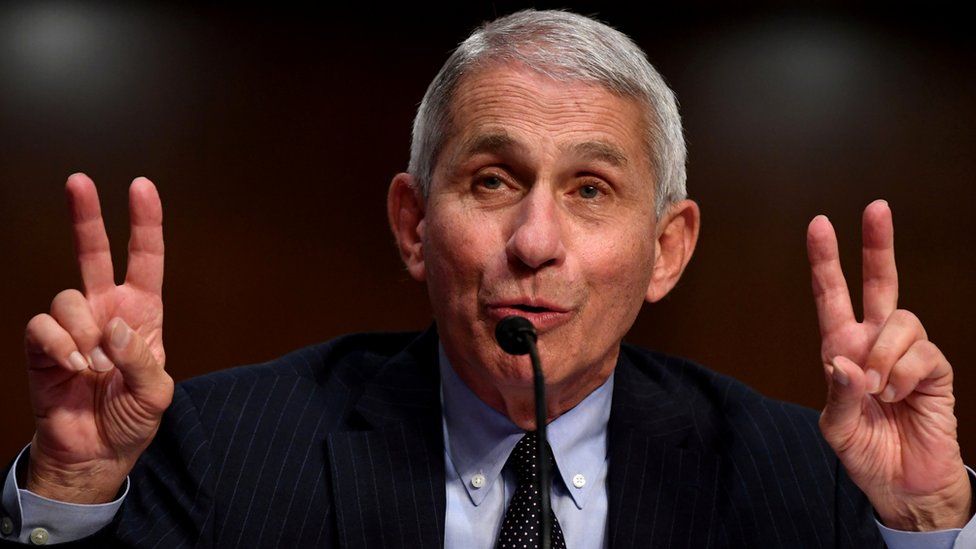
When Fauci Speaks
I’ve seen a lot of doubting Dr. Anthony Fauci on my social media feeds over the last few days. I mean, A LOT.
Look, I have my differences with Dr. Fauci. As anyone who follows me on Twitter or Facebook is well aware, I’ve (uselessly) advocated for the Swedish model for battling the novel coronavirus, SARS-CoV-2, or COVID-19. I’ve doubted the models, because I thought the models were going to be woefully incapable of predicting anything given the paltry and inaccurate data they were being fed. And guess who else thought the models were going to be terribly, horribly, awfully inaccurate?
Dr. Anthony Fauci. Yep, he’s been quoted more than once as saying that there wasn’t enough data to rely on the models for making policy decisions.
The difference between Dr. Fauci and me is our preferred approach to dealing with the insufficient data. I prefer some caution, but generally keeping life going as normal as possible to minimize the long-term risks to society from an economic collapse. Dr. Fauci prefers to prioritize short-term risk mitigation and letting the economists and sociologists deal with the long-term effects.
That’s it. That’s all it is – a difference of opinion as to which approach is better. History will be the judge as to which approach is better, eventually. After all, we’re still debating which approach was best in combating the original SAR virus a generation ago.
I do not attribute Dr. Fauci’s motivations to anything nefarious. He is not a secret Bilderberger looking to destroy society so that his wealthy buddies can take over everything. He is not a closet Bernie Bro looking to force the government to implement socialism on the down-low. He is not a member of the deep state hoping that the more the administration stumbles, the easier it will be for Joe Biden to sneak into the Oval Office.
He is a very cautious doctor. Nothing more, nothing less, and he’s acting as any very cautious doctor would. You can disagree with him. But assigning some weird conspiracy theory to him isn’t warranted.
 Political Baseballs