Musings on Sports, Politics and Life in general

Latest

Borders: More Than a Word


Bor•der [bawr-der] (n): The part or edge of a surface or area that forms its outer boundary; the line that separates one country, province, state, etc. from another, the frontier of civilization (courtesy Random House Dictionary).

It’s funny how “border,” a seemingly simple word with a clear definition, can rile up so many people. This isn’t one of George Carlin’s Seven Dirty Words either, although the reaction it generates in certain quarters would make you think it was. Sometimes, when I’m bored and need some entertainment, I’ll seek one of that crowd out and ask them why they refuse to recognize our national borders. The apoplectic rage with which the question is met, the incoherence of the replies and the visceral hatred exposed by the body language is almost humorous.

Mind you, I can understand why some groups find borders detestable. I can see why an illegal alien would rather chain himself to a bus rather than cross back over the border. The Catholic Church has never believed in national sovereignty. International businesses dislike tariffs almost as much as payroll taxes and unions are desperately in need of new members. Liberals hate anything that might actually be good for the country. Barack Obama needs a new distraction; after all, both Obamacare and the national economy remain unmitigated disasters.

But what perplexes me is the seeming disinterest the general public has regarding borders. I’m talking about the 70% or so of people who don’t generally pay attention to politics. If there was one issue that they should be interested in 100% of the time, you would think borders – and their security – would be it. After all, everyone is extremely interested in protecting their personal borders, right? We lock the doors to our houses, apartments and cars, we build fences and hedges around our property. Those of us who commute by mass transit quickly learn the unwritten rules regarding personal space and what happens when somebody crosses that border. We alarm our property, install security gates around communities and staff them with armed guards. We install expensive camera systems so we can watch for others crossing the borders around our property. As a society, we even have legal penalties for those who penetrate our personal borders, ranging from trespassing to breaking and entering. In most communities, if the legal resident kills a person who crossed their border, they are applauded as courageous.

Yet if anyone suggests those same measures be used to secure the national borders, they are met with scorn and ridicule. We’re told we should just accept illegal immigrants as new residents – even though if somebody just simply camped out in your front yard, you would do everything possible to get them off the lawn. We’re told the border can’t possibly be secured, although I bet ADT is just salivating at the chance to try it. We’re told posting armed guards along the border with shoot-to-kill orders is impractical, yet we use thousands of American troops to enforce that same standard along the North-South Korean border.

As a nation, we already spend over $34 billion to secure our personal borders. To secure the national borders in a similar fashion, the Congress has already approved $46 billion. But for some reason, most of the country remains blase when it comes border security. So, I have a solution. Make it illegal to provide any greater security for your person and property, than is in effect along the border.

After the general public gets tired of hosting a few dozen people for dinner every night, I suspect attitudes might change.

Is It Time?


As I sit here writing this, the US Federal government is embroiled in a partial shutdown. Since both sides are refusing to even talk to one another (although they are doing an excellent job of talking past each other), the impasse doesn’t seem likely to end anytime soon. Most in the media are equally embroiled in teeth gnashing and other trivial pursuits, while ignoring the underlying reason for the shutdown. And no, I’m not referring to the Affordable Care Act. That is merely the causi belli that ultimately led to the current situation.

No, the underlying reason is that the nation is more politically divided today than since the days leading up to the Civil War 150 years ago. Despite media grandstanding (and cries from an ever shrinking portion of the population) for compromise and reconciliation, such a thing is all but impossible in today’s political environment. Fire cannot be reconciled to ice. Ammonia cannot be mixed with bleach. In today’s political environment, you cannot mix the driving forces behind each political party without similar effect. The results are explosive, caustic and predictable.

The reality is we are a nation with two competing, incompatible ideas on what a government is supposed to do. On the one hand, there is a concerted belief that government should be as unobtrusive as humanly possible. In opposition is the view that government exists to provide for the populace. The reason compromise does not exist on the major topics of our day is that the underlying belief systems are polar opposites. Everything else is window dressing.

The Obamacare mess is just the biggest example of this dystopia. It wasn’t passed in a bipartisan manner whatsoever. In fact, not one Republican voted the bill into law; not one Democrat voted against it. If anyone thinks the same bill would pass the Congress today they need a serious mental examination. It brought to the surface ideological divisions that were evident for the past 20 years, but buried beneath a veneer of political conformity. Like a volcano before erupting, fault lines and fissures have occasionally appeared. But the explosion came about with the debate and passage of that seminal legislation.

So, the questions begs to be asked, though I don’t see it being raised: is it time to dissolve the union and create two separate entities – one that can pursue a restrictive government and one to pursue a restricted government? I’ll leave the answer to that to you… Comment away!

Now, the Hard Part for the Yankees


The 2013 season has ended uncharacteristically early for the Yankees. Since 1995, the team has played October baseball 17 times. The only miss before this season was in 2008.

Well, this year may be the beginning of a new streak, one many fans aren’t familiar with: one where the Yankees are irrelevant to the postseason for a decade or longer. It’s happened twice in my lifetime. There was a 13 year drought from 1965 – 1976 and then a 15 year absence from 1981-1995. But for a fan under 30, odds are they don’t remember those periods of futility. They are as remote to their experience as the days of Honus Wagner and Babe Ruth. To them, I can only say: “Buckle up. It’s going to be a bumpy ride.”

2013 is the season in which age finally caught up to the team. Baseball is a young man’s game, and trying to remain competitive when you’re starting line-up features 6 players over the age of 33 was going to be an adventure. That five of the six suffered serious injury isn’t a huge surprise. That the sixth, RF Ichiro Suzuki, played 148 games this year should be. 2014 will probably be the season when age and the salary cap finally sink the team. Ownership has repeatedly announced they plan to drop payroll below $187 million, a drop of $40 million from this season. Of that, about $93 million is already committed to a handful of players. That leaves precious little to shore up a team that is going to lose some key players, has two key contributors entering free agency and not much in the farm system. Let’s take a look at the internal options for next year – and what can reasonably be expected.

IF: Returning – 1B Mark Teixeira, SS Derek Jeter, SS Eduardo Nunez, UT Jayson Nix, C Chris Stewart, C Francisco Cervelli, C Austin Romine
Free Agents – 1B/3B Kevin Youkilis, 1B/3B Mark Reynolds, 1B Lyle Overbay, 1B Travis Hafner, 2B Robinson Cano
Limbo – 3B Alex Rodriguez
In the minors – 2B/3B David Adams, C JR Murphy, 1B Corban Joseph, C Gary Sanchez, 3B/OF Ronnier Mustelier

When you feature three shortstops on your major league roster, you realistically don’t have any. For a team that featured a future Hall-of-Famer at the position since 1996, it’s a strange place to be. Yet the Yankees would be insane if they think Jeter can be an everyday shortstop at age 40, especially coming off a season in which he never healed from a season ending injury in 2012. Do the Yanks stand pat, praying that the talented, but erratic Nunez can blossom while Jeter plays perhaps 30-40 games in the field? Equally concerning is the situation at third, where the safe bet is that PED King Alex Rodriguez will serve most, if not all, of his record 211 game suspension. He didn’t look like a major league caliber fielder during his abbreviated stint this season and the options behind him aren’t terrific. First appears set with the return of Mark Teixeira, but how effective will the 34 year old be coming off major wrist surgery?

But the biggest question of all is what to do about Cano. The guy is talented, but he’s always lacked the inner drive that transforms talent into greatness (ever watch him run out a ground ball or routine double?). He often looks bored and tends to press when the team needs him most. Still, without him the Yankees could face a total power outage in 2014 and beyond. Reports today have him asking for a 10 year, $310 million contract. Given their financial commitments, there’s no way the Bronx Bombers resign him at anything close to that price. But they really don’t have any options at second base, They could get a decent second sacker in free agency, but there aren’t any of Cano’s caliber, or even any viable long term solutions available.

OF: Returning – CF Brett Gardner, LF Alfonso Soriano, RF Ichiro Suzuki, OF Vernon Wells
Free Agents – OF Curtis Granderson
In the minors – LF Zoilo Almonte, CF Melky Mesa, OF Mason Williams, OF Slade Heathcott, OF/IF Addison Maruszak

The outfield could actually be okay next year, provided Soriano and Ichiro don’t break down. Gardner is never going to be a stud outfielder, but does possess speed and a great glove. Wells is a waste of a roster spot at this point, while Almonte showed signs of being at least a quality fourth outfielder in limited duty.

SP: Returning – LHP CC Sabathia, RHP Ivan Nova, RHP David Phelps
Free Agents/Retired – RHP Phil Hughes, RHP Hiroki Kuroda, LHP Andy Pettitte
In the minors – LHP VIdal Nuno, RHP Michael Pineda, LHP Manny Banuelos, LHP Nik Turley

This could be the worst starting rotation in baseball next season. No, really – I’m not joking. The team is losing three members from this year’s rather mediocre staff (unless GM Brian Cashman has aneurysm and resigns Hughes). That leaves an aging and increasingly ineffective CC Sabathia as the lone proven quantity. Ivan Nova has shown flashes, but not consistency. Phelps will probably develop into a reliable back-of-the-rotation pitcher. Adam Warren probably earned a shot at a starting spot with his strong effort out of the bullpen. Barring a free agent signing, that means the Yanks will hope that Pineda, Nuno or Banuelos can come back from injury plagued seasons and turn their talent into major league performance.

RP: Returning – RHP David Robertson, RHP Preston Claiborne, RHP Shawn Kelly, LHP Boone Logan, RHP Adam Warren, LHP David Huff
Free Agents/Retiring – RHP Mariano Rivera, RHP Joba Chamberlain
In the minors – LHP Cesar Cabral, RHP Dellin Betances, RHP Brett Marshall

This was the strongest unit for the Yanks in 2013 and looks to be again in 2014. Of course, replacing Mariano Rivera is impossible, but David Robertson should be more than adequate as the closer. The setup corps will suffer from the promotion of Robertson and the likely move of Warren to the rotation, but adding Cabral (who has looked good as a LOOGY) and Betances should be adequate. Chamberlain is addition through subtraction at this point.

Why I Support the #Defund Obamacare Movement


Obamacare & Your Career

If you spend any time on Twitter or Facebook, you’ve undoubtedly come across the “#Defund” hashtag. If you follow the news even cursorily (and odds are you follow it more closely than that, if you’re reading this) then you also know the House of Representatives voted yesterday to continue funding government operations until December. Everything, that is, except the Affordable Care Act – more popularly known as “Obamacare.”

The President’s reaction? He’s taking the CR personally, certain that the motivation behind it cannot be ideological in nature. “They’re not focused on you. They’re focused on politics. They’re focused on trying to mess with me. They’re not focused on you” he stated during yet another campaign speech yesterday. (As an aside, why is he campaigning? I thought the election was last November.) While my personal dislike for the the man in the Oval Office has grown considerably over the last five years, my disdain for Obamacare hearkens all the way back to its inception. Trust me on this one, Mr. President. My opposition is nothing personal – and neither is it for the people with whom I’ve conversed with on the subject.

I support the defund movement, because it is our last, best hope of getting rid of the “train wreck” (Max Baucus, the guy who helped write the ACA, called it that) and replacing it with something that actually addresses the rising costs and failed delivery of health care in the United States. I support the defund movement, because the economic impact of even a temporary federal shutdown would be far less than realized from your weapon of Mass Economic Destruction. Finally, I support the defund movement because the American people have had about all they can take of Obamacare.

Let’s start with that last point first. That you’ve always a had somewhat regal view of the Presidency is certain. Since early on, you’ve complained that you aren’t a dictator, or king, or emperor, or president of China. The actual concerns of the average American were hardly the thing that kept you awake at night; why else the dozens of “pivots to the economy” over your 5+ years in office? Over the past year, overwhelming evidence was exhumed that you consider yourself above the American people. From the failure in Benghazi, to the IRS crackdown on conservative and libertarian groups, through the revelation that the NSA is spying on everyone, to your recent attempt to force the nation into an ill-conceived war in Syria, said evidence is damning. You really did think for a while there that you are a de facto dictator.

Obamacare was our precursor. Yes, the American people wanted something done about health care. But what we wanted and what we eventually got are two very different things. Instead of reform that lowered costs and made delivery easier, we simply got told we had to go buy health insurance – or else. No matter, we were assured countless times since: once the law rolls out, you’ll love it! Why, didn’t Nancy Pelosi tell us that in order to find out all about the wonderful goodies in the ACA, Congress had to pass it first? The sycophant press quickly dubbed the new law “Obamacare” and you ‘begrudgingly’ accepted the name. FDR had the New Deal, LBJ had the Great Society, BHO had Obamacare.

Never mind that your signature piece of legislation has never been popular with the very people it is supposed to help. Polls show what support existed at passage has slowly slipped away. It’s your signature piece of legislation, by golly! So of course you’re right to be mad at Congress for attempting to undo the damage done, for seeing it as a personal attack and a personal affront. Never mind that the CR defunding Obamacare is actually more popular than the law and never mind that it enjoys popular support (and not just among the Tea Party). Never mind that it’s very passage is regarded is the single most important reason your party lost control of Congress in the 2010 mid-terms. If you refuse to sign that CR, then it’s the Republicans’ fault that the government runs out of operating cash on October 1. Not your own pigheadedness, not your own wanting to be a dictator – or failing that, being seen as the most “transformational” President since FDR.

About that threatened federal shutdown. We’ve been down that path a few times and quite frankly, they aren’t that scary to most Americans. There will be an inconveniences, of course. For instance, I won’t be able to track a flight on the NTSB’s website. I won’t be able to call the IRS with a question about my taxes (which, by the way, I’d probably sit on hold for 20 minutes and then be told to ask my tax professional). But we already know from past experience that essential government functions will continue: the Army won’t be disbanded, the FBI will keep hunting bank robbers, grandma will still get her social security check. Even progressive economists admit the actual economic impact would be minimal, resulting in a reduction of less than 1% of GDP.

But the economic impact of Obamacare is already being felt across the economy. Nobody has a full accounting thus far, but in the past week alone nearly 500,000 people have had their hours cut to 28 or fewer and their existing health coverage terminated. Another 35,000 have lost their jobs completely. Although you love to tout the   million jobs created in 2013, you have yet to acknowledge the fact that 1.2 million of those jobs are part-time, without health coverage. Those are real economic impacts directly attributable to your signature legislation. Here’s another impact you may not want to acknowledge: those workers are not only facing a drop in income from reduced pay, they are now going to be hit with a new expense: mandated health coverage. Sure, there’s a subsidy headed their way (provided Obamacare is fully funded) – but those subsidies won’t cover the full cost for health insurance. A government shutdown might reduce GDP by 1%. But Obamacare is easily dropping GDP farther than that and will cause it to crash even further. All this was avoidable, but neither you nor your progressive friends apparently live in the real world, the one in which businesses aren’t going to spend a dime more than necessary. You were warned by everyone from the Chamber of Commerce to (gulp) Donald Trump, but still you refused to listen. The economic mess your signature legislation created is wholly owned by you, as well as the Senators and Congressmen you bought off.

Finally, there is the train wreck. I could list everything that has gone wrong so far with getting this mess in place, but I did that a while back. To that list I add three more fiascos: the doctor shortage, the uninsured and one I’ll keep you guessing about until the end.

The doctor shortage was known and supposedly addressed in the ACA. Simply put, there aren’t enough primary care doctors available to cover everyone. Getting an appointment to see your doctor is already hard enough (and let’s not forget the wait times once you’re in the waiting room). The AMA now anticipates that wait times are going up by about 6% – and nobody anticipates getting an appointment will get easier. Will we see British-type difficulties in getting an appointment, with waits as long as a month? Will they be more like typical waits in the VA system, where it can take up to 6 months to get an appointment? Nobody knows, but the alarm bells should be sounding: in the New York metro area, a recent study found that time to appointment was now ranging from 6 to 61 days, with an average of 24.

The uninsured? When Obamacare was trotted out to the public, we were told that all but a few, perhaps 3 million, of those without insurance wouldn’t be covered. In March, CBO blew that apart with a new estimate: 7.5 million. Last week, that get shattered again, when  DHS announced that because of the rollbacks, waivers and deferments, that as many as 30 million people still would be uninsured come January 1, 2015. That would mean we went through all these gyrations over the last 36 months to insure an additional 2 million. Call me what you will, but that amounts to the second biggest load of crap ever handed the American people from Washington DC.

The biggest load of crap ever? Well, here’s the caboose of the Obamacare train wreck. Mr. President, you have promised us that “If you like your health plan, you can keep it.” You’ve pummeled the American people with that line for over four years, even though as far back as June, 2009 you admitted yourself that the statement WAS A LIE. Now millions of Americans are finding out what a monstrous pile of horse manure that line really is. Insurance companies, because of the regulatory morass that this demon child legislation created, are gutting health plans and informing their customers that come January 1, 2014 their current insurance will no longer be available.

In short, I’m supporting the #DEFUND movement because really, what other choice does our country have?

Welfare: It’s Worse Than Cato Realizes


On Monday, MIchael D. Tanner and Charles Hughes of the Cato Institute published their white paper, The Work vs. Welfare Trade-Off: 2013. Even if you haven’t read the full 52 page report, odds are you have at least heard of it. In the last 48 hours, it’s been reported on by FOX News, Twitter has exploded with mentions of the report and the authors’ conclusions. It keeps popping up on Facebook.

Then again, you may not have heard about Cato’s latest. Despite the hew and cry the report has generated amongst the small government crowd, left wing outlets and publications have hardly made mention of it. Searches of Huffington PostSalonThe New Republic, and The Nation will not yield any mentions of the authors or their paper. Nor has MSNBC deigned to give any coverage, although a search of their website does produce a a short, paragraph spot from WISE in Indiana. Even the “mainstream” networks (ABC, CBS, NBC, CNN) haven’t seen fit to give this story even a 1 second mention (although CNN does see fit to list articles about Dr. Phil and Jerry Springer among their “top stories”).

As the cliche notes, the silence from the liberals is deafening.  It’s to be expected, I suppose. For over 90 years, the linchpin in liberal ideology is that government assistance is a requirement for good governance. It gave rise to the New Deal programs of the 1930’s and the Great Society / War on Poverty in the 1960’s. Ask a liberal why, despite these massive government assistance programs, poverty rates remain basically unchanged over the past 60 years and you will hear dozens of excuses. From latent racism to corporate greed, liberals have a smorgasbord of time-worn choices to use. Admitting that the welfare programs they cherish have a problem isn’t in that toxic stew. When faced with as well researched a report as the one produced by Tanner & Hughes, with irrefutable facts that demonstrate the sheer lunacy of the American welfare system, all a liberal can do is cover their ears and stomp around in denial.

The authors conclude that despite the much ballyhooed 1996 Welfare Reform Act, the typical welfare recipient receives more benefits for a longer time with less chance of actually working in 2013. The one achievement that Bill Clinton can point to in defending himself as as a moderate has turned out to be an even bigger failure than his handling of a nascent terror group calling itself Al-Qaeda.

I don’t disagree with the authors regarding their conclusion. If welfare is meant to be a bridge towards making the poor self-sufficient, the the government has completely failed. The authors report:

The current welfare system provides such a high level of benefits that it acts as a disincentive for work. Welfare currently pays more than a minimum-wage job in 35 states, even after accounting for the Earned Income Tax Credit, and in 13 states it pays more than $15 per hour.

This is where I have a small problem with Cato’s paper. While I agree that the system is a mess, I believe it is even more of a mess than Cato presents. Why? Two reasons. First, Cato used a 40 hour work week to determine the “equivalent wage” for a welfare recipient. This might have been acceptable when doing this report 17 years ago. However, the average hours worked per week has been steadily falling for the past 14 months (thanks, Obamacare!) and currently stands at 34.4 hours. Odds are since someone transitioning from welfare to work would be in an entry level position and said positions have seen even more drastic cuts to the workweek, the equivalent wage should be based on the 25.9 hours worked per week by chambermaids or the 31.4 hours worked by retail clerks. I’m fairly comfortable using 34.4 hours, since it closely replicates the original reports intent.

Second, the authors failed to account for the individual states minimum wage laws when computing their statistics. They deliver two pretty powerful snapshots:

  • “Welfare currently pays more than a minimum wage job in 35 states, even after accounting for the Earned Income Tax Credit.”
  • “In fact, in 13 states, welfare pays more than $15 per hour.”

Yet, when accounting for the two factors I entered, I came up with even more grim results:

  • Welfare currently pays more than a minimum wage job in 44 states, even after accounting for the EITC
  • In fact, in 21 states, welfare pays more than $15 per hour

And I would add a third bullet point:

  • Currently, welfare pays an equivalent wage more than $5 per hour greater than the minimum wage in 33 states

In fact, if the goal is to make welfare an unattractive option for the poor and we want to move them into working, it can be argued that the equivalent wage should be at least $1 less than the state minimum wage. Using that criteria, only one state – Idaho – is succeeding.

Yes, my friends. Bill Clinton promised to “end welfare as we know it.” He was right. Welfare has become a highly paid career choice.

Below is a chart showing the difference between the equivalent wage and the state minimum for all 50 states, plus the District of Columbia. Where does your state rank?

Rank Jurisdiction Equivalent Wage Difference, State Minimum vs. Welfare
1 Hawaii  $                   26.62
2 Massachusetts  $                   20.25
3 DC  $                   20.16
4 New York  $                   17.18
5 New Jersey  $                   17.04
6 Connecticut  $                   16.55
7 Rhode Island  $                   16.47
8 Vermont  $                   15.07
9 New Hampshire  $                   14.97
10 Maryland  $                   14.08
11 California  $                   12.77
12 Wyoming  $                   10.98
13 Oregon  $                   10.22
14 Minnesota  $                     9.16
15 Delaware  $                     9.08
16 North Dakota  $                     8.87
17 Pennsylvania  $                     8.78
18 Nevada  $                     8.42
19 New Mexico  $                     8.10
20 South Dakota  $                     7.62
21 Kansas  $                     7.56
22 Michigan  $                     7.37
23 Montana  $                     7.25
24 North Carolina  $                     7.15
25 Alaska  $                     7.01
26 Washington  $                     6.93
27 Ohio  $                     6.80
28 West Virginia  $                     6.67
29 Alabama  $                     5.78
30 Indiana  $                     5.55
31 Missouri  $                     5.39
32 Oklahoma  $                     5.32
33 Louisiana  $                     5.19
34 South Carolina  $                     5.00
35 Wisconsin  $                     1.07
36 Virginia  $                     1.06
37 Nebraska  $                     0.81
38 Arizona  $                     0.76
39 Iowa  $                     0.69
40 Georgia  $                     0.61
41 Utah  $                     0.55
42 Colorado  $                     0.46
43 Maine  $                     0.28
44 Kentucky  $                     0.21
45 Texas  $                   (0.23)
46 Arkansas  $                   (0.41)
47 Tennessee  $                   (0.48)
48 Mississippi  $                   (0.64)
49 Illinois  $                   (0.66)
50 Florida  $                   (0.75)
51 Idaho  $                   (1.02)

GLOBAL ELITE: Stop the parasites


An interesting concept and reasonably well thought arguments. Opinions?

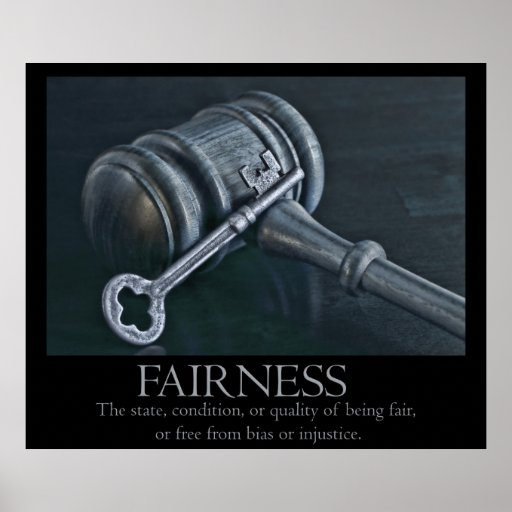
Liberty and Fairness


“The natural distribution is neither just nor unjust; nor is it unjust that persons are born into society at some particular position. These are simply natural facts. What is just and unjust is the way that institutions deal with these facts.” ― John Rawls, A Theory of Justice

Recent events in my own life have forced me to re-examine some of my most deeply held convictions. During the time I’ve been absent from this blog (wait – you didn’t notice???), four events in particular gave rise to self-reflection:

  • Crohn’s Disease, with which I’ve done battle for 22 years, once again reared up and forced me to the sidelines
  • My eldest son, who was born with a developmental disability, is now caught up in the nightmare that is the state mental health system
  • I’ve rented a room to a family that is emblematic of all that is wrong with the way government abuses good people
  • Another of my tenants passed away during the night

You’re probably wondering why I would spend the time to ponder what one prominent politician describes as “esoteric debates” when life brings such immediacy. You’re probably wondering further why I would take the time to write about that internal debate. The answer is that such internal debates are neither esoteric nor a thriftlessness exercise. It is by determining if our views are malleable to the events in our lives that we discover if our core values are the result of dogma or the sound exercise of judgement.

The overarching theme of President Obama’s tenure is that of “fairness.” Only, in Mr. Obama’s world, the fairness is defined by outcome; one in which those aggrieved receive what they deem to be their just share. This doctrine is exemplified in the policy objectives of his administration. Be it the underlying argument for Obamacare (that the only fair medical system is one in which everyone has health insurance), economic policy, the tacit embrace of the Occupy Wall Street movement, the management of foreign policy (attempting the equal embrace of islamist and democratic ideologies abroad) or dozens of other initiatives pursued, Mr. Obama is clear in how he defines “fair.” Further, his actions (including his insistence on defending the possibly unconstitutional and certainly intrusive domestic spying program) demonstrate a certainty that governmental institutions are the best method of obtaining this measure of fairness while denigrating the roles of other, traditional venues.

Unlike many of the President’s critics, I do not think he is an uncaring ogre bent on instituting a draconian new way of life on the American people. Although we disagree on most issues, I certainly applaud his efforts to afford all people equal protections under the law. I think it is indicative of his nature, in that he actually cares about the quality of life afforded ordinary Americans. I think most of my fellow countrymen have that same feeling and that underlying belief in his nature is the ultimate reason he won re-election – even though most of us remain opposed to his specific action plan.

I also think that more than a difference in political philosophy, we have divergent views on reality and possibility that slice to the core of our differences. The President is what might best be termed a government interventionist. Government Interventionism infects both the modern liberal and conservative movements. It is characterized by a belief that not only can the government positively effect outcomes, but that it should. While conservatives and liberals often have different goals in mind, they agree with the principle of a results-based system. As anyone who follows me on Facebook or Twitter is well aware, I have never subscribed to this view of governance.

My introspection of the past weeks has called me to wonder if, perhaps, this approach is best. One of the criticisms of Libertarians is that we are a callous bunch, uncaring about how life’s travails affect our fellow men. Those who know me personally know this isn’t the case. Of the root causes for my self-reflective journey, two involved people that I know cursorily. Yet, they are people who strike me as somehow getting less from life than their character would indicate they deserve.

Allow me to begin with the woman who died in her room last Wednesday. Although I knew her only a few months, what I did know belied her situation. She worked full-time (a rarity in today’s economy) and was well-respected by both her coworkers and employer, she had a large and close-knit family and she was outgoing, gregarious even. Yet, she died alone in rented room, the victim of a long battle with a chronic illness; in her case, diabetes. From what I could see, it was not a pleasant or painless death. She must have known she was in desperate trouble – I found her collapsed at the foot of her bed, in a position indicating she struggled to get to her door, with her phone fallen from her outstretched hand and smashed into bits. If we live in a results based society, why did she die in this manner? What could society have done differently that would have ensured that at the very least, one of her family would have been with her in her time of greatest need? At her funeral on Saturday, meeting her family and friends and seeing the outpouring of grief that overcame them all, I wondered why a woman so beloved by so many, who had done all society asked of her, should have been subjected to such a terrible death?

The week prior to her passing, I rented a room to a family of four. One room, four people, sharing a kitchen and bath with three other tenants. These are decent people, again doing all society says they should do. Both parents work and the mother attends nursing school; the children are incredibly well behaved (I wish mine had been so well behaved!). But they are victims of governmental bureaucracy as much as anything. The father openly admits to making mistakes when he was younger, which resulted in a felony conviction two decades ago. Since then, he’s done the things we tell him he should do: work to support his family, avoid the drama of street life, return to school and complete his GED. He would like to continue his education, but supports his wife as she works towards getting her degree. This is a family, in short, that is playing by all the rules our society dictates – yet they are reduced to living four to a single room, because it is all they can afford. The welfare system, the one that liberals tell us prevents this type of thing from happening and conservatives insist is too generous, is unavailable to them unless the father abandons his family. It is his decades old prior conviction that denies them access to it. Somehow, this result doesn’t seem fair to me.

Along the same lines, my personal struggle with chronic illness – in particular, a 22 year battle with Crohn’s Disease – has become much more difficult over the past two years. Over that time, I’ve had to shutter a business, spent nearly 8 months (cumulative) hospitalized and watched my family’s wealth get drained until we were destitute. I’ve rebounded some financially, but am in no way near the same fiscal position I was in 2011. Most of those around me think it unfair that my life has taken such a drastic turn, or that my reality is I’m likely wheelchair bound within the next two years and probably blind in less time than that. Certainly I wish there were a better prognosis.

Finally, there is my oldest son, Dennis. Some of my long-time readers are aware that he is what society euphemistically calls “developmentally disabled.” His reality is that he will never comprehend things the way you or I do. His IQ is 54; intellectually his development is equivalent to a second grader, emotionally he is at roughly the same stage as most 13- or 14-year olds. So while physically he’s a strapping 25 year old young man, his mind has yet to catch up to his body. Odds are that the two will never be in sync. This is the crux of his current problem. Because of his condition, he finds it difficult to express his feelings, except to occasionally blow up the way most 14 year old boys will. About 6 weeks ago, he found himself in a situation where he was being teased (not an uncommon situation, unfortunately) and lost his temper. The police were called; they followed protocol and brought him to the emergency room for observation. Which is where the nightmare began. Rather than checking his medical records, the hospital diagnosed Dennis as a violent schizophrenic and packed him off to the closest mental hospital. The doctor (I use the term in deference to his degree, not his competence) there confirmed the diagnosis, again ignoring his medical condition. A competency hearing was held, in which the doctor amplified his diagnosis to include the term “homicidal.” And so my son sits in a mental hospital, not understanding what’s happening or why as we fight to have him moved to another facility and have a new diagnosis issued that accounts for his disability. I’m not sure who would consider this outcome “fair.” If the President thought the justice system was ultimately unfair to the family of Trayvon Martin, I can’t see how he could consider this fair.

In reflecting on these incidents, each with an outcome which seems disproportionate in outcome to circumstance, I wondered if the results would be different were the fairness doctrine imposed by society replaced by libertarian values. Chances are that in three cases, the results would be the same but the perception would be different.

  • In a Libertarian society, we would acknowledge that the young lady who died chose to live her final days alone. While there still would be sadness accompanying her death, it wouldn’t be considered unfair that she had neither friends nor family with her in her final hours.
  • For the family renting the single room, society wouldn’t consider it unfair that a hard working mother and father would resort to housing their family in these conditions. In a Libertarian society, they would be celebrated as examples of how to face adversity.
  • As for my health, nobody would consider it unfair that I’m sick and fated to becoming sicker. Unfortunate? Unlucky? Sure, those sentiments would be common. But the choices my family made in previous years were our own and left us in the financial position we find ourselves. I knew my health was precarious before launching my last business; it was our choice to take that route as opposed to my taking a job in what is a poor economy. Using Libertarian values, we took a calculated risk that proved unwise. But in the interventionist society we live in, we demonstrated incredible recklessness and need to be saved from ourselves.

Libertarians believe that fairness in opportunity is far more important than fairness of outcome. After all, if everyone is free to pursue their life’s goals – if they are truly at liberty – then the outcomes are inherently fair. Differences in outcome will have more to do with natural ability and desire than anything a government can do. While the odds are that the above situations would not be dramatically different than in a Libertarian society, there is one important way in which one of those situations would be better. The people above would be less constrained by a restrictive society. The family in one room may well be much better off, since Libertarians tend to look at most drug laws as counter-productive – meaning no felony record for the father. He would certainly have better employment opportunities without that black mark.

As for my son, a Libertarian society would probably mean all the difference in the world for him right now. Without the modern police state in which presumed innocence is nothing more than a tired cliche, it’s doubtful he would be where he is now.

So, yes, I’ve reflected and pondered. You’ve read my conclusions. You may not agree with them, but I end this period of introspection confident in my core belief that the equitable outcomes can only be guaranteed by the one truly fair system ever known to humankind. That is, that by believing in the individual and providing them with the liberty to achieve to their individual potential, a government does its best service to the governed.

The Real Culprit in the Martin-Zimmerman Case


Sanford, FL Logo

Unless you live under a rock, in a cave on a deserted island, by now you’re certainly aware that George Zimmerman was acquitted of all charges in the death of Trayvon Martin. There are no heroes in this case. From what I’ve read about both of the principals, I can’t honestly see how anyone would want to emulate their behavior. George Zimmerman comes across as a power hungry hothead with more ego than common sense. Trayvon Martin was a wannabe gang-banger, sent to Sanford from Little Haiti by his mother because he had spent the past year in continuous trouble with authority.

Their chance encounter was a recipe for disaster. That it ended in one was predictable – and preventable. The real culprit is neither George Zimmerman nor Trayvon Martin, regardless of their latent anti-social tendencies. It is not the prosecutor, a woman with political aspirations who went forward with a prosecution despite lacking any evidence. It is not the original investigators, who concluded (correctly, in hindsight) that there was insufficient evidence to charge Zimmerman. It is not the jury, who reached the only conclusion feasible with the evidence presented.

The real culprits are those the residents of Sanford, FL pay to prevent these types of tragedies from happening: their police.

The Sanford police are not culprits because they let Zimmerman walk after the initial investigation. As shown during the trial there wasn’t enough evidence to warrant an arrest, much less charge with a crime. Instead, they deserve goat’s horns because their initial response was horrifically slow. Drive time from the nearest police substation to where the shooting occurred is less than 6 minutes; it took the police more than 8 to arrive after the initial call by Zimmerman to arrive. The responding officer arrived 5 seconds after the fatal shot was fired. Think about that for a moment: had the police simply driven the speed limit, the physical confrontation between the two men would have been averted. Further, the reason Zimmerman took it upon himself to patrol his neighborhood was due to a rash of robberies. There had been three in the previous five days; the description of the suspects were of “young, african-american males wearing hooded sweatshirts” (those robberies have yet to be solved).

Additionally, the management of the law enforcement in Sanford is a case study in how not to run a small city police force. The crime rate is comparable to that of notoriously crime laden large cities like New York, Newark and Miami. In the five years prior to the Martin-Zimmerman altercation, the Sanford police had been implicated in cases involving police cover-ups and racially motivated shootings. Because of the police department’s history, they left themselves open to charges of misconduct and negligence by those who looked to politically profit from the incident.

So, there’s the reality of the situation. The vast majority of us would never have heard of Trayvon Martin or George Zimmerman had the Sanford PD simply been competent.

An Open Love Letter to my Wife


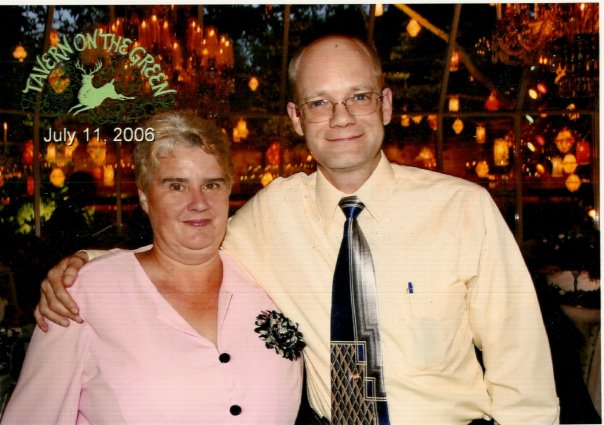
My Wife Linda with some bald guy

My Wife Linda with some bald guy

Some years ago I decided to walk up to Pacific Avenue in Wildwood, with the sole purpose of watching the parade of classic cars. Little did I know when I began walking down Wildwood Avenue that within minutes, my life would forever be changed.

It was the night I met you. Never a more fortuitous moment came across any man’s life.

You were standing there, in front of my friend Steve’s bicycle rental stand, where I always went to watch the parade. I had never seen a more beautiful vision in my life. You had just come from work, your hair somewhat mussed, and still…I was drawn to you, the way a moth is drawn to a bug zapper. You slew my playboy ways without even looking in my direction, much less saying anything to me. They say love at first sight doesn’t exist. You and I know better; that when you find the person God decided is the one for you, everything else fades away.

In all my life, I had never been so anxious and nervous to strike up a conversation with another person. Thankfully, that ’67 GTO rolled by and gave me my chance:

“Sweet car,” I said.

“Yes, it is” you answered.

And then you walked away. I thought I had blown it, although I didn’t know why. But I was certain that I had just missed on something spectacular. But God, in his wisdom, never lets the folly of men get in his way – and it was to my immense joy that I found you at my hotel pool later that evening. Little did I know then that the same things I felt in front of that bicycle stand were shared by you.

That summer bore fruit to a whirlwind romance between Raymond Rothfeldt and Linda Shelly. It was a fantastic time and ended one night at Neil’s Steak House. It ended with me on one knee, asking your hand in marriage. Of course, I never expected to shock you with the proposal – and I never expected to spend an eternity on one balky knee waiting for an answer. But I did; I would again.

13 years ago today we married. It proved to become the perfect metaphor for our lives together. From the JP disappearing less than an hour before the wedding (leading to our being married by Fred Wager, in his Hawaiian shirt)  to the mis-sized wedding bands, our life hasn’t been one of ease or plans coming to fruition. But you’ve figured out a way laugh through the worst life can toss at us and made me laugh at myself in the process.

Over time, my love for you has only grown stronger. Where once I couldn’t imagine life without you by my side, now I cannot picture what my life was like before you came into it. Your beauty, your grace under pressure, the way you enliven a room: all this and more constantly amazes me. It is your strength that has guided this little family over the years, your wisdom that has saved us from catastrophe, your resilience that enabled us to bounce back every time things went astray. You’ve always known when I needed a laugh to get me past a difficult situation, a poke to get me moving in the right direction and a roadblock to keep me from going off on wild tangents.

And after all these years, there still isn’t another woman who can thrill me with just a smile, who has the ability with just a look to set my pulse racing and get my palms sweating. I may be well into middle age, but you can still make me feel like a teenager going on his first date; that odd combination of anticipation and nervousness.

For all of this and more, things I cannot write here or that are beyond my ability to write about, I love you. I love you for being you – and I love you for loving me. Your marrying me was the greatest gift I’ve ever received, one that I’ve treasured for the past 13 years and the one I’ll cherish above all others for the rest of my life.

Happy Anniversary, Sweetheart! I hope you don’t mind my sharing this with the rest of the world (although I don’t think you will) – but I think everyone, everywhere should know what a wonderful, wonderful woman you are. ♥

THE WISDOM OF JUNIUS P. LONG


It is not “politcally correct.” But then again, the people who are have never stood for anything in their lives, so there’s that…

asknod's avatarVeterans Claims Help

“If we concentrated on the really important things in life

securedownloadthere’d be a shortage of fishing poles.”

Brownwater Jimster sends me this to share with you. As most know, I tread lightly on political subjects because they are, like religion, fraught with chuckholes. However, when someone like Mr. J.P. Long emerges and points out the sky is indeed falling (and he’s right), I feel obligated to second the sentiment.

Here are Mr. Long’s well-reasoned observations on the state of the Union.

If you can get arrested for hunting or fishing without

a license, but not for being in the country illegally …

you might live in a country run by idiots.

If you have to get your parents’ permission to go on

a field trip or take an aspirin in school, but not to get

an abortion …

You might live in a country run by idiots.

If you have…

View original post 524 more words