
Remember when I was begging and pleading with lawmakers to reject President YOYO’S inane payroll tax cut? My worry is that doing so dramatically underfunds Social Security. Well, guess what. Independent analysis is confirming that those worries are justified. Read more at this Washington Post article. My question is, where was this article two weeks ago? Oh, that’s right. The Post, like the rest of the MSM, remains an Obama sycophant.
Latest
Iowan Insanity

Cherokee Hospital for the Insane - Cherokee, Iowa
Here we go again. In four days, the nation is going to let a state representing 7 electoral votes set the tone for the quadrennial Presidential Election process. This state is hardly representative of the nation as a whole, either. The residents of Iowa have more disposable income than the rest of us. Demographically, Iowa is less ethnically diverse, less educated and more rural than the country in general. The state’s largest city, Des Moines, is ranked 106th in total population and 98th in population density – making it more a large suburb than an actual city.
Why do we do this? Why do we allow 1.2% of the nation’s populace decide the fate of the Unites States for the next four years? I can’t think of a particularly good reason. But I can think of a particularly good way to end the charade. Have all primaries conducted on the same day.
To be clear, I am NOT advocating for federal administration of primary elections. The states have done a fine job running them. If they would rather have the circus atmosphere of a caucus than an election, fine. If they want restrictive and onerous ballot rules, okay. This is directed at the national parties, who are responsible for creating the primary schedule and have perpetrated the insanity of allowing a very non-representative portion of the population to determine their candidates for President. (After Iowa comes New Hampshire, with its four electoral votes and even less representative of the nation).
But a National Primary Day does several things to help end the confusion common to Presidential primaries. First, it effectively ends the candidacy of people with marginal appeal. Let’s face it, by focusing all of their energies on one small state, some pretty marginal people have been able to enter the national conversation based on one position – only to fade into political oblivion. Mike Huckabee won Iowa, only to become a talk show host. Pat Buchanan used Iowa to re-energize a fading career as a political pundit. Howard Dean made plenty of noise in Iowa, only to become a punch-line on late night television. This year, can anyone really imagine that the race baiting history of a Ron Paul wouldn’t be a political albatross in states with more than a 5% minority population? Or that single issue candidates Michelle Bachmann or Rick Santorum would be players on a national stage?
Second, having all Presidential primaries contested at the same time would require candidates to create a national political organization. Newt Gingrich and Rick Perry were surprised by their inability to get on the Virginia primary ballot. Yet the underlying reason is their inability to properly organize. Gingrich can be excused, in a sense; his campaign is underfunded and was largely seen as a joke until last month (although, residing in Virginia probably means he should have understood the rules better than any other candidate). Perry, however, has oodles of money – more than anyone in the race not named Romney – and his inability is due simply to a lack of campaign oversight. Seriously, do we want a President who can’t organize well enough to ensure he’s on every state ballot? Or hire someone to do that for him? Making speeches is one thing, but ensuring the basics are attended to is an essential leadership trait. The United States federal government is a much larger enterprise than any political campaign. A candidate who can’t assume the responsibilities of Chief Executive of a political campaign certainly can’t be trusted to be the Chief Executive of the United States.
Finally, a National Primary Day ensures that every primary vote carries the same weight. The essential element is this: by giving various states an initial say in the nominating process, the citizens voting later have less input. Odds are that by the time “Super Tuesday” rolls around, the parties have already settled on a presumptive nominee. By the time I get to cast a ballot in June, the nominee has been decided – voting becomes nothing more than a pro forma exercise in civic responsibility. The effect, of course, is suppressed turnout in those states, which has dramatic effects on down ballot candidates and initiatives.
It is time to end the madness. Allowing the voters in Iowa (or New Hampshire) to have more input than voters in California (or us poor New Jerseyans) is one 19th century idea whose time has passed.
Merry Christmas!

Courtesy: http://www.snoopy.com
Fuzzy Math & the Payroll Tax

There I go again...
If there’s one thing we should have learned from this recession, it’s that politicians may not know how to fix it – but they sure know how to play politics with it. So, you’ll pardon me if my eyebrows arched up when the Great Obama proclaimed the House’s refusal to go along with the payroll tax compromise was “stealing $1,000 from hard-working middle class Americans.” The President has told some whoppers during his time in office (seems becoming President imbues the office holder with that ability), but where on earth did he come up with that number?
The compromise reached in the Senate only covers two months. Given the typical American earns $34,720 a year and we’re talking about 2% of pre-tax income, that $1,000 seems a pretty big number. So I ran some quick calculations and didn’t come near the $1,000 promised by the President. Over 8 weeks, the typical American would see a “whopping” $106.83 extra in take-home pay – or $13.35 per week. I don’t know about you, but $13.35 doesn’t buy me very much. It won’t fill my gas tank. It also doesn’t fit the bill on the “What $40 Means to Me” White House website. Even the TWO months of extra take home pay wouldn’t cover ONE month’s cell phone bill. So, I thought that perhaps the President simply got the two month compromise bill and the extra cash from a full year of the payroll tax reduction confused (could happen; I’m sure he’s busy fielding calls from Michelle about how sunny Hawaii is right now). Nope, wrong again – that only comes to $694.40, or about ½ of 1 month’s mortgage payment. Could it be he was talking about the top-end earner under the plan, the guy making $110,000 a year? Not really – he still only comes home with an extra $338 in his pocket over the course of the compromise. (See chart below for details)
While the extra take-home money is welcome by pretty much everyone, I don’t think if people stop to consider the implications of this tax cut they’ll be so anxious to get that extra $13 or so in their pockets. Hey, here’s a novel idea, one that gets the same amount of money into everyone’s pockets without annihilating the Social Security system: why not pass an income tax cut for everyone earning under $110,000 per year? Too simple an idea? Too broad based to get real support? Probably.
In the meantime, I’m not sure what they’re smoking during these White House – Senate confabs. But they better legalize it before Eric Holder catches a whiff.

Payroll Tax Reduction
Why the Electoral College Matters

Belushi: An Electoral College Attendee?
One of those arcane topics that makes its way into political conversation is the Electoral College. Despite the fact that it should be treated as a pretty technical subject, it is usually given the same bumper-sticker treatment that serves as political discussion these days. Popular sentiment boils down to, the will of the people is ignored by the Electoral College and it should be reformed or replaced to more directly represent the popular vote.
Hey, great idea, right? Who could possibly be against the will of the people and the popular vote? And besides, isn’t the Electoral College some arcane leftover from the 18th century? Wasn’t it devised by a bunch of fuddy-duddies who were after maintaining power for the privileged few? Like most bumper sticker ideas, these are all exploded rather easily once you actually examine things.
First of all, the founders created the Electoral College expressly to prevent the type of insane power brokering that happens when somebody is incapable of winning the popular vote. Having experienced the shortcomings of parliamentary elections first-hand as British subjects, they were determined that Presidential elections should have a clear winner. Further, they were determined that each state would have a fair say in determining the winner. As odd as it may seem to people without a solid grounding in American history, our nation has always had regional differences in culture, along with the attendant political differences that arise from them. Although we love to dismiss many of their ideas as outdated and irrelevant in modern society, the Founders understood that direct elections bring with them tremendous peril for functioning government.
Were they right in their assumptions and fears? That anyone of voting age could think otherwise demonstrates either the inability to comprehend civics – or do some basic math. Currently, there is a proposal going around calling for each state to amend their constitutions to allow for direct apportionment of their Electors. The Republican Party is similarly apportioning their votes in the 2012 primary process. The result, based on the fact no candidate can seem to muster more than 40% of the vote and the front runners routinely poll in the mid-20’s, is likely to be a brokered convention. For those of you wondering what one of those looks like, I refer you to the 1968 Democratic Convention. Most people only know it for the chaos in the streets of Chicago – forgetting the chaos inside the convention itself. Before finally settling on Eugene McCarthy as the party’s candidate, the convention floor was raucous while party leaders haggled behind closed doors for days.
But could such an outcome be the result of states directly apportioning Electors? Consider three elections in our recent history:
2000: This is the election most cite in wanting to do away with the Electoral College. Neither major party candidate achieved 50% of the popular vote, but thanks to the Constitution George W. Bush garnered 279 electoral votes, 9 more than needed for victory, despite trailing Al Gore 48.4% to 47.9% in the popular vote. But had the electors been decided by the direct apportionment method, the electoral votes would have tallied as Bush 259, Gore 258, Ralph Nader 17, Pat Buchanan 4. Nader would have been a kingmaker in that scenario, as he could have pledged his votes to either major party candidate. The result would be what we witness in countries with otherwise weak minor parties – a leader forced to try and hold a coalition together, held at whim by the minor party’s demands.
1996: Bill Clinton swept to re-election with 379 electoral votes (despite only garnering 49.2% of the popular vote), but direct apportionment would have yielded a much different outcome. The tally would have been Clinton 263, Bob Dole 222, Ross Perot 53. Perot’s nascent Reform Party would have had the power to change history, but that possibility is dwarfed by the results from…
1992: This is the granddaddy of all examples as to why the Electoral College works. Perot garnered nearly 20 million votes nationwide, finishing second in Utah and Vermont (and falling short of winning Utah by less than 12,000 votes). It was the most successful third party candidacy in history, with Perot capturing 18.9% of the total popular vote. Yet, he won no electoral votes since he didn’t carry a single state. Bill Clinton won the electoral vote, 379-159 over George H.W. Bush, despite only capturing 43% of the popular vote. Under direct apportionment, the result would have been grim, indeed. Clinton would have managed only 229 electoral votes, Bush 201 – and Perot 108. Try to imagine the type of havoc Perot could – and would – have created had electors been directly apportioned. Constitutional crisis only begins to describe it.
That’s three elections within the past 20 years that would have been turned upside down, without a clear winner or any semblance of legitimacy for the eventual President. Except that the Electoral College was there to sort through the debris and declare a new President. So, before signing on to do away with the Electoral College or make dramatic changes to its structure, remember that those aging fuddy-duddies who wrote the Constitution knew a thing or two. As usual, we would be well advised to stop and think about the how and why they created the structures of our government before casting them aside.
Don’t Pass the Payroll Tax Cut
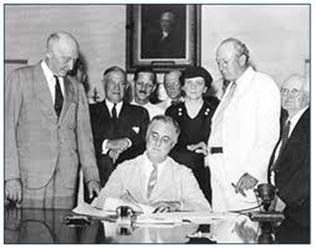
FDR Signing the Original Social Security Act
Yesterday, the House of Representatives may have given the American people an early Christmas present – although the majority of my fellow citizens won’t realize it and (urged on by the President) will cry bloody murder. And yes, the motives of the House members are hardly pure. Those are certainly little more than angling for political gain. But the result is the same; an end to the insanity that is the payroll tax cut.
It isn’t that I’m opposed to tax cuts, in general principle. Anything that reduces the inflow of money from the private sector to the public is usually a good thing. But the consequences of reducing this particular tax levy amount to far more than the few pennies saved by the average taxpayer. Why? Because this is a targeted tax, whose revenue is designed purely to keep the Social Security system afloat.
Okay, some background here. The payroll tax amounts to 12.4% of the earned income of every wage earner in the country, up to $100,000. Of that, you normally pay 6.2% and your employer pays 6.2% (unless you’re self-employed, in which case you pay the full 12.4%). For 2011, Congress and the President reduced the amount paid by employees to 4.2%. That cost the Social Security system $117 billion. Now, here’s the rub: most people think there’s this massive social security trust fund, into which new revenues get deposited and from which existing current beneficiaries receive their monthly stipend. Reducing the amount coming for a year or two won’t matter, because the trust fund is earning interest on past deposits and there is plenty of time to make up the current shortfall. The reality is there isn’t a trust fund. There never was one; there never will be. Rather, the money you pay in is turned right around to retirees. Smart people realized that the system as it existed was untenable back in the 80’s; they worked out some changes in the ways benefits are paid and increased the payroll tax. Depending on who you talk to, the system was saved from insolvency until 2037 or 2052.
Except the $117 billion that came out of this year’s Social Security funding left us with an $83 billion shortfall, either 26 or 41 years before it was supposed to happen. If the payroll tax remains at 4.2% for this year, the CBO expects the shortfall to top $105 billion. (Actual reduction in revenue amounts to approximately $120 billion). The folks in the Senate came up with some neat trickery to “pay” for the reduced payroll tax, mostly relying on forecasting budget cuts 10 years down the road to pay the difference. That’s not exactly a reliable funding formula, but it is what passes for budget restraint these days.
What I find really amazing about the whole thing is the way Democrats – supposedly the guardians of the Social Security system from all assaults – have caved on this issue. Most of them probably haven’t realized yet that by breaking the essential funding formula created by the original Social Security Act and relying on general revenues to keep the system solvent, they’ve subjected their sacred cow to the whims of future Congresses. I can’t imagine they actually thought through the idea that Social Security is now on the general budgeting table, open to political negotiation on funding – and payments.
I think most people realize that Social Security needs to be revisited, if for no other reason that retirees are living longer and collecting more. Pro-rating payments, delaying the official retirement age, means testing, even incorporating private retirement accounts should all be on the table. But if Congress continues reducing the inflow of funds in to the Social Security system, the idea that we can address the topic later rather than sooner will be gone.
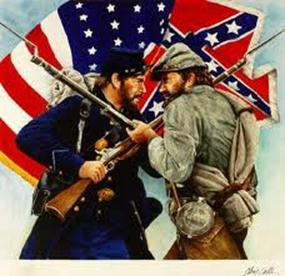
Is an Uncivil War on the Horizon?
 First, an apology: I realize it’s been while since I’ve posted. Some of you are probably disappointed with my lack of output. For that, I’m sorry.
Despite this being the earnest start of the 2012 election cycle, as a nation we’ve failed to come to grips with the most pressing issue of our lifetime. Our politics – and politicians – consume themselves with playing politics as usual. Rather than engage the electorate in an honest debate about what type of nation we are and what type of nation we want to be, the political class (and that includes the punditry and news outlets) spends our time discussing ancillary issues.
Every other issue – the economy, foreign policy, education, civil rights, immigration – is secondary to the central question of just who we are. We’re often told of how the “greatest generation” came together to answer that question in the 1940’s. The truth is that that they didn’t answer that question completely. No generation has. Each succeeding generation has answered parts of the question, building upon the work done by those preceding it. Until, that is, the two generations currently in control of public discourse: the “Baby Boomers” and “Generation X.” The Boomers can be forgiven for thinking that the protests and civil rights gains of the 1960’s and 70’s finally delivered the answer. Gen X, growing up with those examples in relative affluence, assumed the nation would never need to revisit the question.
But current circumstances have proven that the question of what constitutes the American character was never solved. As the nation devolves into chaos, political gridlock born of competing ideals is the order of the day. As a people, we seem stuck in one camp or the other. We compartmentalize ourselves into either being “conservative” or “liberal” without fully understanding what those labels construe. Worse, we build walls around our encampments, refusing to even listen to ideas that challenge our preconceived notions. Often, those viewpoints don’t come from reason – they come from an ingrained political ideology. It’s the pathology that allows political machines to flourish in all their corrupt glory. Every day on Facebook and Twitter, I see people who’ve known each other for decades “unfriend” each other over political disagreements, often with comments like “that person is an idiot.” Or worse, involving language that makes this old Marine blush.
Hopefully, the act of using social networks to be unsocial is as far as we go towards civil war. But as I gaze upon the national landscape, I wonder when and if we’re capable of answering the question of what the United States of America represents now and in the future. The answer is out there and we need to answer it. If we leave it to our children and grandchildren to answer, there may not be a nation left for them to inherit.
So, in the hope of sparking discussion I’ll be spending the free time I have over the next few weeks posting continually about who we are as a nation today – and how we get from here to there. Feel free to join in the discussion. But keep in mind that this is an open forum – you’re liable to run into ideas that challenge you.
Can We Get Real?
Every once in a while I come across a story that brings home how insane the world became. These stories used to pop up in my inbox once in blue moon, but either blue moons occur more frequently than in the past or somewhere along the way we lost our collective common sense.
Today’s submission for “Are You Kidding Me?” comes courtesy of several people, all of whom suggest an outright ban on Halloween. Yes, you read that right. Otherwise sane and rational people are up in arms over a centuries-old tradition of dressing up in costume, begging for candy and tossing the occasional rock at an abandoned house. The reasoning runs from apocalyptic, fringe religiousity (the type that used to be associated strictly to Jehovah’s Witnesses) to worries about police overtime.
Get a life, people. If you’re worried about your kid growing up to practice devil worship, then you obviously haven’t done as good a job teaching them your religious beliefs as you thought. If you’re worried about your teenage urchin wreaking havoc on local property values, odds are you haven’t done much of a job teaching them to respect other’s belongings. I strongly suspect that in both cases, you may have been the victim of an egging on some Halloween in the distant past. Whatever the cause, you’re allowing your “NO FUN ALLOWED” attitude to cramp a perfectly harmless bit of fun.
Whatever your hang-up is, get over it and let the youngsters bob for apples while dressed as Superman. You can sit there, shotgun in hand to ward off the evil ghouls and goblins that are bound to ring your doorbell. As for me, I’ll be happily handing out Hershey and Nestle products by the glow of a Jack o’ Lantern, giant stuffed spider on my shoulder.

Mr. Perry, Only serious candidates need apply
In a way, I feel sorry for Texas Governor Rick Perry.

Is Rick Perry really just another Bozo?
When Sarah Palin decided not to run for President, Perry was anointed as the only real conservative with any political heft running for President. After all, he is the longest serving Governor of the nation’s second largest state, a state that remains prosperous despite the national economy generally being in the tank for the past four years. He announced his candidacy to the thunderous roar of making the federal government “as inconsequential in your life as I can.” I’m hoping that statement isn’t a result of introspection – because right now, a Perry presidency looks like an even bigger disaster than the Obama presidency became.
First, Perry proved everyone right when they said he was a lousy debater. Along with the rest of the nation, I can handle a guy who flubs an occasional fact (it happens to everyone). I can stomach the person who comes across as a walking stiff; nobody should be overly confident on a debate stage. But Mr. Perry managed to come in even below the already low expectations set by his campaign and supporters. When Perry was awake enough to pay attention to what was happening on the stage around him, he demonstrated an incredible inability to articulate even the simplest thoughts, much less explain policy decisions a Perry administration would make. In the end, his only recourse was to lash out angrily (a lá Newt Gingrich, but without Newt’s wit) at his competitors. The resulting image is of a slightly dim-witted bully, not a future President of the United States.
Now, we have the Perry economic plan. In announcing this plan, Perry declared it to be “bold.” If by bold, you mean “schizophrenic,” then I agree with you, Mr. Perry. This is nothing more than pandering to various interest groups. If meant as a way to kick-start the conversation about the role of government, then it might be acceptable. But I think he actually meant it as an economic outline, in which case it will only work to drive millions of Americans into destitution and despair. Why? Look under the hood and here’s what you find:
- Tax policy: Perry proposes a 20% flat tax, except it isn’t. It is a 20% personal income tax policy, with deductions for mortgage interest, state and local taxes, and charitable gifts. Worse, for those with incomes under $500,000 the personal exemption increases to $12,500 per person. Taxes on business profits are also reduced to 20%, with no deductions – save for a one-time reduction on off-shore profits to 5.6%, intended to lure overseas profits here to spur job growth. Still, even if you get past the misnomer (a flat tax is just that; one tax rate without any exemptions) then you’re tempted to say this seems reasonable.The biggest complaints regarding the current tax code are the complexity and that the current distribution of the tax burden predominately falls on the middle class. How does the Perry Plan address these two problems? My best guess is by ignoring them. For starters, any taxpayer can opt to keep the current tax plan instead of the new one. Imagine running a business under those circumstances: now you have to track two different tax codes and try to determine which works best for your company (I suppose accounting firms will love it).An entire new level of complexity just got added into your business model, because no business I know is going to arbitrarily choose one plan over the other without doing a full cost-benefit analysis. As to the personal taxes, Perry is correct in assuming most Americans will opt for his single rate plan. After all, a full 50% of American households won’t pay any taxes under it. The remaining half will bear the brunt of the tax burden – which is roughly the same distribution as we currently have, just with less money coming in. Unless you’re in the middle class, in which case you’ll probably wind up paying more in taxes. Brilliant election year strategy (see: Cain, Herman for how well raising taxes on the middle works).
This is no gain, all loss. (You can find the data used to compute tax distribution here).
- Social Security: Perry proposes relieving income taxes on those receiving Social Security, while making it an opt-in program for current workers. Sounds great, except the only people currently paying taxes on Social Security benefits are those with over $50,000 in personal income per couple (how many retired couples do you know with $50,000 in annual income?). As for making Social Security an opt-in program, there’s a very big problem with that plan: current workers actually pay for existing retirees. The. idea that the government takes your money, then invests it into a “trust fund” from which you draw your retirement benefits is patently false. What happens is the government takes those payroll taxes we all pay and uses those funds to pay current retirees. If there’s a surplus, then the government uses that money to purchase T-Bills and then uses those funds to help the general ledger; if there’s a shortage, then the reverse is true. This is a month-to-month accounting system, not an annual line-item budget item. So, imagine what happens if even half of current workers opt out of Social Security? Yes, you guessed it: the entire system goes belly up, threatening in one fell swoop to turn us into Greece, with a national debt ballooning by the billions every month and an unfunded national pension plan. Worse, you and your employer is still obligated to pay those pesky payroll taxes, but with an entirely new level of complexity. Is this now income, since it is being deposited into an investment account? What type of account is it? Who manages it? What level of accountability is there, and to whom?Social Security does need to reform to keep it solvent. But nuking the entire economy in order to do it isn’t very bright.
- Health Care: One of the greatest threats to economic growth, both now and in the future, is the dizzying rate of increase in health care costs. Nobody has yet to put forth a proposal that actually does anything to reduce that curve and Perry joins right in. His plan is little more than “reduce fraud in Medicare.” Lovely idea and it should certainly be part of the agenda. Except we’ve been hearing about that for 25 years now. It seems to me that with that much emphasis on reducing Medicare fraud, it should amount to $1.30 or so by now.
- Balancing the budget: Well, of course. Everyone I know agrees the federal budget should be balanced (except for a few die-hard Keynesians, but they’ve been proven wrong on this so many times over the past 60 years I find it hard to believe they’re still around). But Perry doesn’t offer any specifics aver how he would do it. He does offer platitudes, such as “Pass a Balanced Budget Amendment” and “Cap Federal Spending at 18% of GDP.” He suggests freezing federal hiring – not a bad idea, but we’re not running $1.4 trillion deficits because of federal hiring. He also wants to do away with earmarks. While that is certainly an admirable goal, the President (as leader of the Executive branch) can’t do much about it: appropriations bills are still written by Congress. If some Congressman from Bum Rush wants $800 million for a road to nowhere and can convince a majority of his peers to go along with the idea, it’s getting added into an appropriations bill somewhere.
Frankly, the entire Perry candidacy so far has shown him to be a man whose ambitions far outstrip his talents, ability, intelligence and demeanor. As such, I think his current poll standing is about right (barely treading more water than Michelle Bachman or Rick Santorum). The American people are interviewing candidates for the Presidency, Mr. Perry. Only serious applicants will be considered.
RIP, Mr. Jobs

I’m writing this with a heavy heart. Well, typing might be the better description. I hardly ever actually write anything any longer. And if I really wanted to be exact, I would say that I’m typing this on my smartphone.
30 years ago this would have been unimaginable. I wrote almost everything. Even when I typed something on my old Olivetti, I wrote it first – since making corrections on the fly was time consuming and rarely came out right, anyway. 30 years ago a handheld device that could do everything this smartphone can didn’t exist, not even on Star Trek. 30 years ago, if I needed to make a call away from home I had to find a public phone – and pray I had a dime in my pocket. 30 years ago, video recorders were the size of a car battery (and just as heavy) and portable music consisted of tinny sounding radios. 30 years ago, computers took up an entire room. The idea of having one in every room in my house, along with one I can fit in my pocket, was unimaginable.
Unimaginable, except to one man who had the vision of making personal computing a reality. Over the next three decades his vision would transform the way the world communicates, interacts and thinks. That innovative spark would not only change the world as a whole, but change the future of one geeky, 16 year old from a sleepy little town on the Jersey shore. The way Steve Jobs envisioned the way the world could work fired my imagination and led me into a career in tech.
So, you’ll pardon me if I occassionally break into tears over the next day or so. When Mr. Jobs passed away earlier this evening, the world may have lost the greatest technologist since Thomas Edison. But I lost a hero.
 Political Baseballs