
8 Things after New Hampshire
In case you hadn’t noticed, yesterday New Hampshire had a primary. Mitt Romney won. Here’s five other things you should know.
- Mitt Romney may be inevitable: Romney wasn’t running so much against the other Republican candidates as against expectations in New Hampshire. Since the state is a second home for the front-runner, he was expected to win – and win big. Earlier, I wrote that anything less than 40% of the vote would be disappointing for his camp. Well, Romney met and possibly beat expectations. 40% of the vote? Check. Double digit lead over number 2? Check – second place finisher Ron Paul finished 17 points back. Increase in share over his 2008 run? Check – he even beat 2008 winner John McCain’s share. On top of all that, he pulled off a feat no non-incumbent Republican has managed: first place finishes in both Iowa and New Hampshire. That’s pretty impressive. One can forgive Mitt if he’s feeling a bit smug today.

Romney Celebrates his New Hampshire win
- Then again, maybe not: Now comes the hard part for Romney. The campaign shifts to the South, with the South Carolina primary on January 21 up next, followed by Florida on January 31. Yes, South Carolina, home to the Tea Party and where over half the Republican electorate identifies as being evangelical. The state is about as diametrically opposed to New Hampshire as one gets. Look for the attacks to come fast and furious now, as the various conservative alternatives pile-on in an attempt to paint Romney as nothing more than Barack Obama in Mormon clothing. If he falters at all, it could open the door to one of the other challengers to get a crucial win and pull the shine off the campaign’s front runner.
- Kiss Jon Huntsman good–bye: Huntsman bet the ranch on if not a win, then at least a strong showing in the Granite State. A 17% third place finish doesn’t really meet the standard. Really, he has no one else to blame but himself (and maybe his campaign manager). I’ve been watching politics for over three decades and I’m not sure I’ve ever seen a more disjointed campaign. His only concrete position seemed to be anti-everything Republican Party. He never adequately defended his diplomatic service in the current administration – and seemed pro-China in his foreign policy. Actually, I’ve never figured how he lasted this long, other than that the mainstream media loves the guy. Unless he’s willing to spend his considerable fortune to fly around the country bashing Romney (it’s possible), Iook for Huntsman to slip quietly away. And for David Brooks to write a column lambasting fellow Republicans for not giving Huntsman a fair shot.
- New Hampshire still hates social conservatives: Beware social conservatives in 2016. You may want to skip New Hampshire. The combined vote totals for the three social conservative candidates didn’t even match Huntsman’s total. This comes four years after social conservatives Mike Huckabee, Fred Thompson and Duncan Hunter split 13% of the vote. New Hampshire may be the home of fiscal conservatism and small government, but they don’t want their politicians dealing with personal matters of faith or family.
- Can Ron Paul keep the momentum moving? Paul has managed to harness large numbers of college students, independents and disaffected Democrats in both Iowa and New Hampshire, each time coming in with slightly more than 1/5 of the vote (21.8% in Iowa; 22.9% in New Hampshire). But neither electorate is as conservative as South Carolina’s. And Florida’s electorate is more than slightly older than college age. Can he continue to pull 1/5 of the vote (and be a thorn in the GOP’s rear at the same time)? If yes, then look for him to seriously contest Romney in the remaining caucus states. If his decidedly isolationist foreign policy scares the large number of military retirees in South Carolina and anti-Social Security/Medicare stance riles up the Floridians, Paul will be a footnote in a history text.
- Can conservatives rally in time? South Carolina is social conservatives last real opportunity to derail the Romney train. So far, it looks like a repeat of 2008, when Mike Huckabee and Fred Thompson beat each other up. McCain wound up winning the state; Thompson was forced to drop out and Huckabee was never a real factor again. This year, you can cast Rick Santorum as Huckabee and Rick Perry as Thompson – but the script looks awfully familiar. (The difference is this year we have Newt Gingrich, but more on him in a moment). Like Huckabee, Santorum pulled off a surprising finish in Iowa. Like Huckabee, he virtually disappeared in New Hampshire. Perry, like Thompson, was an also-ran in Iowa. Unlike Thompson, he didn’t even register as a blip in New Hampshire (really Rick? Less than 1% of the vote?). The conservative’s best hope is a pair of confab’s taking place this weekend, one in Texas and the other in South Carolina. If the powers that be can’t decide to back one of the conservatives left in the race, look for a replay of 2008.
- Newt Gingrich is now…a Democrat?!? We all knew Newt loathes Mitt. We all knew Newt was waiting for his chance to go “nucular” on Mitt after the way Romney and his SuperPAC demolished Gingrich’s chances in Iowa. None of us realized how far Newt would go. In fact, over the past 48 hours, Newt sounds more like Barack Obama than a Republican in his denunciation of free markets and Romney’s participation. He’s already been blasted by conservative media (see video below). And, his attack didn’t help him in New Hampshire, where he only polled 9% of the vote. Is Newt going to continue along this line, or will party bosses work to neuter him? If there’s one thing the past 25 years has taught us, it’s that Newt will always put himself above party. But still, it’s an amazing turn-around for a man who only ten days ago was chiding his fellow candidates for breaking the Reagan Commandment – even for Newt Gingrich.
- The Obama Campaign better be nervous: Ok, New Hampshire really isn’t indicative of the country as a whole. But still, turnout in yesterday’s primary beat 2008 by better than 10% as unhappy Democrats and Independents showed up to vote Republican. Even taking away the pull of Ron Paul, that’s a lot of people who voted for Obama in 2008 who decided to vote for somebody else this year. The first referendum on the Obama presidency is in, and it isn’t good news for the current resident of 1600 Pennsylvania Avenue.
Poll: Who is your choice?
Earlier today, I broke down the different blocks within the Republican Party. As we get ready for tonight’s debate, who is your choice if you had to vote today?
The Roots of the Republican Divide

Gratuitous Use of Sex to Sell Blog (Not related to content)
One of the memes that’s taken hold during this year’s Republican primary contest is the punditry’s inability to grasp the reason that, despite a seemingly overwhelming desire among the rank-and-file voters NOT to elect Mitt Romney, they haven’t been able to agree on who their standard bearer should be. The answer isn’t so difficult to understand, once one understands that the term “conservative” has been used in an overarching manner to describe competing entities within the Republican Party.
The Republican coalition actually consists of four disparate “movements.” The first is the establishment or business conservative. This movement is primarily concerned with the ways government and business interact; in particular, ensuring that business is unencumbered and assisted. They prefer low taxes and few regulations, yet also want to government to maintain the social contract (thereby absolving them of the need to provide medical care, education or pensions for their employees). There are the fiscal conservatives, whose principle concern is the financial health of the nation. This group places great emphasis on balanced budgets, reducing public debt and ending wasteful government spending. There are social conservatives, who are primarily concerned with maintaining a “traditional” society based on Judeo-Christian principles. For these people, government should not shun its power, but rather use it to enforce a social contract that preserves traditional values. Finally, there are the libertarians, who espouse a reduction of government responsibility in all arenas of public life.
There are moments of overlap between each group, of course. For instance, fiscal and establishment conservatives, along with libertarians agree on the principle of a government that lives within its means. Social conservatives and libertarians share disapproval of foreign trade agreements. Establishment and social conservatives both espouse a “big” government view of government’s role in personal decisions. But each group maintains positions that are not easily reconciled: the social and establishment consensus about the role of government is diametrically opposed to the libertarian view, while the costs associated are anathema to fiscal conservatives. Libertarian foreign policy is poison to the world view of the other three movements. The establishment view of immigration is 180 degrees removed from that of social conservatives.
These competing forces have been on full display during this campaign. Each group has its champion, though the candidates have done an admirable job to blur the lines whenever possible. On the establishment front are Mitt Romney, Newt Gingrich, Jon Huntsman and Rick Perry. Each candidate is undeniably pro-business in their outlook, although each has also made attempts at representing themselves as the fiscally conservative candidate (the reality is, none exactly has a record of fiscal certitude). Social conservative candidates are led by Rick Santorum and (until a few days ago) Michelle Bachmann. Perry has also made a bid for these voters, though his record has left many suspicious. All of the candidates are attempting to make a case of fiscal conservatism – some are sublimely ridiculous (Santorum) in that assertion. Herman Cain, while he was in the race, had the strongest position among fiscal conservatives. Ron Paul, of course, is the standard bearer for the libertarian caucus.
So, the fact that Republicans haven’t been able to rally behind a single candidate shouldn’t be a surprise. The party is trying to sort itself out as to what particular flavor of conservatism will dominate the convention. Until Republicans have settled that debate, unifying behind one candidate will be impossible. The big question for Republicans is whether they will be to unify such disparate movements. The last Presidential candidate who succeeded in doing so was Ronald Reagan – and that really didn’t happen until his re-election bid in 1984. (Party members tend to forget that in 1976 and 1980, establishment conservatives wanted anyone but Reagan). Can any in the current field do so again? Let me know your thoughts below.
When Governments Fail
One of my pet peeves – ok, my biggest peeve – is that government doesn’t understand it’s role in society. In particular, one of the overarching themes I find disturbing is how government thinks it knows how best to serve the citizenry. The reality is that government, even when it means well, generally manages to get things wrong. Bureaucrats being bureaucrats, the law of unintended consequences is never taken into account. People’s lives are destroyed in a sort of “collateral damage.”
It doesn’t only happen at the Federal level, where the Great Society ushered in the era of society-killing programs. (Think how many families end up dissolving so the mother can receive food stamps). No, it happens all the way down to the local level. Consider the case of the Lakewood (NJ) “Tent City.” I realize most of you reading this have no idea what I’m talking about, so here’s a little background. In 2006, before the Great Recession hit the nation as a whole, Ocean County experienced a dramatic increase in the homeless population. A largely rural area where the principle economic driver is tourism, there are neither facilities nor public funds available to assist the homeless. The nearest homeless shelter is located in Atlantic City; they don’t have the ability to house people except in the short-term and most of their resources are dedicated to the types of problems found in inner-city homeless populations (things like rampant drug and alcohol abuse, for instance). A local pastor, Steve Brigham of the Lakewood Outreach Ministry, saw a need in his community and took action. With a few tents set up in the woods, the Lakewood Tent City was born. With no public funding, Pastor Steve has established a community that at times has housed as many as 76 people. The rules are simple and direct: no drugs, no alcohol, everyone pitches in and everyone has to be actively looking for work (or working).

Lakewood Tent City Chapel
Why local government feels the need to get involved in this ministry is still an open question. The tent city is located in the woods and doesn’t infringe on anyone’s property rights. Nor is it located on public parklands or other facilities. The town has attempted several time to evict the campers, with the most recent rejection of their efforts coming earlier today. Their court pleadings have included the usual, such as health and safety concerns. Yet, by all accounts, this hasn’t been an issue at the tent city – as opposed to most of the “Occupy” encampments from this past fall. No, I suspect the real issue here is that a sole individual used a bit of initiative and with a few hundred dollars of private fundraising accomplished something the county said for years it couldn’t: established a viable homeless shelter. No, it’s far from an ideal solution. These are still tents pitched in the woods, without electricity, running water or heat. But it has provided a sense of community and support for those people that would otherwise fall through the cracks.
And I wasn’t kidding about a few hundred dollars in private donations. A perfect example is Heather Skolsky, who became involved after her cousin stayed at the tent city in 2006. (He now lives in New York and works for the Salvation Army). Her first fundraising effort yielded about $300, a few blankets and other supplies. This weekend she’s organized a benefit concert. These are the types of results that government can’t seem to replicate – and remains dedicated to stopping.
So, what can you do? For starters, look around your own communities. Odds are, you’ll find similar organizations in need of help and under assault from local officials. Of course, if you want to help out Pastor Steve in his mission, you can click here to give a donation. If you’re in the Lakewood area, you can always stop by to lend a hand. And if you’re interested in attending the benefit, I’ve included those details below.
The point is this: too often we’ve forgotten the meaning behind JFK’s inaugural address in 1961. While we all remember the words, “Ask not what your country can do for you; ask what you can do for your country,” the reality is that the socialist left still prefers government action to citizen initiatives. In the process, they’ve made programs like the Lakewood Tent City persona non grata in the eyes of the public – even though they create far better results at far less cost than similar government programs. Something to keep in mind the next time someone tells you that government assistance programs are “needed.”
To attend the Lakewood Tent City Benefit tomorrow night:
High Velocity Sports Bar, Rte 166, Beachwood NJ
Doors open 9:30pm. Cash bar, cash donations and/or donations of winter camping gear. For more info, call 732-600-7432 or email Laurens72882@comcast.net
Reexamining Rick Perry
 After sounding for all the world as if he were dropping out of the Republican primary race Wednesday morning, Rick Perry tweeted he wasn’t less than 12 hours later (said tweet included the picture to the left).
It’s yet another mystifying twist for the Texas governor, who has managed to parlay what was once strong conservative support into a mere 10% finish in the Iowa caucuses. This is despite the fact that he is telegenic, has an immense campaign war chest, the Super PAC “Make us Great Again” is in his corner and has a history of job creation in his home state that should play well in this year’s campaign cycle. Despite these advantages, Perry’s poll numbers continue to drop precipitously. For the past month, he has basically tracked at around 6% nationally; suggesting his relatively good showing in Iowa may be an outlier and portend even worse electoral showings in the future.
There are several reasons that the more the country has gotten the chance to know Rick Perry, the more his numbers drop.
- Public speaking isn’t a strong suit: For most of us, this would be problematic. For a politician, it’s failing at their bread and butter. Perry often comes across in public speaking engagements as befuddled. That may actually be a kind way of expressing his speaking abilities. The reality is he is cringe-inducing when on stage, whether reading from prepared statements or trying to speak “off-the-cuff.” Anyone who watched his bumbling attempts at reading a campaign activist’s letter the other night couldn’t have been impressed. It’s a continuation of a theme that began in earnest with his debate performances (or rather, non-performances). Perry supporters continually dismiss his speaking ability is irrelevant, but the American people have a different opinion. Why? Anyone who has ever taken a public speaking course knows the answer. How you speak in public conveys hidden information regarding your confidence and intelligence. If you want to be seriously considered as Presidential material, it’s fine to be an average speaker. But turning in performances that wouldn’t be suitable for kindergarten won’t win you many votes.
- Illegal Immigration: Perry actually has strong record on attempting to get the Federal government to live up to its responsibility in maintaining border security. That includes urging the current administration to assign National Guard units to patrol the border between Texas and Mexico. Unfortunately for him, he was side-swiped by a decision he made to offer in-state tuition rates to the children of illegal immigrants in Texas. For immigration hard-liners (for whom, nothing short of execution will seem satisfy them), this was a couple of steps too far. Having a moderate position regarding immigration isn’t really anathema to Republican rank-and-file (Ronald Reagan and George W. Bush both shared similar values), but there is a hard core movement on the right that absolutely refuses to address immigration pragmatically. Rather than take time to fully outline his immigration policy (a sensible plan, that actually reinforces the American ideals of fairness while adopting a tough stance on border security), Perry has vacillated on the issue under the heat of public scrutiny.
- The HPV Mess and privacy rights: In 2007, Governor Perry mandated that underage girls be given the HPV vaccine. His motives sound reasonable. After all, cancer is a terrible disease and a vaccine that can help prevent a form should be lauded. But the mandate runs afoul of several long-standing conservative principles. First is that conservatives (and most liberals, as well) have an aversion to the idea the government can determine what is best for our children. Second is the idea that the government can enforce rules regarding our personal health. Finally, while not particularly vocalized but certainly an affront to religious conservatives, is that the vaccine is used to prevent a sexually transmitted disease in underage girls. It certainly didn’t help Perry’s case when Merck, the maker of the vaccine, was found to have made significant contributions to the Perry campaign. He has attempted to disavow the mandate since, but it’s a bit like closing the barn door long after the horse left.
There are other issues that Perry has found himself fending off, such as his supposed Islamic leanings. (Personally, those seem to be fabricated). Undoubtedly, he never counted on facing such intense scrutiny from his right flank but his inability to properly counter says something about his fitness for office. So does his inability to properly staff his campaign, leading to his not being on the Virginia primary ballot. Can Perry overcome the numerous gaffes he and his campaign have made thus far and still win the nomination? If this were any other candidate possessing the campaign money he does, I would say certainly. But I can’t see it happening here. Perry has yet to demonstrate a feel for the national political stage and worse, seems to be slow on the uptake. I suspect more than a belief he can win the nomination is his personal animosity towards Mitt Romney. If preventing Romney from winning the nomination is the overriding reason Perry is staying in the race, I suggest he drop out sooner than later. I don’t see a way this version can sell his candidacy outside of Texas and his staying in the race will only serve to fracture the conservative base of the party. In case anyone else remembers, it was Fred Thompson’s misguided attempt at reviving his campaign in South Carolina that led to John McCain’s coasting to the Republican nomination in 2008. We all should remember how that turned out.
In light of these failings, I urge Governor Perry to exit the race and support the one true conservative left in the race, Senator Rick Santorum.
Santorum v. Perry
Well, well. It seems Rick Perry took one look at his war chest and decided he’s back in the race. About 12 hours after a dejected and deflated Perry seemingly left the race, he tweeted he was back in. Only caveat: he appears to be bypassing New Hampshire entirely and going for broke in South Carolina.
Skipping New Hampshire makes sense for Perry. That’s Mitt Romney’s back yard and Romney is expected to crush his competition there. Unfortunately for Granite Staters, it makes their primary virtually irrelevant, barring another Rick Santorum miracle or surprise from Jon Huntsman.
No, the real battle becomes a fight for the anti-Romney vote in South Carolina. Perry, well financed but bumbling vs. Rick Santorum, newly minted as the anti-Romney favorite. It should be fun to watch the two conservatives with vastly different styles going after the same voters. Will Perry’s southern charm and immense campaign coffers allow him to overcome the fact he can’t seem to utter a coherent sentence in public? Or will Santorum’s down-to-earth, middle-class sensibilities combine with his oratorical repertoire in wooing over South Carolina’s conservative base?
We’ll know the answer in 16 days. Until then, game on!
5 Things Iowa Taught Us
The Iowa caucuses are over. As usual, they haven’t defined who will win – but they appear to have narrowed the field considerably. Here’s five things other things Iowans clarified last night.
1. The GOP establishment is in trouble: The Republican Old Guard has rallied around Mitt Romney, pitching him as the “electable” candidate who is “inevitable.” They may not say as much, but they have to be worried. Their inevitable candidate has yet to blast through his glass ceiling of support, ending up with only 25% of last night’s vote. Or, to put it in terms they don’t want to hear, 75% of Republican rank-and-file aren’t buying into either the electability or inevitability of Romney – margins eerily similar to the polling prior to the caucus in both Iowa and the national party. They’ll continue to pour in their support (see: John McCain), but Romney is in for a much tougher fight than he or his establishment backers originally thought. A real sign of trouble will be if Romney can’t get past 40% in New Hampshire. If that happens, expect the establishment to really open up with a full barrage – and risk alienating their party’s base of support.
2. Tea Party Conservatives are coalescing: around Rick Santorum. This is the big story out of the caucuses, and already the left is going off a cliff at the idea of a legitimate Santorum candidacy. The real question is how far can Santorum go? He has limited funding and a skeleton operation. He finished strong in Iowa based on old-fashioned retail politicking, a method which is impossible in a nationwide primary. Still, with Michelle Bachmann now officially out and Rick Perry sounding like he is, Tea Partiers are waking to the realization it’s either Santorum or Gingrich for them – and most have an understandable aversion to Newt. Romney may think Santorum will be easy pickings, based on the latter’s lack of political organization. But, the existing Tea Party groups (such as Tea Party Express) may give Santorum all the organization he needs to compete. If they publicly endorse Santorum in the coming days, look for his campaign to take off.

Rick Santorum Celebrates Iowa Win (courtesy: Politico)
3. Newt Gingrich is back in his comfort zone: Newt as the peacemaker never really fit his temperament or his history. Based on his statements leading up to last night’s vote and his remarks after, it sounds as if Newt is going to happily stick around for as long as he can, if just to make life miserable for Romney. Lord knows hell hath no fury like a Gingrich crossed and it looks as if Mitt is about to discover that first hand.
4. The real “flavor of the month” was Ron Paul: No candidate needed a win in Iowa more than Paul. Although he tallied 21% of the vote, the stark reality is that among registered Republicans he only garnered 14%. This comes less than a week after leading all candidates among Republicans in Iowa. It seems once they became familiar with some of his zanier ideas and positions, GOP voters decided a man from Venus wasn’t their best option. Yes, Paul did well in bringing Democrats and independents in to vote for him and the fervor among his disciples is reminiscent of Obama in 2008, but his candidacy is basically over. Look for him to do well in New Hampshire’s open primary, then bolt to challenge Gary Johnson for the Libertarian Party nomination after getting whitewashed in South Carolina.
5. The key to the race is still held by Rick Perry: Perry is still officially in the race, although he has gone back to Texas to reexamine his candidacy. Politicians rarely return from self-imposed exile to resume a campaign. However, Perry still has the second largest war chest of any candidate and several PAC’s that were supporting him. Assuming he drops out of the race, the question is: does he keep his money for a potential bid in 2016, or throw that financial might behind a Santorum candidacy? Buoyed by Perry’s finances, Santorum becomes much more formidable – a fact that Perry, who harbors as much (if not more) animosity towards Romney as Gingrich should be all too aware of.
UPDATED 1:02PM: No sooner did I hit publish on this than I read this article from AP, insinuating Perry is going to continue at least through South Carolina. If that is the case (no confirmation yet one way or the other), than point number 5 becomes moot.
UPDATED: Iowa Caucus Results
I’m heading to bed, but as of 11pm Eastern, the results are as follows (88% reporting):
1. Santorum: 25%
2. Romney: 25% (only 13 votes separate these two)
3. Paul: 21%
4. Gingrich: 13%
5: Perry: 10%
6: Bachmann: 5%
Based on this, I’m fully expecting Bachmann to bow out tomorrow. Rick Perry also sounded as if he’s giving up the ship in an interview earlier tonight on Fox.
Stay tuned to this space tomorrow morning for updates.
Update: The final vote tally has Romney edging Santorum by just 8 votes.
Gov. Perry announced last night that he is returning to Texas to determine if his campaign can continue. He has the money, but it doesn’t sound as if he has the will. Bachmann declared she’s in it to win it, but I still expect her to drop out.
Gingrich essentially declared his attempt to remain positive over – while sounding like he’s ready to act as a bulldozer for Santorum.
In their respective speeches, Santorum came across as a sober but ecstatic victor, while Romney gave his standard stump speech – albeit sounding as if he had drunk an industrial sized pot of coffee.
As Santorum announced, it’s “Game On.” See you in New Hampshire!
Conspiracy theorist Ron Paul is unfit to be President – NY Daily News
I couldn’t have said it better myself.
“After 13 debates and most of a year of campaigning, the selection of a Republican nominee begins Tuesday night in Iowa.
“There’s one candidate in the field of seven whom Republicans cannot trust with their votes: Texas Rep. Ron Paul.
“Behind the grandfatherly, unpolished demeanor is a radical with economic and foreign policy views so dangerous they make him utterly unfit to be the party’s nominee, much less commander-in-chief.
“The congressman doesn’t simply want to reform the Federal Reserve bank, one of the pillars of a stable international monetary system. Paul wants to “end the Fed.”
“He doesn’t simply want to shift foreign aid, which, at about 1% of the U.S. budget, is generally a wise investment in saving lives and advancing American values. He wants to eliminate it.
“He views Social Security and Medicare as outright unconstitutional.
“Paul opposes sanctions to stop the Iranian mullahs from acquiring a nuclear weapon. He wants to withdraw all U.S. armed forces from Afghanistan, even if the Taliban and Al Qaeda take over again. He showed his warped thinking in an Op-Ed penned for these pages in October that ludicrously claimed the American drone strike that killed terror master Anwar al-Awlaki violated the Constitution.
“A former senior aide who worked with Paul for 15 years recalls that after the 9/11 attacks, Paul ‘engaged in conspiracy theories including perhaps the attacks were coordinated with the CIA” and “expressed no sympathies whatsoever for those who died on 9/11.’
“And we haven’t even mentioned the racially inflammatory and anti-Israel newsletters sent under Paul’s name in the 1980s and 1990s that he disavows and claims he never read.
“Late polls show that this man could win Iowa.
“Republican caucusgoers Tuesday night should do the country a service and bury Paul’s campaign in the cornfields.”
via Conspiracy theorist Ron Paul is unfit to be President – NY Daily News.

Ron Paul Speaks at CPAC (courtesy: NY Daily News)
Don’t Drink the Ron-Aid
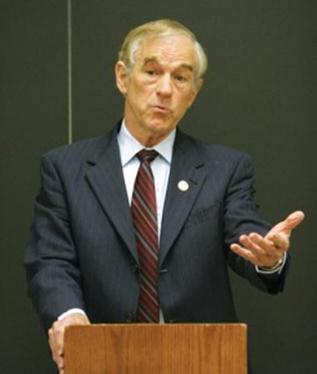 Ron Paul, the Libertarian leaning Congressman from Texas, will not get this Libertarian’s vote for President.
This probably comes as a surprise. Given the legions of Ron Paul fans, which appear poised to capture the Iowa caucus for their hero tomorrow, that’s understandable. But there are very good reasons I can’t support Dr. Paul in his Presidential bid.
For starters, although I have no personal knowledge as to whether or not he is a closet racist, there’s been enough written about the subject to give me pause. There are the newsletters authored in his name during the late 80’s and early 90’s. There is a litany of anti-Jewish statements made throughout his long tenure in politics. There’s his curious refusal to disavow the support he’s receiving from David Duke, various Ku Klux Klan factions and the American Nazi Party. If Dr. Paul were a true libertarian, he would be justified in supporting those groups right to spew their hate, as I do. But as I and every other Libertarian I know does, he would also condemn such speech for what it is: not fit for human consumption, except for the buffoons who speak it. To date, Ron Paul has yet to so, although he has taken significant sums of money from those baboons.
And about those newsletters: I am willing to give Dr. Paul the benefit of the doubt that the hateful passages in them were ghost written. However, if you’re going to be President of the United States, you need either an incredibly meticulous attention to detail or to have someone on your staff who does. If, as he has claimed, he was unaware of what was published in his name until confronted with them in 1996, then that shows a lack of oversight that is completely unacceptable in the nation’s Chief Executive. If he was aware of what was being disseminated in his name, but took no action to stop it – which seems more likely – then that shows the type of poor judgment and moral character that should never be allowed into 1600 Pennsylvania Avenue. After all, those newsletters brought in millions for Paul. It speaks to Dr. Paul’s priorities. Combined with those contributions from the hate groups, it appears Dr. Paul is more concerned with personal profit than dispelling the worst racial and ethnic stereotypes our society has to offer.
There is no doubt that Congressman Paul’s devotion to the cause of personal liberty is real. In the year of the ideological candidate, Dr. Paul is easily the most ideological of them all. Listening to his stump speech (which has only been slightly modified from his original Presidential run in 1988), you get the impression that this is a man who firmly believes what he says. In fact, that unwavering adherence to his ideals is partly responsible for the allegiance his candidacy creates among his followers. While I also support the ideal of personal freedom, the nation as a whole is not ready for the other side of the coin: personal responsibility. If you doubt that, then look no further than the past year. The fights we’ve had over budget priorities; the Occupy movement; these point to a nation still enthralled with Big Government over the hazards of personal freedom and responsibility. Forcing that on the country will lead to blood on the streets. I believe the long-term solution for the country is to return to the Libertarian government we were founded on; I’m pragmatic enough to understand that undoing 100 years of government creep needs to be undone incrementally. If your’e certain I’m wrong, end Social Security tomorrow and watch what happens. Pragmatism is not a Paul strong suit, at least when it comes to governing (it is, of course, when it comes accepting those infernal campaign donations).
That lack of pragmatism is particularly evident in his proposed foreign policy – or perhaps lack of a foreign policy. It’s understandable that a nation that has been at war for 43 of the past 50 years would grow tired of foreign entanglements. But we cannot renounce our international obligations, pack up and come home without plunging the world into utter chaos. One truism has ruled the world since the dawn of civilization: power abhors a vacuum. In a world that is increasingly interdependent, someone had to provide the glue that keeps humanity from entering into a war over resources and economies that would incinerate the globe. Whether or not we like it, absenting ourselves from the world stage would result in just that. After World War II, the world was left with two superpowers. With the dissolution of the Soviet Empire, only the USA remains. The treaties, alliances and trade we’ve developed in the past 70 years are all focused on keeping us prosperous. Abandoning them now would be cataclysmic at best.
And finally, there are is cult of personality that is propelling the Ron Paul candidacy. Fanatical to the core, these people scare me far more than Ron Paul ever will. The world has seen other leaders come to power whose only qualification was the ability to inspire slavish devotion from their followers: Adolph Hitler, Benito Mussolini, Napoleon, Julius Caesar. You’ll be hard pressed to find anyone who thinks those results were positive. Less extreme, but much more recent, we have the current President – whose tenure thus far has been a disappointment to his followers but about what the rest of us expected.
RON PAUL SUPPORTERS: If you’re looking for a Libertarian who is pragmatic enough to actually accomplish something without alienating 80% of your fellow human beings, look to Gary Johnson. Abandoning Ron Paul would be the smartest decision you’ve made.

Is Modern Politics More Vicious than Ever?
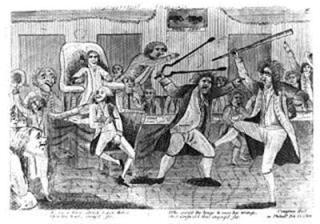
Woodcut of Lyon-Griswold House Floor Brawl, 1798 (Courtesy: Smithsonian Institution)
What spurred me to write about this topic was a recent Facebook discussion I had with an old and respected friend, who opined that he thought political leaders over the past twenty years or so were subjected to more slanderous accusations, ridicule and disrespect than at any time in our history. I might have dismissed that comment, except it seems to be a popular sentiment these days. Whether the cries to denounce comparisons to “Nazis” after Rep. Gabrielle Giffords was shot, complaints by members of Congress regarding ethnic and racial slurs used against them, or statements by people like my friend, there seems to be an overriding sense that politics today has become far too personal. Popular sentiment is that unlike our history, we’re a nation more polarized and more willing to use the most vicious ad hominem attacks in place of reasoned debate than ever before.
Such sentiment may be popular, but it is incorrect. Defaming public figures is an American tradition that is older than the Republic – one can find newspaper articles and pamphlets pre-dating the Revolution that disparage, often in the most personal terms, some of the most famous Americans in history. Thomas Jefferson wrote of “the putrid state into which our newspapers have passed, and the malignity, the vulgarity, and mendacious spirit of those who write for them.” 1 Although Jefferson wrote those words in 1814, the reality is vulgarity and mendacity were hardly new to politics, even at that young age for the nation. As an example, in 1798 Alexander Hamilton published the pamphlet Letter from Alexander Hamilton, Concerning the Public Conduct and Character of John Adams, Esq. In it, Hamilton not only defames Adams’ character (among other things, he asserts that Adams is “a drunkard, the type for whom sound judgement <sic> deserts at the first drop of whiskey.”2). Of course, six years later Secretary of the Treasury Hamilton would be killed by Vice President Aaron Burr – a duel sparked by Hamilton’s characterization of Burr as, among other things, corrupt and treasonous; even going so far as to actually recommend assassination should Burr win the Federalist Party nomination for President.
The election of 1824 gave rise to “The Corrupt Bargain,” but was nothing compared to the vindictiveness and nastiness exhibited in 1828. Andrew Jackson was portrayed by John Quincy Adams as an adulterous murderer(and you thought Bill Clinton had it tough), while Jackson and his camp gleefully heaped charges of prostitution, elitism and corruption on Adams. The slander reached levels not seen since, as the “Coffin Handbills” were widely distributed and Jackson’s wife was accused of bigamy. The attacks were so vicious that Mrs. Jackson fell ill and later died as a result. In 1840, the winning campaign of William Harrison completely avoided the issues of the day (including the worst financial crisis in the nation’s history, to that date), focusing instead on comparing the personalities of Harrison and Martin Van Buren. (Although Van Buren tried to make an issue of Harrison’s age, it went nowhere. The nation should have listened – Harrison served the shortest term in history after falling ill during his Inauguration.) And of course, Abraham Lincoln faced the worst kind of personal attack when ½ the country decided they would rather secede than accept him as President.
Personal attacks haven’t always been limited to the Executive Branch, either. Indeed the mudslinging on the floors of the Congress and Senate have even occasionally led to outright brawls. The first occurred in 1798, between Roger Griswold (Ct.) and Matthew Lyon (Vt.). Griswold, upset about charges of cowardice from Lyon, took it upon himself to whack Lyon with his hickory walking stick. Of course, it should be noted that Lyon didn’t help calm the situation when he spat at Griswold. Both men were later censured by the House. In 1856, Andrew Sumner (Ma.) took the floor to deliver a diatribe against Preston Brooks’ (SC) father-in-law. In a scathing bit of oratory, Sumner alleged Brooks’ in-law kept a mistress “who, though ugly to others, is always lovely to him.” 3 The result was less brawl than mugging: Brooks beat Sumner to within an inch of his life, using his cane; as other members of the Senate attempted to aid Sumner, Laurence Keitt (SC) bayed them at pistol-point. Keitt was hardly a stranger to fisticuffs on the House floor. Two years later, he took exception to Galusha Grow’s (Pa.) calling him a “negro driver” and attempted to strangle Grow – on the House floor. The result was the largest melee ever seen in Congress, involving at least 50 Representatives.
These are just some of the more outrageous examples of how political slander has been a part of our discourse since the days of the Founding Fathers. In fact, you can argue that if anything, politicians today face less derision than their predecessors. The next time somebody you know complains about our leaders being treated like Rodney Dangerfield, feel free to whip out one of these juicy tidbits – and invite them to pay more attention in history class.
- Excerpted from “The Writings of Thomas Jefferson,” edited by Lipscomb & Bergh, published 1903. The excerpt is from a letter written to Walter Jones in 1814.
- As excepted in the Philadelphia Aurora, June 12, 1800.
- Detailed in “The Caning of Senator Charles Sumner“, Senate Historical Office, US Senate.
About that Payroll Tax Cut…
Remember when I was begging and pleading with lawmakers to reject President YOYO’S inane payroll tax cut? My worry is that doing so dramatically underfunds Social Security. Well, guess what. Independent analysis is confirming that those worries are justified. Read more at this Washington Post article. My question is, where was this article two weeks ago? Oh, that’s right. The Post, like the rest of the MSM, remains an Obama sycophant.
Iowan Insanity

Cherokee Hospital for the Insane - Cherokee, Iowa
Here we go again. In four days, the nation is going to let a state representing 7 electoral votes set the tone for the quadrennial Presidential Election process. This state is hardly representative of the nation as a whole, either. The residents of Iowa have more disposable income than the rest of us. Demographically, Iowa is less ethnically diverse, less educated and more rural than the country in general. The state’s largest city, Des Moines, is ranked 106th in total population and 98th in population density – making it more a large suburb than an actual city.
Why do we do this? Why do we allow 1.2% of the nation’s populace decide the fate of the Unites States for the next four years? I can’t think of a particularly good reason. But I can think of a particularly good way to end the charade. Have all primaries conducted on the same day.
To be clear, I am NOT advocating for federal administration of primary elections. The states have done a fine job running them. If they would rather have the circus atmosphere of a caucus than an election, fine. If they want restrictive and onerous ballot rules, okay. This is directed at the national parties, who are responsible for creating the primary schedule and have perpetrated the insanity of allowing a very non-representative portion of the population to determine their candidates for President. (After Iowa comes New Hampshire, with its four electoral votes and even less representative of the nation).
But a National Primary Day does several things to help end the confusion common to Presidential primaries. First, it effectively ends the candidacy of people with marginal appeal. Let’s face it, by focusing all of their energies on one small state, some pretty marginal people have been able to enter the national conversation based on one position – only to fade into political oblivion. Mike Huckabee won Iowa, only to become a talk show host. Pat Buchanan used Iowa to re-energize a fading career as a political pundit. Howard Dean made plenty of noise in Iowa, only to become a punch-line on late night television. This year, can anyone really imagine that the race baiting history of a Ron Paul wouldn’t be a political albatross in states with more than a 5% minority population? Or that single issue candidates Michelle Bachmann or Rick Santorum would be players on a national stage?
Second, having all Presidential primaries contested at the same time would require candidates to create a national political organization. Newt Gingrich and Rick Perry were surprised by their inability to get on the Virginia primary ballot. Yet the underlying reason is their inability to properly organize. Gingrich can be excused, in a sense; his campaign is underfunded and was largely seen as a joke until last month (although, residing in Virginia probably means he should have understood the rules better than any other candidate). Perry, however, has oodles of money – more than anyone in the race not named Romney – and his inability is due simply to a lack of campaign oversight. Seriously, do we want a President who can’t organize well enough to ensure he’s on every state ballot? Or hire someone to do that for him? Making speeches is one thing, but ensuring the basics are attended to is an essential leadership trait. The United States federal government is a much larger enterprise than any political campaign. A candidate who can’t assume the responsibilities of Chief Executive of a political campaign certainly can’t be trusted to be the Chief Executive of the United States.
Finally, a National Primary Day ensures that every primary vote carries the same weight. The essential element is this: by giving various states an initial say in the nominating process, the citizens voting later have less input. Odds are that by the time “Super Tuesday” rolls around, the parties have already settled on a presumptive nominee. By the time I get to cast a ballot in June, the nominee has been decided – voting becomes nothing more than a pro forma exercise in civic responsibility. The effect, of course, is suppressed turnout in those states, which has dramatic effects on down ballot candidates and initiatives.
It is time to end the madness. Allowing the voters in Iowa (or New Hampshire) to have more input than voters in California (or us poor New Jerseyans) is one 19th century idea whose time has passed.

Fuzzy Math & the Payroll Tax

There I go again...
If there’s one thing we should have learned from this recession, it’s that politicians may not know how to fix it – but they sure know how to play politics with it. So, you’ll pardon me if my eyebrows arched up when the Great Obama proclaimed the House’s refusal to go along with the payroll tax compromise was “stealing $1,000 from hard-working middle class Americans.” The President has told some whoppers during his time in office (seems becoming President imbues the office holder with that ability), but where on earth did he come up with that number?
The compromise reached in the Senate only covers two months. Given the typical American earns $34,720 a year and we’re talking about 2% of pre-tax income, that $1,000 seems a pretty big number. So I ran some quick calculations and didn’t come near the $1,000 promised by the President. Over 8 weeks, the typical American would see a “whopping” $106.83 extra in take-home pay – or $13.35 per week. I don’t know about you, but $13.35 doesn’t buy me very much. It won’t fill my gas tank. It also doesn’t fit the bill on the “What $40 Means to Me” White House website. Even the TWO months of extra take home pay wouldn’t cover ONE month’s cell phone bill. So, I thought that perhaps the President simply got the two month compromise bill and the extra cash from a full year of the payroll tax reduction confused (could happen; I’m sure he’s busy fielding calls from Michelle about how sunny Hawaii is right now). Nope, wrong again – that only comes to $694.40, or about ½ of 1 month’s mortgage payment. Could it be he was talking about the top-end earner under the plan, the guy making $110,000 a year? Not really – he still only comes home with an extra $338 in his pocket over the course of the compromise. (See chart below for details)
While the extra take-home money is welcome by pretty much everyone, I don’t think if people stop to consider the implications of this tax cut they’ll be so anxious to get that extra $13 or so in their pockets. Hey, here’s a novel idea, one that gets the same amount of money into everyone’s pockets without annihilating the Social Security system: why not pass an income tax cut for everyone earning under $110,000 per year? Too simple an idea? Too broad based to get real support? Probably.
In the meantime, I’m not sure what they’re smoking during these White House – Senate confabs. But they better legalize it before Eric Holder catches a whiff.

Payroll Tax Reduction
Why the Electoral College Matters

Belushi: An Electoral College Attendee?
One of those arcane topics that makes its way into political conversation is the Electoral College. Despite the fact that it should be treated as a pretty technical subject, it is usually given the same bumper-sticker treatment that serves as political discussion these days. Popular sentiment boils down to, the will of the people is ignored by the Electoral College and it should be reformed or replaced to more directly represent the popular vote.
Hey, great idea, right? Who could possibly be against the will of the people and the popular vote? And besides, isn’t the Electoral College some arcane leftover from the 18th century? Wasn’t it devised by a bunch of fuddy-duddies who were after maintaining power for the privileged few? Like most bumper sticker ideas, these are all exploded rather easily once you actually examine things.
First of all, the founders created the Electoral College expressly to prevent the type of insane power brokering that happens when somebody is incapable of winning the popular vote. Having experienced the shortcomings of parliamentary elections first-hand as British subjects, they were determined that Presidential elections should have a clear winner. Further, they were determined that each state would have a fair say in determining the winner. As odd as it may seem to people without a solid grounding in American history, our nation has always had regional differences in culture, along with the attendant political differences that arise from them. Although we love to dismiss many of their ideas as outdated and irrelevant in modern society, the Founders understood that direct elections bring with them tremendous peril for functioning government.
Were they right in their assumptions and fears? That anyone of voting age could think otherwise demonstrates either the inability to comprehend civics – or do some basic math. Currently, there is a proposal going around calling for each state to amend their constitutions to allow for direct apportionment of their Electors. The Republican Party is similarly apportioning their votes in the 2012 primary process. The result, based on the fact no candidate can seem to muster more than 40% of the vote and the front runners routinely poll in the mid-20’s, is likely to be a brokered convention. For those of you wondering what one of those looks like, I refer you to the 1968 Democratic Convention. Most people only know it for the chaos in the streets of Chicago – forgetting the chaos inside the convention itself. Before finally settling on Eugene McCarthy as the party’s candidate, the convention floor was raucous while party leaders haggled behind closed doors for days.
But could such an outcome be the result of states directly apportioning Electors? Consider three elections in our recent history:
2000: This is the election most cite in wanting to do away with the Electoral College. Neither major party candidate achieved 50% of the popular vote, but thanks to the Constitution George W. Bush garnered 279 electoral votes, 9 more than needed for victory, despite trailing Al Gore 48.4% to 47.9% in the popular vote. But had the electors been decided by the direct apportionment method, the electoral votes would have tallied as Bush 259, Gore 258, Ralph Nader 17, Pat Buchanan 4. Nader would have been a kingmaker in that scenario, as he could have pledged his votes to either major party candidate. The result would be what we witness in countries with otherwise weak minor parties – a leader forced to try and hold a coalition together, held at whim by the minor party’s demands.
1996: Bill Clinton swept to re-election with 379 electoral votes (despite only garnering 49.2% of the popular vote), but direct apportionment would have yielded a much different outcome. The tally would have been Clinton 263, Bob Dole 222, Ross Perot 53. Perot’s nascent Reform Party would have had the power to change history, but that possibility is dwarfed by the results from…
1992: This is the granddaddy of all examples as to why the Electoral College works. Perot garnered nearly 20 million votes nationwide, finishing second in Utah and Vermont (and falling short of winning Utah by less than 12,000 votes). It was the most successful third party candidacy in history, with Perot capturing 18.9% of the total popular vote. Yet, he won no electoral votes since he didn’t carry a single state. Bill Clinton won the electoral vote, 379-159 over George H.W. Bush, despite only capturing 43% of the popular vote. Under direct apportionment, the result would have been grim, indeed. Clinton would have managed only 229 electoral votes, Bush 201 – and Perot 108. Try to imagine the type of havoc Perot could – and would – have created had electors been directly apportioned. Constitutional crisis only begins to describe it.
That’s three elections within the past 20 years that would have been turned upside down, without a clear winner or any semblance of legitimacy for the eventual President. Except that the Electoral College was there to sort through the debris and declare a new President. So, before signing on to do away with the Electoral College or make dramatic changes to its structure, remember that those aging fuddy-duddies who wrote the Constitution knew a thing or two. As usual, we would be well advised to stop and think about the how and why they created the structures of our government before casting them aside.
Don’t Pass the Payroll Tax Cut
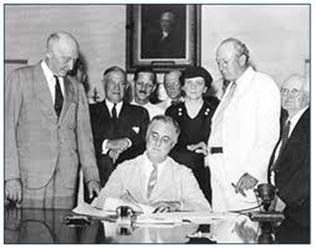
FDR Signing the Original Social Security Act
Yesterday, the House of Representatives may have given the American people an early Christmas present – although the majority of my fellow citizens won’t realize it and (urged on by the President) will cry bloody murder. And yes, the motives of the House members are hardly pure. Those are certainly little more than angling for political gain. But the result is the same; an end to the insanity that is the payroll tax cut.
It isn’t that I’m opposed to tax cuts, in general principle. Anything that reduces the inflow of money from the private sector to the public is usually a good thing. But the consequences of reducing this particular tax levy amount to far more than the few pennies saved by the average taxpayer. Why? Because this is a targeted tax, whose revenue is designed purely to keep the Social Security system afloat.
Okay, some background here. The payroll tax amounts to 12.4% of the earned income of every wage earner in the country, up to $100,000. Of that, you normally pay 6.2% and your employer pays 6.2% (unless you’re self-employed, in which case you pay the full 12.4%). For 2011, Congress and the President reduced the amount paid by employees to 4.2%. That cost the Social Security system $117 billion. Now, here’s the rub: most people think there’s this massive social security trust fund, into which new revenues get deposited and from which existing current beneficiaries receive their monthly stipend. Reducing the amount coming for a year or two won’t matter, because the trust fund is earning interest on past deposits and there is plenty of time to make up the current shortfall. The reality is there isn’t a trust fund. There never was one; there never will be. Rather, the money you pay in is turned right around to retirees. Smart people realized that the system as it existed was untenable back in the 80’s; they worked out some changes in the ways benefits are paid and increased the payroll tax. Depending on who you talk to, the system was saved from insolvency until 2037 or 2052.
Except the $117 billion that came out of this year’s Social Security funding left us with an $83 billion shortfall, either 26 or 41 years before it was supposed to happen. If the payroll tax remains at 4.2% for this year, the CBO expects the shortfall to top $105 billion. (Actual reduction in revenue amounts to approximately $120 billion). The folks in the Senate came up with some neat trickery to “pay” for the reduced payroll tax, mostly relying on forecasting budget cuts 10 years down the road to pay the difference. That’s not exactly a reliable funding formula, but it is what passes for budget restraint these days.
What I find really amazing about the whole thing is the way Democrats – supposedly the guardians of the Social Security system from all assaults – have caved on this issue. Most of them probably haven’t realized yet that by breaking the essential funding formula created by the original Social Security Act and relying on general revenues to keep the system solvent, they’ve subjected their sacred cow to the whims of future Congresses. I can’t imagine they actually thought through the idea that Social Security is now on the general budgeting table, open to political negotiation on funding – and payments.
I think most people realize that Social Security needs to be revisited, if for no other reason that retirees are living longer and collecting more. Pro-rating payments, delaying the official retirement age, means testing, even incorporating private retirement accounts should all be on the table. But if Congress continues reducing the inflow of funds in to the Social Security system, the idea that we can address the topic later rather than sooner will be gone.
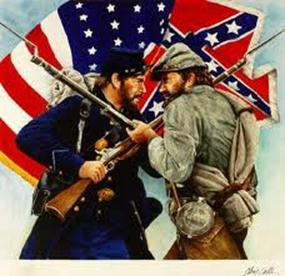
Is an Uncivil War on the Horizon?
 First, an apology: I realize it’s been while since I’ve posted. Some of you are probably disappointed with my lack of output. For that, I’m sorry.
Despite this being the earnest start of the 2012 election cycle, as a nation we’ve failed to come to grips with the most pressing issue of our lifetime. Our politics – and politicians – consume themselves with playing politics as usual. Rather than engage the electorate in an honest debate about what type of nation we are and what type of nation we want to be, the political class (and that includes the punditry and news outlets) spends our time discussing ancillary issues.
Every other issue – the economy, foreign policy, education, civil rights, immigration – is secondary to the central question of just who we are. We’re often told of how the “greatest generation” came together to answer that question in the 1940’s. The truth is that that they didn’t answer that question completely. No generation has. Each succeeding generation has answered parts of the question, building upon the work done by those preceding it. Until, that is, the two generations currently in control of public discourse: the “Baby Boomers” and “Generation X.” The Boomers can be forgiven for thinking that the protests and civil rights gains of the 1960’s and 70’s finally delivered the answer. Gen X, growing up with those examples in relative affluence, assumed the nation would never need to revisit the question.
But current circumstances have proven that the question of what constitutes the American character was never solved. As the nation devolves into chaos, political gridlock born of competing ideals is the order of the day. As a people, we seem stuck in one camp or the other. We compartmentalize ourselves into either being “conservative” or “liberal” without fully understanding what those labels construe. Worse, we build walls around our encampments, refusing to even listen to ideas that challenge our preconceived notions. Often, those viewpoints don’t come from reason – they come from an ingrained political ideology. It’s the pathology that allows political machines to flourish in all their corrupt glory. Every day on Facebook and Twitter, I see people who’ve known each other for decades “unfriend” each other over political disagreements, often with comments like “that person is an idiot.” Or worse, involving language that makes this old Marine blush.
Hopefully, the act of using social networks to be unsocial is as far as we go towards civil war. But as I gaze upon the national landscape, I wonder when and if we’re capable of answering the question of what the United States of America represents now and in the future. The answer is out there and we need to answer it. If we leave it to our children and grandchildren to answer, there may not be a nation left for them to inherit.
So, in the hope of sparking discussion I’ll be spending the free time I have over the next few weeks posting continually about who we are as a nation today – and how we get from here to there. Feel free to join in the discussion. But keep in mind that this is an open forum – you’re liable to run into ideas that challenge you.
Can We Get Real?
Every once in a while I come across a story that brings home how insane the world became. These stories used to pop up in my inbox once in blue moon, but either blue moons occur more frequently than in the past or somewhere along the way we lost our collective common sense.
Today’s submission for “Are You Kidding Me?” comes courtesy of several people, all of whom suggest an outright ban on Halloween. Yes, you read that right. Otherwise sane and rational people are up in arms over a centuries-old tradition of dressing up in costume, begging for candy and tossing the occasional rock at an abandoned house. The reasoning runs from apocalyptic, fringe religiousity (the type that used to be associated strictly to Jehovah’s Witnesses) to worries about police overtime.
Get a life, people. If you’re worried about your kid growing up to practice devil worship, then you obviously haven’t done as good a job teaching them your religious beliefs as you thought. If you’re worried about your teenage urchin wreaking havoc on local property values, odds are you haven’t done much of a job teaching them to respect other’s belongings. I strongly suspect that in both cases, you may have been the victim of an egging on some Halloween in the distant past. Whatever the cause, you’re allowing your “NO FUN ALLOWED” attitude to cramp a perfectly harmless bit of fun.
Whatever your hang-up is, get over it and let the youngsters bob for apples while dressed as Superman. You can sit there, shotgun in hand to ward off the evil ghouls and goblins that are bound to ring your doorbell. As for me, I’ll be happily handing out Hershey and Nestle products by the glow of a Jack o’ Lantern, giant stuffed spider on my shoulder.

Mr. Perry, Only serious candidates need apply
In a way, I feel sorry for Texas Governor Rick Perry.

Is Rick Perry really just another Bozo?
When Sarah Palin decided not to run for President, Perry was anointed as the only real conservative with any political heft running for President. After all, he is the longest serving Governor of the nation’s second largest state, a state that remains prosperous despite the national economy generally being in the tank for the past four years. He announced his candidacy to the thunderous roar of making the federal government “as inconsequential in your life as I can.” I’m hoping that statement isn’t a result of introspection – because right now, a Perry presidency looks like an even bigger disaster than the Obama presidency became.
First, Perry proved everyone right when they said he was a lousy debater. Along with the rest of the nation, I can handle a guy who flubs an occasional fact (it happens to everyone). I can stomach the person who comes across as a walking stiff; nobody should be overly confident on a debate stage. But Mr. Perry managed to come in even below the already low expectations set by his campaign and supporters. When Perry was awake enough to pay attention to what was happening on the stage around him, he demonstrated an incredible inability to articulate even the simplest thoughts, much less explain policy decisions a Perry administration would make. In the end, his only recourse was to lash out angrily (a lá Newt Gingrich, but without Newt’s wit) at his competitors. The resulting image is of a slightly dim-witted bully, not a future President of the United States.
Now, we have the Perry economic plan. In announcing this plan, Perry declared it to be “bold.” If by bold, you mean “schizophrenic,” then I agree with you, Mr. Perry. This is nothing more than pandering to various interest groups. If meant as a way to kick-start the conversation about the role of government, then it might be acceptable. But I think he actually meant it as an economic outline, in which case it will only work to drive millions of Americans into destitution and despair. Why? Look under the hood and here’s what you find:
- Tax policy: Perry proposes a 20% flat tax, except it isn’t. It is a 20% personal income tax policy, with deductions for mortgage interest, state and local taxes, and charitable gifts. Worse, for those with incomes under $500,000 the personal exemption increases to $12,500 per person. Taxes on business profits are also reduced to 20%, with no deductions – save for a one-time reduction on off-shore profits to 5.6%, intended to lure overseas profits here to spur job growth. Still, even if you get past the misnomer (a flat tax is just that; one tax rate without any exemptions) then you’re tempted to say this seems reasonable.The biggest complaints regarding the current tax code are the complexity and that the current distribution of the tax burden predominately falls on the middle class. How does the Perry Plan address these two problems? My best guess is by ignoring them. For starters, any taxpayer can opt to keep the current tax plan instead of the new one. Imagine running a business under those circumstances: now you have to track two different tax codes and try to determine which works best for your company (I suppose accounting firms will love it).An entire new level of complexity just got added into your business model, because no business I know is going to arbitrarily choose one plan over the other without doing a full cost-benefit analysis. As to the personal taxes, Perry is correct in assuming most Americans will opt for his single rate plan. After all, a full 50% of American households won’t pay any taxes under it. The remaining half will bear the brunt of the tax burden – which is roughly the same distribution as we currently have, just with less money coming in. Unless you’re in the middle class, in which case you’ll probably wind up paying more in taxes. Brilliant election year strategy (see: Cain, Herman for how well raising taxes on the middle works).
This is no gain, all loss. (You can find the data used to compute tax distribution here).
- Social Security: Perry proposes relieving income taxes on those receiving Social Security, while making it an opt-in program for current workers. Sounds great, except the only people currently paying taxes on Social Security benefits are those with over $50,000 in personal income per couple (how many retired couples do you know with $50,000 in annual income?). As for making Social Security an opt-in program, there’s a very big problem with that plan: current workers actually pay for existing retirees. The. idea that the government takes your money, then invests it into a “trust fund” from which you draw your retirement benefits is patently false. What happens is the government takes those payroll taxes we all pay and uses those funds to pay current retirees. If there’s a surplus, then the government uses that money to purchase T-Bills and then uses those funds to help the general ledger; if there’s a shortage, then the reverse is true. This is a month-to-month accounting system, not an annual line-item budget item. So, imagine what happens if even half of current workers opt out of Social Security? Yes, you guessed it: the entire system goes belly up, threatening in one fell swoop to turn us into Greece, with a national debt ballooning by the billions every month and an unfunded national pension plan. Worse, you and your employer is still obligated to pay those pesky payroll taxes, but with an entirely new level of complexity. Is this now income, since it is being deposited into an investment account? What type of account is it? Who manages it? What level of accountability is there, and to whom?Social Security does need to reform to keep it solvent. But nuking the entire economy in order to do it isn’t very bright.
- Health Care: One of the greatest threats to economic growth, both now and in the future, is the dizzying rate of increase in health care costs. Nobody has yet to put forth a proposal that actually does anything to reduce that curve and Perry joins right in. His plan is little more than “reduce fraud in Medicare.” Lovely idea and it should certainly be part of the agenda. Except we’ve been hearing about that for 25 years now. It seems to me that with that much emphasis on reducing Medicare fraud, it should amount to $1.30 or so by now.
- Balancing the budget: Well, of course. Everyone I know agrees the federal budget should be balanced (except for a few die-hard Keynesians, but they’ve been proven wrong on this so many times over the past 60 years I find it hard to believe they’re still around). But Perry doesn’t offer any specifics aver how he would do it. He does offer platitudes, such as “Pass a Balanced Budget Amendment” and “Cap Federal Spending at 18% of GDP.” He suggests freezing federal hiring – not a bad idea, but we’re not running $1.4 trillion deficits because of federal hiring. He also wants to do away with earmarks. While that is certainly an admirable goal, the President (as leader of the Executive branch) can’t do much about it: appropriations bills are still written by Congress. If some Congressman from Bum Rush wants $800 million for a road to nowhere and can convince a majority of his peers to go along with the idea, it’s getting added into an appropriations bill somewhere.
Frankly, the entire Perry candidacy so far has shown him to be a man whose ambitions far outstrip his talents, ability, intelligence and demeanor. As such, I think his current poll standing is about right (barely treading more water than Michelle Bachman or Rick Santorum). The American people are interviewing candidates for the Presidency, Mr. Perry. Only serious applicants will be considered.
RIP, Mr. Jobs

I’m writing this with a heavy heart. Well, typing might be the better description. I hardly ever actually write anything any longer. And if I really wanted to be exact, I would say that I’m typing this on my smartphone.
30 years ago this would have been unimaginable. I wrote almost everything. Even when I typed something on my old Olivetti, I wrote it first – since making corrections on the fly was time consuming and rarely came out right, anyway. 30 years ago a handheld device that could do everything this smartphone can didn’t exist, not even on Star Trek. 30 years ago, if I needed to make a call away from home I had to find a public phone – and pray I had a dime in my pocket. 30 years ago, video recorders were the size of a car battery (and just as heavy) and portable music consisted of tinny sounding radios. 30 years ago, computers took up an entire room. The idea of having one in every room in my house, along with one I can fit in my pocket, was unimaginable.
Unimaginable, except to one man who had the vision of making personal computing a reality. Over the next three decades his vision would transform the way the world communicates, interacts and thinks. That innovative spark would not only change the world as a whole, but change the future of one geeky, 16 year old from a sleepy little town on the Jersey shore. The way Steve Jobs envisioned the way the world could work fired my imagination and led me into a career in tech.
So, you’ll pardon me if I occassionally break into tears over the next day or so. When Mr. Jobs passed away earlier this evening, the world may have lost the greatest technologist since Thomas Edison. But I lost a hero.
 Political Baseballs