
SOTU Dissected

Trust Me
Last night President Obama delivered his constitutionally-mandated State of the Union address. It was, of course, little more than the official start of his re-election campaign. Still, the 65 minutes he spent in the House well delivered more than a few interesting tidbits. I thought we could have some fun digging into the speech‘s rhetoric and laying bare the facts.
Obama: “We have subsidized oil companies for a century. That’s long enough. It’s time to end the taxpayer giveaways to an industry that’s rarely been more profitable, and double-down on a clean energy industry that’s never been more promising.”
This is the third SOTU address in which he floated the idea of ending oil subsidies. It’s also going to be the third time this falls on deaf ears. He couldn’t get this passed in 2009, when his party controlled the House and had a filibuster-proof majority in the Senate – and that was with a specific legislation calling for $36.5 billion in energy taxes over ten years. The administration never followed up a similar proposal in last year’s SOTU with draft legislation. It seems equally doubtful that a candidate who received nearly $3 million in campaign donations from the oil industry (thus far) is in any rush to see this put into law. Further, we’ve seen the results of the investment in “green energy” companies like Solyndra. In blackjack, that’s the equivalent of “doubling-down” on a 9 when the dealer is showing an ace.
Obama: “Our health care law relies on a reformed private market, not a government program.”
Perhaps the President needs to go back and re-read that health care law. First of all, the reform relies primarily on an individual mandate, enforced through the IRS. If that enforcement doesn’t qualify as the biggest government program in history, then obviously I’m not as good a student of our nation’s history as I thought. And there are other, already existing programs that will be greatly expanded should the Supreme Court not throw the whole thing out this summer. For instance, Medicaid grows to cover anyone up to 138% of the official poverty line, which the CBO scored as requiring a funding increase of $434 billion per year. In and of itself, that would make Medicaid the single largest line item in the federal budget – and most state budgets, too.
Obama: “Take the money we’re no longer spending at war, use half of it to pay down our debt, and use the rest to do some nation-building right here at home.”
This is a wonderful assertion, except that it ignores the reality of the federal budget. The Iraq campaign was financed entirely on debt. Ending that war doesn’t actually result in any savings, except in the strange and convoluted world of Washington finance. It just means we’re able to borrow less money and keep everything else funded at the same levels. Of course, the President largely ignored the problem of the federal debt, so I suppose he thinks keeping deficits at staggeringly high levels in order to score a few rhetorical points is money well spent.
Obama: “Through the power of our diplomacy a world that was once divided about how to deal with Iran’s nuclear program now stands as one.”
I’m not sure which world he meant by this, but it obviously wasn’t this one. Yes, the European Union seems likely to join the US in applying stringent sanctions. But Russia and China have no intention of doing so, and both countries used their veto power in the UN to prevent that body from enforcing them. Besides, the sanctions will have limited effect on the Iranian economy, since the Iranians switched from accepting dollars and euros to rials or rubles. Just for good measure, Israel seems hell-bent on taking unilateral military action if they deem it necessary. It’s hardly the unified front the President presented.
Obama: “The Taliban’s momentum has been broken, and some troops in Afghanistan have begun to come home.”
Apparently, the President failed to read his latest NIE. In that document, the Taliban is expected to gain strength by using the ongoing talks to re-establish their legitimacy in the Afghani countryside while stalling until we pull out. This assertion is as hollow as LBJ’s that “the Government of South Vietnam has grown steadily stronger.” Of course, we all know well that turned out.
An overarching theme last night was the idea of economic “fairness.” As described by Mr. Obama, fairness is “an economy where everyone gets a fair shot, everyone does their fair share, and everyone plays by the same set of rules.” Yet, at no point did he actually outline how to make that a possibility. He suggested that millionaires aren’t paying their fair share of income taxes – yet according to the IRS the effective rate for those people is 26.5%. Only 10% of people making under $100,000 per year are paying a higher effective rate – and less than 5% of millionaires pay a lower rate. Thanks to that disparity, millionaires accounted for 36.5% of the federal government’s income. Unfair? You bet it is – but I doubt asking the 47% of Americans whose effective tax rate is negative to pony up is what the President had in mind when talking about “fairness.”
Finally, one thing was ominously missing from the speech: any discussion of individual freedom and liberty. The entire speech was a discussion of increasing the role and prominence of the federal government in our lives. “With or without this Congress, I will keep taking actions that help the economy grow,” declared the Mr. Obama. Quite frankly, I can’t think of a scarier statement by any President in our recent history. Putting aside the obvious constitutional questions raised by a President acting unilaterally, consider that some 13 million more Americans are looking for work since he assumed office and real GDP growth (accounting for inflation) is -7.3% over the same period, I don’t want this President touching the economy. Especially when he has demonstrated an incredible desire to amass power in the West Wing and during an election year.
UPDATED (3/7): Delegate Counts
For all the talk this season about the Republican presidential primary season, one thing keeps getting overlooked: it takes delegates to lock up a first ballot nomination. A lot of delegates. 1,144 of them, in fact.
In fact, the total number of delegates up for grabs through January 31 is 115, or only 5.1% of the total. So ignore the press when they tell you anyone can wrap up the nomination before Super Tuesday – Republican Party leaders intentionally set up the primary season to be a drawn out affair. And that’s exactly what they’re getting.
UPDATED 3/7: Super Tuesday results included. Note that there’s a whole gaggle of unallocated delegates. How they break could really shake up the race!
Below, is a basic chart showing the total number of delegates up for grabs by state and the total number each candidate has won. I’ll update this after each contest.
| State by State |
Candidates |
Others/ Unallocated |
||||
| (date) |
Delegates |
Gingrich |
Romney |
Santorum |
Paul |
|
| IA (1/3) |
28 |
1 |
12 |
13 |
1 |
1 |
| NH (1/10) |
12 |
0 |
7 |
0 |
3 |
2 |
| SC (1/21) |
25 |
25 |
0 |
0 |
0 |
0 |
| FL (1/31) |
50 |
0 | 50 | 0 | 0 | 0 |
| NV (2/4) |
28 |
6 | 14 | 3 | 5 | 0 |
| CO (2/7) |
36 |
4 | 13 | 17 | 2 | 0 |
| MN (2/7) |
40 |
4 | 6 | 19 | 11 | 0 |
| ME (2/11) |
24 |
0 | 9 | 3 | 10 | 2 |
| AZ (2/28) |
29 |
0 | 29 | 0 | 0 | 0 |
| MI (2/28) |
30 |
0 | 16 | 14 | 0 | 0 |
| WA (3/3) |
43 |
0 | 16 | 7 | 8 | 12 |
| AK (3/6) |
27 |
0 | 0 | 0 | 0 | 26 |
| GA (3/6) |
76 |
43 | 12 | 1 | 0 | 20 |
| ID (3/6) |
32 |
0 | 32 | 0 | 0 | 0 |
| MA (3/6) |
41 |
0 | 41 | 0 | 0 | 0 |
| ND (3/6) |
28 |
2 | 7 | 11 | 8 | 0 |
| OH (3/6) |
66 |
0 | 35 | 21 | 0 | 10 |
| OK (3/6) |
43 |
13 | 13 | 17 | 0 | 0 |
| TN (3/6) |
58 |
11 | 12 | 31 | 0 | 4 |
| VT (3/6) |
17 |
0 | 9 | 4 | 4 | 0 |
| VA (3/6) |
49 |
0 | 43 | 0 | 3 | 0 |
| WY (3/6) |
29 |
1 | 10 | 8 | 6 | 4 |
| Guam (3/10) |
9 |
|||||
| KS (3/10) |
40 |
|||||
| USVI (3/10) |
9 |
|||||
| AL (3/13) |
50 |
|||||
| Samoa (3/13) |
9 |
|||||
| HI (3/13) |
20 |
|||||
| MS (3/13) |
40 |
|||||
| MO (3/17) |
52 |
|||||
| PR (3/18) |
23 |
|||||
| IL (3/20) |
69 |
|||||
| LA (3/24) |
46 |
|||||
| DC (4/3) |
19 |
|||||
| MD (4/3) |
37 |
|||||
| TX (4/3) |
155 |
|||||
| WI (4/3) |
42 |
|||||
| CT (4/24) |
28 |
|||||
| DE (4/24) |
17 |
|||||
| NY (4/24) |
95 |
|||||
| PA (4/24) |
72 |
|||||
| RI (4/24) |
19 |
|||||
| IN (5/8) |
46 |
|||||
| NC (5/8) |
55 |
|||||
| WV (5/8) |
31 |
|||||
| NE (5/15) |
35 |
|||||
| OR (5/15) |
28 |
|||||
| AR (5/22) |
36 |
|||||
| KY (5/22) |
45 |
|||||
| CA (6/5) |
172 |
|||||
| MT (6/5) |
26 |
|||||
| NJ (6/5) |
50 |
|||||
| NM (6/5) |
23 |
|||||
| SD (6/5) |
28 |
|||||
| UT (6/26) |
40 |
|||||
| Totals |
2226 |
110 |
386 |
169 |
53 |
81 |
* Maine’s caucuses open on February 4, but vote totals are not released until the following week.
End Piracy, Not Liberty – Just Say “NO” to SOPA!
While there have been some positive developments today regarding the effort to derail internet censorship, not all is well. Yes, all of the bill’s co-sponsors ended their support earlier. And several high profile legislators have since reversed positions and are now opposed to the measure, including Marco Rubio.
But SOPA’s author, Lamar (Lamer?) Smith of Texas, is still promising to go forward with the bill. With typical DC hubris, he continues to insist his bill doesn’t allow censorship – and even if it does, we shouldn’t worry about it.
Don’t let up. Keep the pressure on. If you haven’t signed the petition yet, hit the link below and do so now. Then make sure you send it to your Congressmen and Senators and have them sign, too.
Poll: Who is your choice?
Earlier today, I broke down the different blocks within the Republican Party. As we get ready for tonight’s debate, who is your choice if you had to vote today?
When Governments Fail
One of my pet peeves – ok, my biggest peeve – is that government doesn’t understand it’s role in society. In particular, one of the overarching themes I find disturbing is how government thinks it knows how best to serve the citizenry. The reality is that government, even when it means well, generally manages to get things wrong. Bureaucrats being bureaucrats, the law of unintended consequences is never taken into account. People’s lives are destroyed in a sort of “collateral damage.”
It doesn’t only happen at the Federal level, where the Great Society ushered in the era of society-killing programs. (Think how many families end up dissolving so the mother can receive food stamps). No, it happens all the way down to the local level. Consider the case of the Lakewood (NJ) “Tent City.” I realize most of you reading this have no idea what I’m talking about, so here’s a little background. In 2006, before the Great Recession hit the nation as a whole, Ocean County experienced a dramatic increase in the homeless population. A largely rural area where the principle economic driver is tourism, there are neither facilities nor public funds available to assist the homeless. The nearest homeless shelter is located in Atlantic City; they don’t have the ability to house people except in the short-term and most of their resources are dedicated to the types of problems found in inner-city homeless populations (things like rampant drug and alcohol abuse, for instance). A local pastor, Steve Brigham of the Lakewood Outreach Ministry, saw a need in his community and took action. With a few tents set up in the woods, the Lakewood Tent City was born. With no public funding, Pastor Steve has established a community that at times has housed as many as 76 people. The rules are simple and direct: no drugs, no alcohol, everyone pitches in and everyone has to be actively looking for work (or working).

Lakewood Tent City Chapel
Why local government feels the need to get involved in this ministry is still an open question. The tent city is located in the woods and doesn’t infringe on anyone’s property rights. Nor is it located on public parklands or other facilities. The town has attempted several time to evict the campers, with the most recent rejection of their efforts coming earlier today. Their court pleadings have included the usual, such as health and safety concerns. Yet, by all accounts, this hasn’t been an issue at the tent city – as opposed to most of the “Occupy” encampments from this past fall. No, I suspect the real issue here is that a sole individual used a bit of initiative and with a few hundred dollars of private fundraising accomplished something the county said for years it couldn’t: established a viable homeless shelter. No, it’s far from an ideal solution. These are still tents pitched in the woods, without electricity, running water or heat. But it has provided a sense of community and support for those people that would otherwise fall through the cracks.
And I wasn’t kidding about a few hundred dollars in private donations. A perfect example is Heather Skolsky, who became involved after her cousin stayed at the tent city in 2006. (He now lives in New York and works for the Salvation Army). Her first fundraising effort yielded about $300, a few blankets and other supplies. This weekend she’s organized a benefit concert. These are the types of results that government can’t seem to replicate – and remains dedicated to stopping.
So, what can you do? For starters, look around your own communities. Odds are, you’ll find similar organizations in need of help and under assault from local officials. Of course, if you want to help out Pastor Steve in his mission, you can click here to give a donation. If you’re in the Lakewood area, you can always stop by to lend a hand. And if you’re interested in attending the benefit, I’ve included those details below.
The point is this: too often we’ve forgotten the meaning behind JFK’s inaugural address in 1961. While we all remember the words, “Ask not what your country can do for you; ask what you can do for your country,” the reality is that the socialist left still prefers government action to citizen initiatives. In the process, they’ve made programs like the Lakewood Tent City persona non grata in the eyes of the public – even though they create far better results at far less cost than similar government programs. Something to keep in mind the next time someone tells you that government assistance programs are “needed.”
To attend the Lakewood Tent City Benefit tomorrow night:
High Velocity Sports Bar, Rte 166, Beachwood NJ
Doors open 9:30pm. Cash bar, cash donations and/or donations of winter camping gear. For more info, call 732-600-7432 or email Laurens72882@comcast.net
Is Modern Politics More Vicious than Ever?
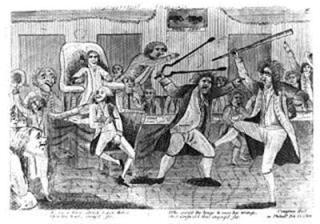
Woodcut of Lyon-Griswold House Floor Brawl, 1798 (Courtesy: Smithsonian Institution)
What spurred me to write about this topic was a recent Facebook discussion I had with an old and respected friend, who opined that he thought political leaders over the past twenty years or so were subjected to more slanderous accusations, ridicule and disrespect than at any time in our history. I might have dismissed that comment, except it seems to be a popular sentiment these days. Whether the cries to denounce comparisons to “Nazis” after Rep. Gabrielle Giffords was shot, complaints by members of Congress regarding ethnic and racial slurs used against them, or statements by people like my friend, there seems to be an overriding sense that politics today has become far too personal. Popular sentiment is that unlike our history, we’re a nation more polarized and more willing to use the most vicious ad hominem attacks in place of reasoned debate than ever before.
Such sentiment may be popular, but it is incorrect. Defaming public figures is an American tradition that is older than the Republic – one can find newspaper articles and pamphlets pre-dating the Revolution that disparage, often in the most personal terms, some of the most famous Americans in history. Thomas Jefferson wrote of “the putrid state into which our newspapers have passed, and the malignity, the vulgarity, and mendacious spirit of those who write for them.” 1 Although Jefferson wrote those words in 1814, the reality is vulgarity and mendacity were hardly new to politics, even at that young age for the nation. As an example, in 1798 Alexander Hamilton published the pamphlet Letter from Alexander Hamilton, Concerning the Public Conduct and Character of John Adams, Esq. In it, Hamilton not only defames Adams’ character (among other things, he asserts that Adams is “a drunkard, the type for whom sound judgement <sic> deserts at the first drop of whiskey.”2). Of course, six years later Secretary of the Treasury Hamilton would be killed by Vice President Aaron Burr – a duel sparked by Hamilton’s characterization of Burr as, among other things, corrupt and treasonous; even going so far as to actually recommend assassination should Burr win the Federalist Party nomination for President.
The election of 1824 gave rise to “The Corrupt Bargain,” but was nothing compared to the vindictiveness and nastiness exhibited in 1828. Andrew Jackson was portrayed by John Quincy Adams as an adulterous murderer(and you thought Bill Clinton had it tough), while Jackson and his camp gleefully heaped charges of prostitution, elitism and corruption on Adams. The slander reached levels not seen since, as the “Coffin Handbills” were widely distributed and Jackson’s wife was accused of bigamy. The attacks were so vicious that Mrs. Jackson fell ill and later died as a result. In 1840, the winning campaign of William Harrison completely avoided the issues of the day (including the worst financial crisis in the nation’s history, to that date), focusing instead on comparing the personalities of Harrison and Martin Van Buren. (Although Van Buren tried to make an issue of Harrison’s age, it went nowhere. The nation should have listened – Harrison served the shortest term in history after falling ill during his Inauguration.) And of course, Abraham Lincoln faced the worst kind of personal attack when ½ the country decided they would rather secede than accept him as President.
Personal attacks haven’t always been limited to the Executive Branch, either. Indeed the mudslinging on the floors of the Congress and Senate have even occasionally led to outright brawls. The first occurred in 1798, between Roger Griswold (Ct.) and Matthew Lyon (Vt.). Griswold, upset about charges of cowardice from Lyon, took it upon himself to whack Lyon with his hickory walking stick. Of course, it should be noted that Lyon didn’t help calm the situation when he spat at Griswold. Both men were later censured by the House. In 1856, Andrew Sumner (Ma.) took the floor to deliver a diatribe against Preston Brooks’ (SC) father-in-law. In a scathing bit of oratory, Sumner alleged Brooks’ in-law kept a mistress “who, though ugly to others, is always lovely to him.” 3 The result was less brawl than mugging: Brooks beat Sumner to within an inch of his life, using his cane; as other members of the Senate attempted to aid Sumner, Laurence Keitt (SC) bayed them at pistol-point. Keitt was hardly a stranger to fisticuffs on the House floor. Two years later, he took exception to Galusha Grow’s (Pa.) calling him a “negro driver” and attempted to strangle Grow – on the House floor. The result was the largest melee ever seen in Congress, involving at least 50 Representatives.
These are just some of the more outrageous examples of how political slander has been a part of our discourse since the days of the Founding Fathers. In fact, you can argue that if anything, politicians today face less derision than their predecessors. The next time somebody you know complains about our leaders being treated like Rodney Dangerfield, feel free to whip out one of these juicy tidbits – and invite them to pay more attention in history class.
- Excerpted from “The Writings of Thomas Jefferson,” edited by Lipscomb & Bergh, published 1903. The excerpt is from a letter written to Walter Jones in 1814.
- As excepted in the Philadelphia Aurora, June 12, 1800.
- Detailed in “The Caning of Senator Charles Sumner“, Senate Historical Office, US Senate.
About that Payroll Tax Cut…
Remember when I was begging and pleading with lawmakers to reject President YOYO’S inane payroll tax cut? My worry is that doing so dramatically underfunds Social Security. Well, guess what. Independent analysis is confirming that those worries are justified. Read more at this Washington Post article. My question is, where was this article two weeks ago? Oh, that’s right. The Post, like the rest of the MSM, remains an Obama sycophant.
Why the Electoral College Matters

Belushi: An Electoral College Attendee?
One of those arcane topics that makes its way into political conversation is the Electoral College. Despite the fact that it should be treated as a pretty technical subject, it is usually given the same bumper-sticker treatment that serves as political discussion these days. Popular sentiment boils down to, the will of the people is ignored by the Electoral College and it should be reformed or replaced to more directly represent the popular vote.
Hey, great idea, right? Who could possibly be against the will of the people and the popular vote? And besides, isn’t the Electoral College some arcane leftover from the 18th century? Wasn’t it devised by a bunch of fuddy-duddies who were after maintaining power for the privileged few? Like most bumper sticker ideas, these are all exploded rather easily once you actually examine things.
First of all, the founders created the Electoral College expressly to prevent the type of insane power brokering that happens when somebody is incapable of winning the popular vote. Having experienced the shortcomings of parliamentary elections first-hand as British subjects, they were determined that Presidential elections should have a clear winner. Further, they were determined that each state would have a fair say in determining the winner. As odd as it may seem to people without a solid grounding in American history, our nation has always had regional differences in culture, along with the attendant political differences that arise from them. Although we love to dismiss many of their ideas as outdated and irrelevant in modern society, the Founders understood that direct elections bring with them tremendous peril for functioning government.
Were they right in their assumptions and fears? That anyone of voting age could think otherwise demonstrates either the inability to comprehend civics – or do some basic math. Currently, there is a proposal going around calling for each state to amend their constitutions to allow for direct apportionment of their Electors. The Republican Party is similarly apportioning their votes in the 2012 primary process. The result, based on the fact no candidate can seem to muster more than 40% of the vote and the front runners routinely poll in the mid-20’s, is likely to be a brokered convention. For those of you wondering what one of those looks like, I refer you to the 1968 Democratic Convention. Most people only know it for the chaos in the streets of Chicago – forgetting the chaos inside the convention itself. Before finally settling on Eugene McCarthy as the party’s candidate, the convention floor was raucous while party leaders haggled behind closed doors for days.
But could such an outcome be the result of states directly apportioning Electors? Consider three elections in our recent history:
2000: This is the election most cite in wanting to do away with the Electoral College. Neither major party candidate achieved 50% of the popular vote, but thanks to the Constitution George W. Bush garnered 279 electoral votes, 9 more than needed for victory, despite trailing Al Gore 48.4% to 47.9% in the popular vote. But had the electors been decided by the direct apportionment method, the electoral votes would have tallied as Bush 259, Gore 258, Ralph Nader 17, Pat Buchanan 4. Nader would have been a kingmaker in that scenario, as he could have pledged his votes to either major party candidate. The result would be what we witness in countries with otherwise weak minor parties – a leader forced to try and hold a coalition together, held at whim by the minor party’s demands.
1996: Bill Clinton swept to re-election with 379 electoral votes (despite only garnering 49.2% of the popular vote), but direct apportionment would have yielded a much different outcome. The tally would have been Clinton 263, Bob Dole 222, Ross Perot 53. Perot’s nascent Reform Party would have had the power to change history, but that possibility is dwarfed by the results from…
1992: This is the granddaddy of all examples as to why the Electoral College works. Perot garnered nearly 20 million votes nationwide, finishing second in Utah and Vermont (and falling short of winning Utah by less than 12,000 votes). It was the most successful third party candidacy in history, with Perot capturing 18.9% of the total popular vote. Yet, he won no electoral votes since he didn’t carry a single state. Bill Clinton won the electoral vote, 379-159 over George H.W. Bush, despite only capturing 43% of the popular vote. Under direct apportionment, the result would have been grim, indeed. Clinton would have managed only 229 electoral votes, Bush 201 – and Perot 108. Try to imagine the type of havoc Perot could – and would – have created had electors been directly apportioned. Constitutional crisis only begins to describe it.
That’s three elections within the past 20 years that would have been turned upside down, without a clear winner or any semblance of legitimacy for the eventual President. Except that the Electoral College was there to sort through the debris and declare a new President. So, before signing on to do away with the Electoral College or make dramatic changes to its structure, remember that those aging fuddy-duddies who wrote the Constitution knew a thing or two. As usual, we would be well advised to stop and think about the how and why they created the structures of our government before casting them aside.
 Political Baseballs