Musings on Sports, Politics and Life in general

Latest

It’s Not Fair!


150709211727-trump-on-obama-birthplace-sot-cooper-ac-00001004-large-169

Ever since getting blown out in Wisconsin, Donald Trump has been hollering about the way we select presidential candidates, calling it unfair, or deriding it as a “rigged system.” Sure enough, the left-of-center pundits and writers who support him, and most of the misguided people who’ve pledged their allegiance to the “Trump Train,” have suddenly decided that a system that’s been around almost as long as the United States is fundamentally flawed. I shouldn’t be surprised. The typical Trumpster also tends to think the US Constitution is terribly flawed and no longer relevant.

The delegate system is based on the same idea that fueled the adoption of our Constitution. That is, the best system of governance is a representative republic, with semi-autonomous states sharing power with a centralized national government. As conceived by the men who gave us our Constitution, the office of President was not to be directly entrusted to the general populace. Rather, they conceived the idea of electors being chosen by the people. The electors would then choose the President. They had two reasons for this, both outlined in Federalist 68. The first is that the general populace can be easily swayed by emotional appeals to our baser instincts. As Alexander Hamilton noted, “Talents for low intrigue, and the little arts of popularity, may alone suffice to elevate a man to the first honors in a single State; but it will require other talents, and a different kind of merit, to establish him in the esteem and confidence of the whole Union.” The second was they understood the vast majority of citizens are not active politically, nor are they as attuned to the issues and policies as their brethren who are politically active. Their decision was that by entrusting the selection of Chief Executive to a  group of people who were politically active, they were ensuring that the gravitas of the position was honored. Yet at the same time, because the electors were selected by the citizenry, the people’s voice would be heard. Hamilton, again: “… the immediate election should be made by men most capable of analyzing the qualities adapted to the station, and acting under circumstances favorable to deliberation, and to a judicious combination of all the reasons and inducements which were proper to govern their choice. A small number of persons, selected by their fellow-citizens from the general mass, will be most likely to possess the information and discernment requisite to such complicated investigations.”

I realize this conception of how our political system was created will confound most of you. After all, you’ve heard since childhood that the United States is a democracy. Every politician declares it during every speech. Most sadly, we’re taught in school that because we vote, we’re a democracy. Some people are taught that we’re a representative democracy; that our votes go to elect representatives who are supposed to vote the way we want them to. That’s also incorrect! We are a representative republic. We elect representatives. The representatives we elect are then to debate and vote on the issues and policies as best they see fit. The decisions they reach are not bound by any measure to popular will. We then can decide if we approve of those decisions at re-election time. There have been occasions – quite a few, actually – when a representative has defied popular will in the votes they cast. One of the most celebrated books of the 20th century, Profiles in Courage, highlights eight such occasions that profoundly changed the history of our nation.

Our founders were against the idea of political parties, but their creation is a natural outgrowth of politics. It’s only natural that people who share similar views and goals would coalesce into groups working towards implementing those ideas into law and policy. Even in our nascent stages, the republic soon found itself being divided into political parties. The very men who were opposed to the idea of political parties were creating them. As those parties formed, they began to decide on which candidates for office would receive the backing of the party – including candidates for President. Should it be a surprise that they adopted a similar system for choosing their candidates as the one outlined in the Constitution?

Of course not. Many of you seem surprised at the notion that the popular vote doesn’t decide who a party’s nominee for political office. In order to understand why this is, you need to realize that prior to 1972, most states didn’t even have primary elections. Those that did, did not “bind” their delegates to vote for any particular candidate. The delegates, in most cases, were selected at state conventions. In the remainder, delegates were directly chosen during a caucus. In either case, the general public was barred from attending: only members of the party could choose their delegates. And quite often, the national party conventions did not resolve the issue of who the Presidential nominee would be on the first ballot of delegates. It seems to me that the system worked rather well. In the case of the Republicans, the convention chaos resulted in some pretty momentous choices; men who went on to become some of our most consequential Presidents. Lincoln (3rd ballot), Harding (10th), and Eisenhower (2nd) were all the products of contested/brokered conventions. In fact, during the 1952 convention Robert Taft accused Eisenhower of “stealing” delegates that were supposedly his. That led to the adoption of the “Fair Play” rule. In an ironic twist, it is that rule which Trump is using to accuse Cruz and Kasich of “stealing” delegates this year.

The liberalization of the nomination process began in 1972, in the aftermath of the riots at the Chicago and Miami party conventions in 1968. Most states adopted primaries, many opened those primaries up to the general public (no party affiliation required) and states bound the delegates chosen to reflect the popular vote at the convention for at least the first ballot. Only a few states opted to remain with caucuses or conventions selecting their delegates. And only one state does not bind any of their delegates, while several have a mix of bound and unbound delegates. The desired effect, the nominee being chosen by popular affirmation, has been achieved. Indeed, only the 1976 Republican and 1980 Democratic conventions have offered any drama, although in both cases the insurgent candidate was defeated between the end of the primaries and the convention.

Since the liberalization of the nomination process, consider the men nominated by the popular vote: Nixon, Ford, Reagan, George H.W. Bush, Dole, George W. Bush, and Romney. Only one of those men could be considered consequential in a positive manner. Only 3 of them have managed to win the Presidency, and two of those left office with the country in far worse shape than when they entered. If we were to change anything as regards candidate selection, I would prefer we return to closed caucuses and conventions without general public input. You may call it “undemocratic,” but the objective is to find the best candidate; to find people who can represent the values of the party and lead the nation. The general public has demonstrated exactly what the founders feared: an incredible ability to choose the very worst people for the most important job in the world.

Consider the roll call of Presidents since 1972 and see if you can actually dispute that. Nixon, Ford, Carter, Reagan, GHW Bush, Clinton, Bush, Obama have been elected as President. One was forced from office, another was impeached. Both Bushes left the nation economically in tatters. Carter is best remembered for his failures, while Obama is ending his Presidency with his signature achievement about to go belly up and the nation slipping back towards recession. Only Reagan managed to accomplish anything of note, but even his accomplishments have proven to be short-lived. Even ending the Cold War hasn’t lasted; today we’re faced with a resurgent and belligerent Russia and China.

You might also argue that by returning a system by which party insiders, we would be disenfranchising you. I don’t think so. Remember, the nominee is supposed to represent the party, not the general populace. I know many people who call themselves Republican or Democrat, but the reality is, they only are on election day, and often only on Presidential Election day. The other 1,460 days of the election cycle they do absolutely nothing to support the party. It’s kind of like telling people you’re a member of the cast of your favorite TV show, because you can quote some dialogue and know all the characters. In other words, if you want a say in who a party nominates, it would mean actually getting involved in the political system. Simply voting is a privilege of being a citizen. Performing the actual duties of citizenship – canvassing for candidates, raising funds, perhaps serving in local government, attending party meetings – these are also ways of becoming involved with a party at the local level. Not incidentally, it’s also how you become more acquainted with the political system.

In this year when so many of you seem more interested in blowing up the system, rather than putting in the individual effort to make it “work,” it’s also the best way to change the things about the system you don’t like. And who knows? Maybe, instead of whiners-in-chief, we can actually get back to commanders-in-chief, to Senators who worry more about representing their states than the national party committee and Representatives with more than graft on their minds.

Why 1237 Means Trump’s Political Career is Over


By now, you’ve undoubtedly heard that Ted Cruz’ primary win in Wisconsin made Donald Trump’s chances of securing the GOP nomination more difficult. Folks, I’m here to let you know: Cruz’ Wisconsin victory means Trump will never see the inside of the Oval Office, unless invited by the President. This is where the dream crashes into reality, and as usually happens in that case, dreams end up in a thousand little pieces.

As you’ve heard ad nauseum by now, in order to secure the nomination on the first ballot at the GOP Convention in July, a candidate needs to have secured the votes of 1,237 delegates. Most states require their delegates to vote as instructed by the popular vote during the first ballot. Most don’t if voting goes to a second ballot, and only two require it on a third. By the time a fourth ballot is required, all delegates are free agents: they can vote for anyone they like.

There are two reasons why Trump will not win the nomination in a floor fight. To put it another way, Trump needs to 1,237 delegate votes on the first ballot, or else he’s toast. The first is that Trump’s lack of campaign organization has prevented him from having a significant presence at the state and county conventions where the delegates are actually chosen. The other is that his main rival may not be loved by the GOP establishment, but he has been a Republican for his entire life. He’s built a strong grass-roots network among other GOP activists, the very people who make up the bulk of the delegate selectees. That combination has led to a large bloc of delegates who, although required to vote Trump on the first ballot, will be voting Cruz on subsequent ballots. We already know Trump will lose the majority of delegates from Louisiana, Alabama, Mississippi and Florida. We also know he will lose the entire South Carolina delegation. His inability to organize at the state level has cost him Colorado and North Dakota. Additionally, Cruz’ organizational strength makes it likely he will have a majority on the 112 delegate Rules Committee – and that will allow him to set rules in place that will further complicate Trump’s ability to wage a floor fight.

So, obviously, Trump desperately needs to get to 1237 and preferably more, so that he can withstand any defections from states that do not require their delegations to vote as per the popular vote (think Pennsylvania). While not impossible, the math would require he outperform what he’s done to date. To wit: as of this point, Trump has secured 37% of the GOP vote, and 714 delegates, or 45%. To get to 1237, he needs another 523 of the available 912 delegates, or 57%. All Cruz needs to do is hold Trump under 523 delegates in the remaining contests.

Begin in New York, with 95 delegates available. New York’s rules are relatively simple: for each congressional district won with a majority, the winning candidate receives 3 delegates. For each district won with a plurality, the winning candidate receives two delegates and the second place finisher (provided they receive at least 20% of the vote) receives one. Additionally, there are 14 at-large delegates. If a candidate receives a majority of the vote statewide, he receives all of them. Otherwise, they are allocated according to the popular vote, to all candidates receiving more than 20% of the vote. So, in order to secure all the delegates, Trump will  not only need to win a majority in the state, but also in each of 27 individual districts. He is polling above 50% statewide, but not in every district. Because New York has roughly half of it’s population clustered in New York City, Queens, Kings, Staten Island, Suffolk, Westchester, Bronx and Nassau counties, Trump’s decided advantage there (around 90%, according to some polls) bodes well for the overall percentage. But Cruz will win several upstate counties, and John Kasich may actually hold Trump under 50% in Nassau, Suffolk and Westchester. It is more likely that Trump will go to bed on April 19 with about 60 more delegates than he woke up with.

The other sizable contest is in California, another apportioned state. Similar to New York, the state awards 3 delegates for every congressional district won by a candidate. While Trump is polling slightly ahead of Cruz in the Golden State, Cruz has a decided advantage in the Los Angeles area, with it’s 54 delegates, and the Orange County area, with another 18 delegates. Overall, California has 172 delegates available, but it’s unlikely that Trump gets more than  90.

There are several states remaining that are winner take all, but most of these are probably going to end up in Cruz’ column. The only one of these Trump is expected to win is New Jersey, with 51 delegates. Cruz is expected to carry Indiana (57 delegates),  Montana (27) and South Dakota (29).

So, that means Trump will need to garner 313 of the other 481 delegates remaining. New Mexico’s 24 delegates are unbound, so call it 313 of 457. And Pennsylvania has a quirky method of allocating delegates – only 17 are bound, the remaining 54 unbound. So, assuming Trump carries the state with a plurality and receives 12 of the 17 committed delegates, that means he needs to carry 301 of the remaining 386 delegates. Even though the remaining contests are primarily in the Northeast and Mid-Atlantic regions, which are areas Trump is expected to do very well in, grabbing 78% of those delegates is a herculean feat. There is absolutely no margin of error, no way more unforced errors such as led up to the Wisconsin primary can roil the headlines.

So what about the oft-threatened independent Trump candidacy? There are unsurmountable obstacles to his mounting one. Indeed, there is a reason Trump entered the race as a Republican, rather than attempting to resurrect the Reform Party or another independent bid. It comes down to money. Trump is not a poor man, but most of his estimated $2.4 billion net worth is not in disposable assets. It’s tied up in major real estate or marketing licenses. Coming up with the estimated $750 million to $1 billion required to mount an independent presidential campaign is no small feat. Indeed, campaign rhetoric aside, Trump hasn’t even been able to afford the primary bid he’s mounted: according to his latest FEC filing, he’s been forced to raise $25 million from outside sources. Further dispelling the notion of a self-financed campaign, Trump’s campaign announced on Tuesday they would be soliciting donors should he prevail at the Convention.

When combined with the organization required to ensure ballot access in all 50 states, an organization he lacks, the opportunity to mount an independent bid has already passed. It’s why the other billionaire who seriously considered entering the race as an independent set March 1 as his drop dead decision day.

So there you have it. The odds of Donald Trump securing the Republican nomination are somewhere between razor thin and none. The odds of him mounting an independent campaign are even less. Donald Trump’s political career effectively ended last Tuesday.

And for that, we can all breath a little easier.

A Big, Beautiful Wall


berlin-memorial_to_the_victims_of_the_wall-1982

Berlin Wall, circa 1982

One of Donald Trump’s tag lines this election has been that he’s going to build a “big, beautiful wall” along our southern border and get Mexico to pay for it. The idea is that such a wall will prevent illegal aliens from entering the country. In an election that has been defined by emotional hyperbole, it’s turned into Trump’s clarion call. So how effective would it be? How would Mexico be forced to pay for it?

First, walls have been used since the beginning of civilization as a way to keep “others” away. They’ve proven since the beginning of time to be more of a psychological defence than an effective physical defense. From the famed walls of Jericho to Hadrian’s Wall, they’ve all been breached. Medieval warfare centered on methods for breaching castle walls. Constantinople was famed for its walls, but the city was conquered. The French grew so complacent behind the Maginot Line that they never even considered the German’s running around that wall.

Most recently, the East Germans built a wall around West Berlin. It even included machine gun emplacements and mine fields. The purpose was to keep the east Germans in East Germany. How effective was it? The simple fact that I’m writing this post in English from a comfortable office in the USA can tell you that.

So, walls aren’t terribly effective at actually keeping populations separated. But there is the psychological factor. It might make us feel safer, so perhaps the cost to build a 1700 mile long wall makes sense from that perspective. Of course, we’ll have to remain focused on wetbacks crossing the Rio Grande and completely ignore the fact that half of our illegal alien population came here legally and then overstayed their visas for that to make sense. There’s no wall that can change that.

Oh, yes – the cost. How much would it cost to build a 1700 mile long wall, say 15 feet tall and 8 feet wide? Well, just in concrete, that would work out to around $39.5 billion – that’s at the going rate of around $90/yard. To make it a wall that wouldn’t collapse under its own weight, you’ll need to reinforce with rebar, and of course you’ll need explosives, tools & equipment, manpower, etc. Let’s say the final cost is around $100 billion.

I think giving everyone in America a year’s supply of Xanax might be cheaper, if you’re looking for a way to ease our collective anxiety.

That cost (I know, Trump is saying he can do it for $8 billion, but not even he could swing that real estate deal) wouldn’t be an issue IF you could, in fact, get Mexico to foot the bill. But really, Mexico is a sovereign nation. They are hardly obligated to pay our bills. Trump has said he’ll use the trade deficit with Mexico to seize the funds. That’s so nonsensical I have a hard time believing I actually even need address it, but here I go. Trade deficits are not accrued by governments – they are the difference between the imports and exports of trade goods between nations. And, just to demonstrate how silly even Trump thinks that notion is, another major point of his platform is that he’ll redress trade imbalances by forcing companies to make everything in the US. So, if there isn’t a trade deficit with Mexico, then there is no way to seize those thousands of balance sheets from private companies and presenting them to the construction companies. who built the wall as payment.

Wait, WHAT?

Exactly. Trump’s entire idea can be imagined this way: your neighbor has a dog, who insists on doing his business on your front lawn. After months of feuding with your neighbor over his not curbing his dog, you finally get fed up and build a fence. All your neighbors “ooh” and “ah” over how beautiful you fence is. It is truly the most impressive fence they’ve ever seen. It even has camera emplacements and a barbed wire top, disguised as a giant flower garden. When the contractor presents you with the bill, you give him an IOU, telling him to collect from your neighbor. He sues you and you spend the next three years in court, fighting over the bill.

In the meantime, your neighbor snickers at you from his side of the fence. Eventually, the courts rule in the contractor’s favor, but now with interest and court costs your $4,000 fence is going to cost you $8,000.

And then, to add insult to injury, one morning you walk onto your front lawn and find that a mole has taken up residence. Your big, beautiful wall didn’t do the job, after all.

It’s Time for the 21st Century


One of the things that’s driving me absolutely bonkers this election season is the focus all the candidates have on returning the USA to the economy of the 1950’s and 60’s. All of them, but especially Messers Trump and Sanders, seem to think that if we wall ourselves off from the rest of the world, we can return to those halcyon days.

It’s a pipe dream, and if you’re buying into it, you might be stuffing something other than tobacco in your pipe. I’m going to drop some knowledge on you that you might have heard whispers of, but never been forced to grasp. The “good ol’ days” are gone forever – and they’re never coming back. Labor-intensive work, requiring little to no skills that pays well, is a thing of your memories. Soon, many of the jobs that we kid ourselves about being in demand will have gone the way of the blacksmith, the cobbler and the typesetter.

It’s understandable that most of us do not want to hear this. We grew up being to ld that if we worked hard, kept out of trouble and were good citizens we could live the American dream. Then, one day we woke up to find that our jobs disappeared and they aren’t coming back. Nobody told us why, or what jobs would replace them. Then, we found out the jobs that did replace them required all kinds of skills that most of us lacked. It didn’t matter that we’d proven ourselves as good employees by every other measure: we simply didn’t qualify for these new jobs.

It would be wonderful if we could bring back those labor-intensive jobs that didn’t require much in the way of training or skills. But here’s the thing: anything that’s labor-intensive is now being done elsewhere, for much less than you would accept as a pay rate. No company in their right mind would bring those jobs back here. As an example, let’s take Apple Corporation’s outsourcing the manufacturing of iPhones to FoxConn, a Chinese company. What nobody told you (or apparently, Mr. Trump) is that FoxConn turns out those millions of units using fewer than 100 employees, and they’re mostly engaged in packaging and shipping. 85% of an iPhone’s manufacturing is automated: it’s built by robots. So, yes, I suppose you could force Apple to build a factory in the USA. But do you suppose they wouldn’t also build the doggone thing with robots? Of course they would.

This is the reality that the snake oil salesmen have avoided telling you this election season. What’s worse, they aren’t telling you that the move away from those jobs is accelerating. They aren’t telling you that by 2025, many of the jobs we currently take for granted will be gone, replaced by automation or cheaper competition from overseas. Think of it this way: the only place you find elevator operators today is in old movies. Fairly soon, anyone who drives for a living, works in the fast-food industry, works in a warehouse or does general office work will be looking for a new career. How can I say that with certainty? Because those jobs are already being slowly replaced. Amazon now has robots doing order picking. McDonald’s is rolling out ordering kiosks in their restaurants. Self-driving vehicles are already on the roads, and companies like Uber and UPS are already in partnerships with vehicle makers to implement driverless delivery systems.

In other words, you needn’t be prescient to realize that the jobs of today are disappearing and that the jobs of yesterday are not coming back. But rather than gird Americans for this reality, we get platitudes about “forcing” manufacturing jobs back to US shores. When future jobs are discussed at all, it’s usually with vague rejoinders about “getting the skills for the jobs of tomorrow.” The politicians are afraid to tell you the truth. It’s a truth I suspect most of you have already grasped, even if you haven’t acknowledged it.

This isn’t the first time we’ve undergone a dramatic shift in the workforce. Over a century ago, our great-grandparents were faced with the shift from an agrarian society to a manufacturing one. They didn’t handle it particularly well. Now it’s out turn, as we lurch from a manufacturing economy to a knowledge economy. But we can do one of two things: we can embrace it and lead the world once again. Or we can fight it and  get left behind, becoming a second-rate power.


Revisiting the Eligibility Question


About two months ago, I addressed Sen. Ted Cruz’ eligibility to assume the Presidency.Apparently, based on my Twitter feed over the past 18 hours or so, people are still confused. So here’s a quick synopsis, for those of you still insisting that Cruz’ is somehow ineligible.

  1. Article 1, Section 8 clearly defines that all matters relating to citizenship are defined by Congress.
  2. Congress defined natural citizenship in 1952, under 8 US Code 1401.
  3. Under paragraph D of that statute, Senator Cruz is a “natural born citizen.” Further, if you really wanted to say his mother had taken residence in Canada  more than a year prior to his birth, he would still be eligible under paragraph G.

So, sorry birthers. This is Civics 101 stuff, and about as uncomplicated as it gets.

Why I’m #NeverTrump


Many others have already set out their reasons for pledging to never support Donald Trump’s Presidential campaign. It is time to add my voice to theirs; to express my outright horror and dread at the thought of a Trump presidency. There are many reasons why I can not support Trump, but they boil down to this: I will not abandon the principles that led to the creation of this Nation. Our nation, in living by those principles, once gave refuge to my family from the totalitarian states that flourished in Europe in the mid-20th century. In return, I’ve spent my lifetime defending those principles, adopting them as a creed. To abandon them on the altar of Trump would make a mockery of everything I, my family, and the United States has ever stood for.

Reason #1: Donald Trump may not be a fascist, but he sure acts like one
Fascism is a system of government that relies on four things – a cult of personality, managed markets (usually by coercion), identifying national problems as being caused by an “other,” and militarism, both abroad and domestically. Trump hits on all those themes as part of his standard spiel. The cult of personality is obvious, he’s spent 40 years developing it.

The managed markets part of his platform isn’t as obvious. After all, Trump loves to proclaim his affinity for business. But if you listen closely, you begin to see a pattern emerge. If you want to do business in Trump’s America, you have to do it his way – or else. He’s threatened Nabisco, Ford Motors,  Carrier, Apple and Pfizer in just the past week. You might think using governmental power to force companies to do business in ways that are neither profitable nor humane isn’t really socialism. I’m sure many Germans thought the way Hitler coerced everyone from Mercedes to Krupps to only do business the Nazi way was perfectly respectable, too.

Trump launched his campaign last June with a diatribe against the “others.” As with all fascists, he identified a sub-population that isn’t well liked by the majority of the citizenry. A group that is forced to live on the periphery of society. Just as with the Jews and Gypsies of central and eastern Europe, a group that is largely homogenous. Donald Trump chose to demonize illegal aliens. From day one, he has castigated illegal aliens as purveyors of rape, murder and mayhem. Why do we have rampant crime in our cities? Illegal aliens. Why do we have high unemployment? Illegal aliens. Why are illicit drugs flooding our neighborhoods? Illegal aliens. For such  a marginalized and relatively small group, illegal aliens have a tremendous amount of sway over our everyday lives.

Then, after the terrorist attacks in Paris and San Bernardino last year, Trump had a second group of “others”: muslims. Another marginalized group, living on the periphery of society and not well understood by most Americans (I read once that only 20% of us have ever actually met a muslim). And again, Trump laid many of our national ills at their feet. It’s a repetitive cycle; a simple solution to the world’s most complex and vexing problems.

Now, I am not a fan of illegal immigration or Islamists. but it isn’t difficult to see where Trump’s call for mass deportations lead to a national secret police force and internment camps. It is equally possible to foresee what they might look like:

dachau_coll

Dachau Concentration Camp, Nazi Germany

One of Trump’s standard lines is that he’s “strong.” The United States needs “strength.” We don’t “win” anymore because America’s leadership is “weak.” And how does Trump define strength? He identifies strong governments as like the one in Beijing, using tanks to literally crush protesters. He identifies strong leaders as men like Vladimir Putin, who maintains a reign of terror over not only the Russian people but also those in neighboring countries. In short, he identifies strength as a willingness to use force – if necessary military force – to achieve goals and suppress opposition. That such a man could command the world’s largest military is something that should give everyone pause.

Reason #2: Donald Trump may not be a bigot, but he sure acts like one
Bigotry is nothing new to the United States. Carroll O’Connor and Sherman Helmsley both gained fame by playing bigots on memorable television shows. Donald Trump may be a TV star, but the bigotry he overtly displays isn’t a laughing matter. Like Archie Bunker, Trump has shown bigotry towards almost everyone who isn’t a WASP. Women, blacks, hispanics, asians – all have come under fire and derision. The ugliness almost caught him when he wouldn’t tell David Duke, of KKK fame, to take a hike. A consummate politician, Donald understands his base of support is white bigots – he couldn’t do the right thing, for that simple reason. Besides, the bigotry serves a useful purpose for him: it’s much easier to ostracize minority groups when they’re guilty of nothing more than being a minority group.

In times past, we’ve had bigots occupy the Oval Office, including the guy currently there. We survived them. But odds are the next president will serve two terms (most do) and by 2025, no ethnic group will command a majority of the population. The next President needs to be a president of and for ALL Americans, not just WASPS. If not, the divisions we’re already witnessing will fracture the nation irreparably.

Reason #3: Donald Trump may understand the Constitution, but he doesn’t act like he does
Many of Trump’s proposed solutions run counter to the Constitution. He wants to undo First Amendment protections for the press and protesters. He demands arbitrary control over the nation’s budget, even though that power is reserved for the House of Representatives. Indeed, as much as Barack Obama has run roughshod over the Constitution, he would be a piker compared to what Trump has planned. Trump’s very first act as President would be a lie: swearing to protect and defend the Constitution of the United States.

Reason #4: Donald Trump’s moral code was written Machiavelli
I understand politics is a dirty game. It always has been and always will be. However, one could and should expect that people of conscience would occupy the political world, that their decisions would be informed by a moral code that reflects the best in humanity. Trump’s morality, such as can be discerned from his public stances throughout his life, is best described as one of expediency and instant gratification. If ever there were a perfect representative of the moral faults of the “Me Generation,” Trump is it.

Extended to how Trump would “reign,” his brand of morality would cause all previous generations of Americans to blanche. In matters of the military, he has made it plain he would order the torture of POW’s and mass casualties of enemy non-combatants. Officers who refused to carry out those orders “will be made to pay.” As if that weren’t enough, he wants to turn our military into a mercenary force, available to any nation that wants to wage war, for whatever reason, so long as they can pay the price.

That Donald is corrupt is irrefutable, he gladly admits to it. What’s more, he admits to corrupting public officials. Imagine such a man with his hands on the levers of the executive branch. The damage he can cause is nearly unfathomable when combined with Trump’s greed and insatiable desire for attention, I shudder at the thought of what would happen should he get Presidency.

I realize that for many, taking this stance is unacceptable. They argue that withholding my vote from Trump means I am tacitly supporting the Democrat nominee (and this election, both choices offered by that party are as distasteful as Trump). However, the idea that Trump represents the Republican party is either a joke or the Republican party no longer aspires to make America a “shining city on the hill.” Of course, Trump’s nomination is far from assured. I hope Republicans awake from their slumber and realize the danger their flirtation with a demagogue poses not only to the party, but the nation.

In the meantime, I hope you’ll take a few minutes of your time to watch this video. Almost 70 years ago, we recognized the dangers a man like Donald Trump posed to the national well-being, and the stability of the world. It is almost eerie watching this, as if a newsreel of current events had been transported back to 1947.

What Everyone’s Missing About Apple vs. the FBI


iphone

Well, actually everyone is missing a few things regarding the fight between Apple and the FBI.

First, in case you’re living under a rock, to recap what the fight is over. One of the San Bernardino shooters had an iPhone that was issued to him through his job, a county agency. The FBI would like to look at the data on the phone, as it might contain information valuable to tracing the terrorists movements, finances and communications prior to the attack. This is not an unreasonable thought. It seems as if the FBI crossed all their legal T’s and dotted their Constitutional I’s, even getting a warrant for the search. Unfortunately, the FBI is incapable of getting past the security measures Apple has built into the iPhone’s operating system. So they went back to court and obtained an order that compels Apple to bypass the phone’s security. Apple is refusing, citing privacy concerns.

That’s the 10,000 foot view of the issue. And were it that easy, I don’t think Apple would put up this much a fuss about it. The problem comes about once you drop down and look at the issue up close. And the reason everyone is freaking out, I think, is they don’t understand the technology or how it works. They only know that it works – which, of course, is what makes Apple’s iOS so successful.

That’s the first thing that everyone is missing: nobody actually understands what it is they’re complaining about. For a guy who’s worked in software development and mobile tech, it would be comical if the stakes weren’t so high. Everyone just assumes that Apple can magically give the FBI the phone’s unlock code. It isn’t that easy. The iPhone’s encryption is integral to iOS – the only way to get past the unlock code is to break the encryption within iOS. To comply with the FBI’s request, Apple would have to write a software program that would alter the way iOS functions. In essence, they would have to destroy their own product.

That’s the second thing that everyone is missing: the government’s order would require Apple to blow up their business model. One of the reasons, perhaps the biggest reason, Apple has been so successful is they’ve stuck to a simple proposition for over 20 years. That proposition is that their software and hardware live as an integrated unit. Form and function, together as one. To make that happen, Apple’s products have always worked with proprietary, closed operating systems. The underlying code is not available to the general public. The FBI is asking Apple to do the exact opposite of what they’ve always done. To write code that opens iOS to the public domain; in essence, to allow anyone with minimal code writing ability to alter the way iOS (and thus, the iPhone itself) works. Is that reasonable? Can the government actually require a private firm to fundamentally change the way they do business, create products and market them?

The next thing everyone seems to be missing is that the government has massive signals intelligence infrastructure. It includes the NSA, CIA, DIA, as well as the FBI and 12 other agencies you might not have heard of. A major part of signals intelligence is code-breaking. By demanding Apple break their encryption, the United States Intelligence Community is announcing to the world they are incapable of cracking the code themselves.

The Director of National Intelligence’s counterparts in Beijing, Tehran and Moscow must be laughing themselves silly at the admission.

Now, this might sound ludicrous, but it seems to me that a government that spends $4 trillion every year can come up with $600 to buy an iPhone and have one of their ace code-breakers get past the iOS encryption. If they can’t, then we need to seriously ask why people aren’t being fired.

Finally, the last thing everyone seems to be missing is what having the iOS code broken and in the public domain would mean for privacy and security in the digital age. This isn’t like asking for the key to a locked room. The reality is that most of us have our entire lives on our phones. Everything from sensitive financial data to our Facebook profiles live in the bits and bytes of data stored on them. The government is asking Apple to provide a tool that would allow everyone access to everything stored there. Additionally, if your one of the millions of users who’ve stored things in the cloud, that data would also be available to anyone with a $10 NFC reader and 30 seconds to get close enough to pull it from your phone. The concept of privacy would be moot.

It’s a lot to digest. But what many in the media and government want to portray as relatively simple is anything but.

Do Emotions Trump Facts?


When Trump says his trade policy amounts to insanely high tariffs and a multinational trade war, keep this in mind: “Unemployment was 6.3 percent in June 1930 when a Democratic Congress and a Republican president made a bipartisan deal that produced the Smoot-Hawley tariffs. Within 6 months, unemployment hit double digits —and stayed in double digits throughout the entire decade of the 1930s.”

Double Brokered Conventions?


8440005_G

One of the popular discussions in political circles has been the prospect that this summer’s Republican Convention could end up being the first brokered convention since 1976. But I think there is a very real possibility that both parties’ conventions might end being brokered. Regardless of who emerged as the nominees in this case, the resulting political earthquake would reset American politics. Indeed, it would recreate the paradigm that both parties strove to leave in the past over 40 years ago, in the wake of the disastrous 1968 Democratic Convention in Chicago.

Perhaps I should begin by explaining what the term “brokered convention”means. Put simply, it is one in which the party elites, the “bosses,” pick the nominees for President and Vice-President. This was once the norm, but liberalization of both parties primary and caucus rules -and especially the awarding of delegates based on the results  – had made them a thing of the past. Over the past 40 years, the eventual nominees were able to garner a majority of delegates prior through the electoral process. While the party bosses still held significant power during the convention, it did not include the ability to change the popular choice for the Presidential nominee.

This year, there exists a very real possibility that no candidate in either party ends the primary season with a clear majority of delegates.

On the Republican side, there are still 6 candidates in the running. Of those, Ben Carson would seem most likely to drop out soon, but the other 5 have the funding and enough backing to continue on, at least until the March 1 primaries. In terms of delegates and convention politics, the longer the field remains this crowded, the longer the possibility that no candidate is able to cobble together 50.1% of the delegates. In fact, a scenario exists wherein the current frontrunner, Donald Trump, could exit the March 1 primaries with more state wins and higher percentage of the popular vote, but fewer delegates than the putative number 2 candidate, Ted Cruz. (And now, you understand why The Donald becomes unhinged at the mere mention of Cruz’ name). How? Cruz’ home state of Texas (where he holds a decided polling advantage) has a complicated two-step, primary and caucus method for picking delegates. Mobilizing the vote there requires an extensive and disciplined network, the type of which Cruz has demonstrated an ability to knit together and which Trump has not. Were Cruz to win Texas, a “winner take all” state and her 155 delegates, he could simply run a strong 2nd or 3rd in the remaining 15 states voting that day – and end up with more delegates.

Of course, we’ll know more after South Carolina votes. But to understand how crazy this is shaping up,  you only need to realize that for all his braggadocio  (and vaping by the press corps), Trump hasn’t even garnered 1/3 of the delegates awarded so far. And here’s the quirky part about primary elections: each state gets to choose how their delegates are divvied up. For the Republicans, South Carolina is a terrific example of how the winner of the popular vote can wind up with fewer delegates, especially with this many candidates. First, delegates are awarded to the winner in each Congressional district. There are 3 delegates available per district, awarded based on a “winner take all” basis. There are 16 “at-large” or “bonus” delegates, awarded to the winner of the popular vote – provided the winner exceeds 50% of the vote total. Finally there are 3 “RNC” delegates, bound to the winner of the popular vote, regardless of the percentage won. First, it’s extremely unlikely any candidate will win more than 50% of the popular vote, immediately putting those 16 at-large delegates into limbo. In fact, it seems likely that Trump will win Districts 1 and 7, while Cruz is strong in Districts 2, 3 and 4. District 5 is a Democratic stronghold and no Republican polls well there. District 6 is the heart of establishment politics in South Carolina and Jeb Bush’s redoubt.

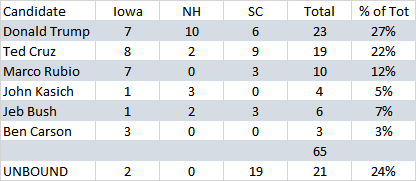
So, while we’ll know more about how the race is shaping up, there’s a very strong probability that no candidate will emerge with so much as 40 total delegates. If current polling holds true, then the delegate race exiting South Carolina will look like this:


prof deleg

So, to recap: the likelihood is that even after March 1,  no candidate will have even so much as 1/4 of the total delegates required to ensure the nomination, and the leader in popular vote could well be trailing in total delegates. This is despite that by then, 19 states with 554 delegates will have voted. This is how you get to a brokered convention.

Of course, there’s been a lot of talk and speculation regarding the possibility of a brokered Republican National Convention. To date, I haven’t heard anyone mention the possibility of a brokered Democratic National Convention. But the possibility exists, and the longer Bernie Sanders remains in the race, the greater the likelihood becomes. The reason has to do with the DNC’s “superdelegates.”

Unlike the potential Republican fiasco, the Democratic one would result from a direct divide between the party elders and the base. The elders (quite correctly, I think) do not believe that an avowed socialist can win the Presidency and thus have bet on Hillary Clinton as their standard bearer. Their primary process includes not only voted delegates, but also some 700 superdelegates. These are members of Congress and other party faithful who may vote for whomever they choose at the convention. Effectively, this means for Sanders to win the Democratic nomination outright, he needs to win the state delegates by a 701 vote margin.

Currently, Sanders holds a slight edge in awarded delegates, 36-32. However, to ensure the nomination, he needs to garner around 59% of the remaining at-large delegates. That’s a tall order. Partly because the Democrats have as  many quirky state rules regarding how delegates are divvied up as their Republican counterparts, and partly because winning 59% of the electorate in any election is a tall order. Assuming Sanders does well in Nevada and better than expected in South Carolina, the possibility becomes much more likely that Sanders does wind up winning the popular vote among Democrats – but falls short of the delegate count required to secure the nomination.

If Bernie enters the convention with a lead in declared delegates but not enough to secure the nomination, you will have a brokered convention. The party elders will be faced with a grim choice: do they cast their ballots for Hillary, angering the rank-and-file members of their party? Or do they acquiesce to the popular vote and back Bernie? The floor fight might well be reminiscent of 1968, along with the attendant mayhem.

One thing is for certain. Regardless of whether these scenarios play out or not, this is an election cycle that won’t soon be forgotten. I expect the nastiness, vulgarity and personal attacks to intensify the longer the campaigns roll on without a clear victor. Strap in, it’s going to be a long ride until summer!

Let Trump Walk


Have we ever been here before?

Have we ever had a candidate for President who thought himself so far above the process that he felt as though he should dictate the terms of a debate? Who throws temper tantrums when he doesn’t get his way? Who treats the body politic as if it were there solely for his personal gratification?

None that I can recall.

Here’s my suggestion to the RNC: let him walk. If he wants to mount a third-party bid, let him. Do not fear him and do not fear his minions. Those mindless, spineless fools are not your partisans. They inhabit the same criminal, delusional world bereft of morals and moral fiber as their champion. Better to be a minority party of principle than a minority party led by a buffoon.

But make it plain. Be sure to put it in words that even the charlatan can understand. Failure to respect the American citizen and the Republican party means you are NOT on the ballot in any Republican primary or caucus. Being a rich boor will get you nothing but treated as a wealthy crank. He wants respect? It is time for him too start respecting us. Too many good men have died for our nation and our freedom to willingly give it to a slumlord sleazeball.

Otherwise, good-bye. And good-riddance.