Musings on Sports, Politics and Life in general

Latest

Keynesian Kops


The Obama Economic Plan

Back in the silent movie days, a popular serial involved the escapades of the Keystone Kops. They were a frenetic bunch, but ultimately so incompetent they couldn’t do much of anything. They would run this way and that, stumbling about and generally more successful at running into walls and slipping on banana peels than solving crimes. As a vaudeville act, they were hilarious. As a police force, not so much.

Watching economists from the Keynesian school is a lot like watching those old silent films. They trip over each other in explaining why the economy is moribund and what should be done about it. Never mind that everything in the Keynesian playbook has been tried (and predictably, failed). Fiscal stimulus: over the past 30 months, the federal government has pumped in $2.5 trillion over and above previous spending levels – and GDP is declining after inflation, not growing. Monetary stimulus: the Federal Reserve burned through two rounds of pumping cash into the economy. No growth, but inflation is growing exponentially each quarter. Now the Fed is planning on QE3 – pumping even more cash into an economy that has more cash than can be spent.

Keynesians love to point out that their economic theories are borne out by their successes in the Great Depression. But that assumes that those policies were successful. It seems pretty doubtful that they were. For instance, here in the US, the government did manage to achieve an aggregate GDP growth rate of 9.68% between 1933 and 1940. But in order to achieve that growth, the federal government increased spending by 110% from 1932 levels. In raw numbers, the government spent just shy of $61 billion during those 7 years. But GDP only grew by $47 billion. Remove the government spending, and the economy actually shrank by 26%. That’s a pretty dubious success.

In fact, that’s exactly what happened in 1937: Congress slashed spending, and the economy promptly declined 4.64%. Rather than create sustainable growth, all that government largesse accomplished was an economy that was reliant on government largesse. Entrepreneurship, innovation and efficiency were replaced as keys to success by graft, corruption and political machines. (There was a reason Frank Capra’s Mr. Smith Goes to Washington struck a nerve when released in 1939).

Equally important – and hugely different – from today is the amount of debt headroom FDR had when deciding on a Keynesian approach. In 1932, total federal debt amounted to 51% of GDP. By 1940, that had risen to 71%. In 2008, total debt was already approaching 100% GDP and we’ve since surpassed that.

The liberal wing of politcracy wants a return to full-blown Keynesian economics. If we go down that path, by 2020 the federal government will account for 8 out every 10 dollars spent in the US – but the government will need to borrow 9 out of every 10 dollars it spends.

Maybe our President thinks that kind of vaudeville act is one worth emulating. But I doubt many other Americans agree with him.

The debt ceiling is falling!


One thing that the popular media keeps forgetting about in their reporting about the debt ceiling negotiations: the sky will not fall and the US has no reason to default if a deal isn’t reached by August 2. That date was created out of thin air by Tim Geithner and I’ve been wondering what, exactly, his criteria is for that date. Aside from trying to get the story off the front pages of the newspapers before September, that is –which is traditionally when the general populace begins to seriously pay attention to the world of politics.

The chart below (courtesy of the Treasury Department) outlines the projected cash flow for the United States during the month of August:

The black line represents the money coming into the treasury, assuming they can’t borrow another dime. The bars represent the cumulative day-by-day expenditures. Note that on every single day for the month, spending on Social Security, Medicare, Defense and the debt interest is covered. What isn’t covered is what we commonly refer to as discretionary spending. There is a reason for that – discretionary spending isn’t necessary. Just like you might eliminate dining out or your Netflix subscription if your personal budget didn’t have the cash to cover them, these are the programs that are nice to have – but aren’t essential to a functioning country.

So when the President dramatically raised the stakes yesterday by suggesting that old-age pensioners won’t receive their Social Security checks, he prioritized a chunk of discretionary spending over Social Security. If you or I did that, we’d have to answer for that in a bankruptcy court. This is President Obama at his finest: threatening the most vulnerable – and vocal –constituency when he isn’t getting his way and looking to score political points.

Based on the Treasury’s own cash-flow predictions; we wouldn’t face the prospect of a default until mid-October. Even then, the federal government could do what a large number of the states are doing now: put off paying federal contractors for 180 days (among other programmatic delays), which would allow Washington until next April to hammer out a budget. (Irregardless of the fact one was due two weeks ago for FY2012 – and we still don’t have one for FY2011). I’m not sure where Geithner is getting his information, but I’m beginning to think it’s directly from David Plouffe.

This isn’t to say raising the debt ceiling won’t be required at some point. It will. But the Republicans should stick to their guns and insist that any rise in the ceiling be accompanied by budget cuts, both immediate and long-term.

Spending is the problem


Now, Wait a Minute!

President Obama has finally realized the federal debt is a real problem, not something that can be pushed off for another decade or so. I’m not certain what woke him to a fact millions of Americans already understood, but welcome to the party, anyway. Unfortunately for the country, he seems obsessed with the idea that the reason our debt problem is crucial is because the federal government doesn’t have enough money.

On the one hand, the President is right when he says that federal revenues are lower than at any point in a generation. In 2011, the government is on pace to gather less than 30% of the nation’s GDP in revenue for the first time since 1983. But the reason for that isn’t because tax rates are too low – it’s because despite all of those reassurances that the economy is recovering, it isn’t. After adjusting for inflation, real GDP growth has fallen to less than 1% and is in real danger of turning negative. Add in the fact that that the economy is now 14 million jobs short of full employment (vs. 8 million when he took office), and it becomes pretty easy to see where the revenue shortfall comes from.

In traditional Democratic fashion, the President’s answer to the economic malaise has been to throw as much money as possible into the economy. The results have been disastrous. Deficit spending as a percentage of GDP during his tenure is running higher than at any point since the closing days of WWII. Since 2009, the federal deficit has averaged 9.91% of GDP, the second highest three year average over the past century. Only the period from 1944-1946 saw a higher level of deficit spending, at 24.02%. But besides the obvious (we were spending to save the world then), there are two marked differences between that period and this one:

  1. The US GDP accounted for close to 80% of the world’s total economic output. Europe and Asia were bombed out ruins and wouldn’t actually see real recovery for another 15 years. Africa and South America were not industrial or economic centers. Much of that debt was racked up as loans to our allies and repaid by the mid-1960’s. Today, the US is now less than 30% of world GDP and projections show us steadily losing share over the next decade. We face the prospect of having to pay much of our debt to overseas lenders, while at the same time having fewer assets with which to pay them.
  2. All of this new spending is taking place on top of what was already a huge debt burden to begin with. At the advent of WWI, the total federal debt – even with New Deal spending – stood at 67.62% of GDP. When the current recession began in 2007, debt stood at 85.53% of GDP. Today, we’re at 129% of GDP –the only time it was higher was from 1946-48. But by 1950, debt was down to 97.7% of GDP and by 1960, 70.51%.

The President has spent much of his time screaming from the mountain that the tax cuts enacted under his predecessor (which he voted for, by the way) are the leading cause of our current deficits. But he should re-check his math: in the 6 years after their passage prior to his assuming office, federal deficits averaged 2.04% per year – roughly one-fifth of the deficit spending under Mr. Obama. And federal revenues averaged 33% of GDP, slightly higher than the average for the previous 20 years (32.7%). So where is the discrepancy? If those tax cuts actually produced more revenue, why are deficits exploding?

The answer is completely on the spending side of the equation. Under President Bush, federal spending averaged 35.08% of GDP. Under Presidents Reagan, Bush Sr., and Clinton, federal spending averaged 34.83% of GDP. Under President Obama, federal spending has averaged a whopping 40.72% of GDP. For historical perspective, under President Roosevelt spending averaged 27.62% and under President Johnson (who also fought an unpopular war and greatly expanded social services) federal spending averaged 29.82% of GDP. In fact, the US government didn’t begin spending more than a third of our GDP consistently until the Carter administration.

In short, the President can stop with all his nonsense about needing to raise taxes. If he wants the nation to take him seriously when he says he wants to balance the budget, then he should start by simply bringing spending back down to the historical levels for the previous 30 years. That won’t solve all the nation’s economic ills, but at least that’s the starting point for a rational discussion.

Local Economics, Local Politics


When I moved my family to the NYC metro area 8 years ago, this seemed like the perfect neighborhood. Housing was relatively inexpensive, the neighborhood mix in terms of blue-collar and white-collar types, and a true representation of the American melting pot. Crime was low, the schools were better than average. In short, my town (and my neighborhood, especially) are about as representative of as you can find, with one glaring exception: this place is as solidly Democratic as anywhere in the country. The Republican party is virtually non-existent in the county and there is no local Republican organization.

I got to thinking about this yesterday after seeing one of my neighbors put a Mitt Romney sign in his yard and reflecting on recent conversations with others. There is palpable anger and despair with the current administration – anger and despair that emanates from the economic morass that Kearny, like so many other towns, finds itself stuck in. There’s a well-worn adage, coined by former House speaker Tip O’Neill, that “all politics is local.”  There’s another equally well-known political saying, created by political consultant James Carville, that says “it’s the economy, stupid.” And after listening to my friends and neighbors, I found myself wondering just how exactly President Obama can win re-election. In a town where he holds an irrefutable edge in organization, he’s losing the local citizenry. And he’s losing that edge for one simple reason: the economy.

President Clueless

There’s the guy who owns the local bodega. He scrimped and saved to send his son to Columbia Law School. Despite graduating with honors and clerking at the Bronx DA’s office, his son cannot find permanent work. And thanks to the fact that nearly half of my neighbors are unemployed, his business is foundering. Where once he used to hire one or two local kids to help stock shelves, he hasn’t hired anyone. Instead, he has his cousin – an out-of-work software engineer – doing those tasks.

There’s a guy on my block who lost his job a month ago, because the company he worked for hasn’t had any new business in over a year. Despite more than 20 years working as a master stonemason, he is collecting unemployment for the first time in his life. He can’t find work. He’s falling behind on his mortgage. And he’s worried.

Around the corner, there’s a Brazilian restaurant that has cut back on their hours of operation and laid off half the staff. The woman who owns the place is in shock – three years ago she had a booming business ( you couldn’t even get a table without an hour wait) and even opened a second restaurant. Last week, she had to borrow money from her son just to turn the lights back on. She fully expects to have to shutter her business by September if conditions don’t improve.

Two doors up is a guy who owns a bakery. Every night, he leaves for work around 9pm. Last summer, he laid off his delivery driver and took to doing the deliveries himself. This summer, he’s been handing out free bread throughout the neighborhood – because orders are getting canceled at the last minute. While I’m grateful for the free bread, I wonder how much longer he can keep his ovens fired up at this pace. So does he.

After being vacant for two years, the house next door to me finally sold in May. The previous owner paid $378,000 for the property. The bank initially offered it at $290,000. The final selling price: $118,000. The new owners are excited. The rest of us looked at that selling price and weren’t quite so happy.

Down the street is an accountant I know. He got laid off in the bloodbath that was the Fall of 2009 and hasn’t found permanent employment since then. He’s surviving by taking much lower paying, no-benefit contract positions – a far cry form his former $100K salary. Where once he dreamed of sending his daughter to Princeton, the recent graduate is now headed to Hudson County Community College. And without a car – they had to sell her 17th birthday present back to the dealer, since they couldn’t make the payments.

These are just a few of the stories from my neighborhood. And as the anger seethes and despair grows, I can’t help but wonder if the President realizes he’s on a path to be remembered in the same vein as Jimmy Carter and Herbert Hoover. All because he forgot that all politics is local, and it’s the economy, stupid.

The Jury Got It Right


A little more than 24 hours have passed since the Casey Anthony trial ended with what most people see as a travesty of justice.

I happen to think the jury got the verdict right. Don’t get me wrong – I think that Ms. Anthony is guilty as hell, in some fashion, with the death of her daughter. However, American jurisprudence requires two things of a jury:

  1. The defendant is presumed innocent, regardless of the nature of the crime, intensity of media coverage or other outside factors.
  2. The prosecutor must prove beyond reasonable doubt that the defendant is guilty.
In both respects, the jury did their job. They did not convict Casey Anthony prior to the trial, nor were their most pressing questions answered by the prosecutor.
The prosecution failed to establish the essential facts in the case. They could provide neither time nor method of death. More importantly, they failed to provide a motive that the jury could find credible, given their theory of the case. The motive they ascribed to Ms. Anthony – she wanted her 2 year old daughter dead so that she could assume a party-girl lifestyle – is the motive of a narcissistic psychopath. In order to prove that motive (and make no mistake, despite all the forensic evidence, the case hung on motive), they needed to prove that Casey Anthony is, in fact a narcissistic psychopath.
The prosecution failed to do so. They were able to prove that Casey Anthony is a pathological liar – which is why she was convicted of four counts of lying. But rather than prove that she is inhuman enough to kill her own daughter, the prosecution only succeeded in demonstrating that Casey Anthony is a lot like the rest of  us. Somewhat self-centered, but hardly a narcissist.  Flawed and hardly a person of the highest moral character, but I think we all know plenty of people who fit that mold. As far as I know, none are child killers.
In demonstrating that she did, in fact, enjoy her time in the bars and clubs of Central Florida, the prosecution made a serious blunder. Rather than prove Casey only wanted to party, to the detriment of her daughter, they proved that she had child-care options when she did decide to hit the bar scene. The defense demonstrated while the Anthony family is more dysfunctional than The Simpsons, both Casey and her parents loved little Caley – in fact, it was Caley that was the binding force. If Casey wanted to be rid of Caley so desperately, there is no doubt that she could have simply packed her belongings and left a note on the fridge: “Gone to enjoy my life. Back in 20 years. Look after Caley.”
So, failing to dehumanize Casey Anthony – and in fact, making her seem just as human as most of our neighbors – the prosecution was unable to convince the jury of her guilt. The principle question of the case, why would a mother kill her own daughter – was left unanswered. And the highest principle of our court system (the one that says “It is better 1,000 guilty men go free rather than one innocent man stands convicted) was affirmed yet again.

So you want to talk pain?


I came across an article from Catherine Hinton that just may be the best description of the pain from which Crohn’s Disease patients suffer. I usually compare it to being in labor, but not being a member of the fairer sex I’ve relied on descriptions of that pain from my wife (and others).

Catherine begins her description this way:

If you have Crohn’s Disease you are familiar with pain. Not just a ‘pain’, but the whole repertoire of pain sensations that the human body can manufacture. Sometimes you might be treated to a solo rendition that can be quietened down with over the counter meds, but more often than not Crohn’s pulls out all the stops and decides to delight you with a symphony performance that inclues the equivalent of timpani drums and death metal guitars. You might think that the pain is limited to bowels (it is after all Inflammatory Bowel Disease) but oh no, if Crohn’s can drag in other parts of the body, it will!

I highly suggest you hit the link above and read the rest of her description, then share it with your friends and family. It’s both funny and highly accurate!

Leader or Crybaby?


Yesterday, Presdent Obama held a news conference. The sole purpose of said conference was apparently to whine about not getting his way on the deficit reduction talks.

Look, I realize the President has certain liberal economic ideas he holds dearly. I don’t expect him to abandon them simply because the political reality is they will never make it through either house of Congress. But I also don’t expect him to take over the airwaves for an hour in order to throw a temper tantrum. I bet Sasha and Malia don’t get away with that type of behavior in the White House; I see no reason their father should, either.

He’s supposed to be not only the leader of the United States, but the free world. Leaders don’t complain that nobody is following their lead. They don’t beg, plead and berate. (Well, really poor leaders do, but then they usually find a pink slip one day). No, principle number one in leadership is to recognize the problem, identify a solution and then get buy-in from everyone. Those three traits were all visibly missing yesterday.

  1. Recognize the problem: The problem, to quote another President, is the economy, stupid. All the talk about debt ceilings and corporate tax loopholes doesn’t amount to a hill of beans as long as the economy is still in recession. (It is, as you can read here). While nobody really wants to risk not raising the debt ceiling, the idea of rasing taxes during a recession is an economic no-no, whether you come from the Keynesian or Austrian school. Not even the ultimate Keynesian, FDR, raised taxes. Second half of problem: the Congress will not raise taxes right now, even if it means not raising the debt ceiling. Political reality – that’s how most of them got voted into office, in the first place.
  2. Identify a solution: So, how do you get the debt ceiling raised, reduce spending and get additional revenue, without raising taxes? Go back to a standard TEA party plank: restructure the tax code completely, simplifying the whole thing. Can it be done by August 2? Probably not. But put it out there – ok, we’ll agree to all of these cuts IF you agree to have the tax code completely rewritten in time for the 2013 budget, leaving nothing off the table.
  3. Get buy-in: It’s pretty hard to see who wouldn’t buy-in to that solution. Immediate problem of debt ceiling solved. Short-term problem of deficit reduction solved. Long-term problem of restructuring our finances solved.

Of course, the tactic the President chose is purely political. He’ll be certain to get a bump from his core supporters. But even the most liberal economists are already deriding the lack of any real plan behind yesterday’s posturing. And the right is eviscerating him for playing politics with the national economy.

Where are the jobs?


Something to chew on over the next few days:

According to Keynesian economics, all of this government spending over the past few years should have led to an explosion of job growth. After all, since 2008 the US Government has ballooned the debt by an annualized rate of 17.47% or about twice the rate of growth over the previous decade. But the jobs aren’t coming. This first graph shows the rate of employment vs. total working age population:

Table 1: May Total Employment Ratio

Notice that the percentage of working age people now working has dropped and kept dropping like a stone, despite all of that spending. In fact, the last time this few people had jobs was in 1982 – and prior to that, 1956, when farm payrolls were significantly higher than they are now. Now for the second half of the equation, part time employment vs. full time:

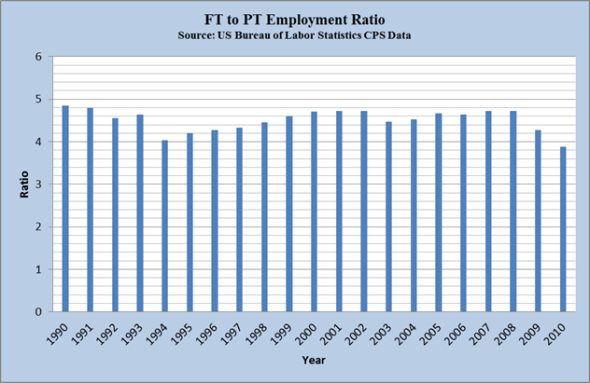
Table 2: May Employment Type Ratio

Fulltime employment has also continued to decline. Of course when you realize most of this recovery job “gains have been in retail or service industries, that shouldn’t come as a surprise. Still, the ratio now has dropped below4 FT employees per PT employee, territory we’ve never seen before. You can’t sustain a recovery on the back of McJobs. Right now, if you run the numbers, only 47% of working age Americans have a full-time job. If you’re shocked, you should be. The last time the number fell below 50% was in 1933.

If Barack Obama thinks this is the way towards recovery, he needs a new navigator.

Whither the Recovery?


For an economy in recovery, depressing economic news is all around us, it seems. In the past few weeks we’ve been told our home values have declined to 2002 levels. Unemployment ticked up to an official 9.1%, although the majority of non-governmental analysts tell us the real unemployment number is closer to twice that. More Americans are losing their jobs, as 7 of the past 9 weeks have seen new unemployment claims exceeding 400,000. For the fortunate few who are able to find work, they are winding up in the McJob industries. Of the 54,000 jobs created in May, 62,000 were actually McDonald’s hires.

You do the math: McDonald’s hired 62,000. Take away those menial, low-paying, no benefit jobs and the economy actually lost 8,000 jobs. For anyone aspiring to middle class, a McDonald’s job is not exactly high on the career path, either.

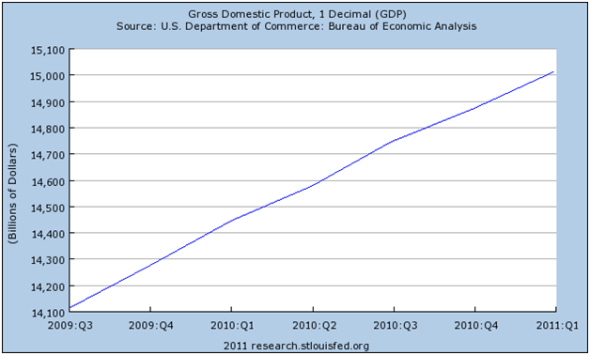
We’re told that economic growth has been muted. The truth is, there hasn’t been any real economic growth during the Obama administration. What we’ve experienced is a decline in the rate of recession. In other words, we’re still in an economic slump, it’s just not as bad as it was at the end of 2008. Let me explain, using the charts below. First, is quarterly GDP or the net worth of all goods and services produced:

Yes, that’s right. In the 6 quarters the US economy has been recovering, the net gain in GDP amounts to $900 billion. Under the technical definition of a recovery, even this paltry real rate of growth (about 1% per quarter) qualifies. Yet, inflation over that period remained higher than the growth in GDP. Mind you, these are the Fed’s own numbers:

Why is this notable? If inflation is growing faster than the value of goods and services, then GDP growth has come as a direct result from inflation. In fact, if you readjusted GDP growth to account for inflation, you get this:

And if you look at the growth curve over this same period, you get the dreaded upside-down smiley face:

We’ve never actually any real growth, despite what the spinmeisters in Washington would have you believe. When accounting for the effects of inflationary fiscal policy by both the government and the Federal Reserve, the best the economy has managed is two quarters without decline. The next time you find yourself wondering where the “recovery” is and why it’s left you behind, don’t feel so bad.

There never was one.

A Soldier Died Today


Thanks to my friend and fellow Marine Howard Cooper for passing this along. Neither of us know who the author is, so I can’t properly attribute this poem. But while everyone else is still nursing hangovers or trying to get back in the flow of normal life, there are some of us who will not forget…

He was getting old and paunchy and his hair was falling fast,
And he sat around the Legion, telling stories of the past
Of a war that he had fought in and the deeds that he had done,
In his exploits with his buddies; they were heroes, every one.

And tho’ sometimes, to his neighbors, his tales became a joke,
All his Legion buddies listened, for they knew whereof he spoke. But we’ll hear his tales no longer for old Bill has passed away, And the world’s a little poorer, for a soldier died today.

He will not be mourned by many, just his children and his wife,
For he lived an ordinary and quite uneventful life. Held a job and raised a family, quietly going his own way, And the world won’t note his passing, though a soldier died today.

When politicians leave this earth, their bodies lie in state,
While thousands note their passing and proclaim that they were great. Papers tell their whole life stories, from the time that they were young, But the passing of a soldier goes unnoticed and unsung.

Is the greatest contribution to the welfare of our land
A guy who breaks his promises and cons his fellow man?
Or the ordinary fellow who, in times of war and strife,
Goes off to serve his Country and offers up his life?

A politician’s stipend and the style in which he lives Are sometimes disproportionate to the service that he gives.
While the ordinary soldier, who offered up his all,
Is paid off with a medal and perhaps, a pension small.

It’s so easy to forget them for it was so long ago, That the old Bills of our Country went to battle, but we know It was not the politicians, with their compromise and ploys, Who won for us the freedom that our Country now enjoys.

Should you find yourself in danger, with your enemies at hand,
Would you want a politician with his ever-shifting stand?
Or would you prefer a soldier, who has sworn to defend
His home, his kin and Country and would fight until the end?

He was just a common soldier and his ranks are growing thin,
But his presence should remind us we may need his like again.
For when countries are in conflict, then we find the soldier’s part Is to clean up all the troubles that the politicians start.

If we cannot do him honor while he’s here to hear the praise,
Then at least let’s give him homage at the ending of his days.
Perhaps just a simple headline in a paper that would say,
Our Country is in mourning, for a soldier died today.