
The Obama Economic Plan
Back in the silent movie days, a popular serial involved the escapades of the Keystone Kops. They were a frenetic bunch, but ultimately so incompetent they couldn’t do much of anything. They would run this way and that, stumbling about and generally more successful at running into walls and slipping on banana peels than solving crimes. As a vaudeville act, they were hilarious. As a police force, not so much.
Watching economists from the Keynesian school is a lot like watching those old silent films. They trip over each other in explaining why the economy is moribund and what should be done about it. Never mind that everything in the Keynesian playbook has been tried (and predictably, failed). Fiscal stimulus: over the past 30 months, the federal government has pumped in $2.5 trillion over and above previous spending levels – and GDP is declining after inflation, not growing. Monetary stimulus: the Federal Reserve burned through two rounds of pumping cash into the economy. No growth, but inflation is growing exponentially each quarter. Now the Fed is planning on QE3 – pumping even more cash into an economy that has more cash than can be spent.
Keynesians love to point out that their economic theories are borne out by their successes in the Great Depression. But that assumes that those policies were successful. It seems pretty doubtful that they were. For instance, here in the US, the government did manage to achieve an aggregate GDP growth rate of 9.68% between 1933 and 1940. But in order to achieve that growth, the federal government increased spending by 110% from 1932 levels. In raw numbers, the government spent just shy of $61 billion during those 7 years. But GDP only grew by $47 billion. Remove the government spending, and the economy actually shrank by 26%. That’s a pretty dubious success.
In fact, that’s exactly what happened in 1937: Congress slashed spending, and the economy promptly declined 4.64%. Rather than create sustainable growth, all that government largesse accomplished was an economy that was reliant on government largesse. Entrepreneurship, innovation and efficiency were replaced as keys to success by graft, corruption and political machines. (There was a reason Frank Capra’s Mr. Smith Goes to Washington struck a nerve when released in 1939).
Equally important – and hugely different – from today is the amount of debt headroom FDR had when deciding on a Keynesian approach. In 1932, total federal debt amounted to 51% of GDP. By 1940, that had risen to 71%. In 2008, total debt was already approaching 100% GDP and we’ve since surpassed that.
The liberal wing of politcracy wants a return to full-blown Keynesian economics. If we go down that path, by 2020 the federal government will account for 8 out every 10 dollars spent in the US – but the government will need to borrow 9 out of every 10 dollars it spends.
Maybe our President thinks that kind of vaudeville act is one worth emulating. But I doubt many other Americans agree with him.
July 15, 2011 | Categories: Economics, Politics | Tags: Barack Obama, Debt, Debt Ceiling, Deficit, Deficit Debate, Economy, Great Depression, Great Recession, John Maynard Keynes, Keynesian Economics | Leave a comment

Now, Wait a Minute!
President Obama has finally realized the federal debt is a real problem, not something that can be pushed off for another decade or so. I’m not certain what woke him to a fact millions of Americans already understood, but welcome to the party, anyway. Unfortunately for the country, he seems obsessed with the idea that the reason our debt problem is crucial is because the federal government doesn’t have enough money.
On the one hand, the President is right when he says that federal revenues are lower than at any point in a generation. In 2011, the government is on pace to gather less than 30% of the nation’s GDP in revenue for the first time since 1983. But the reason for that isn’t because tax rates are too low – it’s because despite all of those reassurances that the economy is recovering, it isn’t. After adjusting for inflation, real GDP growth has fallen to less than 1% and is in real danger of turning negative. Add in the fact that that the economy is now 14 million jobs short of full employment (vs. 8 million when he took office), and it becomes pretty easy to see where the revenue shortfall comes from.
In traditional Democratic fashion, the President’s answer to the economic malaise has been to throw as much money as possible into the economy. The results have been disastrous. Deficit spending as a percentage of GDP during his tenure is running higher than at any point since the closing days of WWII. Since 2009, the federal deficit has averaged 9.91% of GDP, the second highest three year average over the past century. Only the period from 1944-1946 saw a higher level of deficit spending, at 24.02%. But besides the obvious (we were spending to save the world then), there are two marked differences between that period and this one:
- The US GDP accounted for close to 80% of the world’s total economic output. Europe and Asia were bombed out ruins and wouldn’t actually see real recovery for another 15 years. Africa and South America were not industrial or economic centers. Much of that debt was racked up as loans to our allies and repaid by the mid-1960’s. Today, the US is now less than 30% of world GDP and projections show us steadily losing share over the next decade. We face the prospect of having to pay much of our debt to overseas lenders, while at the same time having fewer assets with which to pay them.
- All of this new spending is taking place on top of what was already a huge debt burden to begin with. At the advent of WWI, the total federal debt – even with New Deal spending – stood at 67.62% of GDP. When the current recession began in 2007, debt stood at 85.53% of GDP. Today, we’re at 129% of GDP –the only time it was higher was from 1946-48. But by 1950, debt was down to 97.7% of GDP and by 1960, 70.51%.
The President has spent much of his time screaming from the mountain that the tax cuts enacted under his predecessor (which he voted for, by the way) are the leading cause of our current deficits. But he should re-check his math: in the 6 years after their passage prior to his assuming office, federal deficits averaged 2.04% per year – roughly one-fifth of the deficit spending under Mr. Obama. And federal revenues averaged 33% of GDP, slightly higher than the average for the previous 20 years (32.7%). So where is the discrepancy? If those tax cuts actually produced more revenue, why are deficits exploding?
The answer is completely on the spending side of the equation. Under President Bush, federal spending averaged 35.08% of GDP. Under Presidents Reagan, Bush Sr., and Clinton, federal spending averaged 34.83% of GDP. Under President Obama, federal spending has averaged a whopping 40.72% of GDP. For historical perspective, under President Roosevelt spending averaged 27.62% and under President Johnson (who also fought an unpopular war and greatly expanded social services) federal spending averaged 29.82% of GDP. In fact, the US government didn’t begin spending more than a third of our GDP consistently until the Carter administration.

In short, the President can stop with all his nonsense about needing to raise taxes. If he wants the nation to take him seriously when he says he wants to balance the budget, then he should start by simply bringing spending back down to the historical levels for the previous 30 years. That won’t solve all the nation’s economic ills, but at least that’s the starting point for a rational discussion.
July 11, 2011 | Categories: Economics, Politics | Tags: Barack Obama, Debt, Debt Ceiling, Debt Debate, Debt Limit, Deficit, Deficit Debtate, Democrats, Federal Spending | Leave a comment
When I moved my family to the NYC metro area 8 years ago, this seemed like the perfect neighborhood. Housing was relatively inexpensive, the neighborhood mix in terms of blue-collar and white-collar types, and a true representation of the American melting pot. Crime was low, the schools were better than average. In short, my town (and my neighborhood, especially) are about as representative of as you can find, with one glaring exception: this place is as solidly Democratic as anywhere in the country. The Republican party is virtually non-existent in the county and there is no local Republican organization.
I got to thinking about this yesterday after seeing one of my neighbors put a Mitt Romney sign in his yard and reflecting on recent conversations with others. There is palpable anger and despair with the current administration – anger and despair that emanates from the economic morass that Kearny, like so many other towns, finds itself stuck in. There’s a well-worn adage, coined by former House speaker Tip O’Neill, that “all politics is local.” There’s another equally well-known political saying, created by political consultant James Carville, that says “it’s the economy, stupid.” And after listening to my friends and neighbors, I found myself wondering just how exactly President Obama can win re-election. In a town where he holds an irrefutable edge in organization, he’s losing the local citizenry. And he’s losing that edge for one simple reason: the economy.

President Clueless
There’s the guy who owns the local bodega. He scrimped and saved to send his son to Columbia Law School. Despite graduating with honors and clerking at the Bronx DA’s office, his son cannot find permanent work. And thanks to the fact that nearly half of my neighbors are unemployed, his business is foundering. Where once he used to hire one or two local kids to help stock shelves, he hasn’t hired anyone. Instead, he has his cousin – an out-of-work software engineer – doing those tasks.
There’s a guy on my block who lost his job a month ago, because the company he worked for hasn’t had any new business in over a year. Despite more than 20 years working as a master stonemason, he is collecting unemployment for the first time in his life. He can’t find work. He’s falling behind on his mortgage. And he’s worried.
Around the corner, there’s a Brazilian restaurant that has cut back on their hours of operation and laid off half the staff. The woman who owns the place is in shock – three years ago she had a booming business ( you couldn’t even get a table without an hour wait) and even opened a second restaurant. Last week, she had to borrow money from her son just to turn the lights back on. She fully expects to have to shutter her business by September if conditions don’t improve.
Two doors up is a guy who owns a bakery. Every night, he leaves for work around 9pm. Last summer, he laid off his delivery driver and took to doing the deliveries himself. This summer, he’s been handing out free bread throughout the neighborhood – because orders are getting canceled at the last minute. While I’m grateful for the free bread, I wonder how much longer he can keep his ovens fired up at this pace. So does he.
After being vacant for two years, the house next door to me finally sold in May. The previous owner paid $378,000 for the property. The bank initially offered it at $290,000. The final selling price: $118,000. The new owners are excited. The rest of us looked at that selling price and weren’t quite so happy.
Down the street is an accountant I know. He got laid off in the bloodbath that was the Fall of 2009 and hasn’t found permanent employment since then. He’s surviving by taking much lower paying, no-benefit contract positions – a far cry form his former $100K salary. Where once he dreamed of sending his daughter to Princeton, the recent graduate is now headed to Hudson County Community College. And without a car – they had to sell her 17th birthday present back to the dealer, since they couldn’t make the payments.
These are just a few of the stories from my neighborhood. And as the anger seethes and despair grows, I can’t help but wonder if the President realizes he’s on a path to be remembered in the same vein as Jimmy Carter and Herbert Hoover. All because he forgot that all politics is local, and it’s the economy, stupid.
July 7, 2011 | Categories: Economics, Politics | Tags: Barack Obama, Democrats, Economy, Employment, Jobs, Kearny, Local Politics, unemployment | Leave a comment
Yesterday, Presdent Obama held a news conference. The sole purpose of said conference was apparently to whine about not getting his way on the deficit reduction talks.
Look, I realize the President has certain liberal economic ideas he holds dearly. I don’t expect him to abandon them simply because the political reality is they will never make it through either house of Congress. But I also don’t expect him to take over the airwaves for an hour in order to throw a temper tantrum. I bet Sasha and Malia don’t get away with that type of behavior in the White House; I see no reason their father should, either.
He’s supposed to be not only the leader of the United States, but the free world. Leaders don’t complain that nobody is following their lead. They don’t beg, plead and berate. (Well, really poor leaders do, but then they usually find a pink slip one day). No, principle number one in leadership is to recognize the problem, identify a solution and then get buy-in from everyone. Those three traits were all visibly missing yesterday.
- Recognize the problem: The problem, to quote another President, is the economy, stupid. All the talk about debt ceilings and corporate tax loopholes doesn’t amount to a hill of beans as long as the economy is still in recession. (It is, as you can read here). While nobody really wants to risk not raising the debt ceiling, the idea of rasing taxes during a recession is an economic no-no, whether you come from the Keynesian or Austrian school. Not even the ultimate Keynesian, FDR, raised taxes. Second half of problem: the Congress will not raise taxes right now, even if it means not raising the debt ceiling. Political reality – that’s how most of them got voted into office, in the first place.
- Identify a solution: So, how do you get the debt ceiling raised, reduce spending and get additional revenue, without raising taxes? Go back to a standard TEA party plank: restructure the tax code completely, simplifying the whole thing. Can it be done by August 2? Probably not. But put it out there – ok, we’ll agree to all of these cuts IF you agree to have the tax code completely rewritten in time for the 2013 budget, leaving nothing off the table.
- Get buy-in: It’s pretty hard to see who wouldn’t buy-in to that solution. Immediate problem of debt ceiling solved. Short-term problem of deficit reduction solved. Long-term problem of restructuring our finances solved.
Of course, the tactic the President chose is purely political. He’ll be certain to get a bump from his core supporters. But even the most liberal economists are already deriding the lack of any real plan behind yesterday’s posturing. And the right is eviscerating him for playing politics with the national economy.
June 30, 2011 | Categories: Politics | Tags: Barack Obama, Economy, Jobs | Leave a comment
Something to chew on over the next few days:
According to Keynesian economics, all of this government spending over the past few years should have led to an explosion of job growth. After all, since 2008 the US Government has ballooned the debt by an annualized rate of 17.47% or about twice the rate of growth over the previous decade. But the jobs aren’t coming. This first graph shows the rate of employment vs. total working age population:
Table 1: May Total Employment Ratio

Notice that the percentage of working age people now working has dropped and kept dropping like a stone, despite all of that spending. In fact, the last time this few people had jobs was in 1982 – and prior to that, 1956, when farm payrolls were significantly higher than they are now. Now for the second half of the equation, part time employment vs. full time:
Table 2: May Employment Type Ratio
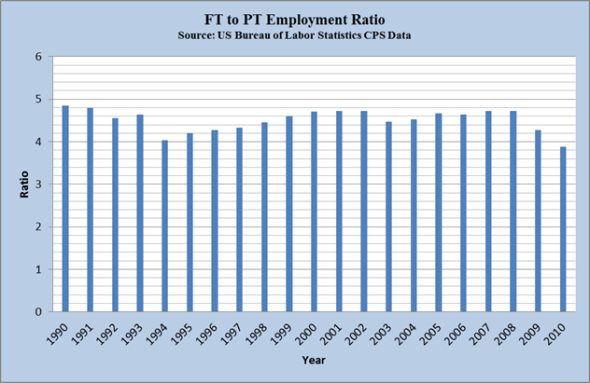
Fulltime employment has also continued to decline. Of course when you realize most of this recovery job “gains have been in retail or service industries, that shouldn’t come as a surprise. Still, the ratio now has dropped below4 FT employees per PT employee, territory we’ve never seen before. You can’t sustain a recovery on the back of McJobs. Right now, if you run the numbers, only 47% of working age Americans have a full-time job. If you’re shocked, you should be. The last time the number fell below 50% was in 1933.
If Barack Obama thinks this is the way towards recovery, he needs a new navigator.
June 14, 2011 | Categories: Economics | Tags: Barack Obama, Economy, Employment, Jobs, unemployment | Leave a comment
Yesterday, I documented how the nation’s fixation with “soaking the rich” is not only bad economics but bad public policy. To recap briefly, those who are better off are already providing the federal treasury with far more than their share. The top 400 earners comprise less than 1% of the population, yet their taxes provide more than 2% of total take – while some 45% of Americans don’t pay any income tax. The best way to improve the revenue side of the fiscal equation is to get those 45% to start paying their taxes again.
Of course, we all know that we can’t tax our way out of the debt hole. It’s too deep and deepening every second; even if we close all the tax loopholes and get those 45% to ante up we still won’t close the projected budget deficits for any year over the next ten. Spending needs cutting, although liberals are typically offended by that notion. But it’s the 800 pound gorilla in the room and finally people are noticing.
While the Washingtonians had their fun earlier with whittling away at discretionary spending, the fact is that chopping away at 12% of the annual budget isn’t going to make enough of a difference. (And the reality is, they chopped very little – about $352 million according to CBO). To really tackle our deficit – which needs to be done before we get to paying down the debt – we have to tackle entitlements.
The President’s seriousness about tackling entitlement spending was summed up by this line from his April 13th speech:
“We don’t have to choose between a future of spiraling debt and one where we forfeit investments in our people and our country. To meet our fiscal challenge, we will need to make reforms. We will all need to make sacrifices. But we do not have to sacrifice the America we believe in. And as long as I’m President, we won’t.“
Gee, Mr. President. Sure glad you reiterated for us your commitment to maintaining the status quo.
The small part of the speech he did dedicate to his Medicare reformation plan was filled with smoke and mirrors. There weren’t any concrete details, only a pledge to reduce Medicare costs by $500 billion over the next 12 years. In case you’re wondering, that is less than $45 billion per year – or less than the budget cuts enacted this year. Talk about fiddling while Rome burns! To accomplish that meager goal, the administration proposes to focus on cutting waste and fraud – laudable goals and an admission that the government is doing a terrible job at administering the program. If there is $45 billion in abuse, somebody needs to be fired. The rest is the smoke and mirrors part – relying on the IPAB to force reductions in payments. Grandma will certainly be happy when her doctor tells he can’t see her anymore because the government won’t pay him enough to make it worth his while.
The Republican plan put forth by Paul Ryan kicks the can down the road for another 10 years, then applies an indexed government co-payment to a private plan. While that does provide some cost certainty in the future, it does nothing to address the spiraling debt created today by the program. It also does absolutely nothing to address the cost inflation in health care. In short, it’s more smoke and mirrors accounting.
So if both plans are nothing more than speaking points and fall well short of actually tackling the problem of entitlements, where do we go from here?
The answer is to address the very idea of government entitlements. The very word “entitlement” means that a right to a specific benefit is granted by…somebody. What’s more, expectation of entitlements are often tied to narcissistic attitudes. If you don’t think the two are related, consider what your visceral reaction is to the idea that entitlements need to be cut: odds are that like most people in the Western world, you recoiled at the thought. What, take away my benefits?
The President danced around this very issue in his speech. Namely, what kind of society do we want to be and where do we to place our priorities? The President, along with most liberals, envision a society in which regardless of circumstance you will always be taken care of. To enable this vision, they propose that the productive members of society take care of the unproductive – the misfortunate, as the termed it. Most Republicans also think entitlements are just dandy, although they would prefer the private sector pony up to those responsibilities. In other words, they’re perfectly happy to let businesses handle society’s ills. Anyone who has ever read Dickens can tell you what kind of world that is.
It seems like a horrible quandary, doesn’t it? On the one hand, we’re faced with the prospect of a federal takeover of society; on the other, a return to Merry Olde England of the 1850’s. But there is another way – one that Americans throughout our history relied upon.
Tune in on Saturday to find out what that might be. J
April 21, 2011 | Categories: Economics, Politics | Tags: Barack Obama, Budget, Democrats, Medicare, Paul Ryan, Republicans | Leave a comment
A positive development in our politics is that attention is finally turning to the debt and the annual deficit. In case you aren’t aware of the raw numbers, the deficit for the past two years has ballooned to more than an aggregated $3 trillion. That has raised the national debt to more than $14 trillion – or, about $123,000 for every household in the United States. I give President Obama credit for finally listening to the nation and recognizing the seriousness of the problem. It marks a dramatic turn for him, seeing as how he spent more in his first two years in office than his predecessor did in eight.
In his speech last week, the President didn’t mince words: he expects the “wealthy” to pay substantially more than they currently do while he continues to spend like a drunken sailor on things only a drunken politician would consider necessary. Lo, the blogosphere and networks have focused on the President’s new Medicare proposal (more on that tomorrow) and how yes, the “rich” should pay more. After all, the argument goes, the middle class is paying higher rates than the wealthy and that is just unfair. It certainly seems a winning political argument; after all, who isn’t for soaking the rich?
This makes for good sound bites and good politics, but bad policy. I realize that in some regions the Democrats definition of “wealthy” (a family earning $250,000/year) might make sense. But in others, $250,000 per year is simply middle class. Upper middle class, to be sure, but hardly wealthy. In the New York metro area, a family easily achieves a combined $250,000 in income with two public sector workers. It is even easier to reach if one person sells cars and the other works in the local bodega. The same holds true for San Francisco, Los Angeles and other major metro areas around the country. This is really a call to arms in class warfare, the destructive political game played by Andrew Jackson and Teddy Roosevelt, with disastrous effects for the nation – though those effects weren’t felt until decades later. Even liberal icon FDR understood the dangers of the game and generally shied away from playing it.
Fortunately, the IRS keeps records on the truly wealthy and the rest of us. The latest data they have is from 2007; but since the one tax policy liberals love to hate – the “Bush Tax Cuts” were already in effect – it makes a good statistical reference point. You can find it here. In it, the IRS keeps tabs on the 400 wealthiest taxpayers in the country and compares their rates to the rest of the taxpaying public. They began tracking the data in 1992, so we have a 15 year window in the way tax policy evolved through both the Bush and Clinton eras.
At first blush, it seems as though liberals may be on to something. The IRS calculated the effective tax rate on the top 400 earners as 26.38% in 1992, rising to a high of 29.93% by 1995, and then steadily dropping to 16.62% by 2007. But statistics are wonderful things; anyone can quote a number out of context to prove an argument and this is exactly what the liberal media is doing.
First, I give credit to the IRS for doing what nobody to the left of center has bothered doing in their arguments. Their numbers reflect 1990 dollars ,thereby accounting for inflation (in mathematical terms, they normalized values). So, if the truly wealthy were paying lower effective rates, then the government should have been taking in less money from them, right? Not so fast: in 1992, the IRS collected about $4.5 trillion; by 2007 that figure rose to $14.5 trillion. Why? Well, in 1992 not a single one of those 400 returns reflected an effective tax rate over 31%. By 2007, even with the hated “Bush Tax Cuts”, 55% of the top 400 had an effective tax rate of at least 35%. The lower overall tax rate for these taxpayers is reflected in the fact that 35 of them paid no tax – an effective rate of 0%.
Overall, the truly wealthy combined to pay 2.05% of the taxes in 2007, nearly double the 1.04% they contributed in 1992. In actual dollars, they contributed nearly $23 billion of the government’s total tax take of $1.1 trillion. Those who make up this class are certainly already paying their share and the administrations attempts to paint them as sore winners can only result in flat out class warfare.
We do have a revenue problem, since we’re spending more than 4 times what the government is taking in. A better focus would be on the 45% of Americans who currently do not pay any income tax. Certainly, if you’re gross income is below the poverty line for your region, you shouldn’t be expected to pay, but I doubt 45% of Americans are living in poverty. That certainly seems much fairer and also guarantees that those currently benefiting from living here also gain equity in the system.
However, I doubt we’re going to find $1.6 trillion in revenue by asking everyone to pay their taxes. We still need deep spending cuts just to get the 2012 budget balanced. Tune in as I tackle those issues throughout the week.
April 20, 2011 | Categories: Economics, Politics | Tags: Andrew Jackson, Barack Obama, conservatives, Democrats, Economy, IRS, liberals, Republicans, taxes, Teddy Roosevelt, Wealth | 1 Comment
There are numerous reports circulating on the web that Fidel Castro has seen the light. According to Jeffrey Goldberg of The Atlantic, Castro told him “The Cuban model doesn’t even work for us anymore.”
 Huh? What? The leader of the Western Hemisphere’s oldest communist dictatorship admitting communism doesn’t work?
Shock value aside, you have to wonder if (a) Fidel is losing his mind or (b) he’s finally seen the light.
Here’s guessing (b). A little later in the article, Goldberg reports his interpreter said, “I took it to be an acknowledgment that under ‘the Cuban model’ the state has much too big a role in the economic life of the country.”
That’s a WHOA moment if ever there was one. One of the last communist dictators on earth acknowledging government control of the economy doesn’t work. In case you’re wondering, even though Cuba has instituted some economic reforms the country is hardly a bastion of capitalsim. The typical worker earns $20 a month. In the same article, Goldberg describes how the Havana Aquarium was opened especially for Fidel. Just so he could watch a dolphin show. Oh, and all the employees “volunteered” to work on their day off, including the aquarium’s director (who happens to be a – hold onto your hat – nuclear physicist.) You can’t make this stuff up.

Barry takes a break
The question that went unasked in the article is, if the leader of the Cuban revolution realizes that the socialist model failed, why hasn’t the Democratic Party here in the USA? For that matter, why hasn’t our President? This report came out on the same day that President Obama looked to Trotsky and Lenin for political inspiration. He invoked class warfare (tax hikes on the wealthy) and suggested stronger government intervention in key industries is needed to get America back to work. It’s kind of sad, actually, that the last great communist dictator understands what the leader of the free world fails to grasp.
Of course, if Obama and the Democrats get their way, we could wind up with the one thing Cuba can lord over us Americans economically: full employment. Of course, we’ll all earn $20 a month. Oh, and we’ll all have to “voluntarily” give up our days off whenever the President wants to watch a dolphin show.
Besides, who doesn’t want a 1958 Chevrolet in the driveway?
September 9, 2010 | Categories: Economics, Politics | Tags: Barack Obama, Democrats, Economy, Fidel Castro, Jeffrey Goldberg, liberals, The Atlantic | Leave a comment
 Once every two years, Labor Day signals the opening of the “Silly Season.” What is this “Silly Season” you ask?
In a nutshell, the “Silly Season” is when the general populace joins political junkies in paying attention to the politicians running for office in November. And the politicians, on cue, begin campaigning in earnest. But what it makes the season silly is the way the politicians act. Suddenly, Democrats begin espousing conservative ideals. Ordinarily, they’re joined by Republicans discovering their love of liberal programs.
But this year promise to be sillier than most. With an unsettled economy, unemployment rising and public dissatisfaction in both political parties rising to all-time highs, Democrats are in serious trouble heading into the
campaign season. Many Congressional seats once considered safe for the Donkey Party are now in play; seats once considered as being in-play or toss-up’s are now leaning Republican. As reported in yesterday’s New York Times, the DNC is cutting loose many candidates, hoping to minimize losses in the November mid-terms.
In short, what many Democrats are discovering is that the positions they’ve spent the past four years carving out are not exactly what the country wanted. The reason they won most of their seats – including the Presidency – was national dissatisfaction with the Bush administration. The initiatives the current administration have pushed through have proven even more unpopular than the ones proposed by GWB. How bad is it? 56% of Americans want the abomination that passed as health care reform repealed. Republicans now lead Democrats in all ten of the major issues polls.
Not surprisingly, in light of these developments many Democrats are running as far from their own party as possible. It’s amazing how many Democrats are now against the very health care package they passed earlier this year. (Remember when Nancy Pelosi declared that once we knew what was in the bill, we would love it? Oops.) Even President Obama is finding his conservative voice, as reports suggest he will ask Congress to pass “targeted” tax breaks on Wednesday. To add to the sense of desperation from the Democrats, many are hoping to cast their opponents as extremists who would destroy the fabric of American life.
Of course, Republicans are tempted to equally join in the insanity, but so far have held the line on leaning left. They fully understand that the nation has peeked behind the Progressive curtain and been repulsed by the view. This is turning into one of the strangest elections ever seen, where the minority party is the one fending off negative attacks. Normally the reverse is true, but Republicans don’t need to go on the attack in this cycle. The news, even left-leaning organizations like MSNBC and the NY Times, can’t help but report the dismal employment numbers. So Republicans are remaining more or less silent, except to point out that the news hasn’t been good since the Obama administration took over. That’s attack ad enough. Besides, the left is self-immolating itself well enough that the Republicans don’t need to join in.
So kick back and enjoy the Road to November. It promises to be a fun – if bumpy – ride.
September 6, 2010 | Categories: Politics | Tags: Barack Obama, conservatives, Democrats, Economy, Employment, Glenn Greenwald, hcr, health care, Nancy Pelsoi, Republicans, taxes, unemployment | Leave a comment
One of the more intriguing topics to come up for debate in this election cycle is the issue of “Park51,” more commonly referred to as the “Ground Zero Mosque.” Despite President Obama’s insistence that his presidency would represent an ascension past the culture wars that have defined American politics since the founding of the nation, this has become the flashpoint issue for 2010.
Like most cultural issues, this one pits two core American values in opposition to one another: our first amendment rights to congregate freely and the freedom from having one group impose its values on any other, as described in the ninth amendment.
Under the First Amendment, the members of the Cordoba Initiative certainly have the right to peaceably assemble, to worship their god and to disseminate information about their beliefs. Those are their stated reasons for wanting to build their edifice virtually on top of the Twin Towers site. They say that they want to foster an understanding of Islam as a religion of peace, not terror. In other words, by building on the site they have selected they hope to heal the wounds many feel are directly causal from an intractable religious dogma that preaches the destruction of all things and people not Muslim. In the Cordoba’s view, that opinion of Islam is distorted and incorrect. But in their attempted healing gesture, they are demonstrating an incredible callousness towards the very society they hope to inform.
What they forgot is that for most Americans, our only exposure to Islam is what we’ve seen on TV, and foremost among those images is the image of the Twin Towers collapsing to the ground – and the Muslim world celebrating the wound inflicted upon the “Great Satan.” 9/11 was not an attack by one nation on another – unlike any assault since the Middle Ages; this was purely a religious war being waged by Muslims acting in the name of Allah. Even if the impression upon our nation is incorrect and this is merely one sect of the religion striking out at their perceived enemy, there are better ways to inform the American public than by pouring salt into the wound. Of course, it isn’t the first time the leader of the Cordoba sect has demonstrated an incredible lack of sense when speaking to the his adopted country: this is the same Imam who, in the days immediately after 9/11, essentially blamed the US for the attack. He is also on record attacking Israel and defending Hamas, to the point of helping sponsor the June provocation.
By refusing to reconsider their position, the Cordoba Initiative ignored the nation they are hoping to educate and thereby, gain further assimilation. It shouldn’t be that difficult for them: suppose a group of extremist Lutherans attacked Mecca? And then the Catholic Church built a large cathedral on the site? Would the Islamic world understand the differences between Christianity, radical Lutheranism and Catholicism? Most likely not – and the local bishop would be considered an idiot if he were to expect any local support.
By stepping into the middle of this muddle, the President turned up the heat on the issue. Perhaps he meant to. Perhaps he miscalculated. Either way, the mosque became definitive of a larger issue; namely, how does a subset of American culture successfully integrate into the mainstream? Is it through legal channels or gradual acceptance? It seems the left wing of the American body politic, as it often does, chose the method of legality: of asserting one constitutional right over another. In so doing, both they and the Cordoba’s have turned their mosque into a temple of rights vs. right and given the nation a new wedge issue. By embracing the intransigent side of the debate, the President has assured his party will bear yet another millstone on their way to the November elections.
August 23, 2010 | Categories: Politics | Tags: Barack Obama, Elections, First Amendment, Ground Zero, Imam Rauf Faisal, Islam, liberals, Muslims, Ninth Amendment, Park51, President Obama | Leave a comment
Just a quick follow-up to this post from the other day: Missouri voters have, by about a 75% plurality, approved Proposition C. I offer my sincere thanks to the voters of Missouri for demonstrating that American values still beat strong in the breast of this Nation.
This marks the first time that the general public has, by the electoral process, rejected the federal mandate to purchase health insurance. Although I doubt anything will be done about before the legal challenges have been resolved by the Supreme Court, I sincerely hope the Obama administration will reconsider and revoke that onerous provision of their health care reform effort. The public has spoken and soundly repudiated the idea that the government can require private citizens to purchase a product offered by a private company. It’s time the President and Congress listened to their employers.
August 4, 2010 | Categories: Economics, Politics | Tags: Barack Obama, hcr, health care, Proposition C | Leave a comment
I love reading all of these articles about how the reason the economy isn’t picking up because the American consumer is “afraid.” Like this one from CNN.
What is it that all of these pundits fail to understand? The reason Americans aren’t spending, the reason for the fear about the economy is…well, because in real world terms, the economy sucks. Look, the President can talk all he wants about how the economy could be worse. He can pat himself on the back all for a stimulus package that only stimulated the national debt, but those of us who don’t live in big mansions in the District of Columbia understand one very vital thing: there aren’t any jobs out there. And the few that do exist have more intense competition than ever before. As noted in this article from Daily Finance, the US Department of Labor’s unemployment statistics amount to books-cooking. While the government touts a 9.5% unemployment number (bad enough), the actual unemployment rate looks to be closer to 22%. If you or I tried to pass off that type of accounting, we’d be in prison.
To put it simply: until people start getting hired again, nobody is going to be spending anything beyond what is absolutely necessary. Unfortunately, the one thing the current administration has displayed is an absolute disregard for getting folks hired. Why else would they be pushing the largest tax hike in history on the nation? Why would they talk about how wonderful it was to save GM – when GM just offshored another 32,000 jobs? Why would they talk about how they love the technology sector, while Verizon is in the middle of laying off over 24,000? That’s 56,000 jobs gone in 10 days from just 2 corporations, but they’ll never show up in the official DoL statistics.
Until this administration stops putting nonsense like “climate change” on the front burner and starts getting serious about job creation, the economy will continue to free fall. The object lesson in job creation can be found pretty easily, too – if Obama just opens up a history book. In 1962, President Kennedy spurred job creation by reducing income and corporate taxes and reducing regulation. In 1981, President Reagan did the same. And in 1995, President Clinton did the same, again. President Obama should also note that two of those presidents were Democrats – funny how job creation understands only one ideology. It’s not the one the current President espouses, though – so I guess we’re stuck int he “Fear Economy” until 2012.
July 27, 2010 | Categories: Economics | Tags: Barack Obama, Economy, stimulus, unemployment | Leave a comment

 Political Baseballs