
I’ve Stopped Feeling the Johnson
I’ve made no secret of my support for Gary Johnson since the GOP convention. He seemed the only sane choice left, and really, the only candidate with a legitimate chance of winning who was even qualified to assume the Presidency.
Hillary Clinton is terribly corrupt, incapable of following the law and eager to toss out the First and Second Amendments to the Constitution.
Donald Trump is terribly corrupt, abuses the law and unaware of the Constitution.
Both the major party candidates are inveterate liars and lifelong con artists. They are not presidential material.
Gary Johnson is a two-term governor, who worked with a democratic state legislature to actually reduce the burden government placed on his state’s citizens. While I don’t agree with all of his positions, he has consistently held them for two decades. Prior to elective office, he built a major construction company from scratch, a personal exemplification of the American Dream. He is that rarest of breeds, the honest politician. He seemed to be the only candidate running who is qualified to be President.
And then came this morning.
In an appearance on the Morning Joe television program, Johnson showed he’s just as unqualified as the other two. Panelist Mike Barnicle asked him what he would do about Aleppo. Johnson replied by asking, “What is Aleppo?”.
Now, if you asked, “What is Aleppo?”, I could give you a pass. But Gary Johnson is not some schmuck walking the street. He is asking the American people to give him the most powerful office in the world. It is not beyond the pale to expect him to know at least the basics of foreign affairs.
I appreciate the honesty in admitting he didn’t know about one of the world’s major hotspots. But the lack of basic knowledge is disqualifying.
And for those of us trying to find someone we can support this November, it is also disheartening.
Trump Wants Blood
On a day when the world should have been talking about Hillary Clinton’s cavorting with Taliban sympathizers, or discussing the emails that disclose how closely her State Department employees were rushing about doing Clinton Foundation business, Donald Trump managed to deflect attention away from her yet again.
At a campaign rally in North Carolina, he said this:
“Hillary wants to abolish — essentially abolish the Second Amendment. By the way, if she gets to pick, if she gets to pick her judges, nothing you can do, folks. Although the Second Amendment people, maybe there is, I don’t know. But I tell you what, that will be a horrible day.”
Evil is Still… Evil

Libertarian Presidential candidate Gary Johnson. The only non-evil candidate.
There are people supporting Donald Trump’s candidacy who honestly and fervently believe he is the savior the country needs. It’s seemingly a small slice of the country, somewhere between 15-20% of the country. Polling has consistently shown this for about six months now. This post is not directed at those people.
I’m speaking to the roughly 60% of the country who feel that Hillary Clinton is such a terrible, awful, horrendous candidate that she should never see the inside of the White House again. I feel the same. Her legacy of corruption, belief that the only wrong with government is that it’s not big enough and terrible judgement when given authority, should be enough to disqualify her from public office. But what really scares ordinary Americans about the potential of an HRC presidency is the blatant disregard for Constitutional principles and the way people around her keep dying. Envisioning her as the modern Nero, adding to her bank accounts while the country burns, isn’t a stretch.
Of those who think this way, about half of you are prepared to vote for a candidate who is equally unfit for office. A man who openly advocates violence against his detractors, who uses bigotry and classism as cover for his own corruption. The same man who has abandoned friends for political expediency while embracing those who mean the country harm.
The excuse, and that’s all it is, to those who think this way is that you’re voting for the lesser of two evils. That is not only illogical, it’s repugnant. It’s akin to voting for Baal instead of Satan, because while Baal might destroy the world, you know Satan will.
People, evil is still evil. If you’re voting for candidate A instead of candidate B because one is a murderer while the other is only a rapist, then you are still voting for a person of low moral character who has a disregard for society. You are voting for evil and condemning the country to ruin.
There is a better way, a candidate C. Perhaps you don’t agree with all of his positions. Maybe you find some of the things he advocates to be an affront to your sensibilities. But his character is not impugned, nor his patriotism. He isn’t holding rallies to talk about using violence in furtherance of political goals, and he doesn’t have a team of lifetime sycophants trying to cover up the daily revelations of corruption.
Candidate C is Gary Johnson, the Libertarian candidate. By voting for him, you won’t feel like you need to take a decontamination bath 24/7 for the next 4 years. Take a closer look, #NeverHillary voters. I think you’ll like what you see.
In 2018, the Yankees Will Win the World Series
So, Mark Teixeira and Alex Rodriguez have pretty much been given their walking papers and the youth movement has begun. Here are some names to remember, if you’re one of those fans who never paid much attention to the minor league system. These players will probably be in Pinstripes in 2017 (and maybe before this season is over):
Aaron Judge: an outfielder whose power has been compared to Giancarlo Stanton. Remember those moon shots Stanton hit during the Home Run Derby? Check out this Judge blast –
Clint Frazier: another outfielder, he was the lynchpin of the Andrew Miller trade. He’s been compared to Mike Trout in terms of raw ability. Except with more power.
Gary Sanchez: Not only the catcher of the future, but it looks like he’s the catcher of the present. Since his call-up on August 3, he’s hitting .333 with an .813 OPS.
Tyler Austin: The slugging outfielder/first baseman was nearly derailed by injuries in 2014 & 2015, but has recovered in a big way this year, with a .321 average, 17 homers and 76 RBI.
Greg Bird: The first baseman with a sweet left handed swing hurt his should this spring and has spent the year rehabbing. But as an emergency replacement for Teixeira towards the end of last year, the then 22 year old hit .261/11/31 in 46 games.
Bryan Mitchell: The right handed pitcher with the overpowering fastball had made the big club in Spring Training, before a freak broken big toe cost him his season. Still, look for him and Luis Severino to provide major innings in the starting rotation in 2017.
Luis Cessa/Chad Green: the young righties have made a few appearances for the Yankees as part of the “Scranton Shuttle” this season. The return for last year’s Justin Wilson trade, the former Mets and Tiger’s farmhands are both probable swingmen, joining Adam Warren in giving Joe Girardi plenty of options (and potential innings) out of the Yankee middle relief corps.
And in 2018, these kids will probably be ready to see big-league action:
Dustin Fowler: A speedster in the Brett Gardner mold, the outfielder has hit .287 with 8 homers and 20 steals at AA this year.
Billy McKinney: Yet another speedy outfielder, the left handed McKinney was part of the Aroldis Chapman trade.
Ian Clarkin: the former first round pick has recovered from a lost 2015 and become an even better pitcher. The young lefty, once compared to Ron Guidry, now has 3 off speed pitches to compliment his 97mph fastball.
Justus Sheffield: The left hander is another of the players who came back in the Andrew Miller deal.
Ben Heller: the righty reliever with a 99mph fastball was another player in the Miller trade. He has a shot to see action out of the Yankee bullpen next year, if he gets better command of the strike zone. Even so, in his first AAA action this year, he’s posted a 1.60 ERA with a 0.88 WHIP in 28 innings.
Kyle Higashioka: the catcher slugged his way from AA into a AAA promotion, and hasn’t stopped hitting yet. In 17 games at Scranton, the late-blooming Higashioka has hit .359 with 6 homers.
There’s even more talent waiting in the low minors. Kids like Jorge Mateo, Gleyber Torres, Blake Rutherford, James Kaprellian, Miguel Andujar and Kyle Holder are all considered among the 100 best minor league prospects. (Indeed, the Yankees almost have an embarrassment of riches at shortstop and catcher).
And don’t forget, the Yankees are reducing their payroll by almost $70 million by Opening Day in 2018- and that’s before current veterans (see: Brett Gardner, Brian McCann, Chase Headley) find themselves on the trade block. You know who hits free agency in 2018? Manny Machado. Bryce Harper. Josh Donaldson. Matt Harvey. Clayton Kershaw. Jose Fernandez. AJ Pollock. Andrew Miller.
To think the Yankees won’t open the checkbook and grab a few of those perennial all-stars and fill in the blanks before Opening Day 2018 is ludicrous. Combine, say, Machado, Harper and Harvey with the upcoming crop of Baby Bombers and that’s why I’m predicting it now:
The New York Yankees will win the World Series in 2018.

Not only that, it’s going to be the start of another dynasty.
The Conventions Are Over. Let the Race Begin.

Both major parties have now concluded their national conventions. Traditionally, this is when most Americans actually begin paying attention to politics. This marks the point when what may have been a cursory delving into the upcoming election gels into a closer examination of the candidates, their positions and their histories among the general population. Everything up to this point has been debated, argued and bandied about by only the most politically active people in the country.
As a data point, consider this. In the primary elections, approximately 57.6 million people voted. That was less than 29% of eligible voters. If turnout rates simply match those of 2012, when 58% of eligible voters cast a ballot, that would mean another 57.6 million people voting. If turnout is closer to the 63% from 2008, it would mean an additional 67.5 million voters. And if turnout is the same as the last time primary participation reached as high as this year, in 1960? In 1960, 31% of eligible voters cast a primary ballot* and 67% one in the general election. An equivalent turnout this year would mean an additional 75.4 million votes cast in November.
What all of those numbers mean is this: at best, only half of the people who are going to vote this November have actually paid enough attention to this point to have participated in the electoral process. Each candidate has been able to play their base, solidify their standing and not worry too much about attracting the votes of the rest of the country. But with the close of the conventions, that changes.
What we do have is a clearer idea of what each party intends as it’s core message for the fall campaign. For the Republicans, the message is the country is hopelessly fouled up, and only Donald Trump can save us from ourselves. The Democrats message is that things aren’t really that bad and we need the experienced hand of Hillary Clinton at the nation’s tiller.
But this year also features an electoral monkey wrench unheard of in prior contests. Both nominees are almost universally disliked, distrusted and flat-out repulsive to most of the electorate. How that plays out, in terms of messaging and voter turnout this fall, remains to be seen. It also presents third party candidates an opening unseen since Teddy Roosevelt ran as a Bull Moose over a century ago. Indeed, it is completely possible that a third party candidate could garner Electoral College votes for the first time since 1912.
The only thing certain about this year’s election is that these factors will create a race unique to our time. Prior models will almost certainly prove worthless to pundits and political scientists alike. The only relatively sure thing about this year is, it will be fascinating to watch and take part in the process.
*Note: The primary system was much different in 1960, as there were only 14 Democratic and 13 Republican primary contests held.
Enough is Enough
As Americans, it is not in our nature to demonize a segment of the population based on the actions of a few of their members. That is, of course, unless the actions of the community in general, in response to the reprehensible actions of the few, are equally reprehensible.
We have reached that point as regards the American Muslim community.
Whether by design or ignorance, it has failed to accept responsibility for the fact that it’s members are willingly conducting acts of violence against the American public writ large. Rather than work with the authorities to identify those members who’ve espoused radical ideologies, they’ve given them sanctuary. Rather than remove leaders whose mosques preach hatred, they’ve continued to fund them, often lavishly. Rather than work to drown out the voices within the Muslim community who’ve preached jihad against the rest of us, those voices are elevated and given prominence.
As a nation, we’ve asked the Muslim community to effectively police itself. After Ft. Hood, after Boston, after San Bernadino, Americans said we want you to work with us. We said we understand there are differences in worship, but so long as you agree on the principles of life and liberty, we’ll work to overcome any prejudices.
Now, we can add Orlando to the list of American tragedies created by a member of the Muslim community. Another young man who had espoused antagonism towards his homeland for years, not hiding his views. Another young man who studied at mosques that reinforced his hatred of the United States. In his case, his imam has been caught on video telling his minions that “homosexuals should be killed to save them from themselves.”
This willful, conscious and intentional separation of the Muslim community from American society by Muslims can no longer be tolerated by the rest of us. We must remove them from our midst. Expel them, imprison them – by whatever means necessary; Muslims have demonstrated they are a cancer on the rest of the American public. They have proven to have loyalties not to the United States, but to Mecca.
Stop to consider if any other group acted towards the rest of us as Muslims have. If Catholics were an insular religion that demanded the extermination of Jews, they would be ostracized and imprisoned. If Baptists preached that anyone who wasn’t Baptist should be killed to save them from themselves, the rest of us would demand the expulsion of Baptists.
Undoubtedly, our political leaders will respond to this latest Muslim atrocity with appeals for calm and requests of Muslims to police themselves. And undoubtedly, those appeals and requests will be ignored and mocked by Muslims. Yet again, as they were after Boston. Our feckless and cowardly “leaders” will be ridiculed in mosques from Newark to Appleton, as they were after San Bernadino.
No more. Enough is enough. It is time to admit what we have been loathe to admit and accept reality. Muslims do not want to be part of the fabric of our nation. Rather, they want to be a nation within the nation and at war with the rest of us. That is unacceptable and intolerable. And for that reason, they must go.
Donald Trump is a Racist. If You Support Him, You Might Be, Too.
“Four score and seven years ago our fathers brought forth, upon this continent, a new nation, conceived in liberty, and dedicated to the proposition that “all men are created equal.“ – Abraham Lincoln, Gettysburg Address
The Party of Lincoln has abandoned Lincoln in its embrace of Donald Trump. I daresay, the The Party of Lincoln has abandoned the United States of America in it’s embrace of Donald Trump.
 There is no other explanation. Honest Abe understood that what makes us “American” is the simple proposition that “all men are created equal.” Have we always lived up to that expectation? No. Our history is one of struggling with that ideal and overcoming the innate prejudices that animate us. From Harper’s Ferry through the Civil War, Reconstruction to Rosa Parks, The March on Washington to today, we have moved forward towards recognizing the inherent worth of all our citizens. Until now.
By selecting Trump as their standard-bearer, with his campaign rhetoric harkening back to the Know-Nothing Party of the 19th Century and a record of racist taunts and statements stretching back nearly 45 years, the Republican Party has taken a giant step back in time. If you aren’t sickened by Trump’s statements over the past ten days denigrating Hispanics, Muslims, Blacks and all Americans, then I don’t know what else to say to you. You are the same people who would have gladly posted signs in your shops announcing “Irish Need Not Apply” in the 1850’s or “No Wops Allowed” a century ago. You are the same people who would have loosed the dogs upon the marchers in Selma. You are the same people who threw bricks through the buses in Boston.
If you cannot denounce Trump and all he stands for, you must ask yourself what it is, that separates you from any other nationality in the world? You want a return to “American Exceptionalism”? Fine. But your embrace of Trump demonstrates that you haven’t the foggiest what that even is. You haven’t any idea what it is that allowed the United States to become the world’s preeminent power, what led to our economic successes and made us the envy of every other nation on the planet.
That exceptionalism lies in the fact that we’re willing to accept anyone who pledges loyalty to the Constitution of the United States of America as an American. We are the only nation on Earth that can say that. The core strength of our nation is that our nationality is not defined by where your parents or grandparents were born. We are united by loyalty to a common ideal rather than a bloodline. Our forefathers left those nations behind, as Mr. Lincoln said, to create a new type of nation – one where belief in liberty and justice for all is both our founding and guiding principle.
So if you want Trump’s overt racism as the standard for the United States of the future, understand what you’re buying into. Understand that by supporting Donald Trump, you are supporting the dissolution of the United States of America and the torching of our Constitution. Understand that you are setting in motion the end of the concept of free men.
So, Mr. McConnell, Mr. Ryan, Mr. Christie, Mr. Sessions and all of the other Republican “leaders” who have jumped aboard the Trump Train: the choice laid before you can’t be more stark. You may continue to support Mr. Trump as your party’s nominee, and accept the permanent branding as racists. Or you can realize that he isn’t actually the nominee yet and totally not worthy of the Party of Lincoln, and as unceremoniously as possible dump him. The choice is yours.
How Do You Defeat Donald? Get Hillary Out
 The other day, Hillary Clinton launched a blistering attack on Donald Trump’s foreign policy suggestions, his character and his temperament. Among some of the choice words she had were:
- “This is not someone who should ever have the nuclear codes because it’s not hard to imagine Donald Trump leading us into a war just because somebody got under his very thin skin.”
- “He says he doesn’t have to listen to our generals or ambassadors because he has — quote — ‘a very good brain.’ He also said, ‘I know more about ISIS than the generals do, believe me.'”
- “He says he has foreign policy experience because he ran the Miss Universe pageant in Russia.”
- “He believes America is weak. An embarrassment. He called our military a disaster. He said we are — quote — a ‘third-world country.’ And he’s been saying things like that for decades. These are the words of someone who doesn’t understand America or the world.”
- “He has the gall to say that prisoners of war like John McCain aren’t heroes.”
- “He has said that he would order our military to carry out torture and the murder of civilians who are related to suspected terrorists — even though those are war crimes.”
- “Donald Trump’s ideas aren’t just different — they are dangerously incoherent. They’re not even really ideas, just a series of bizarre rants, personal feuds and outright lies.”
- “This is a man who said that more countries should have nuclear weapons, including Saudi Arabia.”
Salient points, all. Nothing about them can be disputed: the policies she attacked are all direct quotes of the Donald. There was just one problem with the entire speech.
It was delivered by Hillary Clinton.
This is the same Hillary Clinton responsible for the “Russian reset,” which has resulted in Vladimir Putin annexing parts of Georgia and Ukraine, harassing US & NATO ships and aircraft and settling into Syria.
The same Hillary Clinton responsible for starting the negotiations with Iran. The net result is that Iran will have US sanctioned nuclear weapons within a decade; weapons that we actually paid them to build.
The same Hillary Clinton who demonstrated (at the very least) horrible judgement in how she handled the nation’s top secrets. As a result of her insistence on breaking the rules and relying on a private, unsecured email system, it’s likely rogue nations like North Korea, China, Russia and others were reading classified intel in real-time. Heck, a Bulgarian hacker broke into that server in under 30 minutes, working by himself.
The same Hillary Clinton who bungled a Libya-to-Syria gun running operation, after bungling the “Arab Spring” related removal of Muammar Gaddafi, and then bungled the security arrangements of the US Consulate in Benghazi. The result? One dead American ambassador, along with three other Americans. And let’s not forget, there are still unanswered questions about why a rescue mission to save those men was never launched. The military has put that onus squarely on Hillary’s State Department.
In short, the Democrats aren’t incorrect in attacking Donald Trump as man wholly unfit for the office he is seeking. The problem is, their candidate is equally unfit for that same office. For every misstep Donald makes, Hillary has already made two. Her 44 year Washington DC record is as flawed as it is complete. And every attack she launches is easily parried with a counter-attack on her equally horrible record.
In fact, both candidates are so terrible that electing either could result in an immediate Constitutional crisis. It is a situation unprecedented in our history.
It’s also skewed the election in ways that pollsters and pundits can’t begin to sort out. But there is definitely one effect that doesn’t need to be polled to be understood: there are a lot of people who aren’t so much as supporting one candidate, as they are voting against the other. The same holds true for many of the political arena’s actors. They’ve endorsed their party’s candidate, not of party loyalty as much as pure disgust with the other party’s choice. Among Republicans, the one constant I hear regarding Trump is, “He’s not Hillary.”
I personally have my doubts about that. I look at both and see mirror images of one another. For me, Donald is Hillary. Hillary is Donald.
That being said, in the latest polling, Trump is only getting the support of roughly 1/3 of the electorate. I believe if Hillary were not the Democratic nominee, that support would crumble. Better than half of his support is of the #NeverHillary variety – those people do not support Donald and they will do anything to keep Hillary out of the Oval Office. That includes voting for someone they think is a horrible candidate.
So, it’s up to you, Democrats. If you truly want to keep Donald Trump from getting his tiny hands on the nuclear football, you’ll select someone other than Hillary Clinton as your nominee in Philadelphia. Oh, and for God’s sake:
Don’t let it be Bernie Sanders, either.
The SCOTUS Argument Debunked

Perhaps the most convincing argument coming from those who’ve decided to back up the truck to Donald Trump’s candidacy is the one regarding appointments to the Supreme Court. Even the most politically clueless individual realizes that Hillary Clinton will never nominate anyone with a conservative viewpoint. Hillary probably doesn’t even know any lawyers or professors who aren’t decidedly liberal. With one court vacancy already and the majority of the sitting Justices eligible for Social Security benefits, odds are the next President will have a once in a century opportunity to shape the Court. Certainly, nobody who cares about the Constitution can reasonably argue that a Clinton Presidency wouldn’t greatly imperil our system of government.
So the argument becomes we know what Hillary will do as regards SCOTUS, and that’s pack it with as many anti-gun, pro-abort, big government types as she can get past the Senate. Trump has at least made noises about nominating conservative justices. Who knows? He might actually keep his word on at least this subject and select people from the list he published a couple of weeks ago.
I’ll admit, that’s almost a compelling argument. Nobody of sound mind wants to see the Supreme Court packed with people who make Lenin look like James Madison. Of course, it relies on assuming that Trump will hold true to his word on this topic. And we know the old saying about assumptions… The question becomes, can we trust Trump to nominate, as he claims, a justice worthy of Antonin Scalia’s seat?
Well, no. In fact, I’m here to show that not only won’t he nominate a Scalia type to the court, but that his nominees would be every but as dangerous to the long-term health of the republic as Hillary’s. And I have two reasons I can say this with absolute, complete and total certainty.
First, one only need look at that list a little more closely. It’s a list of potential jurists that any high school junior could have put together in about 15 minutes by doing a Google search (and that’s assuming they were slow at copying and pasting). Of the eleven potential nominees, nine are politicians first, jurists second. None are considered an actual legal scholar, much less in the intellectual vein of Justice Scalia. Only three have taught law (one in an adjunct capacity only) and none taught the Constitution. Besides being intellectual lightweights, they all share two other things. The first is a trail of opinions justifying judicial activism. Their other common trait (one that frankly I applaud) is that all have struck down restrictions on the 2nd Amendment. Unfortunately, reading through their legal reasoning in doing so is at best, bewildering. Judge Sykes, for instance, is most famous for striking down Chicago’s attempt to outlaw gun ranges. (Well, in legal circles, anyway. She’s also famous for another reason). But in her opinion, she gave credence to the idea that prior restrictions on gun possession and ownership could and should be considered when adjudicating 2nd Amendment cases. In other words, had a prior legislature outlawed firing ranges and another court upheld that ban, she would have gone along with it. Or to put it more bluntly: she would place legal precedent ahead of the Constitution. That is about as far from Justice Scalia as one can get and not end up with someone named Ginsburg.
Perusing through the other nominees’ legal opinions reveals the same sort of bent. These are not legal conservatives. They may be social conservatives, but are willing to tear the Constitution to shreds in the name of their “conservatism.” Of course, that isn’t conservative at all. That’s the flip side of the same judicial coin that social liberals have been flipping for 70 years. It’s also the sort of person Trump has consistently been throughout his life. Which is to say, one with little regard for the law – and if the law gets in your way, either ignore it or change it. A politician willing to change the law willy-nilly is dangerous enough. A Supreme Court justice willing to ignore the Constitution in furtherance of a goal is inherently dangerous. In fact, we have one such “conservative” justice now occupying the Chief Justice’s seat, and it was his pursuit of maintaining the court’s “integrity” over the Consitutional principles it is supposed to be upholding that gave us Obamacare.
In this light, it isn’t surprising that actual Scalia-type legal scholars, who also happen to be social conservatives, are nowhere to be found in Trump’s thinking. Not one of Janice Rogers-Brown, Brett Kavanaugh or Paul Clement seems to even have been considered. I’m not even going to mention Mike Lee or Ted Cruz. We all know how Trump feels about Cruz, and putting Thomas Lee on the list seems like a sop towards Mike (they’re brothers). The point is, those are people who firmly believe in the Constitution’s delineation of powers, including restrictions on executive authority. If there’s one thing the Donald hates, it’s anyone telling him what he cannot do, especially a legal authority.
Which brings me to the second proof that Trump will not nominate a Scalia-type conservative. As you are probably aware, he is facing several lawsuits for his involvement with Trump University, about as scammy an operation as has ever operated in these United States. The one that is closest to being heard is in California, being presided over by US District Judge Gonzalo Curiel. Late last week, Trump launched into one of the most hateful diatribes against a sitting federal judge in US history. It was certainly a first for a presidential candidate. In terms of political assassination of a court, the only comparable thing that comes to mind was President Obama’s singling out the Supreme Court for not bending to his will during his 2010 State of the Union.
Stop to let that sink in for a moment: Donald Trump and Barack Obama have the same regard for courts that don’t do as they want.
Of course, Trump did his best to poison the well further. He decried Judge Curiel as Mexican (he’s actually from Indiana) in his inimitable “I’m-not-a-racist-but-I-am” wink & nod cattle call. Indeed, he pushed right up to the edge of facing contempt of court charges. That he hasn’t is an example of judicial restraint, a concept foreign to Judge Trump (as is restraint in anything). But more instructively, Trump’s willingness to harangue a sitting federal judge tells us what he expects from the judicial branch of the federal government: total compliance with Trump. Comply, or face my Brownshirts. In Curiel, however, Trump’s threats probably don’t have much currency. After all, he’s faced down Mexican drug cartels in his courtroom.
Besides sending a shudder up the spine of anyone who happens to think the separation of powers provided by the Constitution is a good idea that’s worked really well, this type of behavior also lays low one of the other arguments I’ve heard. Namely, that Trump would be constrained by the both the Constitution and the grinding bureaucracy of the federal system. Trump has already subverted the second half of that argument; watching the likes of Mitch McConnell and Marco Rubio licking his boots proves that. Seeing what Trump expects of a justice, and the lengths he will go to exact compliance, makes the first invalid, as well.
Urgent Letter to ALL Physicians: Take Action to STOP MACRA MIPS Rules
You can keep your doctor…if your doctor can afford to stay in practice with all these new bullshit rules #Obamacare is forcing on them…
Colleagues, Please read the following letter on MACRA MIPS current rulemaking pending with CMS. The report is the unanimous result of a comprehensive review by the National Physicians Council on He…
Source: Urgent Letter to ALL Physicians: Take Action to STOP MACRA MIPS Rules
What Does the GOP Stand Fow Now?

Photo courtesy: Retro-Christianity
First things first. I was wrong. I did not think Republican voters would choose Donald Trump as their nominee for President. There are plenty of people dissecting and offering opinions as to the how and why; I’ll probably add my two cents to that discussion later. But I prefer to focus on the future, and now Mr. Trump is the presumptive nominee, that future begins today.
I seriously considered going down to the courthouse today and changing my registration from Republican to Independent. When I went to bed last night, that was my intention. After all, if I am to remain #NeverTrump (and I do), then how can I honestly consider myself a member of the party that supports him? But here’s my problem: there are many other people who consider themselves Republicans who also do not support Mr. Trump. Governors, Senators, Congressmen and others who have expressed no interest in even voting for him, much less actively supporting his candidacy. People like Rand Paul, Mike Lee and Ben Sasse in the Senate. Conservative writers Geroge Will, Ben Shapiro, Eli Lake Philip Klein and Jamie Weinstein all penned columns this morning on the same theme: they remain adamantly #NeverTrump.
I certainly do not want to hand over the downballot races this November to the Democrats. That would turn fiasco into disaster, as the only hope the nation has is that the Congress will act much as it has for the 8 of the past 10 years. Which is to say, by simply refusing to even consider any of the sitting President’s proposals, much less act on them. Trump cannot trample all over the Bill of Rights and Clinton can’t seat liberal SCOTUS nominees wihout a compliant Congress. States under conservative leadership can continue to foul up the insane progressive programs sent down from 1600 Pennsylvania Avnue.
So, in the interest of protecting those downballot candidates, I’m not changing my voter registration – yet. What I’m waiting on is the party platform to be decided at the GOP convention in July.
We already know Trump is wildly inconsistent on policy and as socially inept a candidate as we’ve ever seen. But distilled down to their basic elements, the principles Trump has run on are as follows:
- Nativism: the idea that “others” cannot participate in the American Dream.
- Protectionsism: The US cannot compete – militarily, diplomatically or economically – with the rest of the world.
- Isolationsism: The rest of the world is a big, dangerous, scary place filled with “others.” We must disengage from it and let the “others” fend for themselves.
- Bigotry: Everyone is great – but some people are greater than “others.”
- Government: The bigger and more intrusive, the better. A powerful Federal government is the only way to ensure peace and prosperity.
A platform is the shared policy positions of the party. It also outlines the enabling principles of the party. The problem facing Republicans in July, and particularly the platform committee, is defining those standards. If they adopt any of the principles above, then the Republican party has given up even the pretense of being a conservative party. Conservatism (or the term now being bandied about to seperate from Trumpism, “Classical Liberalism”) is the antithesis to all of those princples. As conservatives, we understand how dangerous any of them can be by themselves. Combinations of two or three yield the Democratic platform since the days of Bill Clinton; combine everything but the bigotry and you get the Democratic platform of Jimmy Carter, Teddy Kennedy and Michael Dukakis. Combine all 5? Yes, that would look eeirly similiar to the platfrom of the American National Socialist Movement Party.*
Should that happen, I will bolt the GOP faster than Usain Bolt with a case of diarrhea. Here’s the thing: should the GOP adopt a truly conservative platform (or even a center-right platform, giving up prior socially oncservative positions), I don’t expect Trump to actually run on it. After all, he’s done his own thing and changed positions as often as five times in one day, so expecting him to suddenly have the discipline to follow a platform would be completely out of character. But I would fully expeect downballot candidates to point to it and say, “this is what being a Republican means.” It would provide a blueprint, one that would find Trump instinctively opposed, but something the rest of the party and country could point to. And I would fully expect Republicans to honor that committment once elected.
Do I have hope that such a thing is possible, that the GOP could adopt a platform opposed to everything their Presidential candidate believes? Yes, and here’s why: we’ve seen conservative candidates win some of the downballot races in the same states where Trump has been strongest. People who are for lower taxes, reduced government, less regulation and have both feet firmly planted in the real world. So, as enamored as a sizable chunk of the Republican electorate seems to be of Mr. Trump, it also seems to want true “Classical Liberalism.”
We’ll find out come July which the way the wind prevails. Until then, I will continue to fight for conservative principles to be the GOP’s guiding light, and for the GOP to return that light to the Shining City on the Hill.
It’s Not Fair!

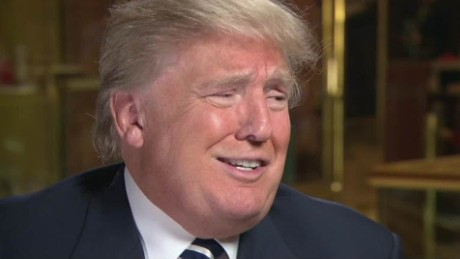
Ever since getting blown out in Wisconsin, Donald Trump has been hollering about the way we select presidential candidates, calling it unfair, or deriding it as a “rigged system.” Sure enough, the left-of-center pundits and writers who support him, and most of the misguided people who’ve pledged their allegiance to the “Trump Train,” have suddenly decided that a system that’s been around almost as long as the United States is fundamentally flawed. I shouldn’t be surprised. The typical Trumpster also tends to think the US Constitution is terribly flawed and no longer relevant.
The delegate system is based on the same idea that fueled the adoption of our Constitution. That is, the best system of governance is a representative republic, with semi-autonomous states sharing power with a centralized national government. As conceived by the men who gave us our Constitution, the office of President was not to be directly entrusted to the general populace. Rather, they conceived the idea of electors being chosen by the people. The electors would then choose the President. They had two reasons for this, both outlined in Federalist 68. The first is that the general populace can be easily swayed by emotional appeals to our baser instincts. As Alexander Hamilton noted, “Talents for low intrigue, and the little arts of popularity, may alone suffice to elevate a man to the first honors in a single State; but it will require other talents, and a different kind of merit, to establish him in the esteem and confidence of the whole Union.” The second was they understood the vast majority of citizens are not active politically, nor are they as attuned to the issues and policies as their brethren who are politically active. Their decision was that by entrusting the selection of Chief Executive to a group of people who were politically active, they were ensuring that the gravitas of the position was honored. Yet at the same time, because the electors were selected by the citizenry, the people’s voice would be heard. Hamilton, again: “… the immediate election should be made by men most capable of analyzing the qualities adapted to the station, and acting under circumstances favorable to deliberation, and to a judicious combination of all the reasons and inducements which were proper to govern their choice. A small number of persons, selected by their fellow-citizens from the general mass, will be most likely to possess the information and discernment requisite to such complicated investigations.”
I realize this conception of how our political system was created will confound most of you. After all, you’ve heard since childhood that the United States is a democracy. Every politician declares it during every speech. Most sadly, we’re taught in school that because we vote, we’re a democracy. Some people are taught that we’re a representative democracy; that our votes go to elect representatives who are supposed to vote the way we want them to. That’s also incorrect! We are a representative republic. We elect representatives. The representatives we elect are then to debate and vote on the issues and policies as best they see fit. The decisions they reach are not bound by any measure to popular will. We then can decide if we approve of those decisions at re-election time. There have been occasions – quite a few, actually – when a representative has defied popular will in the votes they cast. One of the most celebrated books of the 20th century, Profiles in Courage, highlights eight such occasions that profoundly changed the history of our nation.
Our founders were against the idea of political parties, but their creation is a natural outgrowth of politics. It’s only natural that people who share similar views and goals would coalesce into groups working towards implementing those ideas into law and policy. Even in our nascent stages, the republic soon found itself being divided into political parties. The very men who were opposed to the idea of political parties were creating them. As those parties formed, they began to decide on which candidates for office would receive the backing of the party – including candidates for President. Should it be a surprise that they adopted a similar system for choosing their candidates as the one outlined in the Constitution?
Of course not. Many of you seem surprised at the notion that the popular vote doesn’t decide who a party’s nominee for political office. In order to understand why this is, you need to realize that prior to 1972, most states didn’t even have primary elections. Those that did, did not “bind” their delegates to vote for any particular candidate. The delegates, in most cases, were selected at state conventions. In the remainder, delegates were directly chosen during a caucus. In either case, the general public was barred from attending: only members of the party could choose their delegates. And quite often, the national party conventions did not resolve the issue of who the Presidential nominee would be on the first ballot of delegates. It seems to me that the system worked rather well. In the case of the Republicans, the convention chaos resulted in some pretty momentous choices; men who went on to become some of our most consequential Presidents. Lincoln (3rd ballot), Harding (10th), and Eisenhower (2nd) were all the products of contested/brokered conventions. In fact, during the 1952 convention Robert Taft accused Eisenhower of “stealing” delegates that were supposedly his. That led to the adoption of the “Fair Play” rule. In an ironic twist, it is that rule which Trump is using to accuse Cruz and Kasich of “stealing” delegates this year.
The liberalization of the nomination process began in 1972, in the aftermath of the riots at the Chicago and Miami party conventions in 1968. Most states adopted primaries, many opened those primaries up to the general public (no party affiliation required) and states bound the delegates chosen to reflect the popular vote at the convention for at least the first ballot. Only a few states opted to remain with caucuses or conventions selecting their delegates. And only one state does not bind any of their delegates, while several have a mix of bound and unbound delegates. The desired effect, the nominee being chosen by popular affirmation, has been achieved. Indeed, only the 1976 Republican and 1980 Democratic conventions have offered any drama, although in both cases the insurgent candidate was defeated between the end of the primaries and the convention.
Since the liberalization of the nomination process, consider the men nominated by the popular vote: Nixon, Ford, Reagan, George H.W. Bush, Dole, George W. Bush, and Romney. Only one of those men could be considered consequential in a positive manner. Only 3 of them have managed to win the Presidency, and two of those left office with the country in far worse shape than when they entered. If we were to change anything as regards candidate selection, I would prefer we return to closed caucuses and conventions without general public input. You may call it “undemocratic,” but the objective is to find the best candidate; to find people who can represent the values of the party and lead the nation. The general public has demonstrated exactly what the founders feared: an incredible ability to choose the very worst people for the most important job in the world.
Consider the roll call of Presidents since 1972 and see if you can actually dispute that. Nixon, Ford, Carter, Reagan, GHW Bush, Clinton, Bush, Obama have been elected as President. One was forced from office, another was impeached. Both Bushes left the nation economically in tatters. Carter is best remembered for his failures, while Obama is ending his Presidency with his signature achievement about to go belly up and the nation slipping back towards recession. Only Reagan managed to accomplish anything of note, but even his accomplishments have proven to be short-lived. Even ending the Cold War hasn’t lasted; today we’re faced with a resurgent and belligerent Russia and China.
You might also argue that by returning a system by which party insiders, we would be disenfranchising you. I don’t think so. Remember, the nominee is supposed to represent the party, not the general populace. I know many people who call themselves Republican or Democrat, but the reality is, they only are on election day, and often only on Presidential Election day. The other 1,460 days of the election cycle they do absolutely nothing to support the party. It’s kind of like telling people you’re a member of the cast of your favorite TV show, because you can quote some dialogue and know all the characters. In other words, if you want a say in who a party nominates, it would mean actually getting involved in the political system. Simply voting is a privilege of being a citizen. Performing the actual duties of citizenship – canvassing for candidates, raising funds, perhaps serving in local government, attending party meetings – these are also ways of becoming involved with a party at the local level. Not incidentally, it’s also how you become more acquainted with the political system.
In this year when so many of you seem more interested in blowing up the system, rather than putting in the individual effort to make it “work,” it’s also the best way to change the things about the system you don’t like. And who knows? Maybe, instead of whiners-in-chief, we can actually get back to commanders-in-chief, to Senators who worry more about representing their states than the national party committee and Representatives with more than graft on their minds.
Why 1237 Means Trump’s Political Career is Over
By now, you’ve undoubtedly heard that Ted Cruz’ primary win in Wisconsin made Donald Trump’s chances of securing the GOP nomination more difficult. Folks, I’m here to let you know: Cruz’ Wisconsin victory means Trump will never see the inside of the Oval Office, unless invited by the President. This is where the dream crashes into reality, and as usually happens in that case, dreams end up in a thousand little pieces.
As you’ve heard ad nauseum by now, in order to secure the nomination on the first ballot at the GOP Convention in July, a candidate needs to have secured the votes of 1,237 delegates. Most states require their delegates to vote as instructed by the popular vote during the first ballot. Most don’t if voting goes to a second ballot, and only two require it on a third. By the time a fourth ballot is required, all delegates are free agents: they can vote for anyone they like.
There are two reasons why Trump will not win the nomination in a floor fight. To put it another way, Trump needs to 1,237 delegate votes on the first ballot, or else he’s toast. The first is that Trump’s lack of campaign organization has prevented him from having a significant presence at the state and county conventions where the delegates are actually chosen. The other is that his main rival may not be loved by the GOP establishment, but he has been a Republican for his entire life. He’s built a strong grass-roots network among other GOP activists, the very people who make up the bulk of the delegate selectees. That combination has led to a large bloc of delegates who, although required to vote Trump on the first ballot, will be voting Cruz on subsequent ballots. We already know Trump will lose the majority of delegates from Louisiana, Alabama, Mississippi and Florida. We also know he will lose the entire South Carolina delegation. His inability to organize at the state level has cost him Colorado and North Dakota. Additionally, Cruz’ organizational strength makes it likely he will have a majority on the 112 delegate Rules Committee – and that will allow him to set rules in place that will further complicate Trump’s ability to wage a floor fight.
So, obviously, Trump desperately needs to get to 1237 and preferably more, so that he can withstand any defections from states that do not require their delegations to vote as per the popular vote (think Pennsylvania). While not impossible, the math would require he outperform what he’s done to date. To wit: as of this point, Trump has secured 37% of the GOP vote, and 714 delegates, or 45%. To get to 1237, he needs another 523 of the available 912 delegates, or 57%. All Cruz needs to do is hold Trump under 523 delegates in the remaining contests.
Begin in New York, with 95 delegates available. New York’s rules are relatively simple: for each congressional district won with a majority, the winning candidate receives 3 delegates. For each district won with a plurality, the winning candidate receives two delegates and the second place finisher (provided they receive at least 20% of the vote) receives one. Additionally, there are 14 at-large delegates. If a candidate receives a majority of the vote statewide, he receives all of them. Otherwise, they are allocated according to the popular vote, to all candidates receiving more than 20% of the vote. So, in order to secure all the delegates, Trump will not only need to win a majority in the state, but also in each of 27 individual districts. He is polling above 50% statewide, but not in every district. Because New York has roughly half of it’s population clustered in New York City, Queens, Kings, Staten Island, Suffolk, Westchester, Bronx and Nassau counties, Trump’s decided advantage there (around 90%, according to some polls) bodes well for the overall percentage. But Cruz will win several upstate counties, and John Kasich may actually hold Trump under 50% in Nassau, Suffolk and Westchester. It is more likely that Trump will go to bed on April 19 with about 60 more delegates than he woke up with.
The other sizable contest is in California, another apportioned state. Similar to New York, the state awards 3 delegates for every congressional district won by a candidate. While Trump is polling slightly ahead of Cruz in the Golden State, Cruz has a decided advantage in the Los Angeles area, with it’s 54 delegates, and the Orange County area, with another 18 delegates. Overall, California has 172 delegates available, but it’s unlikely that Trump gets more than 90.
There are several states remaining that are winner take all, but most of these are probably going to end up in Cruz’ column. The only one of these Trump is expected to win is New Jersey, with 51 delegates. Cruz is expected to carry Indiana (57 delegates), Montana (27) and South Dakota (29).
So, that means Trump will need to garner 313 of the other 481 delegates remaining. New Mexico’s 24 delegates are unbound, so call it 313 of 457. And Pennsylvania has a quirky method of allocating delegates – only 17 are bound, the remaining 54 unbound. So, assuming Trump carries the state with a plurality and receives 12 of the 17 committed delegates, that means he needs to carry 301 of the remaining 386 delegates. Even though the remaining contests are primarily in the Northeast and Mid-Atlantic regions, which are areas Trump is expected to do very well in, grabbing 78% of those delegates is a herculean feat. There is absolutely no margin of error, no way more unforced errors such as led up to the Wisconsin primary can roil the headlines.
So what about the oft-threatened independent Trump candidacy? There are unsurmountable obstacles to his mounting one. Indeed, there is a reason Trump entered the race as a Republican, rather than attempting to resurrect the Reform Party or another independent bid. It comes down to money. Trump is not a poor man, but most of his estimated $2.4 billion net worth is not in disposable assets. It’s tied up in major real estate or marketing licenses. Coming up with the estimated $750 million to $1 billion required to mount an independent presidential campaign is no small feat. Indeed, campaign rhetoric aside, Trump hasn’t even been able to afford the primary bid he’s mounted: according to his latest FEC filing, he’s been forced to raise $25 million from outside sources. Further dispelling the notion of a self-financed campaign, Trump’s campaign announced on Tuesday they would be soliciting donors should he prevail at the Convention.
When combined with the organization required to ensure ballot access in all 50 states, an organization he lacks, the opportunity to mount an independent bid has already passed. It’s why the other billionaire who seriously considered entering the race as an independent set March 1 as his drop dead decision day.
So there you have it. The odds of Donald Trump securing the Republican nomination are somewhere between razor thin and none. The odds of him mounting an independent campaign are even less. Donald Trump’s political career effectively ended last Tuesday.
And for that, we can all breath a little easier.
A Big, Beautiful Wall

Berlin Wall, circa 1982
One of Donald Trump’s tag lines this election has been that he’s going to build a “big, beautiful wall” along our southern border and get Mexico to pay for it. The idea is that such a wall will prevent illegal aliens from entering the country. In an election that has been defined by emotional hyperbole, it’s turned into Trump’s clarion call. So how effective would it be? How would Mexico be forced to pay for it?
First, walls have been used since the beginning of civilization as a way to keep “others” away. They’ve proven since the beginning of time to be more of a psychological defence than an effective physical defense. From the famed walls of Jericho to Hadrian’s Wall, they’ve all been breached. Medieval warfare centered on methods for breaching castle walls. Constantinople was famed for its walls, but the city was conquered. The French grew so complacent behind the Maginot Line that they never even considered the German’s running around that wall.
Most recently, the East Germans built a wall around West Berlin. It even included machine gun emplacements and mine fields. The purpose was to keep the east Germans in East Germany. How effective was it? The simple fact that I’m writing this post in English from a comfortable office in the USA can tell you that.
So, walls aren’t terribly effective at actually keeping populations separated. But there is the psychological factor. It might make us feel safer, so perhaps the cost to build a 1700 mile long wall makes sense from that perspective. Of course, we’ll have to remain focused on wetbacks crossing the Rio Grande and completely ignore the fact that half of our illegal alien population came here legally and then overstayed their visas for that to make sense. There’s no wall that can change that.
Oh, yes – the cost. How much would it cost to build a 1700 mile long wall, say 15 feet tall and 8 feet wide? Well, just in concrete, that would work out to around $39.5 billion – that’s at the going rate of around $90/yard. To make it a wall that wouldn’t collapse under its own weight, you’ll need to reinforce with rebar, and of course you’ll need explosives, tools & equipment, manpower, etc. Let’s say the final cost is around $100 billion.
I think giving everyone in America a year’s supply of Xanax might be cheaper, if you’re looking for a way to ease our collective anxiety.
That cost (I know, Trump is saying he can do it for $8 billion, but not even he could swing that real estate deal) wouldn’t be an issue IF you could, in fact, get Mexico to foot the bill. But really, Mexico is a sovereign nation. They are hardly obligated to pay our bills. Trump has said he’ll use the trade deficit with Mexico to seize the funds. That’s so nonsensical I have a hard time believing I actually even need address it, but here I go. Trade deficits are not accrued by governments – they are the difference between the imports and exports of trade goods between nations. And, just to demonstrate how silly even Trump thinks that notion is, another major point of his platform is that he’ll redress trade imbalances by forcing companies to make everything in the US. So, if there isn’t a trade deficit with Mexico, then there is no way to seize those thousands of balance sheets from private companies and presenting them to the construction companies. who built the wall as payment.
Wait, WHAT?
Exactly. Trump’s entire idea can be imagined this way: your neighbor has a dog, who insists on doing his business on your front lawn. After months of feuding with your neighbor over his not curbing his dog, you finally get fed up and build a fence. All your neighbors “ooh” and “ah” over how beautiful you fence is. It is truly the most impressive fence they’ve ever seen. It even has camera emplacements and a barbed wire top, disguised as a giant flower garden. When the contractor presents you with the bill, you give him an IOU, telling him to collect from your neighbor. He sues you and you spend the next three years in court, fighting over the bill.
In the meantime, your neighbor snickers at you from his side of the fence. Eventually, the courts rule in the contractor’s favor, but now with interest and court costs your $4,000 fence is going to cost you $8,000.
And then, to add insult to injury, one morning you walk onto your front lawn and find that a mole has taken up residence. Your big, beautiful wall didn’t do the job, after all.
It’s Time for the 21st Century
One of the things that’s driving me absolutely bonkers this election season is the focus all the candidates have on returning the USA to the economy of the 1950’s and 60’s. All of them, but especially Messers Trump and Sanders, seem to think that if we wall ourselves off from the rest of the world, we can return to those halcyon days.
It’s a pipe dream, and if you’re buying into it, you might be stuffing something other than tobacco in your pipe. I’m going to drop some knowledge on you that you might have heard whispers of, but never been forced to grasp. The “good ol’ days” are gone forever – and they’re never coming back. Labor-intensive work, requiring little to no skills that pays well, is a thing of your memories. Soon, many of the jobs that we kid ourselves about being in demand will have gone the way of the blacksmith, the cobbler and the typesetter.
It’s understandable that most of us do not want to hear this. We grew up being to ld that if we worked hard, kept out of trouble and were good citizens we could live the American dream. Then, one day we woke up to find that our jobs disappeared and they aren’t coming back. Nobody told us why, or what jobs would replace them. Then, we found out the jobs that did replace them required all kinds of skills that most of us lacked. It didn’t matter that we’d proven ourselves as good employees by every other measure: we simply didn’t qualify for these new jobs.
It would be wonderful if we could bring back those labor-intensive jobs that didn’t require much in the way of training or skills. But here’s the thing: anything that’s labor-intensive is now being done elsewhere, for much less than you would accept as a pay rate. No company in their right mind would bring those jobs back here. As an example, let’s take Apple Corporation’s outsourcing the manufacturing of iPhones to FoxConn, a Chinese company. What nobody told you (or apparently, Mr. Trump) is that FoxConn turns out those millions of units using fewer than 100 employees, and they’re mostly engaged in packaging and shipping. 85% of an iPhone’s manufacturing is automated: it’s built by robots. So, yes, I suppose you could force Apple to build a factory in the USA. But do you suppose they wouldn’t also build the doggone thing with robots? Of course they would.
This is the reality that the snake oil salesmen have avoided telling you this election season. What’s worse, they aren’t telling you that the move away from those jobs is accelerating. They aren’t telling you that by 2025, many of the jobs we currently take for granted will be gone, replaced by automation or cheaper competition from overseas. Think of it this way: the only place you find elevator operators today is in old movies. Fairly soon, anyone who drives for a living, works in the fast-food industry, works in a warehouse or does general office work will be looking for a new career. How can I say that with certainty? Because those jobs are already being slowly replaced. Amazon now has robots doing order picking. McDonald’s is rolling out ordering kiosks in their restaurants. Self-driving vehicles are already on the roads, and companies like Uber and UPS are already in partnerships with vehicle makers to implement driverless delivery systems.
In other words, you needn’t be prescient to realize that the jobs of today are disappearing and that the jobs of yesterday are not coming back. But rather than gird Americans for this reality, we get platitudes about “forcing” manufacturing jobs back to US shores. When future jobs are discussed at all, it’s usually with vague rejoinders about “getting the skills for the jobs of tomorrow.” The politicians are afraid to tell you the truth. It’s a truth I suspect most of you have already grasped, even if you haven’t acknowledged it.
This isn’t the first time we’ve undergone a dramatic shift in the workforce. Over a century ago, our great-grandparents were faced with the shift from an agrarian society to a manufacturing one. They didn’t handle it particularly well. Now it’s out turn, as we lurch from a manufacturing economy to a knowledge economy. But we can do one of two things: we can embrace it and lead the world once again. Or we can fight it and get left behind, becoming a second-rate power.
Revisiting the Eligibility Question
About two months ago, I addressed Sen. Ted Cruz’ eligibility to assume the Presidency.Apparently, based on my Twitter feed over the past 18 hours or so, people are still confused. So here’s a quick synopsis, for those of you still insisting that Cruz’ is somehow ineligible.
- Article 1, Section 8 clearly defines that all matters relating to citizenship are defined by Congress.
- Congress defined natural citizenship in 1952, under 8 US Code 1401.
- Under paragraph D of that statute, Senator Cruz is a “natural born citizen.” Further, if you really wanted to say his mother had taken residence in Canada more than a year prior to his birth, he would still be eligible under paragraph G.
So, sorry birthers. This is Civics 101 stuff, and about as uncomplicated as it gets.
Why I’m #NeverTrump
Many others have already set out their reasons for pledging to never support Donald Trump’s Presidential campaign. It is time to add my voice to theirs; to express my outright horror and dread at the thought of a Trump presidency. There are many reasons why I can not support Trump, but they boil down to this: I will not abandon the principles that led to the creation of this Nation. Our nation, in living by those principles, once gave refuge to my family from the totalitarian states that flourished in Europe in the mid-20th century. In return, I’ve spent my lifetime defending those principles, adopting them as a creed. To abandon them on the altar of Trump would make a mockery of everything I, my family, and the United States has ever stood for.
Reason #1: Donald Trump may not be a fascist, but he sure acts like one
Fascism is a system of government that relies on four things – a cult of personality, managed markets (usually by coercion), identifying national problems as being caused by an “other,” and militarism, both abroad and domestically. Trump hits on all those themes as part of his standard spiel. The cult of personality is obvious, he’s spent 40 years developing it.
The managed markets part of his platform isn’t as obvious. After all, Trump loves to proclaim his affinity for business. But if you listen closely, you begin to see a pattern emerge. If you want to do business in Trump’s America, you have to do it his way – or else. He’s threatened Nabisco, Ford Motors, Carrier, Apple and Pfizer in just the past week. You might think using governmental power to force companies to do business in ways that are neither profitable nor humane isn’t really socialism. I’m sure many Germans thought the way Hitler coerced everyone from Mercedes to Krupps to only do business the Nazi way was perfectly respectable, too.
Trump launched his campaign last June with a diatribe against the “others.” As with all fascists, he identified a sub-population that isn’t well liked by the majority of the citizenry. A group that is forced to live on the periphery of society. Just as with the Jews and Gypsies of central and eastern Europe, a group that is largely homogenous. Donald Trump chose to demonize illegal aliens. From day one, he has castigated illegal aliens as purveyors of rape, murder and mayhem. Why do we have rampant crime in our cities? Illegal aliens. Why do we have high unemployment? Illegal aliens. Why are illicit drugs flooding our neighborhoods? Illegal aliens. For such a marginalized and relatively small group, illegal aliens have a tremendous amount of sway over our everyday lives.
Then, after the terrorist attacks in Paris and San Bernardino last year, Trump had a second group of “others”: muslims. Another marginalized group, living on the periphery of society and not well understood by most Americans (I read once that only 20% of us have ever actually met a muslim). And again, Trump laid many of our national ills at their feet. It’s a repetitive cycle; a simple solution to the world’s most complex and vexing problems.
Now, I am not a fan of illegal immigration or Islamists. but it isn’t difficult to see where Trump’s call for mass deportations lead to a national secret police force and internment camps. It is equally possible to foresee what they might look like:

Dachau Concentration Camp, Nazi Germany
One of Trump’s standard lines is that he’s “strong.” The United States needs “strength.” We don’t “win” anymore because America’s leadership is “weak.” And how does Trump define strength? He identifies strong governments as like the one in Beijing, using tanks to literally crush protesters. He identifies strong leaders as men like Vladimir Putin, who maintains a reign of terror over not only the Russian people but also those in neighboring countries. In short, he identifies strength as a willingness to use force – if necessary military force – to achieve goals and suppress opposition. That such a man could command the world’s largest military is something that should give everyone pause.
Reason #2: Donald Trump may not be a bigot, but he sure acts like one
Bigotry is nothing new to the United States. Carroll O’Connor and Sherman Helmsley both gained fame by playing bigots on memorable television shows. Donald Trump may be a TV star, but the bigotry he overtly displays isn’t a laughing matter. Like Archie Bunker, Trump has shown bigotry towards almost everyone who isn’t a WASP. Women, blacks, hispanics, asians – all have come under fire and derision. The ugliness almost caught him when he wouldn’t tell David Duke, of KKK fame, to take a hike. A consummate politician, Donald understands his base of support is white bigots – he couldn’t do the right thing, for that simple reason. Besides, the bigotry serves a useful purpose for him: it’s much easier to ostracize minority groups when they’re guilty of nothing more than being a minority group.
In times past, we’ve had bigots occupy the Oval Office, including the guy currently there. We survived them. But odds are the next president will serve two terms (most do) and by 2025, no ethnic group will command a majority of the population. The next President needs to be a president of and for ALL Americans, not just WASPS. If not, the divisions we’re already witnessing will fracture the nation irreparably.
Reason #3: Donald Trump may understand the Constitution, but he doesn’t act like he does
Many of Trump’s proposed solutions run counter to the Constitution. He wants to undo First Amendment protections for the press and protesters. He demands arbitrary control over the nation’s budget, even though that power is reserved for the House of Representatives. Indeed, as much as Barack Obama has run roughshod over the Constitution, he would be a piker compared to what Trump has planned. Trump’s very first act as President would be a lie: swearing to protect and defend the Constitution of the United States.
Reason #4: Donald Trump’s moral code was written Machiavelli
I understand politics is a dirty game. It always has been and always will be. However, one could and should expect that people of conscience would occupy the political world, that their decisions would be informed by a moral code that reflects the best in humanity. Trump’s morality, such as can be discerned from his public stances throughout his life, is best described as one of expediency and instant gratification. If ever there were a perfect representative of the moral faults of the “Me Generation,” Trump is it.
Extended to how Trump would “reign,” his brand of morality would cause all previous generations of Americans to blanche. In matters of the military, he has made it plain he would order the torture of POW’s and mass casualties of enemy non-combatants. Officers who refused to carry out those orders “will be made to pay.” As if that weren’t enough, he wants to turn our military into a mercenary force, available to any nation that wants to wage war, for whatever reason, so long as they can pay the price.
That Donald is corrupt is irrefutable, he gladly admits to it. What’s more, he admits to corrupting public officials. Imagine such a man with his hands on the levers of the executive branch. The damage he can cause is nearly unfathomable when combined with Trump’s greed and insatiable desire for attention, I shudder at the thought of what would happen should he get Presidency.
I realize that for many, taking this stance is unacceptable. They argue that withholding my vote from Trump means I am tacitly supporting the Democrat nominee (and this election, both choices offered by that party are as distasteful as Trump). However, the idea that Trump represents the Republican party is either a joke or the Republican party no longer aspires to make America a “shining city on the hill.” Of course, Trump’s nomination is far from assured. I hope Republicans awake from their slumber and realize the danger their flirtation with a demagogue poses not only to the party, but the nation.
In the meantime, I hope you’ll take a few minutes of your time to watch this video. Almost 70 years ago, we recognized the dangers a man like Donald Trump posed to the national well-being, and the stability of the world. It is almost eerie watching this, as if a newsreel of current events had been transported back to 1947.
Do Emotions Trump Facts?
When Trump says his trade policy amounts to insanely high tariffs and a multinational trade war, keep this in mind: “Unemployment was 6.3 percent in June 1930 when a Democratic Congress and a Republican president made a bipartisan deal that produced the Smoot-Hawley tariffs. Within 6 months, unemployment hit double digits —and stayed in double digits throughout the entire decade of the 1930s.”
Double Brokered Conventions?

One of the popular discussions in political circles has been the prospect that this summer’s Republican Convention could end up being the first brokered convention since 1976. But I think there is a very real possibility that both parties’ conventions might end being brokered. Regardless of who emerged as the nominees in this case, the resulting political earthquake would reset American politics. Indeed, it would recreate the paradigm that both parties strove to leave in the past over 40 years ago, in the wake of the disastrous 1968 Democratic Convention in Chicago.
Perhaps I should begin by explaining what the term “brokered convention”means. Put simply, it is one in which the party elites, the “bosses,” pick the nominees for President and Vice-President. This was once the norm, but liberalization of both parties primary and caucus rules -and especially the awarding of delegates based on the results – had made them a thing of the past. Over the past 40 years, the eventual nominees were able to garner a majority of delegates prior through the electoral process. While the party bosses still held significant power during the convention, it did not include the ability to change the popular choice for the Presidential nominee.
This year, there exists a very real possibility that no candidate in either party ends the primary season with a clear majority of delegates.
On the Republican side, there are still 6 candidates in the running. Of those, Ben Carson would seem most likely to drop out soon, but the other 5 have the funding and enough backing to continue on, at least until the March 1 primaries. In terms of delegates and convention politics, the longer the field remains this crowded, the longer the possibility that no candidate is able to cobble together 50.1% of the delegates. In fact, a scenario exists wherein the current frontrunner, Donald Trump, could exit the March 1 primaries with more state wins and higher percentage of the popular vote, but fewer delegates than the putative number 2 candidate, Ted Cruz. (And now, you understand why The Donald becomes unhinged at the mere mention of Cruz’ name). How? Cruz’ home state of Texas (where he holds a decided polling advantage) has a complicated two-step, primary and caucus method for picking delegates. Mobilizing the vote there requires an extensive and disciplined network, the type of which Cruz has demonstrated an ability to knit together and which Trump has not. Were Cruz to win Texas, a “winner take all” state and her 155 delegates, he could simply run a strong 2nd or 3rd in the remaining 15 states voting that day – and end up with more delegates.
Of course, we’ll know more after South Carolina votes. But to understand how crazy this is shaping up, you only need to realize that for all his braggadocio (and vaping by the press corps), Trump hasn’t even garnered 1/3 of the delegates awarded so far. And here’s the quirky part about primary elections: each state gets to choose how their delegates are divvied up. For the Republicans, South Carolina is a terrific example of how the winner of the popular vote can wind up with fewer delegates, especially with this many candidates. First, delegates are awarded to the winner in each Congressional district. There are 3 delegates available per district, awarded based on a “winner take all” basis. There are 16 “at-large” or “bonus” delegates, awarded to the winner of the popular vote – provided the winner exceeds 50% of the vote total. Finally there are 3 “RNC” delegates, bound to the winner of the popular vote, regardless of the percentage won. First, it’s extremely unlikely any candidate will win more than 50% of the popular vote, immediately putting those 16 at-large delegates into limbo. In fact, it seems likely that Trump will win Districts 1 and 7, while Cruz is strong in Districts 2, 3 and 4. District 5 is a Democratic stronghold and no Republican polls well there. District 6 is the heart of establishment politics in South Carolina and Jeb Bush’s redoubt.
So, while we’ll know more about how the race is shaping up, there’s a very strong probability that no candidate will emerge with so much as 40 total delegates. If current polling holds true, then the delegate race exiting South Carolina will look like this:
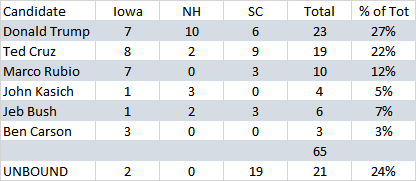
So, to recap: the likelihood is that even after March 1, no candidate will have even so much as 1/4 of the total delegates required to ensure the nomination, and the leader in popular vote could well be trailing in total delegates. This is despite that by then, 19 states with 554 delegates will have voted. This is how you get to a brokered convention.
Of course, there’s been a lot of talk and speculation regarding the possibility of a brokered Republican National Convention. To date, I haven’t heard anyone mention the possibility of a brokered Democratic National Convention. But the possibility exists, and the longer Bernie Sanders remains in the race, the greater the likelihood becomes. The reason has to do with the DNC’s “superdelegates.”
Unlike the potential Republican fiasco, the Democratic one would result from a direct divide between the party elders and the base. The elders (quite correctly, I think) do not believe that an avowed socialist can win the Presidency and thus have bet on Hillary Clinton as their standard bearer. Their primary process includes not only voted delegates, but also some 700 superdelegates. These are members of Congress and other party faithful who may vote for whomever they choose at the convention. Effectively, this means for Sanders to win the Democratic nomination outright, he needs to win the state delegates by a 701 vote margin.
Currently, Sanders holds a slight edge in awarded delegates, 36-32. However, to ensure the nomination, he needs to garner around 59% of the remaining at-large delegates. That’s a tall order. Partly because the Democrats have as many quirky state rules regarding how delegates are divvied up as their Republican counterparts, and partly because winning 59% of the electorate in any election is a tall order. Assuming Sanders does well in Nevada and better than expected in South Carolina, the possibility becomes much more likely that Sanders does wind up winning the popular vote among Democrats – but falls short of the delegate count required to secure the nomination.
If Bernie enters the convention with a lead in declared delegates but not enough to secure the nomination, you will have a brokered convention. The party elders will be faced with a grim choice: do they cast their ballots for Hillary, angering the rank-and-file members of their party? Or do they acquiesce to the popular vote and back Bernie? The floor fight might well be reminiscent of 1968, along with the attendant mayhem.
One thing is for certain. Regardless of whether these scenarios play out or not, this is an election cycle that won’t soon be forgotten. I expect the nastiness, vulgarity and personal attacks to intensify the longer the campaigns roll on without a clear victor. Strap in, it’s going to be a long ride until summer!
Let Trump Walk
Have we ever been here before?
Have we ever had a candidate for President who thought himself so far above the process that he felt as though he should dictate the terms of a debate? Who throws temper tantrums when he doesn’t get his way? Who treats the body politic as if it were there solely for his personal gratification?
None that I can recall.
Here’s my suggestion to the RNC: let him walk. If he wants to mount a third-party bid, let him. Do not fear him and do not fear his minions. Those mindless, spineless fools are not your partisans. They inhabit the same criminal, delusional world bereft of morals and moral fiber as their champion. Better to be a minority party of principle than a minority party led by a buffoon.
But make it plain. Be sure to put it in words that even the charlatan can understand. Failure to respect the American citizen and the Republican party means you are NOT on the ballot in any Republican primary or caucus. Being a rich boor will get you nothing but treated as a wealthy crank. He wants respect? It is time for him too start respecting us. Too many good men have died for our nation and our freedom to willingly give it to a slumlord sleazeball.
Otherwise, good-bye. And good-riddance.
Trump
 Our nation is in great trouble and we seem to have lost our collective minds as a result. Rather than focusing on actual solutions to the things that need solutions, we’re gravitating towards creating even greater problems that may well prove unsolvable. The very dissolution of the Republic is foreseeable in these circumstances.
Allow me to explain. We are fortunate in that we get to choose the people who create and enforce our policies and laws. It’s both a privilege and responsibility. Yet, too many of us do not see it as the grave responsibility to our fellow citizens that this opportunity entails. We do not participate in the process, or when we do, we do not take the time to understand the choices or the people we’re entrusting to make those decisions.
It’s been festering for more than a generation, this lack of civic responsibility. Our founders envisioned a democratic republic and provided the tools required to see that vision through. Even the greatest calamity to strike our nation, the Civil War, wasn’t a result of a failure of those tools. It came about from a deficiency in the nation’s moral character that couldn’t be solved by earnest debate. Yet, even the earnest men of the 1850’s would be shocked to see what has become of us. At the way so many of America’s citizens no longer care enough about the national character to do more than rant, rage and fire off a few nasty tweets.
Which brings us to the current election. At one time, there were 21 declared candidates for the Presidency of the United States. Twenty-One. Amazingly, none of those candidates has been able to elucidate a plan for how the country moves forward while handing the problems we currently face. On the Democrat side, we are given the choice of a septugenarian who wants to return a system of governance thoroughly discredited 25 years ago or a person of such low character that threat of indictment for corruption, murder and treason casts a gloomy shadow over her campaign.
The Republicans haven’t been any better. That the leading contender from that side of the aisle is nothing more than a self-aggrandizing carnival barker should be immensely obvious to even the most daft among us. Yet, somehow it escaped the millions pledging their support that the very character flaws they’ve spent the past eight years deriding the current president for, their champion exhibits.
This is beyond whether the Trump is a conservative or a liberal. This goes straight to our own deficiencies as a society. After all, if we weren’t as morally bankrupt as we’ve become, a third-rate reality TV personality, devoid of ideas and unable to even identify the real threats to the nation, would have been exactly what he should be: a public laughingstock, chased from the political process before the first chill winds of autumn blew. Instead, the modern day PT Barnum continues on, dragging the nation closer to self-immolation with every nonsensical statement he makes, egged on by a hallelujah chorus of sycophants unable to see the danger he represents to their own well being.
“Wait!” you cry. “The Trump speaks the truth I know, when no one else will!” you lament.
But does he?
His entire campaign is based on playing off the legitimate fears of the American people, and the continuing inaction of the Powers That Be to address them. A lackluster economy, a growing terrorist threat and changing mores have all left middle America wondering what happened, and left those who want to be led looking for what they perceive as a strong leader. Trump, whose entire life was built around being the ultimate huckster, the shyster, the carnival barker, selling himself in order to sell his services, is tailor made for this pathos. Ideas and thought are minimized; all that matters is being that perfect reflective surface in which everyone can see the things they want to see. It is Bill Clinton’s “I feel your pain” mantra on steroids. It is as fake as the winter is long. It is the proof that perception can be reality.
Were that all there was to Trump, we would survive (albeit not without pain). But what makes him far more dangerous to the nation is not campaign style nor the way he’s hoodwinked so many of you. We’ve survived empty suits in the Presidency before. We’ve even thrived with some. No, the danger of Trump lies in his history and the few policy positions he has taken. The Trump continuously demonstrates a Machiavellian tendency to get his way. Combined with his proposed solutions to America’s situation, you should be quaking at the very thought of a Trump presidency.
Those solutions are, at best, extra-constitutional. The electorate is supposedly upset over the last two administrations’ use of the Executive Order as a way to get around the Congress and enact policy against the will of the Congress and the people. Yet the idea that you would now support, unequivocally support, a man who plans to use that questionable instrument as a sledgehammer must be acknowledged. Too few of you have bothered to understand what Trump says, and what it means in practice. You do not want to hear that enacting those policies can only happen by suspending the Bill of Rights, a declaration of martial law, and the end of the United States as the world’s preeminent moral compass. In your rage and impotence, you cling to the megalomaniac and the promise of stability. Little do you realize that attaching the nation to the whims of one such as Trump will bring us all to ruin.
So please, by all means, vote for Trump. Just remember that when you do, you aren’t just pulling on a lever in the voting booth. You are also pulling the handle on the toilet and flushing the United States of America away.
Honoring Homeless Veterans

(Author’s note: I originally published this post in November, 2014. Now that the Northeast Corridor is bracing for the first major storm of this winter season, it seemed a good time to remind everyone that the problem hasn’t gone away)
On any given night, some 50,000 veterans end up spending the night outdoors or in a homeless shelter. Additionally, there are estimates that as many as 1.4 million veterans are at risk of becoming homeless.
In a nation where politicians trip over themselves to prove how much they care about veterans, this should be impossible. Yet the facts are what they are. Men and women who’ve sacrificed years of their lives in defense of their country often find themselves reduced to begging for scraps of food and a bit of shelter. The reasons for veteran homelessness mirror those in the general population: mental health issues, substance abuse and just plain bad luck top the list. But if any subset of the population has earned the privilege of not freezing on a winter’s night, veterans should.
The VA, for all of its shortcomings, actually does a reasonable job of trying to care for homeless veterans. But funding remains an issue. For instance, there is the VASH-HUD program, which provides homeless veterans with housing vouchers and community support (such as job assistance and counseling). It has proven to be one of the best homeless programs in the country with less than 5% of the veterans accepted returning to homelessness within 5 years.
For FY2014, VA was granted funding to assist 78 homeless veterans in New Jersey. 78. For the entire year. I can go to Military Park in Newark and find 78 homeless veterans.
But there is a solution, and one that would actually save the government money in the process. All across the United States, sequestration and other budget cuts have resulted in hundreds of military bases being closed. They sit, abandoned, awaiting a government auction where the property will be sold for pennies on the dollar. In New Jersey, Fort Monmouth sits abandoned, falling into disrepair while the former megabase of Fort Dix/Lakehurst Naval Air Station/McGuire AFB occupies 10 1/2 square miles in the New Jersey Pinelands, struggling to find a purpose after the 1991 base closures. Today, it is used a training area for National Guard and reserve units, with a federal prison and aircraft maintenance wing. Fort Monmouth once housed 21,00 troops; Dix-McGuire 27,000. On both bases, the buildings sit, more intact than less.
The proposal is this: turn a portion of either base (and the dozens more around the country) into a Veteran’s Homeless Prevention and Community Reintegration Center. Rather than hiring outside contractors to maintain the buildings, grounds, power stations and the like, assign those jobs to the veteran population living there. That would solve two problems that are often at the heart of veteran homelessness: a lack of civilian job skills (infantryman isn’t exactly a skillset required on Main Street) and providing a sense of purpose. Rather than requiring the VA to provide follow-up care on veteran’s scattered throughout the state, they would be centrally located: a VA clinic could be opened there, proving treatment for medical and mental health issues. Finally, rather than spending up to $25,000/year in housing vouchers per veteran, the government would roll that money into a facility it already owns.
Everyone wins. Homeless veterans find shelter, camaraderie, purpose, services and the opportunity to reclaim their lives. The government honors its promise to “care for him who shall have borne the battle.” And our nation’s citizens can rest easy in their beds at night, knowing that no veteran needs to sleep on a sidewalk.
BAD NEWS: For Republicans
It seems the Donald is about as electable as limburger cheese on a hot day.
 Political Baseballs