
So Much For That
 President Obama’s “Son of Stimulus” (aka the American Jobs Act) is already dying the slow, tortuous death of a thousand paper cuts. And for good reason: the majority of Americans don’t buy the President’s latest smoke-and-mirrors plan. After all, stimulus was tried in 2009 and failed miserably. We were assured that spending nearly $800 billion in direct stimulus, plus billions more for “cash-for clunkers,” the automotive industry bailouts and banking industry bailouts would curb unemployment to 8% and have us under 7% by this point. More telling than the fact that was a terrible overshoot, is that nobody in the administration is willing to put any kind of number on how many jobs this latest round of stimulus would create. I doubt anyone in the White House actually believes this would really do much for the economy.
Americans intuitively understand that stimulus spending doesn’t really do much, except exacerbate the underlying cause of our economic malaise. Economists will tell you that the reason we’re in such a mess is because consumer demand – which fuels around 70% of total economic activity – is depressed. If only that were true.
The real cause for depressed sales is much more basic: people can no longer afford to buy consumer goods. They still want iPads®, flat-screen TV’s and new cell phones. But when they sit down with their bills each month, they aren’t willing to incur new debt to purchase them. After all, the debt frenzy that drove the last 20 years of economic growth met its inevitable end with the financial collapse of 2008. We’re still busy digging our way out from that mess and until the typical household reduces their debt burden, don’t expect them to begin spending again.
The same goes for government. The massive expansion of federal debt leaves Americans feeling equally queasy – after all, we just learned a valuable lesson about what happens when people and companies are over-leveraged. When public debt exceeds the total value of the economy and projected spending continues to go up, not down… Well, let’s just say we aren’t interested in finding out if an over-leveraged government can suffer the same fate as an over-leveraged household.
Death Spiral Debt Deal
As I’m sure we’re all aware, the major political players in Washington agreed to debt ceiling deal last night. Reuters has a terrific breakdown of the final deal here. I’m not happy with this “deal” at all and if I were in Congress, would certainly vote “No” on passage.
Why? Simply put, this agreement does absolutely nothing about either the current deficit or the even larger problem of the national debt. In fact, passage guarantees that the debt will double over the next decade. And just for grins and giggles, there are also some really rosy ideas about anticipated economic growth baked into the framework – ideas that in light of last week’s GDP reports are proven to be a complete sham.
Let’s start with the sham of an idea that this deal somehow trims the deficit. The only guaranteed cuts in the whole package are for FY2012 – and they total all of $6 billion. Even if you use the overly-optimistic CBO estimate of “only” a $1.049 trillion deficit for FY2012, that amounts to about ½ of 1% of the deficit. To put this in perspective, it’s the equivalent of the average American cutting their total annual spending by $37.85, or the typical price for a dinner for two. This is every bit a dog-and-pony show, not budget cutting.
Secondly, this deal does little to curb long term spending, either. The final total of $2.4 trillion takes place over the remaining 9 years. However, the combined deficits over the next decade are forecast to equal another $13 trillion. That would bring the national debt to a total of around $28 trillion by 2020. Even if future Congresses don’t reduce that $2.4 trillion in deficit reduction (good luck with that), the federal debt will amount to $25.6 trillion in 2020. This package doesn’t do anything to actually begin reducing the debt. Only in Washington could a package that will grow the federal government’s debt obligation by 77% be considered a “debt-reduction plan.”
Finally, there’s the kabuki-theater method of arranging these “cuts.” Part of the reduction comes from presupposing that the Pentagon can find $350 billion in cost savings as a result of the wars in Iraq and Afghanistan ending. The deal-makers completely ignored the fact that we recently got involved in another war in Libya and also imagine that we won’t get involved in any others before 2020. I would like to go on record now as believing in the tooth fairy and unicorns, since those are less farfetched assumptions. There is a “super committee” that’s supposed to recommend budget cuts on a straight up-or-down vote; failing that, across the board reductions in all government programs. Well, almost all – federal employee pay, Medicaid, Social Security, welfare and veteran’s benefits are excluded. Considering we’ve already had 16 deficit committees in the past 20 years, each of which has said that the principle way to reduce the debt is to transform entitlement programs – and this deal exempts most of them from automatic cuts – how successful do you suppose this one will be? Expect another political dog-and-pony show, only this one should be a spectacle that would make PT Barnum proud. After all, it’s taking place during an election year. The posturing and grandstanding over recommendations that have no chance of passing both Congressional houses will liven up campaign ads and the evening news, but mean nothing.
So, no, I can’t support this deal. It just lends further proof that Washington is run by inept morons and snake-oil salesmen.
A failure to communicate = a failure of leadership.

Paul Newman as Cool Hand Luke
One of my favorite movies is Cool Hand Luke. In the movie, Paul Newman plays the title character, a WWII hero turned petty criminal who refuses to accept that any man has authority over him unless he grants it. His nemesis is the prison warden (“Captain”) who is determined to break Luke’s spirit. During one memorable scene, after Luke’s capture from his first prison escape, “Captain” delivers the line
“What we got here is … failure to communicate”
Lately, I’ve been getting the feeling that Barack Obama would be excellent in the role of “Captain.” He certainly seems determined to break the spirit of the American people – and then blaming us for his failures. He scold us about the economy almost daily: “Well, you know, I inherited the worst economy since the Great Depression and…” Yes, Mr. President, we’re well aware of what your policies have done to the economy. You took 5% unemployment, sprinkled some of your pixie dust and
*POOF*
all the jobs disappeared. That pixie dust was mostly made of tripling the deficit, selling it by telling us that unemployment wouldn’t cross 8% – but without all of that extra debt, the economy would certainly tank. Fast forward 18 months to the mid-terms. Faced with a soul-crushing economy and an American people distrustful of your policies (not atypical for people who’ve been lied to), you took to blaming… not the message (something about cars and ditches) and not the messenger (because we’ve all been told what a terrific orator you are) but the American people (because we’re too stupid and too busy clinging to guns and religion to understand how good we have it). Then you seemed dumbfounded when your party and their crazy ideals of “spreading the wealth around” got chucked out on their butt.
“What we got here is … failure to communicate”
Fast forward another 8 months and once again, we’re being assaulted by daily pronouncements from the Annointed One. This time, the debt ceiling has been reached. After weeks of having our senses assaulted by your minions telling us the sky will fall come August 2nd, we’re nearly at the appointed day and time. Never mind that this sort of thing generally gets hammered out in the underground corridors of the Capitol; you had to create a crisis. The reason? Apparently to lecture us idiots on the necessity for higher taxes and more spreading the wealth around, only this time couched as “sharing the pain.” Only this time, not even the denizens of your own party are believing that straw man any longer. Every American you talk to is pretty certain that the economy can’t get much worse, but the one thing we can do to ensure that it does is listen to your proscriptions. I guess the TV performance last night was meant to scare the US populace into adopting a plan that nobody has written down anywhere (one heavy on your usual bromides), instead of allowing the House and Senate to haggle out the differences in their resolutions.
Yep, Mr. President, I’m certain that come August 3rd, you’ll be out there blaming us poor, ignorant, ordinary folk for not understanding why you’re the best thing to come down the pike since sliced bread. I’m certain you’ll be comparing your role in the debt crisis with that of Leonidas of Sparta. (You know, valiant last stands no matter the personal cost, blah, blah, blah). In reality, all this episode has proven again is that you can’t lead from behind. Oh, and that for all of your awesome rhetorical abilities…
“What we got here is … failure to communicate”
King Leonidas

On Libertarian Government
 One thing that never fails to amaze me is the reaction I receive from people when I describe my politics as Libertarian. I think it shows how remarkably uninformed the American people are regarding their history, their civics and their individual roles in government. I find myself wondering what Abraham Lincoln (16th President, saved the Union, etc) would think about modern politics and the modern citizen. Lincoln’s primary goal during his term was not to end slavery. While slavery was an underpinning issue of the Civil War, the real reason it was fought was eloquently expressed during the Gettysburg Address:
“…that this nation, under God, shall have a new birth of freedom—and that government of the people, by the people, for the people, shall not perish from the earth.”
Stop to consider those words for a moment. Let them roll around in your mind and ponder their significance. Lincoln considered the preservation of the Union to be paramount; of greater importance than ending the great immoral stain left behind the Founding Fathers. This is the essence of Libertarianism and is counter to the views of most of my fellow citizens, who see Libertarians as being one step from being anarchists. But Libertarianism is actually more aligned with what the media refers to as the “center,” some amorphous grouping of Americans that believe that while government has a role in our lives, that role should be minimalized to the greatest extent possible. We believe in Liberty – not just the ideal of liberty, but the pursuit and practice of Liberty. What’s more, we believe that a government that is supposed to be of the people, by the people and for the people cannot fulfill that role if it becomes bigger than the people. The people then become subsumed by the demands of government –the delicate balance envisioned in the Constitution, the Declaration of Independence and the Federalist Papers is upset. Rather than the a representative republic, the governmental form is turned into something else – a government oppressing the people, by the government and for the government.
Libertarians look at the proper role of government as being like a three-legged stool.
First, government acts as the final arbiter of disputes among people by imposing guidelines based on common morality, while not restricting anyone’s individual liberty. Wait, you say – morality implies religion, so are you implying that government applies a religious principle? No, not hardly. Morality can come from religious faith and certain moral codes are common to most religions (such as provisions against murder or theft). But a common morality is determined by a given society in general. So, while my particular religion considers certain actions to be immoral, general society does not. It is government’s role to say this is the general consensus. And in a well-informed society, impertinent changes to a society’s moral code as represented by the government’s actions are remediated by selecting new representatives. In this way, government does not establish rules of conduct for society and does not impose the will of any group or individual on any other.
Second, government is charged with ensuring the defense of society from those that would harm the society. Most people understand this to mean the defense of the society in cases of armed conflict. But more than that, it also refers to defending a society from internal destruction. Because this is such an awesome power the people cede to their government – the ability to force or coerce a course of action – the Founders took great care to ensure that the application of such force had multiple checks and balances, as represented by our three-headed government. I suspect they would be greatly troubled by the amount of power the Legislative branch has yielded to the Executive over the past 70 years.
Finally, government is responsible for ensuring that it remains the servant of the people and that the people are not the servants of the government. This is a difficult proposition, since it essentially means governments are required to be answerable to society in all cases. As enshrined in our Declaration of Independence:
“We hold these truths to be self-evident, that all men are created equal, that they are endowed by their Creator with certain unalienable Rights, that among these are Life, Liberty and the pursuit of Happiness. — That to secure these rights, Governments are instituted among Men, deriving their just powers from the consent of the governed, — That whenever any Form of Government becomes destructive of these ends, it is the Right of the People to alter or to abolish it, and to institute new Government, laying its foundation on such principles and organizing its powers in such form, as to them shall seem most likely to effect their Safety and Happiness.”
And so, we accept that in cases where government no longer abides by the first two principles, the third allows the society to overthrow the existing government and replace it with a new one.
For Libertarians, the problem with modern government is simple and two-fold: first, society has ceded too much power to government and allowed it to infringe on individual liberty, on any one person’s ability to be who and what they desire to be. Second, the Legislature has ceded too much of its power to the Executive. The result of this is that government is no longer responsive to society, but rather to powerful elements in society. And on those rare occasions when society demands a change in course by exercising its power on the Legislature, they find themselves stymied by a too-powerful Executive.
Tomorrow, we’ll delve into the practical implications that rose from America’s abandonment of Libertarian government –and how we’re still living with those implications today.
Keynesian Kops

The Obama Economic Plan
Back in the silent movie days, a popular serial involved the escapades of the Keystone Kops. They were a frenetic bunch, but ultimately so incompetent they couldn’t do much of anything. They would run this way and that, stumbling about and generally more successful at running into walls and slipping on banana peels than solving crimes. As a vaudeville act, they were hilarious. As a police force, not so much.
Watching economists from the Keynesian school is a lot like watching those old silent films. They trip over each other in explaining why the economy is moribund and what should be done about it. Never mind that everything in the Keynesian playbook has been tried (and predictably, failed). Fiscal stimulus: over the past 30 months, the federal government has pumped in $2.5 trillion over and above previous spending levels – and GDP is declining after inflation, not growing. Monetary stimulus: the Federal Reserve burned through two rounds of pumping cash into the economy. No growth, but inflation is growing exponentially each quarter. Now the Fed is planning on QE3 – pumping even more cash into an economy that has more cash than can be spent.
Keynesians love to point out that their economic theories are borne out by their successes in the Great Depression. But that assumes that those policies were successful. It seems pretty doubtful that they were. For instance, here in the US, the government did manage to achieve an aggregate GDP growth rate of 9.68% between 1933 and 1940. But in order to achieve that growth, the federal government increased spending by 110% from 1932 levels. In raw numbers, the government spent just shy of $61 billion during those 7 years. But GDP only grew by $47 billion. Remove the government spending, and the economy actually shrank by 26%. That’s a pretty dubious success.
In fact, that’s exactly what happened in 1937: Congress slashed spending, and the economy promptly declined 4.64%. Rather than create sustainable growth, all that government largesse accomplished was an economy that was reliant on government largesse. Entrepreneurship, innovation and efficiency were replaced as keys to success by graft, corruption and political machines. (There was a reason Frank Capra’s Mr. Smith Goes to Washington struck a nerve when released in 1939).
Equally important – and hugely different – from today is the amount of debt headroom FDR had when deciding on a Keynesian approach. In 1932, total federal debt amounted to 51% of GDP. By 1940, that had risen to 71%. In 2008, total debt was already approaching 100% GDP and we’ve since surpassed that.
The liberal wing of politcracy wants a return to full-blown Keynesian economics. If we go down that path, by 2020 the federal government will account for 8 out every 10 dollars spent in the US – but the government will need to borrow 9 out of every 10 dollars it spends.
Maybe our President thinks that kind of vaudeville act is one worth emulating. But I doubt many other Americans agree with him.
The debt ceiling is falling!
One thing that the popular media keeps forgetting about in their reporting about the debt ceiling negotiations: the sky will not fall and the US has no reason to default if a deal isn’t reached by August 2. That date was created out of thin air by Tim Geithner and I’ve been wondering what, exactly, his criteria is for that date. Aside from trying to get the story off the front pages of the newspapers before September, that is –which is traditionally when the general populace begins to seriously pay attention to the world of politics.
The chart below (courtesy of the Treasury Department) outlines the projected cash flow for the United States during the month of August:

The black line represents the money coming into the treasury, assuming they can’t borrow another dime. The bars represent the cumulative day-by-day expenditures. Note that on every single day for the month, spending on Social Security, Medicare, Defense and the debt interest is covered. What isn’t covered is what we commonly refer to as discretionary spending. There is a reason for that – discretionary spending isn’t necessary. Just like you might eliminate dining out or your Netflix subscription if your personal budget didn’t have the cash to cover them, these are the programs that are nice to have – but aren’t essential to a functioning country.
So when the President dramatically raised the stakes yesterday by suggesting that old-age pensioners won’t receive their Social Security checks, he prioritized a chunk of discretionary spending over Social Security. If you or I did that, we’d have to answer for that in a bankruptcy court. This is President Obama at his finest: threatening the most vulnerable – and vocal –constituency when he isn’t getting his way and looking to score political points.
Based on the Treasury’s own cash-flow predictions; we wouldn’t face the prospect of a default until mid-October. Even then, the federal government could do what a large number of the states are doing now: put off paying federal contractors for 180 days (among other programmatic delays), which would allow Washington until next April to hammer out a budget. (Irregardless of the fact one was due two weeks ago for FY2012 – and we still don’t have one for FY2011). I’m not sure where Geithner is getting his information, but I’m beginning to think it’s directly from David Plouffe.
This isn’t to say raising the debt ceiling won’t be required at some point. It will. But the Republicans should stick to their guns and insist that any rise in the ceiling be accompanied by budget cuts, both immediate and long-term.
Spending is the problem

Now, Wait a Minute!
President Obama has finally realized the federal debt is a real problem, not something that can be pushed off for another decade or so. I’m not certain what woke him to a fact millions of Americans already understood, but welcome to the party, anyway. Unfortunately for the country, he seems obsessed with the idea that the reason our debt problem is crucial is because the federal government doesn’t have enough money.
On the one hand, the President is right when he says that federal revenues are lower than at any point in a generation. In 2011, the government is on pace to gather less than 30% of the nation’s GDP in revenue for the first time since 1983. But the reason for that isn’t because tax rates are too low – it’s because despite all of those reassurances that the economy is recovering, it isn’t. After adjusting for inflation, real GDP growth has fallen to less than 1% and is in real danger of turning negative. Add in the fact that that the economy is now 14 million jobs short of full employment (vs. 8 million when he took office), and it becomes pretty easy to see where the revenue shortfall comes from.
In traditional Democratic fashion, the President’s answer to the economic malaise has been to throw as much money as possible into the economy. The results have been disastrous. Deficit spending as a percentage of GDP during his tenure is running higher than at any point since the closing days of WWII. Since 2009, the federal deficit has averaged 9.91% of GDP, the second highest three year average over the past century. Only the period from 1944-1946 saw a higher level of deficit spending, at 24.02%. But besides the obvious (we were spending to save the world then), there are two marked differences between that period and this one:
- The US GDP accounted for close to 80% of the world’s total economic output. Europe and Asia were bombed out ruins and wouldn’t actually see real recovery for another 15 years. Africa and South America were not industrial or economic centers. Much of that debt was racked up as loans to our allies and repaid by the mid-1960’s. Today, the US is now less than 30% of world GDP and projections show us steadily losing share over the next decade. We face the prospect of having to pay much of our debt to overseas lenders, while at the same time having fewer assets with which to pay them.
- All of this new spending is taking place on top of what was already a huge debt burden to begin with. At the advent of WWI, the total federal debt – even with New Deal spending – stood at 67.62% of GDP. When the current recession began in 2007, debt stood at 85.53% of GDP. Today, we’re at 129% of GDP –the only time it was higher was from 1946-48. But by 1950, debt was down to 97.7% of GDP and by 1960, 70.51%.
The President has spent much of his time screaming from the mountain that the tax cuts enacted under his predecessor (which he voted for, by the way) are the leading cause of our current deficits. But he should re-check his math: in the 6 years after their passage prior to his assuming office, federal deficits averaged 2.04% per year – roughly one-fifth of the deficit spending under Mr. Obama. And federal revenues averaged 33% of GDP, slightly higher than the average for the previous 20 years (32.7%). So where is the discrepancy? If those tax cuts actually produced more revenue, why are deficits exploding?
The answer is completely on the spending side of the equation. Under President Bush, federal spending averaged 35.08% of GDP. Under Presidents Reagan, Bush Sr., and Clinton, federal spending averaged 34.83% of GDP. Under President Obama, federal spending has averaged a whopping 40.72% of GDP. For historical perspective, under President Roosevelt spending averaged 27.62% and under President Johnson (who also fought an unpopular war and greatly expanded social services) federal spending averaged 29.82% of GDP. In fact, the US government didn’t begin spending more than a third of our GDP consistently until the Carter administration.

In short, the President can stop with all his nonsense about needing to raise taxes. If he wants the nation to take him seriously when he says he wants to balance the budget, then he should start by simply bringing spending back down to the historical levels for the previous 30 years. That won’t solve all the nation’s economic ills, but at least that’s the starting point for a rational discussion.
Local Economics, Local Politics
When I moved my family to the NYC metro area 8 years ago, this seemed like the perfect neighborhood. Housing was relatively inexpensive, the neighborhood mix in terms of blue-collar and white-collar types, and a true representation of the American melting pot. Crime was low, the schools were better than average. In short, my town (and my neighborhood, especially) are about as representative of as you can find, with one glaring exception: this place is as solidly Democratic as anywhere in the country. The Republican party is virtually non-existent in the county and there is no local Republican organization.
I got to thinking about this yesterday after seeing one of my neighbors put a Mitt Romney sign in his yard and reflecting on recent conversations with others. There is palpable anger and despair with the current administration – anger and despair that emanates from the economic morass that Kearny, like so many other towns, finds itself stuck in. There’s a well-worn adage, coined by former House speaker Tip O’Neill, that “all politics is local.” There’s another equally well-known political saying, created by political consultant James Carville, that says “it’s the economy, stupid.” And after listening to my friends and neighbors, I found myself wondering just how exactly President Obama can win re-election. In a town where he holds an irrefutable edge in organization, he’s losing the local citizenry. And he’s losing that edge for one simple reason: the economy.

President Clueless
There’s the guy who owns the local bodega. He scrimped and saved to send his son to Columbia Law School. Despite graduating with honors and clerking at the Bronx DA’s office, his son cannot find permanent work. And thanks to the fact that nearly half of my neighbors are unemployed, his business is foundering. Where once he used to hire one or two local kids to help stock shelves, he hasn’t hired anyone. Instead, he has his cousin – an out-of-work software engineer – doing those tasks.
There’s a guy on my block who lost his job a month ago, because the company he worked for hasn’t had any new business in over a year. Despite more than 20 years working as a master stonemason, he is collecting unemployment for the first time in his life. He can’t find work. He’s falling behind on his mortgage. And he’s worried.
Around the corner, there’s a Brazilian restaurant that has cut back on their hours of operation and laid off half the staff. The woman who owns the place is in shock – three years ago she had a booming business ( you couldn’t even get a table without an hour wait) and even opened a second restaurant. Last week, she had to borrow money from her son just to turn the lights back on. She fully expects to have to shutter her business by September if conditions don’t improve.
Two doors up is a guy who owns a bakery. Every night, he leaves for work around 9pm. Last summer, he laid off his delivery driver and took to doing the deliveries himself. This summer, he’s been handing out free bread throughout the neighborhood – because orders are getting canceled at the last minute. While I’m grateful for the free bread, I wonder how much longer he can keep his ovens fired up at this pace. So does he.
After being vacant for two years, the house next door to me finally sold in May. The previous owner paid $378,000 for the property. The bank initially offered it at $290,000. The final selling price: $118,000. The new owners are excited. The rest of us looked at that selling price and weren’t quite so happy.
Down the street is an accountant I know. He got laid off in the bloodbath that was the Fall of 2009 and hasn’t found permanent employment since then. He’s surviving by taking much lower paying, no-benefit contract positions – a far cry form his former $100K salary. Where once he dreamed of sending his daughter to Princeton, the recent graduate is now headed to Hudson County Community College. And without a car – they had to sell her 17th birthday present back to the dealer, since they couldn’t make the payments.
These are just a few of the stories from my neighborhood. And as the anger seethes and despair grows, I can’t help but wonder if the President realizes he’s on a path to be remembered in the same vein as Jimmy Carter and Herbert Hoover. All because he forgot that all politics is local, and it’s the economy, stupid.
The Jury Got It Right
A little more than 24 hours have passed since the Casey Anthony trial ended with what most people see as a travesty of justice.
I happen to think the jury got the verdict right. Don’t get me wrong – I think that Ms. Anthony is guilty as hell, in some fashion, with the death of her daughter. However, American jurisprudence requires two things of a jury:
- The defendant is presumed innocent, regardless of the nature of the crime, intensity of media coverage or other outside factors.
- The prosecutor must prove beyond reasonable doubt that the defendant is guilty.
Where are the jobs?
Something to chew on over the next few days:
According to Keynesian economics, all of this government spending over the past few years should have led to an explosion of job growth. After all, since 2008 the US Government has ballooned the debt by an annualized rate of 17.47% or about twice the rate of growth over the previous decade. But the jobs aren’t coming. This first graph shows the rate of employment vs. total working age population:
Table 1: May Total Employment Ratio

Notice that the percentage of working age people now working has dropped and kept dropping like a stone, despite all of that spending. In fact, the last time this few people had jobs was in 1982 – and prior to that, 1956, when farm payrolls were significantly higher than they are now. Now for the second half of the equation, part time employment vs. full time:
Table 2: May Employment Type Ratio
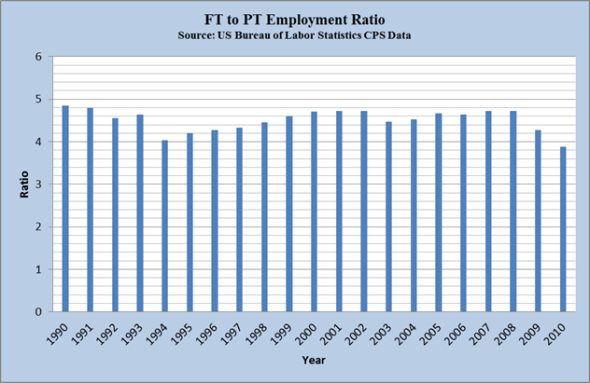
Fulltime employment has also continued to decline. Of course when you realize most of this recovery job “gains have been in retail or service industries, that shouldn’t come as a surprise. Still, the ratio now has dropped below4 FT employees per PT employee, territory we’ve never seen before. You can’t sustain a recovery on the back of McJobs. Right now, if you run the numbers, only 47% of working age Americans have a full-time job. If you’re shocked, you should be. The last time the number fell below 50% was in 1933.
If Barack Obama thinks this is the way towards recovery, he needs a new navigator.
Whither the Recovery?
For an economy in recovery, depressing economic news is all around us, it seems. In the past few weeks we’ve been told our home values have declined to 2002 levels. Unemployment ticked up to an official 9.1%, although the majority of non-governmental analysts tell us the real unemployment number is closer to twice that. More Americans are losing their jobs, as 7 of the past 9 weeks have seen new unemployment claims exceeding 400,000. For the fortunate few who are able to find work, they are winding up in the McJob industries. Of the 54,000 jobs created in May, 62,000 were actually McDonald’s hires.
You do the math: McDonald’s hired 62,000. Take away those menial, low-paying, no benefit jobs and the economy actually lost 8,000 jobs. For anyone aspiring to middle class, a McDonald’s job is not exactly high on the career path, either.
We’re told that economic growth has been muted. The truth is, there hasn’t been any real economic growth during the Obama administration. What we’ve experienced is a decline in the rate of recession. In other words, we’re still in an economic slump, it’s just not as bad as it was at the end of 2008. Let me explain, using the charts below. First, is quarterly GDP or the net worth of all goods and services produced:
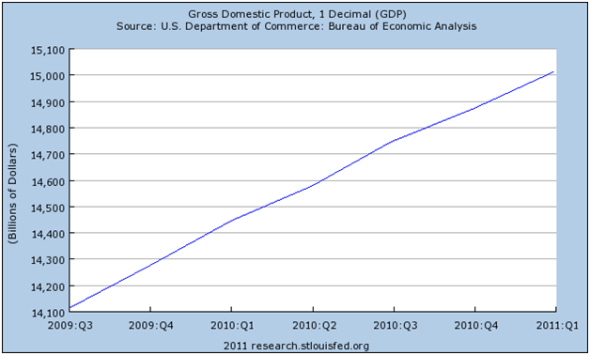
Yes, that’s right. In the 6 quarters the US economy has been recovering, the net gain in GDP amounts to $900 billion. Under the technical definition of a recovery, even this paltry real rate of growth (about 1% per quarter) qualifies. Yet, inflation over that period remained higher than the growth in GDP. Mind you, these are the Fed’s own numbers:

Why is this notable? If inflation is growing faster than the value of goods and services, then GDP growth has come as a direct result from inflation. In fact, if you readjusted GDP growth to account for inflation, you get this:

And if you look at the growth curve over this same period, you get the dreaded upside-down smiley face:

We’ve never actually any real growth, despite what the spinmeisters in Washington would have you believe. When accounting for the effects of inflationary fiscal policy by both the government and the Federal Reserve, the best the economy has managed is two quarters without decline. The next time you find yourself wondering where the “recovery” is and why it’s left you behind, don’t feel so bad.
There never was one.
I Shed a Tear (orig. posted Memorial Day, 2010)
I originally posted this on Memorial Day, 2010, but the sentiment is the same. As you head out to the beach, the barbecue or the ballgame today, please take a moment to remember why you have this particular Monday off from school or work.

I awoke this morning to thoughts of old friends who left us too soon. It’s not an unusual occurrence; most mornings I wake thinking of the same men. When they died, they did not give in to fear; cowardice was not these men’s forte. Some died in battle, some preparing for battle. Two very good friends of mine died not in battle, but the wounds they sustained in defense of liberty hastened their untimely departure from our world. One man was known simply as Tank. He was a large man, but in his later years his body had been ravaged by the effects of two bullet wounds and prolonged exposure to Agent Orange during his two tours of duty in Vietnam. Today, I celebrate not only Memorial Day but the tenth anniversary of his passing. Although Tank never spoke of it, he was awarded a Bronze Star during his second tour. It wasn’t until his funeral that I learned how as a 23 year old platoon sergeant he ran back onto a hot LZ, taking a bullet in the back and one in the shoulder, in order to pull one of his men to the relative safety of a tree line. But anyone who knew the man wasn’t surprised to hear of his courage under fire.
This morning, as I thought of him, I shed a tear.
The other day, I watched my town’s annual Memorial Day parade. In addition to the Korean War and Vietnam vets, a detachment from the local Marine Corps reserve unit marched. As I looked at their eager young faces, I realized that most of those kids weren’t born when I earned my EGA in 1983. In fact, most of them hadn’t been born when I mustered out. Realizing that most of these young men will be shipped to Iraq or Afghanistan, I reflected on my own service. I joined to fight Communism, and like most of the world, I rejoiced when the Berlin War crashed to the ground. I truly thought my service had proven, in some small way, invaluable to the defense of the American way of life. Yet here I was, watching a new generation of Marines preparing to fight a new enemy. Had my service not been as valuable as I once thought? Had the men I had known during my service, men who had fought and died in battles around the world – had they died in vain? I decided that no, our service – their service – had been as important in our time as these brave young men’s service is today. And then I realized that none of those young men will return from their combat tours the same. Even if not scarred on the outside, even if they survive to return home physically intact, they will carry the memories of what they see and feel and endure for the rest of their lives.
And as I watched, I shed a tear.
Last night I watched the National Memorial Day Concert, broadcast from the National Mall on PBS. I listened as Gary Sinise and Dennis Haysbert recounted the final moments of Charlie Johnson’s life. I watched as a new generation of war widows were celebrated. I enjoyed the stylings of Brad Paisley. Like plenty of others, I rose to attention and sang the Marine Corps hymn during the Salute to the Services, and I rose to attention and sang again during “America the Beautiful.”
But many times during the concert, I stopped to shed a tear.
And I wondered, as I prepared to try and sleep, will anyone awake on Tuesday and remember the sacrifices of the men who have fought and died to preserve the United States? It’s terrific that we have a day set aside to pay tribute to those men. And I don’t mind that we celebrate by doing uniquely American things – backyard barbecues, trips to the beach, baseball games. But I wondered, when Tuesday comes will my fellow countrymen remember those who ensured that the backyard barbecues could continue?
A little earlier today, I went to the neighborhood bodega. It was a routine trip to pick up a few items needed for my own backyard barbecue. Like many veterans, I have a “Pride Hat.” You may have seen one perched on a veteran’s head – a baseball cap on which are pinned his campaign ribbons. Mine is nearing retirement. It’s 14 years of service are evidenced by its faded color and the only thing keeping it together are years of starch used to block it. As a result, I only wear it on special occasions. Today being one of those occasions, I wore it on my walk to the bodega. On my return trip, a neighborhood kid – maybe 6 or 7 years old – stopped me and said, “Were you really in the Army?” I smiled and said, no, I am a Marine and we’re better than the Army. The little boy sat on his bike for a minute, seeming to take in this bit of information. The he stood, and said “Thank you” before pedaling off down the street.
I shed a tear. In fact, I’m still shedding a few as write this. Because I have my answer. For as long as children like this can find my service honorable, they will keep the flame of liberty alive. In so doing, the most important thing we can do as Americans is to remember and honor the sacrifices that so many brave men have and will endure. We will continue to live as Americans, preserving our republic as the beacon of freedom and liberty for the rest of the world.
Why is Everyone Afraid of the Debt Ceiling?
One of the things we keep hearing from “establishment” politicians, economists and others is that the US entered into the Great Abyss yesterday afternoon. “The sky is falling” they cry. “We’re doomed” they yell.

This guy is broke - and so are you!
You see, the United States of America just crossed the Rubicon. The debt ceiling – the amount of debt Congress authorizes the Treasury to accumulate – has been reached. The great fear is that the US government is about to default on our public debt, sending the world into an economic vortex never before witnessed. Every talking head and government official in DC is warning against not raising the debt ceiling. “We’ve never defaulted on our debt” is the common cry of alarm.
I would certainly be alarmed at this outcry, except for one thing. It isn’t true. Not a single word of it. In fact, the nation has defaulted on the debt at least twice in our history. The first was in 1790, when we couldn’t service the debt we accrued during the Revolutionary War, among other things. The second was in 1933.
In 1790, the Treasury realized it could not possibly repay the outstanding loans the Federal government assumed after the ratification of the Constitution. The solution was to unilaterally rewrite the terms of those loans, reducing the interest owed and deferring payments for ten years.
The scenario most applicable to today is the one enacted by FDR in 1933. The government, faced with a debt it could not repay unless taxes were raised to incomprehensible levels and wanting to inject some life (i.e, capital) into a lackluster economy, devalued the dollar by more than 40%. The problem was that US bonds were issued in gold: you bought x amount of bonds in dollars and in return you received y amount of gold when the bond matured. The US didn’t own enough gold to cover the debt. The solution was Executive Order 6102, later codified as the Gold Reserve Act of 1934. It essentially confiscated all of the private gold holdings in the US (private citizens were allowed to have 5 troy ounces in their possession; or about $7500 worth in today’s standards).
The exact opposite of what we’ve been told by economists and politicians of all stripes happened: rather than market chaos and depression, the economy stabilized. Freed of the uncertainty spawned from over-indebtedness, the business community actually began expanding again. Yes, the Great Depression was so deep that it took additional government spending to make up for the slack in employment. But contrary to popular myth, it wasn’t the massive infusion of government capital with the outbreak of WWII that jolted the US to full productivity. By 1939, the nation’s economy was growing at 1928 levels again and by the end of 1940 had grown private sector employment to higher numbers than at the outset of the Great Depression. In fact, all of that debt from 1941-1945 precipitated a debt crisis in 1946 comparable to the one we’re now facing. Oh, and Congress took the appropriate actions then, too: they enacted a debt reduction plan that was adhered to by Presidents of both parties until LBJ’s “Great Society” spending in 1967.
Simply put: the US has defaulted on debt obligations before and the world went on as always. Look around you: the debt limit has passed, yet everything continues as on Monday. The real threat is that we continue to spend as profligately as a drunk sailor without any plan to tackle the debt. We can argue about the means to do so. We can inflate it away, as Russia, Argentina, Brazil – and the US in 1933 – did; we can unilaterally reorganize bond terms, as in 1790. We can reserve a greater share of federal revenues for debt service, as in 1946. We can even place tax increases and restructuring on the table. But scaring the citizenry about the implications of failing to to raise the debt ceiling is ludicrous, when raising the the ceiling is the most irresponsible thing the politicians now in Washington can do.
The Scarlet Knight to the Rescue?
The GOP is finally starting to get it’s act together. Some of the “headliners” are throwing their hats in the ring for the upcoming primaries. Over the past week, Newt Gingrich and Ron Paul have officially launched campaigns. They join Herman Cain, Tim Pawlenty and Rick Santorum as officially declared candidates. By this evening we’ll know if Mike Huckabee is running and by the end of the month, we’ll have Donald Trump’s decision. Mitt Romney hasn’t officially declared yet, but he certainly acts as though he’s in the race. Then there are those who are playing coy and may yet run, such as Sarah Palin, Michelle Bachmann, Jon Huntsman and Buddy Roemer.
Color most rank-and-file Republicans unimpressed by their options. Each of the above carries significant baggage. The staunchest conservatives, such as Palin, Bachmann and Santorum, have negative ratings among the general electorate as high – or higher – than their positives and are generally considered “unelectable.” Romney and Gingrich are know commodities but known for the wrong reasons, namely, they change positions so often they’re perceived as standing for whatever will get them elected. Pawlenty and Huckabee are seen by many Republicans as not being conservative enough. Paul is a libertarian at heart; his stances on drug and foreign policy leave many Republicans cold. Everyone else in the race is a virtual unknown – except for Trump, who’s considered so Loony even Bugs Bunny wouldn’t vote for him.
 So, the Republican base is still casting about for their dream candidate: someone who embodies conservative principles, wins in liberal regions and has the national name recognition needed if entering a national race. The names most often floated in conservative circles are Chris Christie and Mitch Daniels, governors of New Jersey and Indiana respectively, and Marco Rubio and Col. Allen West, Senator and Representative from Florida respectively. West would be a long-shot; while he meets the first two criteria, he doesn’t have national name recognition.
Of the remaining three, the rank-and-file and power brokers may be coalescing around one potential candidate in particular: Christie. Why Christie? He’s been on the national stage and fought many of the battles that others are now wading into. Public employee unions, school reform, budget reform; check, done all that. Additionally, his blunt speaking style and deft humor have drawn favorable comparisons to another Republican icon, Ronald Reagan. And like Reagan, regardless of where you align politically, the man is genuinely likable – the kind of guy the average Joe could picture himself having a beer with after a long day at work.
We’ll soon find out if the rubber is meeting the road here. A delegation of Iowa donors is coming to New Jersey at the end of the month to meet with Christie, presumably to persuade the New Jersey governor to enter the primary campaign. This is unique in recent political memory. Where once the primaries were mere formalities and the actual candidate was selected during the convention, that hasn’t been the case in a couple of generations. This could be the ultimate play for Christie, as well. He’s been adamant about not running for President, despite numerous speaking engagements around the country (including a memorable one in which he lambasted politicians for refusing to acknowledge the need to cut entitlement spending). But if he jumps in at the behest of party and country, then abandoning his first term could actually be cast as a positive: I didn’t want to, but was convinced the country needed me – and I can best serve my state by serving my country. Already, the establishment Republicans are lashing out at Christie, as evidenced by this article I came across. They know if he is in the race, then their chances are immediately dwarfed by a Tea Party darling.
Will Christie answer the siren song sung by the Iowans? Time will tell. And this story won’t be over before the convention, especially if the current field continues to uninspirationally march through the primaries and caucuses of 2012.
Crohn’s Disease: Living with a Patient
As a long time Crohn’s patient, I am often sought out for advice on handling the disease by newly diagnosed patients and their families. And while awareness of Crohn’s is much greater than it was twenty years ago, most people really don’t understand much about the disease or the way it impacts a patient’s life. So I’ve decided to write a four-part document that hopefully explains to new Crohn’s patients and the general public what to expect and how to cope. These posts cover the medical symptoms tips for patients living with the disease and tips for people who know someone living with Crohn’s.
So, you’ve just found out a friend or family member has Crohn’s Disease. You probably have a thousand questions swirling around your mind and no idea where to begin asking them. What do I do? Where do I go? Can I get it?
First, don’t worry about catching Crohn’s from someone who has it. While the origins of the disease are unknown, the one thing that is certain is that it isn’t communicable. Second, read the posts regarding symptoms and treatment to get an idea of what your loved one is experiencing – and what they’re likely to go through in the future.
One of the least understood aspects of Crohn’s Disease is the frequency and degree of pain that Crohn’s can inflict on those afflicted with the condition. I’ve compared it labor pains – and my wife has told she doesn’t think I’m far off. When flaring, the constant pain has a dual effect on patients: first, intense pain impairs anyone’s ability to think clearly. Second, the pain meds some doctors prescribe are narcotics which will cloud judgment even further. This relates to the first two things you can do for your Crohn’s patient.
You shouldn’t let them make important decisions alone. You won’t intrude in their personal business by simply asking, “Are you sure?” if you think they’re making a foolhardy choice. Chances are once they’ve achieved remission, they’ll thank you for dissuading them from buying the $5,000 TV. If you’re a close relative (such as wife, husband, mother, father, etc.) speak with their doctors often. If possible, go with your loved one for medical appointments. In this way, you can be an important resource for them, gathering information about treatment plan, medications, future tests and the like when they are at their most vulnerable. You can also gain peace of mind by being fully knowledgeable and participatory in their treatments.
Often, what Crohn’s patients need more than anything else are the simplest things. During a flare, they may not be hospitalized and can often appear “normal” to the casual observer. But they’ll experience extreme fatigue and intense pain when symptomatic and doing everyday tasks can take their toll. And since Crohn’s patients are susceptible to stress (even more so during a flare), the pressure of not being able to attend to those little things can compound an already difficult situation. Offering to pick up a meal or do the dry cleaning might take you an extra 5 minutes, but can relieve your friend of what may seem to them an impossible task.
Perhaps the simplest and easiest – yet one of the most important – things you can do for your friend is keep them in good spirits. Depression is common among people with Crohn’s. Stop to think about it for a moment: how would you respond if you were constantly in and out of hospitals, suffering through intense pain, having to run for a bathroom every ten minutes and getting poked and prodded by teams of doctors? A phone call; dropping by to say hi or simply sending the occasional “Hang in there” text message can do wonders.
It is also important to understand that even when all seems well, your friend may not feel 100% comfortable getting out and about as they once did. For a person with Crohn’s, one of our greatest fears is needing a restroom NOW and not being able to find one. You might want to go to the beach or to the park; they may not say so, but they’ll lack the confidence in their bowels to make such a trip feasible. It’s still important for them to get out of the house and socialize, though – think of an alternative they might enjoy. Shopping malls, movie theaters and other venues with easily accessible public toilets are all good.
There are also various references available for people who know someone with Crohn’s Disease. A great resource for families and friends is the Crohn’s & Colitis Foundation. They do tremendous work in assisting both Crohn’s patients and their support network. Another terrific resource is the Cleveland Clinic, one of the leading research centers in Crohn’s. Both organizations are non-profits; if you’re so inclined, they appreciate donations.
The important thing to remember is that your friend hasn’t changed. Yes, they now have a terrible illness – but the person inside is the same person they were the day before they were diagnosed. They still enjoy doing the same things, but they will need a little more reassurance, a little more compassion and a little more understanding going forward.
State Government Run Amok

Be afraid. Be very afraid.
In the past, I’ve written about all kinds of government ineptitude. Mass Transit agencies that can’t get
passengers where they’re going. Local governments warring over heliports. Billions wasted on projects nobody wants or needs. Bureaucracies duplicating tasks.
Like all Americans, I may pay for government fecklessness through higher taxes and astounding regulations that often don’t make sense, even to those charged with enforcing them. Rarely am I directly impacted, as with most of us.
Enter the New Jersey Motor Vehicle Commission. But I offer fair warning: before doing so, suspend all belief in reality and sanity.
My story begins innocuously enough. In accordance with state law, I needed to renew my drivers license. Aside from having to spend an hour or so of my time in line at the Jersey City MVC office, this task generally isn’t painful. I go in, I fill out a form, a stand in a line, I pay my licensing fee, get issued my renewed license and I’m on my way. I imagine for 98% of New Jersey residents, the story is much the same. So you can imagine my shock at being told:
“I’m sorry, but your driving privileges were revoked in January.“
Thus began a saga that is now ongoing for a full month. Over that time, I’ve discovered more about the way government agencies fail to communicate, audit their records properly, admit errors and update said records than I ever imagined was possible. My journey through the empty vastness of government sanctimoniousness isn’t over yet, so neither is my growing frustration with the way such incompetence can seriously impede normal commerce. Over the course of the next few days, I’ll fill you in the details and keep you abreast of further developments.
Suffice it to say, this bit of personal experience makes for a far better story than any piece of fiction I could ever dream up. Feel free to drop comments and current updates by following me on Twitter.
Of Trains and Automobiles
 Earlier this week, George Will published an opinion piece in which he argued that the reason the liberal wing of our democracy is in love with mass transit is…well…because they see it as a means of imposing a collective social order on Americans. Now, I normally like George, even if he can be a bit long-winded and leave me scrambling for a dictionary. I happen to think that most people who live in our urban metropolises understand the need for mass transit systems, regardless of political bent. I find it hard to believe that anyone who lives in New York or the immediate suburbs can imagine the city without the subway and extensive commuter rail systems. The same holds true for the citizens of Washington DC or Portland or Chicago or any of the other two dozen or so metro areas served by decent mass transit. It’s also hard to imagine that residents of densely crowded metro areas wouldn’t like alternatives (think Los Angeles and Atlanta). So, George probably is just a little off base with his premise. But I can understand where George (and frankly, many conservatives) get his premise: for too long, the discussions of trains and cars has been framed as an either/or proposition. But as any of us who live with both can tell you, the discussion needs to be far more nuanced than that.
The President, in announcing his high-speed rail initiative, failed miserably in seizing the chance to reframe the debate, succumbing to the decades-old “either/or” arguments. What’s more, he missed the opportunity to focus rail projects where they’re vitally needed. And he failed to propose a viable means of funding them.
First, the President envisions a country in which high-speed rail is an inter-city solution, rather than an intra-city one. That flies directly in competition with airlines (for long distances) or autos (for shorter distances). In terms of consumer cost, trains can’t compete. For instance, I can fly from New York to Boston for less than it costs to take the Acela. Round trip on the Acela, without 30 day advance booking, is approximately $290. Flying on a regional carrier costs about $250. Take away the federal subsidies for Amtrak, and rail becomes even less competitive. As for autos, I can drive to Philadelphia in about two hours. Total cost, including tolls and even the currently insane price of gas: around $35. Acela to Philadelphia, one-way: $118.
The second issue with this proposal is convenience. The President said something to the effect that he imagines being able to board a train in one place, and then debark at another within steps of your final destination. This is obviously the sign of somebody who doesn’t understand the way rail systems are designed. If I fly, 9 times of 10 I’ll need to rent a car in order to get to my final destination. That other 10% of the time, I’ll need to hire a taxi. If I take the train, 9 times of 10 I’ll need to rent a car to get to my final destination. That other 10%? I’ll need to hire a taxi. If I drive, I don’t need to worry about hiring a vehicle (and the additional costs that incurs). Once you take into account the time it takes to either find a cab or rent the car, driving my own vehicle often takes less time than taking either a train or plane. Another similarity between the rails and the skies is that you’re limited as the number and size of bags you’re allowed to carry-on, which in both cases is insanely inconvenient if taking a prolonged trip, or even a short trip with the whole family. When driving, of course, the only limitation I face is amount of luggage I can put in my car. One other note on the subject of convenience: the President’s vision also includes not having to pass through TSA checkpoints when boarding these high-speed rail cars. I’ll take that one with a grain of salt, as the TSA is already working on plans for “securing” the nation’s passenger rails.
Finally, the matter of funding comes into question. Building and maintaining railways is an expensive proposition. The reason there aren’t any private passenger rail companies today is they aren’t profitable – not even close. Amtrak lost $1.3 billion in 2010 and the American public will end up paying that from our taxes. The Acela service, which is the high-speed line between Washington and Boston, carried roughly 1/5 of Amtrak’s total passenger load of 27.2 million, yet it also lost money. The total ticket revenue from those 27+ million people was $1.6 billion, yet that barely covered ½ of the total operating expenses. That means we subsidized every passenger riding Amtrak to the tune of around $48 each. (If you’re interested, you can look all of this up on Amtrak’s financial statements.) The only hope that a high-speed rail system has for financial health is dramatically higher ridership than we’re currently seeing. The question is, will Americans prefer to travel by train? Over the last 70 years, the answer has been a resounding “No.” We simply prefer the convenience of the car to the train for intermediate distance travel and the speed of the airplane for long distance travel. Before you get on my about these being “high-speed” trains, picture the hullabaloo raised by folks who have a train barreling through their community at 300mph. And at 300mph (which is the current top speed for passenger service anywhere), you’re still traveling around 200mph slower than a plane.
In plain talk, trains can’t compete financially, technologically or convenience-wise, with the way we currently travel. Heck, even if gas went up to $10/gallon, that drive to Philly would still be cheaper and faster than taking the train!
So, refocus your attention where it’s needed, Mr. President. Improve light rail service in our cities. Improve connections between the suburbs and the downtown areas. Figure out a way to make those services profitable – or at least self-sustaining – then come back to us.
Happy Birthday, President Reagan!
Ronald Reagan was a once-in-a-generation leader; the kind of President who America has been lucky enough to produce every quarter century or so. At least, that is, until lately. Since today is the centennial of his birth, it seems only fitting that our nation look back on what his true legacy is and why nobody in current politics seems up to his measure.
I’m sure if he were alive today, the Gipper would be aghast at the current state of political discourse. While there have always been some extreme differences in the view of what role government should play between conservatives and liberals, Reagan was able to bridge them and enact legislation that positively affected every man, woman and child in the United States. Reagan commanded respect, but more than that, people on both sides of the political divide genuinely liked him. And the reason was that Ronald Reagan was genuine; you knew where he stood and you knew where you stood with him.
Reagan was also an eternal optimist. He believed in the promise of America and he firmly held that American Exceptionalism was not a passe term for the history books. He knew our country had a leading role to play in the world and he wasn’t about to be deterred from taking the lead. “Morning in America” wasn’t just a campaign commercial; it was his attitude about life and about what our nation really stands for.
Many forget the challenges he faced upon assuming office on January 20, 1981. The nation, pummeled by a decade punctuated by Watergate, the loss in Vietnam, the Oil Embargo, 3 Mile Island and Jimmy Carter, no longer believed that government could be trusted to do anything right. Stagflation – characterized by high unemployment, high interest rates, high inflation and low growth – was being heralded as the new economic normal. Overseas, America was reeling from Soviet assertiveness in Asia and Europe. Worst of all, a band of militants had invaded the US Embassy in Iran, capturing and holding 52 US citizens. Despite the vaunted power of the US, the country was helpless to rescue them – and humiliated in the process.
Yet, within two years of his inauguration, inflation had disappeared, jobs were growing at the fastest pace since World War II, interest rates were returning to normal levels and the nation’s economy was booming. While people still weren’t ready to entrust their lives to the government, a wave of patriotism swept across the land and it once again became acceptable to salute the flag, as well as the men & women who served under it. Overseas, the Soviets were sent back into retreat – a retreat that, by the end of the decade, would see the end of communist rule in all but a few small countries. America demonstrated that we would stand by our allies, repelling Cubans from Grenada and dispatching Marines to serve as peacekeepers in Lebanon. Those who would dare tweak our nose soon discovered that America was no more paper tiger, much to the chagrin of nations like Libya and organizations like the Red Brigades.
But all these accomplishments were possible only because of Ronald Reagan’s demeanor and personality and the way he interacted with others. I’ve already mentioned his optimism, but it went far beyond that. He had a gift – he same gift that FDR and Kennedy had before him. The gift to inspire others to do more than they believed they could, to believe in themselves and to believe in the American Way. The Reagan Revolution, in retrospect, was about more than converting lifelong Democrats into Republicans. It was about restoring our faith in ourselves.
That’s why, when I look at the political landscape today, I wonder where that leader is today. I simply don’t see one, in either party. President Obama had his chance, but allowed himself to be dragged into the partisanship that has defined Washington for the past two decades. None of the Republican presidential aspirants have the ability, either. In other words, all of our leading politicians not only play on class and economic divisions, they rely on that strategy to generate votes. Rather than reminding us that we are one nation and that when we act with one voice, we are unstoppable; they continue to survive in a divide and conquer mode. I’ve yet to hear any of today’s crop echo President Reagan’s sentiment that “If we love our country, we should also love our countrymen.” And it our great loss that none are on the horizon.
So, rest in peace, Mr. President. You are sorely missed.
 Political Baseballs