Musings on Sports, Politics and Life in general

Latest

Happy Independence Day!


Today, as we enjoy time with our friends and families, revel in the fireworks and devour our barbecued food, we’re celebrating the 236th Birthday of our great nation. But more importantly, we’re celebrating 236 years of independence – independence from tyranny and oppression.

We all know that the Declaration of Independence was signed by the 56 members of the Continental Congress on this date 236 years ago. Most of us even know how the powerful statement contained in it’s beginning; a statement that has defined Americanism throughout our history. But how many of us have read through the entire document, where the grievances of the original states are enumerated? The American Revolution was far more than a tax revolt. We’re taught in history class that the Stamp Act and Tea Tax were the sparks that ignited the insurrection against the British crown. While far from popular, the reality is that the imposition of those taxes were but symptoms of a far larger problem for the Americans. That problem was the  way the British government disregarded the basic liberties and freedoms of the American colonists, granting or revoking them as it saw fit.

Just like those brave men and women 236 years ago, we believe that the “inalienable rights” of life, liberty and pursuit of happiness cannot be impinged upon by any government – and that any government that tries is answerable to the people. It is what defines us as a nation and a people. It is the essence of American Exceptionalism – that a nation can be founded more on an ideal than a population or geography. To this day, we remain unique in this regard: no other nation can lay claim to such distinction.

Below is the full transcript. Read it through. Remember why celebrate the day, and why freedom loving people the world over celebrate with us.

IN CONGRESS, July 4, 1776.

The unanimous Declaration of the thirteen united States of America,

When in the Course of human events, it becomes necessary for one people to dissolve the political bands which have connected them with another, and to assume among the powers of the earth, the separate and equal station to which the Laws of Nature and of Nature’s God entitle them, a decent respect to the opinions of mankind requires that they should declare the causes which impel them to the separation.

We hold these truths to be self-evident, that all men are created equal, that they are endowed by their Creator with certain unalienable Rights, that among these are Life, Liberty and the pursuit of Happiness.–That to secure these rights, Governments are instituted among Men, deriving their just powers from the consent of the governed, –That whenever any Form of Government becomes destructive of these ends, it is the Right of the People to alter or to abolish it, and to institute new Government, laying its foundation on such principles and organizing its powers in such form, as to them shall seem most likely to effect their Safety and Happiness. Prudence, indeed, will dictate that Governments long established should not be changed for light and transient causes; and accordingly all experience hath shewn, that mankind are more disposed to suffer, while evils are sufferable, than to right themselves by abolishing the forms to which they are accustomed. But when a long train of abuses and usurpations, pursuing invariably the same Object evinces a design to reduce them under absolute Despotism, it is their right, it is their duty, to throw off such Government, and to provide new Guards for their future security.–Such has been the patient sufferance of these Colonies; and such is now the necessity which constrains them to alter their former Systems of Government. The history of the present King of Great Britain is a history of repeated injuries and usurpations, all having in direct object the establishment of an absolute Tyranny over these States. To prove this, let Facts be submitted to a candid world.

He has refused his Assent to Laws, the most wholesome and necessary for the public good.
He has forbidden his Governors to pass Laws of immediate and pressing importance, unless suspended in their operation till his Assent should be obtained; and when so suspended, he has utterly neglected to attend to them.
He has refused to pass other Laws for the accommodation of large districts of people, unless those people would relinquish the right of Representation in the Legislature, a right inestimable to them and formidable to tyrants only.
He has called together legislative bodies at places unusual, uncomfortable, and distant from the depository of their public Records, for the sole purpose of fatiguing them into compliance with his measures.
He has dissolved Representative Houses repeatedly, for opposing with manly firmness his invasions on the rights of the people.
He has refused for a long time, after such dissolutions, to cause others to be elected; whereby the Legislative powers, incapable of Annihilation, have returned to the People at large for their exercise; the State remaining in the mean time exposed to all the dangers of invasion from without, and convulsions within.
He has endeavoured to prevent the population of these States; for that purpose obstructing the Laws for Naturalization of Foreigners; refusing to pass others to encourage their migrations hither, and raising the conditions of new Appropriations of Lands.
He has obstructed the Administration of Justice, by refusing his Assent to Laws for establishing Judiciary powers.
He has made Judges dependent on his Will alone, for the tenure of their offices, and the amount and payment of their salaries.
He has erected a multitude of New Offices, and sent hither swarms of Officers to harrass our people, and eat out their substance.
He has kept among us, in times of peace, Standing Armies without the Consent of our legislatures.
He has affected to render the Military independent of and superior to the Civil power.
He has combined with others to subject us to a jurisdiction foreign to our constitution, and unacknowledged by our laws; giving his Assent to their Acts of pretended Legislation:
For Quartering large bodies of armed troops among us:
For protecting them, by a mock Trial, from punishment for any Murders which they should commit on the Inhabitants of these States:
For cutting off our Trade with all parts of the world:
For imposing Taxes on us without our Consent:
For depriving us in many cases, of the benefits of Trial by Jury:
For transporting us beyond Seas to be tried for pretended offences
For abolishing the free System of English Laws in a neighbouring Province, establishing therein an Arbitrary government, and enlarging its Boundaries so as to render it at once an example and fit instrument for introducing the same absolute rule into these Colonies:
For taking away our Charters, abolishing our most valuable Laws, and altering fundamentally the Forms of our Governments:
For suspending our own Legislatures, and declaring themselves invested with power to legislate for us in all cases whatsoever.
He has abdicated Government here, by declaring us out of his Protection and waging War against us.
He has plundered our seas, ravaged our Coasts, burnt our towns, and destroyed the lives of our people.
He is at this time transporting large Armies of foreign Mercenaries to compleat the works of death, desolation and tyranny, already begun with circumstances of Cruelty & perfidy scarcely paralleled in the most barbarous ages, and totally unworthy the Head of a civilized nation.
He has constrained our fellow Citizens taken Captive on the high Seas to bear Arms against their Country, to become the executioners of their friends and Brethren, or to fall themselves by their Hands.
He has excited domestic insurrections amongst us, and has endeavoured to bring on the inhabitants of our frontiers, the merciless Indian Savages, whose known rule of warfare, is an undistinguished destruction of all ages, sexes and conditions.

In every stage of these Oppressions We have Petitioned for Redress in the most humble terms: Our repeated Petitions have been answered only by repeated injury. A Prince whose character is thus marked by every act which may define a Tyrant, is unfit to be the ruler of a free people.

Nor have We been wanting in attentions to our Brittish brethren. We have warned them from time to time of attempts by their legislature to extend an unwarrantable jurisdiction over us. We have reminded them of the circumstances of our emigration and settlement here. We have appealed to their native justice and magnanimity, and we have conjured them by the ties of our common kindred to disavow these usurpations, which, would inevitably interrupt our connections and correspondence. They too have been deaf to the voice of justice and of consanguinity. We must, therefore, acquiesce in the necessity, which denounces our Separation, and hold them, as we hold the rest of mankind, Enemies in War, in Peace Friends.

We, therefore, the Representatives of the united States of America, in General Congress, Assembled, appealing to the Supreme Judge of the world for the rectitude of our intentions, do, in the Name, and by Authority of the good People of these Colonies, solemnly publish and declare, That these United Colonies are, and of Right ought to be Free and Independent States; that they are Absolved from all Allegiance to the British Crown, and that all political connection between them and the State of Great Britain, is and ought to be totally dissolved; and that as Free and Independent States, they have full Power to levy War, conclude Peace, contract Alliances, establish Commerce, and to do all other Acts and Things which Independent States may of right do. And for the support of this Declaration, with a firm reliance on the protection of divine Providence, we mutually pledge to each other our Lives, our Fortunes and our sacred Honor.
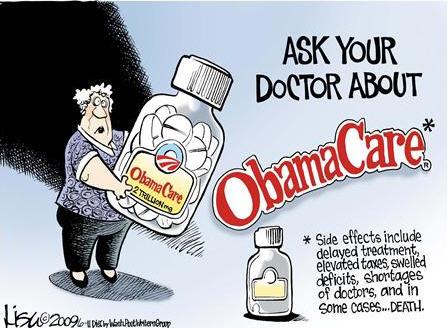
John Roberts is not a Villian


ObamaCare CartoonI’ve read today – far too often today – that Chief Justice of the United States Supreme Court John Roberts is a cross between Judas Iscariot, Pontius Pilate and Benedict Arnold. Or maybe something worse. Although I doubt Chief Justice Roberts needs me to come to his defense (or that he even cares, to be honest), I’m going to give it a shot. Let’s look into what the Supreme Court ruling on the PPACA actually means before passing judgement, shall we?

The Supreme Court ruled that the government cannot compel anyone to buy anything. Ever.

Big? You bet this is huge. We’ve heard for two years from academicians and progressives that under the Commerce Clause, Congress has the ability to force us to buy stuff. Their theory was that because everyone needs health care at some point, we all engage in commerce related to the health industry and the very act of not purchasing health insurance was an action. Well, not so fast.

“The individual mandate, however, does not regulate existing commercial activity. It instead compels  individuals to become active in commerce by purchasing a product, on the ground that their failure to do so affects interstate commerce. Construing the Commerce Clause to permit Congress to regulate individuals precisely because they are doing nothing would open a new and potentially vast domain to congressional authority…The Framers gave Congress the power to regulate commerce, not to compel it, and for over 200 years both our decisions and Congress’s actions have reflected this understanding. There is no reason to depart from that understanding now.”

So, the Obama administration’s argument (echoed by the same academicians above) got the royal smack-down. Chief Justice Roberts may as well have wrote, “What are you, a bunch of moe-rons?”. The result is the same. Rarely does a published opinion go this far (nearly 16 pages) to explain why an argument is so plainly stupid.

The Supreme Court ruled that ObamaCare is the biggest tax hike in US history.

Yes, they ruled the PPACA can move forward, but that the government can no longer try and hide behind the facade of an individual mandate. No, they ruled: ObamaCare is actually a tax increase. Or more precisely, a combination of 21 different tax increases that total $1.2 trillion in new revenue annually. How big is that?  It amounts to new taxes that consume 8% of the nation’s economic output. With only a little over 4 months until the election, I’m not sure how either the President or his minions in Congress feel about running for election on a platform of delivering the biggest tax increase in history. I doubt they’re relishing the chance to find out. Already the cries are being raised about the impending sequestration, with it’s 1.5% tax increase and strong possibility of pulling the economy back into recession. ObamaCare represents a tax increase more than 5 times that impact. By ruling as they did, the Court hand-delivered a gift-wrapped campaign theme for the Republicans this Fall. “If you thought the economy was bad before, just wait until ObamaCare sinks it forever.”

States cannot be forced to participate in ObamaCare. 

A big part of how ObamaCare delivers affordable insurance to the masses is through a massive expansion in Medicaid, by enrolling anyone at 133% of the federal poverty line or below in the program. A big part of how the administration covers up the cost of that expansion is by removing federal subsidies for it by 2017, but still compelling the states to pick up the tab. As of right now, 13 states are balking at the idea of pushing their budgets into the red to make good on this mandate. The Supremes issued another smack-down on this, ruling that unfunded mandates are unconstitutional, even if the mandate is to an existing program.

“It is enough for today that wherever that line may be, this statute is surely beyond it. Congress may not simply “conscript state [agencies] into the national bureaucratic army,” and that is what it is attempting to do with the Medicaid expansion.”

Either the administration can relent and pick up the entire tab for the Medicaid expansion, or live with fact that the original goal of covering more than 95% of Americans in some form of health plan is by the boards.

So, is this really a win for Team Obama? Only in Pyrrhic sense. Yes, the PPACA stands for now – but not all of it. The Medicaid smack-down means that a very large part of the administration’s base of support won’t see any benefit from the law. As for the rest of it, Team Obama is now left to campaign on the largest tax hike in history, in the middle of the worst economy in 80 years. It is also already galvanizing support for the Republican challenger as nothing else could have – especially given Mr. Romney’s own dubious record on health reform.

The President may be heading to bed this evening with a smile on his face. But I bet the one on the Chief Justice’s face come November 6th will be a bit bigger.

ObamaCare Constitutional (Sort of)!


The Supreme Court issued their ruling on the Patient Protection and Affordability Care Act earlier this morning. The short story is, the act stands. But there is much in the  ruling that I can see making the President and entire Federal government wishing they had never taken this up to begin with.

For staters, the Individual Mandate is  completely unconstitutional. No ifs, ands, or buts.

“Construing the Commerce Clause to permit Congress to regulate individuals precisely because they are doing nothing would open a new and potentially vast domain to congressional authority. Congress already possesses expansive power to regulate what people do. Upholding the Affordable Care Act under the Commerce Clause would give Congress the same license to regulate what people do not do. The Framers knew the difference between doing something and doing nothing. They gave Congress the power to regulate commerce, not to compel it. Ignoring that distinction would undermine the principle that the Federal Government is a government of limited and enumerated powers. The individual mandate thus cannot be sustained under Congress’s power to “regulate Commerce.'”

Instead, the Court ruled that Congress can impose a “health tax” as part of the individual tax code, but again, it cannot apply a penalty to persons who refuse to participate in the insurance market. They can only impose the tax uniformly – on everyone – and then refund or credit people who do buy insurance.

But the biggest bombshell coming from this ruling is the Court’s take on unfunded federal mandates. They’ve basically eviscerated one of Washington’s favorite ploys – requiring the states to do something, but not paying for it. In this instance, it is the expansion of Medicaid to cover all persons up to 133% of the federal poverty line. Although Congress offers short-term relief for the increased expenditure, that ends in 2017 and the states eventually pick up most of the tab – or face losing all of their federal funding for Medicaid. The Court ruled that if the Feds want to expand Medicaid that way, they need to pick up the full tab – permanently.

“The Medicaid expansion thus violates the Constitution by threatening States with the loss of their existing Medicaid funding if they decline to comply with the expansion. The constitutional violation is fully remedied by precluding the Secretary from applying §1396c to withdraw existing Medicaid funds for failure to comply with the requirements set out in the expansion.”

Taken broadly, this opens a Pandora’s box of mandates to legal challenges, in everything from education (“No Child Left Behind”) to transportation (Federal Highway Funding). Fun times lie ahead, I’m sure.

I’ll have more in a few days, once I’ve fully digested all 193 pages of the decision. If interested, you can read the full thing here.

Another Take on the College Conundrum


You may recall that earlier this month I did a two-part series on the issue of college costs. Apparently, I’m not the only person who believes the underlying cause for skyrocketing tuition and housing costs is the sheer number of undergraduate students currently enrolled in two- and four-year programs.

I came across this article last night by Richard Vedder, Professor of Economics at Ohio University. Professor Vedder describes in much more detail than I allotted the cause-and-effect of increased enrollment, and also goes into quite a bit of detail about how the federal government’s subsidies only exacerbate the situation, not alleviate it. Given that word broke yesterday that the Senate did what everyone expected and came to an agreement about how to use creative accounting to extend the student loan program at current interest rates, I thought it made sense to revisit the topic. Feel free to hit the link and post your comments.

Social Conservatism and Libertarianism can co-exist


This morning’s post about being a Libertarian raised questions among the readership (thanks for the feedback, by the way) and I thought one in particular needed addressing. It came from a Twitter follower who wanted to know how I, an unabashed Christian and social conservative, can also be an unabashed Libertarian. On first blush, I understand how there is a seeming dichotomy in the two philosophies. The confusion, I think, stems from not understanding how classical liberalism and classic Protestantism influence Libertarian thinking.

As defined today, liberalism invokes the idea that government is the only organization capable of providing social cohesion. Religion, family and community each play a role, but in the end it is the government that must be the glue that keeps society from coming apart. This view – call it modern liberalism – is currently the predominant one in western society. The “enlightened oligarchy” of this model actually isn’t far removed from the “enlightened monarchy” that dominated that dominated European governments in the latter half of the 18th century. It also hews closely to various themes that come to bear in the mid-20th century, in which government control over most or all aspects of social order were encouraged: Socialism, fascism and communism.

However, classical liberalism as practiced in the upper-echelon salons of Western Europe and mainstream American life in the same period held that each institution worked in combination to create a stable society. In this model, government is just another player along with religion, family and community in creating a just and stable society. Classical liberalism, as opposed to modern liberalism (or perhaps, “progressivism” is a more apt term), holds that individual rights outweigh those of the society – provided the individual is a just and moral being. If not, then each of the various factions that comprise a society; the churches, the schools, the community organizations, the family and friends and yes, the government, has a role to play in returning the individual to that place of moral rectitude.

“The foundation of our national policy will be laid in the pure and immutable principles of private morality; the propitious smiles of Heaven can never be expected on a nation that disregards the eternal rules of order and right which Heaven itself has ordained… While just government protects all in their religious rights, true religion affords government its surest support.” –George Washington, First Inaugural Address, April 20, 1789

Although the nation’s creation included the indispensability of a moral citizenry, the founders further outlined the necessity for religion and governance playing separate yet equal roles in public life by purposely cleaving the two. Government would have no role in determining religious affairs and (other than informing the moral character of the citizenry) religion would have no say in the body politic. They codified the principle in the First Amendment to the Constitution, which forbids the government from establishing a national religion or interfering in any religious activity. Moral character may be important, but it is not so important that the government should decide that which is moral. Rather, the government should be informed of that which is moral by the decisions of plebiscite, which in turn should be informed by the communities’ religious institutions.

This reliance on indirect morality in government is how I can be both a Libertarian and socially conservative. It is not the government’s job to dictate morality; that is best left to me, my personal relationship with Jesus Christ and my spiritual mentorship from my church. The moral and religious beliefs I hold will, by nature, play a part in how I vote and participate in the political theater. But the place to make the arguments for those positions is not in the political arena, but the spiritual: in the pews and pulpits, not the halls of Congress.

To put it more plainly: it is not the role of religion to decide the affairs of government and it is not the role of government to decide the affairs of religion. This principle has been a cornerstone of the American Republic since the founding. As JFK said, “I believe in an America where the separation of church and state is absolute.” That many of my fellow social conservatives see fit to now overthrow this essential precept of American republicanism speaks more to their insecurity and unwillingness to engage the populace in true debate over morality – rather, they would impose it by means of government impression. That is antithetical to the teachings they claim to uphold. Christ wants a conversion of souls, not an enslaved people. In the same way, we should look to create a nation of free minds, not coerced opinions.

Libertarianism and social conservatism are more than compatible. Since both teach that the best way to a society that can absorb the worst while coming through with our individual best, they are mutually supportive.

Why I’m a Libertarian


When I announce my political affiliation, the usual responses range from subdued chuckle to loud guffaw. “Oh no,” people say. “You’re not one of those crazies, are you? An anarchist, ready to abolish the government?”

Well, I am a Libertarian and have been for a quite a long time. And the reason is pretty simple: if I’m crazy, then so were men like Thomas Jefferson, Samuel and John Adams, Patrick Henry, George Washington, James Madison and Benjamin Franklin. All, excepting Madison, signed the Declaration of Independence. You might have noticed that these men, the original Libertarians, while unafraid to fight for liberty – to give their lives in the cause of liberty, if needed – were hardly anarchists. In fact, when their first attempt at organized government yielded something much closer to anarchy than we even want to dream of today, they organized the first Constitutional Convention.

So, if that’s crazy, feel free to count me in.

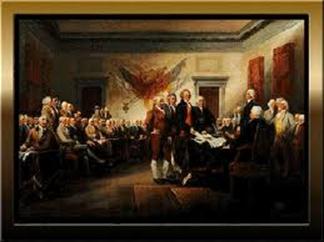
“The Presentation of the Declaration of Independence” by John Trumbull

To put it simply, Libertarians believe that government exists solely to protect individual freedom. But our views on where those freedoms derive are much different than that of the typical Republican or Democrat; in fact, they are diametrically opposed. Ask yourself this question: is government the final arbiter of what constitutes essential liberty? If you answered yes, then you hold the same world view as the vast majority of Republicans and Democrats.

Before you answer that the idea of a government not being responsible for deciding what freedoms we should enjoy is the definition of anarchy, consider the very document that founded our great country, the Declaration of Independence. It is more than a 236 year old piece of parchment that hangs in the National Archives. It is the very embodiment of what makes America, and Americans, unique among other nations and nationalities.

“We hold these truths to be self-evident, that all men are created equal, that they are endowed by their Creator with certain unalienable rights, that among these are Life, Liberty and the Pursuit of Happiness. — That to secure these rights, governments are instituted among Men, deriving their just powers from the consent of the governed…”

Now consider the Preamble to the document that created the federal government, the Constitution for the United States of America. It is 11 years the junior to the Declaration, yet in it the nation’s founding principles are given their equal due – prior to prescribing the methods used to preserve Liberty.

“We the People of the United States, in Order to form a more perfect Union, to establish justice, provide for the common defense, promote the general Welfare, and secure the Blessings of Liberty to ourselves and our Posterity, do ordain and establish this Constitution for the United States of America.”

When you actually read the words, two things immediately become clear:

  • The essence of Liberty, of Freedom, is not something that comes from any government. It comes from a Higher Authority.
  • Government exists to protect those rights, not corrupt them.

Understanding the first point is essential to truly understanding the American concept of Liberty and freedom. The only way individual freedoms are absolute is if they come from an authority higher than that of either men or their institutions. Otherwise, individual freedoms are a caprice, something to be given or withheld as determined by the fancy of others. Governments, rather than working to protect those freedoms, become dishonest arbiters of disputes. Eventually, governments (and the people governing) no longer see themselves as members of the general society, bound by contract and convention to uphold liberty. They become oligarchs; a separate class that believes itself superior to the rest of society.

Does that last paragraph give you pause? It should, because we are witnesses to that very transformation. It is not a sudden transformation that occurred in the past two or three years, either – it’s been underway for most of my lifetime. Is it beginning to snowball, accelerating in pace and breadth? Certainly, and the quickening pace over the past few years makes anyone concerned about preserving liberty queasy.

Now, as to why I identify as a Libertarian and not a Democrat or Republican: the proponents of the two major parties are our modern oligarchs, who see themselves as more fit to determine which liberties are essential and which can be abridged by the government. There truly isn’t much of a difference between them, in that both see distinctions in liberties; the difference is only in which liberties they deem more essential. The things they spend their time arguing over are actually further limitations on those essential liberties and freedoms, disguised as concern for safety of the overall society. The reason they feel secure in their deliberations is that the Nation, once enamored of Liberty, is today concerned less with freedom than safety – or at least, the illusion of safety. The people fear deprivation of material desires than the loss of freedoms. They are convinced the loss of freedom for one party will not result in a curtailing of freedom for themselves – when the reality is that any loss of freedom for any American necessitates that all Americans lose some aspect of their Liberty.

Terrific examples come from exchanges I had this week with unabashedly partisan Democrats and Republicans. I fed the same quote to both, and their reactions were remarkably similar. The quote, from Ben Franklin, is “Those who would give up essential Liberty, to purchase a little temporary safety, deserve neither.” The Democrat’s response was that Franklin has been dead 200 years, and his ideals with him. The Republican’s response was that changing times require changing mores.

That’s the final point that our founding document makes, that most Americans either forgot or were never taught.

“—And for the support of this Declaration, with a firm reliance on the protection of Divine Providence, we mutually pledge to each other our Lives, our Fortunes and our Sacred Honor.”

The nation’s founding principle is that the Liberty and the ideals of freedom supersede anything else. Liberty takes precedence over personal comfort, over wealth, over safety and even life itself, if necessary. The very ideal is worth fighting and dying for, as in the case of the American Revolution and the Civil War. What is more, if this principle is derived from an act of Divine Providence, then it does not disappear with the death of individuals nor the passage of time. It is an everlasting, eternal truth.

Because I am a free man and believe my freedom is not negotiable: That is why I am a Libertarian. Because I believe that the government is my servant, not my master: That is why I am a Libertarian. Because I believe that no man has the right to subject another to his will: That is why I am a Libertarian.

And if you believe these things, so are you.

Facebook Mobile Revenue Takes Another Hit


Facebook needs to make a few bucks, people. I know that sounds crazy, considering how much money they raised in their IPO – but if they lose out on mobile ad revenue, The Social Network will disappear. Read on, from my friends at TC:

Obama’s Amnesty: Two More Cents


On Friday, President Obama shocked most of the country with his latest Executive Order. You know, the one that lit up the blogoshpere – his unilateral decision to stop deporting illegal immigrants who are attending school or served in the military. I figured as long as everyone else was chiming in on the topic, I might as well, too.

Let me begin by admitting that my thoughts on the illegal immigration issue run counter to most people on my side of the political fence. I think it is impractical and probably impossible to deport every single person who migrated to the US outside of the approved immigration policy. Did they break a book full of laws by settling here in that fashion? Sure, and for that I cannot see how any form of reward is proper. I certainly think that anyone who emigrated to the US (legally or otherwise) who engages in unlawful activity should be deported. I’m all for strengthening our border security, up to and including deploying the Army and Air Force with orders to shoot first.

Courtesy: Conservative Jokes

What we do with those who are already here, though, is a much trickier proposition. A big part of the problem is that there really isn’t a way of finding them all: they live mostly in the shadows. There isn’t even reliable data on how many immigrants are here illegally; news reports I’ve read over the past few days use numbers anywhere from 600,000 to 4 million. It’s as much a crap shoot as any statistic you will ever come across. I’ve decided that, essentially, the status quo is probably the best that can be done in their case. Unless they run afoul of the law or ask for social services, we can’t find them. Of course, if they do they should simply be sent packing. But otherwise, I’m content to allow them to stay in their shadow communities.

Often, when thinking in terms of immigration policy and standards, I look at things through my mother and grandmother’s eyes. They arrived here in1959, fresh from the Soviet bloc. As immigrants, they fully understood the challenges faced by other immigrants, regardless of origin, native tongues or anything else. They were both adamantly against illegal immigration, and understandably so. Even as political refugees, they had to go through a battery of tests and pre-qualifications before being allowed into the country. They thought it eminently unfair that anyone should just walk across the border and set up camp, without any need to prove they were willing to fully assimilate into American culture – or even demonstrate they had the skills to contribute to society.

What did they think about the children of illegal immigrants? They both felt that the Constitution should be amended or clarified to ensure that the children of illegals, even if born in the US, should not be granted citizenship. They and their parents should be returned to their home nations and sent to the back of the line, so to speak, and await their turn.

So, extrapolating (there’s your big word for the day, folks!) from that premise, I cannot abide allowing those children to stay here on any sort of amnesty program. I realize the people the President’s order targets didn’t arrive here of their own accord. I’m even willing to let them return to their home countries with a preference on the waiting list. But if anyone thinks this is the beginning of meaningful immigration reform, they are seriously deluded. After all, even under the executive order those illegals affected won’t be granted residency status – only an act of Congress can do that.

We need to recognize this for what it is: an act of political pandering from the President Who Perfected Pandering. The EO signed on Friday only remains in effect until rescinded, either by a new President in 2013 or by the current one when he realizes it costs him more votes than it gains. It wasn’t a grand statement on the mess our immigration policy turned into after Ronald Reagan’s own bit of pandering in 1986 (the Immigration Reform and Control Act). Had Obama actually wanted to enact some type of meaningful reform, he would have combined the EO with a legislative proposal – not a Rose Garden speech asking Congress to do something. You’ll also note that in that speech, the President didn’t outline what he wanted as a result of the reform he demanded, a curious lack of leadership that is in keeping with his style.

What should be of greater concern to all, regardless of where you live, is this fits a pattern of flaunting the Constitution in order to score a cheap political point. In addition to this latest EO, we have other extra-constitutional power grabs that seem derived of partisan political maneuvering. Things like indefinite detention, refusing to support DOMA, international assassinations – the list is growing daily. The President, any President, does not have the prerogative of deciding which laws to enforce. His job is to enforce the law of the land and if he finds one unacceptable, he can request Congress rescind it. This latest EO actually requires a variety of law enforcement agencies, from the FBI and INS to Homeland Security, to willfully ignore the law. Such a situation should never be tolerated by the citizens of our republic.

The College Conundrum: An Alternative


Yesterday, I dissected the underlying problem with higher education, as it currently exists. A college education costs far more than it is actually worth.

At least Bluto wasn’t $500,000 in debt

Today’s students pay far too much and receive far too little benefit to justify the expense. What’s more, in most cases they are strapping themselves with insane amounts of debt in the process. It is a debt that hampers their ability to fully function in modern society. The resulting lack of disposable income for the first decade or more after graduation results in a generation that is incapable of financially supporting themselves. If there is an economic downturn (like now), that lack of spending power means that upwards of 40% of the labor force is unable to do those things which define a middle class lifestyle: own a home, own a car, start a family. Instead of college leading to the middle class, college results in poorly educated people (who mistakenly believe they’re highly educated) reliant on the government or their extended families for support.

So, what’s the solution? We constantly hear that without college, young people have no hope of starting in a good career, that their prospects for future advancement are limited and they will be limited in their ability to fully participate in the American Dream. And so we end up focusing on ways to make college more affordable, without actually looking at the reasons for the high costs involved.

As I pointed out, the principle reason for the inflated cost of higher education boils down to the number of people enrolled. There are 3 times as many college students today as there were 30 years ago – are we really surprised that tuition and fees are also three times higher than 30 years ago? The real question is why we are funneling so many people into colleges. If it is to prepare them for post-academic life, then there can be little doubt that we’re failing in a big way.

I’ve always felt the primary purpose of education – whether primary, secondary or post-secondary – should be a dual mission: first, basic facts and skills (the “3 R’s”) and second, developing critical thinking skills. In American education, we’ve focused primary and secondary education on the former while nearly ignoring the latter. This trend is now extending into post-secondary education. A prime example is the dreaded research paper. I shudder at the memory of writing exhaustive, well-researched papers on a weekly basis while in college. The amount of time I spent developing a final paper for each class was measured in weeks, not days. Yet, today’s students often are tasked with only one paper at term’s end and drilled in preparing for weekly quizzes – an approach similar to the high school experience. The original purpose of higher education in the American system, developing one’s mind to sift through tons of data, determine which pieces are relevant and create a cohesive argument from them, is being lost. In other words, we’re graduating millions of kids prepared for an extended stay on “Jeopardy!” but not ready for the types of jobs that traditionally require a college degree.

This is also a result of herding high school students into college. I think the best way to tackle the costs associated with college stem from rethinking the way we handle primary and secondary education. Current elementary and secondary school curricula are leftovers from the days when the United States was principally an agricultural society, and recent reforms have done little to address that fundamental flaw. If anything, the recent and increasing emphasis on standardized testing and evaluation of student and teacher achievement is a step backward and fails to address the real world situations most young people face after graduating from high school. Because our education system now deemphasizes critical thinking skills in favor of rote memorization and socialization, most kids enter into adulthood knowing a set of facts that are essentially meaningless – unless preparing for life as a game show contestant.

The best course of action, I believe, is to reintroduce vocational training during high school and reemphasize critical thinking skills, beginning in primary school.

Vocational education programs, where they do exist, are often maligned, snubbed and underfunded. However, I see nothing wrong with providing basic education in critical skills developing courses (math, the sciences, history, English) while also providing 2-3 hours per day of vocational instruction to those students who prefer that track. This is a similar education structure to the German model, essentially – only instead of four tracks of study, I would streamline it to two and I wouldn’t begin the vocational track until the age of 13 or 14, not 10. Along with making vocational education an acceptable option, though, we need to reconsider the courses available. Traditional “vo-tech” professions such as auto mechanic and machinist should continue to be included, certainly. But many professions that currently require a bachelor’s degree only require it because it signifies the holder has developed basic critical thinking skills, along with the basic technical skills required. Professions like LPN or Network Engineer do not require the job holder to have in-depth conversations on the merits of St. Thomas Aquinas’ views of married clergy; there is no reason that learning how to create such a dissertation should be part of the education process to enter those fields.

As I said, the current emphasis on standardized testing results in less classroom time devoted to developing critical thinking skills. In extreme cases, it is turning our teachers into nothing more than room monitors and test graders. The practice grew from concerns that education standards in the US lagged other first-world nations in education achievement. While the goal was and remains laudable, the prescribed cure is making things worse. As a nation, we’ve fallen further behind in academic achievement. Somebody, somewhere decided that rather than measuring academic achievement in terms of how well students think, measuring how many arcane facts and figures they memorized was important. Don’t get me wrong, a basic knowledge set is important. But without the ability to turn those facts and figures into a thought, they are nothing more than bytes of data. We need to empower teachers to create thinking students and reward those students for developing their thought processes. The notion that those skills can wait until college to fully develop is proving wrong-headed.

Of course, there are challenges associated with this type of program. The biggest is probably changing the mindset we currently have regarding education. That requires buy-in from multiple stakeholders. Teachers unions, who’ve proven resistant to change in the past. School administrators, beholden as they are to current power structures. The federal government, still trying to figure out how “No Child Left Behind” left so many kids behind. Most importantly, it requires not only acceptance but a demand from parents, who likely will be confused by the changes.

The other option is to simply continue on the current course and leave another generation of kids ill-prepared for adulthood, in three phases of their development: their academic achievement, their career preparation and the amount of debt they’re saddled with before they ever earn a dime.

The College Conundrum


This is an unusual time of year to discuss the state of higher education in America. After all, May is usually the end of the academic year for most universities. The senior classes at most have already received their sheepskins and incoming freshman won’t arrive on campus until August. We’re well into June and most folks thoughts are on summertime fun.

But as with everything in this topsy-turvy year, higher education is taking up space on the front pages of major newspapers. There are two reasons for this. The first is that federal student loan interest rates are set to double in July, a situation that will make the already insane tuition costs even more unbearable for many. The second is the re-emergence of Peter Thiel, the founder of PayPal and his entrepreneur initiative. The first has, as with everything this election cycle, devolved into a partisan fight. Not a fight over the idea of maintaining the current interest rate – both Republicans and Democrats agree they should – but a fight over how to pay for the increased subsidy. (As usual, Democrats want to raise taxes on the upper middle class, while the Republicans want to gut a Democrat sacred cow). The second highlights a more critical discussion and the one I want to focus on here: how much is a college degree worth?

Peter Thiel

For those of you who aren’t familiar with Peter Thiel, he is undeniably one of the world’s brightest individuals, something of a Libertarian lighting rod and as an immigrant, the prototypical American success story. He became something of a Web 2.0 wiz kid, when he co-founded PayPal in 1999 with Elon Musk and Max Levchin. He then founded Clarium Capital and created the Founder’s Fund in 2005. Among his noteworthy achievements, he is a chess grand master. He provided early funding for Facebook and still sits on the Board of Directors. (That initial $500,000 investment is now worth an estimated $9.2 billion, based on yesterday’s market close). Thiel also foresaw the financial crash of 2008 as early as 2004, when he correctly noted that the dot-com bubble of the late 1990’s had simply transferred to real estate.

The reason Thiel is a controversial figure in higher education is his creation of the Thiel Fellowship, whose sole purpose is to find students with great product and/or business ideas, have them drop out of school, and award them with $100,000 grants to launch their businesses. Additionally, business and engineering leaders mentor Thiel Fellows. The goal is to bypass college entirely and get right to work.

Why would Thiel, who holds BACP and JD degree from Stanford, work on a project that is popularly seen as undercutting the value of higher education? Simply put, he doesn’t believe that the way the college experience is currently constructed holds real value for most students.

And it’s easy to understand why. Stop to consider my home state’s primary public university, Rutgers. Students in the 2017 class can expect to pay about $96,000 for their four years – provided they’re a New Jersey resident (that cost balloons to $154,000 for out-of-state students). A New Jersey student from a median income family can fully expect to have to pay $84,000 after state and federal grants. Assuming they don’t receive any scholarships, that hefty price tag will come primarily from loans. This is just an illustration, of course. There are other fine universities that carry lower tuitions and fees, but the point remains: why so much? Well, the answer is actually simpler than the very public teeth gnashing might lead you to believe. Nationwide, tuition is about 300% what it was 30 years ago. Over that same time, student enrollment rose 315%. This is simple supply-and-demand economics. There hasn’t been a commensurate increase in the number of colleges and you have more students competing for the same amount of resources. Everything else (capital improvements, staff, etc.) stems from that simple fact.

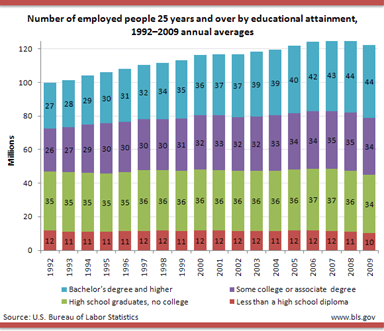
But has the intrinsic value of a Bachelor’s degree risen by a similar value over that time? Probably not. You can make several solid arguments that if anything, the value of a Bachelor’s degree is less than it was when I graduated in 1989. First, there’s the sheer number of college graduates now in the work force. In 1992, BLS estimated there were 27 million college graduates, comprising about 25% of the work force. (See chart to the left).By 2009, that number reached 44 million, comprising 36% of the work force. And for our 2017 graduate, those figures are estimated to be 58 million and 45%. Where once a Bachelor’s degree separated you from the rest of your age group (and therefore put you near the head of the pack for advancement, promotion and salary), by 2009 there were more people sporting a Bachelor’s degree than people with only a high school diploma in the workforce. The BA or BS after your name has become what the high school diploma was a generation ago: a sign of basic academic achievement.

Then there’s the question of what a student learns during their course of study. Certainly, some practical workplace knowledge is gained, but most work skills are acquired as a result of internships and part-time employment. Quite a few students graduate without even the rudimentary skills required – a fact that many hiring managers are well aware of. I have a humorous anecdote that highlights the point: in 2007, I started a paid internship program at a company I ran. One of the interns was a very bright and driven kid attending one of the better business schools in New York. After he graduated in 2008, I offered him a full time position as an assistant site manager at our premier location. I was assisting during one particularly hectic event and asked him to create a pivot table in Excel. After what must have been 15 of the most frustrating minutes in his young life, he looked at me (nearly crying) and admitted he had never learned how to create one. As it turned out, he was an honors graduate who was horribly unprepared to work in his chosen field of study (Business Management). A short while later, he left both the company and the business world behind and decided to follow a vocation more to his liking (Entertainment). I doubt that young man today would say the money he spent on his degree was worth it.

There’s also the question of how much a degree actually prepares you for the life-long learning required in today’s economy. The courses I studied as a young electrical engineering major seem almost quaint by today’s needs. Hardware has changed and so has the software that drives every gadget in our possession. I received a well-grounded (pun intended) theory of how electricity works, but as for specific knowledge related to my field now – that part of my education is useless. The computer languages I use on a daily basis didn’t exist in 1988. The circuits I work with involve components that weren’t dreamt of then – and the gadgets of today do things that could only be found in episodes of Star Trek. The study habits I use to learn these new technologies aren’t the result of a well-honed college experience, otherwise my house would be littered with half-eaten pizzas and empty beer cans. I’ve probably made more use of several of the liberal arts courses I was required to take over the past decade than the ones directly related to my degree.

So, if Peter Thiel is right, what then is the alternative? We’ll look at that tomorrow.