
The Hangover
I’m pretty sure everyone reading this has experienced a bad hangover after a night of too much partying. You wake up with an oversized cotton ball in your mouth, your head is ringing like a fire bell, you have strange cravings for McDonald’s French fries and you can’t seem to move faster than a poorly fed snail. You want to kick yourself. Yeah, the party was awesome (and you still can’t find that missing lamp shade), but man, the hangover is more price than you wanted to pay.
I get the feeling many on the left are feeling something like that today. First, after the euphoria of Bill Clinton’s speech Wednesday night, they had to deal with a less than impressive performance from Barack Obama last night. Either Obama’s speechwriting team needs a shake-up or the President is out of ideas; most of what we heard last night is best summed up as “Hey, I want a do-over!” Most media outlets, including admittedly left-leaning publications like the NY Times and Politico, panned the speech as not one of his best efforts.
Then, along came this morning’s jobs report from the Bureau of Labor Statistics. No wonder the president wants a do-over.
By now, you probably read all of the doom-and-gloom reporting about it. Make no mistake, this was a pretty lousy report. But worse than the numbers themselves is what it all means when you actually dig into them a little.
First, the headline numbers: the economy only created 96,000 new positions in August, but the unemployment rate dropped to 8.1%. This should be good news for the President, right? The unemployment rate is dropping (if somewhat unsteadily) and may actually get under the magic 8% mark most pundits think is needed if Mr. Obama is to have a real shot at reelection. And 96,000 new positions is better than no new positions, right?
Well, yes, sort of. For a better picture of why the jobs report is foreshadowing a major problem, see figure 1. This is the raw BLS data for the past year. Before your eyes begin to glaze over, there are three numbers to pay particularly close attention to.
3,965,000
1,808,000
2,723,000
The first number is the increase in the working age population over the past year. The second is the number positions created in the past year. That last one? That’s the number of working age Americans who simply gave up looking for a job in the past year. To put it another way, more of your friends, relatives and neighbors gave up the hope of even finding a job than actually found one. Nearly a million more, in fact. That’s one million American’s who are now dependent on some outside source just for survival, be it a friend, relative or the handout machine that’s become the US government.

Most economists say we need between 110,000 and 175,000 new jobs each month just to keep up with population growth. But when you look at the actual increase in working age population, the average number actually needed is around 330,000. This is very bad news for team Obama, otherwise he could point to the average of 150,000 jobs created over the past year and claim that his policies are working, albeit slowly. But the reality is that his policies are, at best, creating jobs at only half the rate needed to bring the US back to full employment.
This is particularly troubling, given that every other indicator says we should have been creating jobs at a much faster pace over the past 24 months. If you look at hourly wages, those increased by an average of 3 cents per month between March 2010 and June 2012. Although not at the level of increase seen during the Reagan, Clinton or Bush recoveries, it is still stronger than historic wage growth. Worker productivity across all sectors is also nearing an all-time high and produced solid gains during the same period. Taken together, high wage growth and productivity gains always produced significant jumps in employment before – but not now. What could possibly be holding back the “jobs engine”?
The BLS publishes an “Employee Cost Index” on a quarterly basis, and a large part of the answer can be found there. While wages and productivity show considerable growth, the ECI is also growing – in fact, it’s grown by nearly 11% since March 2010. Of that, change only 18% is represented by increased wages and a 12% drop in non-cash benefits (things like health coverage and gym memberships) counterbalances that number. So, where is the additional 10.3% in employee cost coming from? The answer is a combination of regulatory costs and taxes, the results of 3 years of this administration’s ceaseless efforts to tie nearly every industry into a Gordian knot of inefficiency. New regulations and business taxes now exceed the productivity gains made by our nation’s workforce by a 4:1 ratio, effectively wiping out the need to hire. Indeed, those costs are probably now the single biggest impediment to real employment growth our nation faces. After all, if you owned a business, you would need to be looking at explosive growth potential, not just modest growth, before bringing that much excess on board.
Many of my friends on the left insist that breakneck pace of regulations passed by the Obama administration are not having a negative effect on the economy. I submit they’re not only negatively impacting the economy, but giving business owners throughout all 57 50 states a hangover of our own.
The Ryan Attack
 Regardless your personal feelings about Paul Ryan (R-WI), two things clearly came to the fore with his speech last night:
First, the man is a much more polished politician than his naysayers would have you believe.
Second, mainstream media analysts be damned, he’s perfectly comfortable being Mitt Romney’s pit bull.
The traditional roles for the Vice Presidential nominee are simple. They should deliver his home state’s electoral votes to the party’s nominee. And they should be able to attack the other party’s nominee, without seeming impossibly mean-spirited. Four years ago, Alaska Governor Sarah Palin got the nod in what was one of the most curious choices ever made by a Presidential candidate. Alaska is a solid Republican state, so Mrs. Palin wasn’t going to deliver an additional 3 electoral votes that John McCain likely didn’t already have. While she proved a willing attacker of all things Democrat (and that includes, to this day, Barack Obama), she always seemed…snarky is probably the best way to describe it.
Ryan, on the other hand, may prove to a much more capable VP pick. Even before his speech last night, his selection helped turn what has been a traditional bastion of Democrat electors into a battleground state. (Both CBS/NYT and PPP latest polling in Wisconsin has the Presidential race as statistical tie, where once the President had a commanding 11 point lead). But what may prove even more dire for Mr. Obama’s re-election chances is the way Mr. Ryan demonstrated that you can attack even a likable candidate on pure policy issues, and do so in a way that makes the target still seem likable – but hopelessly inept.
Time and again in his speech, Mr. Ryan pointed out the failures of the current administration in terms of policy: a ragged economy, a sense of hope lost and a looming fiscal crisis that has been worsened by profligate spending and partisanship. Yet at the same time, Mr. Ryan did not attack the President as person. Indeed, he praised Mr. Obama’s rhetoric and ability to connect with voters. In a line certain to get considerable airplay in a commercial near you, he said:
“College graduates should not have to live out their 20s in their childhood bedrooms, staring up at fading Obama posters and wondering when they can move out and get going with life.”
That one statement provides a stark contrast between Senator Barack Obama in 2008 and President Barack Obama in 2012. In 2008, those millions of college freshmen turned out in droves to vote for the senator. In 2012, they are now recent graduates – unable to put their degrees to work, living back home with their parents and thoroughly disillusioned with their former champion.
There were other great soundbites as well (imagine a political speech without a soundbite!). My personal favorite was this, just a few moments later in talking about his beginnings:
“When I was waiting tables, washing dishes, or mowing lawns for money, I never thought of myself as stuck in some station in life. I was on my own path, my own journey, an American journey where I could think for myself, decide for myself, define happiness for myself. That’s what we do in this country. That’s the American Dream. That’s freedom, and I’ll take it any day over the supervision and sanctimony of the central planners.”
For me, that statement IS what the subcontext of this election is about. What is the “American Dream?” Is it, as Mr. Ryan describes, the pursuit of one’s individual goals and the freedom to make them a reality? Or is it, as described by Mr. Obama, the assurance of an equal experience for all Americans, regardless of innate abilities, talents and desires?
If the Republicans succeed in framing the 2012 election in this context – and not Mr. Obama’s preferred context of blame the other guy, rich vs. poor – then I believe they will also win this election. In Mr. Ryan, they found a capable point man, one the Democrats should fear over the next 70 days.
“You Didn’t Build That”

Pres Obama campaigns in Roanoke, VA
July 13, 2012
Our President, it seems, is a socialist at heart. Or maybe a fascist. I used to joke about it, but never really believed our nation could elect anyone so far removed from American thought as that. But one thing is clear after his diatribe against business owners last week in Virginia: Barack Obama does not believe in the American Dream. He believes in the dreams of Karl Marx, instead.
“If you’ve been successful, you didn’t get there on your own. YOU DIDN’T GET THERE ON YOUR OWN… somebody along the way gave you some help…
If you’ve got a business, you didn’t build that. Somebody else made it happen.”
Look, I get it. So do the millions of other Americans – and people from around the world, for that matter. Humans are social creatures; we create and live in societies in which certain responsibilities are shared. The President’s speech highlighted the ones most of us recognize: police and fire protection, education, transportation. But here’s what the President and his acolytes fail to understand: while we do these things for the mutual benefit of everyone in the society, we also understand that differences in outcome depend far more on individual ability than any other factor. The President discounts that notion, and in so doing, insults anyone who has slaved at creating a business. Perhaps he thinks it an archaic anachronism from the 19th century, the same way he does religion or gun rights. I’m pretty sure that the men we celebrate because of the ability to turn their dreams into reality would disagree – from Thomas Edison through to the neighborhood butcher.
Regardless of his reasoning, the result is the same twisted, demented view of society – that all people should enjoy more or less equal outcomes, regardless of ability. That is, of course, the basis for socialist and communist thought. It is the responsibility of those more able to provide the means for the rest of us, and it is our right to expect they will. Of course, that isn’t the American Way – but it is the Obama Way, and it dovetails neatly with the change he promised in 2008.
The American Dream is tied to equal opportunity, not equal outcomes. Stop and consider your own lives. Are you more successful than some of the people from your own past? Less successful? Certainly, as I look back to my own high school graduating class, I’m more successful than some of my classmates and not quite as successful as a few others. Why is that? Did they have a different baseline than I? Of course not. We grew up in the same town, came from families that were more or less similar in economic and social status and attended the same schools with the same teachers. That the difference in our economic and social outcomes might derive from innate talent or desire or even how hard each of us worked throughout our lives is of no consequence to the socialist.
“I’m always struck by people who think, well, it must be because I was just so smart. There are a lot of smart people out there. It must be because I worked harder than everybody else. Let me tell you something – there are a whole bunch of hardworking people out there. If you were successful, somebody along the line gave you some help. There was a great teacher somewhere in your life. Somebody helped to create this unbelievable American system that we have that allowed you to thrive.”
Yes, Mr. President. We are all working from the achievements of those who came before. But there are also the failures who came before and who come along today, and we’re also working from them. Are some the result of bad luck or bad circumstance? Perhaps, but I’ve never believed in “luck” as we commonly refer to it. Besides, I’ve thrived despite what most people would consider horrible luck – being stricken at age 25 with Crohn’s Disease. Has that horrible illness held me back some? Yes, but it is what it is: and it simply means I have to work that much smarter and harder to ensure that I got a positive outcome. So, no, I don’t believe that “luck” plays a significant role in your outcome and your individual ability is far more important.
This is the point that the President fails to understand. Just as every person’s world view is shaped by the circumstances of their life first, I think the President’s is likewise informed. He can look back upon his own life and understand the concept of getting ahead by being pulled ahead far more easily than by working harder or smarter than anyone else. This is a man who, by his own admission, was a pothead in High School, a classic underachiever who wound up attending Harvard and Columbia not because of his academic achievement but because of affirmative action programs. He became Harvard Law Review editor not because of his journalistic or legal abilities, but because of campus connections (to this date, Barack Obama remains the only editor without a single byline). The pattern has repeated itself, time and again throughout his life until he rose to the pinnacle of success and assumed the Presidency. This is not to say the President is not intelligent; he certainly is, but undoubtedly he realizes he would not hold his office were he not the Chosen One from early on. But he believes it impossible to achieve success without some form of divine providence. He completely ignores that individual ability is a far greater indicator of success than any other factor.
Relegating individual ability to a mere production indicator, not success indicator: this has been the progressive dream for over a century, of course. Equality of outcome, not opportunity is the hallmark of the Liberal Dream. In Barack Obama, that dream has found the ultimate champion – and a man determined to foist it upon the United States, regardless of the consequences.
A User’s Guide to the US Constitution
What’s that you say? You didn’t know there was a user’s guide to the Constitution?
Well, obviously SOMEBODY wasn’t paying attention in Civics class. Either that, or you’re one of the unfortunate millions who never had the opportunity to study civics – but that’s a different post for a different day.
Let’s begin with a little history. Our Constitution didn’t just materialize out of thin air. Neither did it arrive at the National Archives in the same manner that Moses received the Ten Commandments. (I’m only half being tongue-in-cheek about that; one of my younger acquaintances honestly thought that God himself gave the Constitution to George Washington in a burning ring of fire. And we wonder why the country is heading off the rails?) In fact, our current Constitution wasn’t even the first one The United States used. That honor belongs to the Articles of Confederation. It’s in there that some of the quirkier aspects of our national government can be found: the idea of state representation, as opposed to popular representation for instance. It went into effect in 1781 and was quickly realized that it made the federal government too weak to be effective. The principle reason we scrapped it is as old as the fight for American Independence: taxes.
 The USA incurred serious debts while fighting off the British Empire, primarily owed to the French. After the Treaty of Ghent was signed and the US officially became an independent nation, the French – who were near broke themselves (this was the time of “Let them eat cake”, after all) – came looking for their money. The French King was quite accommodating: the new United States could pay up in gold and silver, or could hand over land from the former British Colonies. Not willing to give up the territory we had just fought over for the past 8 years, the Continental Congress passed excise duties in order to pay the debt. Great idea, except under the Articles of Confederation, any state could opt out – and 11 of them did. Just to compound matters, most of the states had individual liabilities resulting from the war, mostly due to the French crown as well. So, they passed taxes and tariffs on each other to pay off those debts. By 1787, the entire country was readying for civil war as each state asserted its rights under the Articles and a hapless Congress could only look on in despair.
Enter the Constitutional Convention. In February of 1787, rather than go to war with one another (thankfully), the states agreed to a redo on how the federal government should operate. Originally, 70 people were selected to attend. Only 55 actually did and of those, only 39 signed on to the new Constitution. It was understandable: most had shown up expecting a sort of massive peace negotiation, not a negotiation about scrapping the current government and replacing it with something entirely different. Rhode Island was so upset by the idea that they recalled all of their representatives. The new Constitution, even after weeks of negotiating, was hardly a hit: as mentioned, 16 representatives refused to sign, including some fairly big names of the day. Imagine if we decided to reboot under a new Constitution today and the current Speaker and Vice-President refused to lend their support to the document. That was the same effect that George Wythe (Virginia) and John Lansing (NY) not signing had in 1787. And that was just the beginning of the trouble getting the Constitution ratified: popular support was anything but forthcoming. Just like today, a document that is amazingly short proved to be incredibly difficult for the populace to comprehend.
That’s where our user guide comes in play. The two principle architects of the Constitution, James Madison of Virginia and Alexander Hamilton of New York engaged in a series of letters that sought to explain how the Constitution affected everyone: from vagabond to Senator; scullery maid to Governor. Today, we know these letters as the Federalist Papers. These 85 letters, most commonly published as essays on what equates to our modern op-ed pages of the popular newspapers of the time, provided the Founding Father’s actual vision for how the Federal government is supposed to act.
It is the quintessential user’s guide. Like any good instruction manual, it lays out – in detail – how each branch of government should interact, not only with one another but also with the states and the general population. So next time you have a question about why something is set up the way it is, hit that link and review the reasons before going off half-cocked.
Our Goal is to Make Barack Obama a One-Term President

Ok, color me confused, but I fail to see a problem with the premise that the Republican party is dedicated to ending President Obama’s tenure after four years. This must make me some sort of space alien, since according to the media and my “moderate” friends I should. As for liberals, they’ve already consigned me to a fate worse than a heretic’s during the Spanish Inquisition, so they really don’t get any say here. (Sorry, but you can go back to your corner and wait for your next handout).
For those of you uninitiated, Senate Minority Leader Mitch McConnell (R-KY) made the title statement a year ago today. McConnell was immediately excoriated by the press as being an obstructionist – and almost on cue from Team Obama – disparaged as not caring about the real problems facing the nation. I didn’t understand the diatribes then, and I still don’t see the issue now. If the Republican party’s true aim is to fix what’s ailing the country, shouldn’t they start by fixing the biggest problem we have?
I’ve probably lost more than half my readership by this point, but for those who’ve stuck around, let’s look into that mission statement in a little more detail. Why should the singular aim of the Republicans be to make Barack Obama a one-termer?
First, there are unbridgeable policy differences between the liberal (er, progressive) wing of the Democratic party, led by Barack Obama and the conservative wing of the Republican party. In both parties, there are some self-described moderates, but the last two election cycles reduced their ranks and influence considerably. The few moderates left are an endangered species and most are retiring. As a result, the philosophical divide between the two major parties is greater than at any time since Reconstruction. The partisanship currently displayed in Washington and in state houses in everywhere is symptomatic. Now, don’t get me wrong: there are plenty of issues where I do not agree with either party. I’m a Libertarian, so the headlong rush to continue things like the Patriot Act, ratify SOPA and generally undercut our civil liberties I find particularly offensive. But hey, that seems to be the only thing both parties agree on, so whatever. The point is, the Republicans and Democrats agree on almost nothing else. Why should Republicans want to have the person in charge of the Executive Branch be a man who is personally opposed to their policy objectives?
Second, this is a two-way war. Congressional Republicans are not the only ones refusing to co-operate. In the past three years, the White House released executive orders and regulations that undermine the policies conservative Republicans support. From the unilateral decision not to enforce DOMA or immigration statutes to threatening social security payments, the President and his minions have declared war on conservative policies, past and present. Obama signaled his intention to work with Congressional Republicans early in his administration when he announced to Eric Cantor, “Elections have consequences.” Barack Obama claims to be a bible-reading Christian; perhaps he should open to Galatians 6:7 (“Be not deceived; God is not mocked: for what a man soweth, that shall he also reap”). He asked for this fight on day 1; that he’s surprised it came is a startling admission of how little he understands.
Finally, McConnell was not stating that the Republican goal is simply to prevent the President from having any success. He could have phrased it better, probably. But the goal of conservatives everywhere (and of Libertarians) is to prevent the President or his party from growing the government even larger – and to do that, it means getting him out of office. Government currently has a larger share of the economy than at any time in history, accounting for 41% of GDP, a 6% growth rate over the past three years. Once Obamacare fully kicks in (unless repealed), that percentage projects to rise to 69%. And at that point, you can kiss whatever freedoms you had good-bye. Once you’ve lost economic freedom, the civil liberties you take for granted are quick to follow. Don’t think so?
Consider your job. Your boss comes in one day and says you have to stop reading that loony guy over at Political Baseballs because it upsets upper management. Are you going to quit your job or say so long to my little blog? And don’t pretend it doesn’t happen – it happens all the time. He who controls the purse strings eventually controls every aspect of your life – unless you’re willing to follow the example of the Founding Fathers and pledge your fortune and your life to throw off the yoke of slavery.
So, yes. There are some very real reasons that Republicans – and freedom loving Americans – should want to ensure the President is a one-termer. Anyone who finds that offensive is either a sycophant (you can put your hand back down; I don’t give hand outs) or living in a fairy-tale world where nothing bad can ever come of a government program.
I don’t live in a fairy-tale. I live in the world that will be much better off once Barry O is sent back to Chicago.
Can Romney be Reagan to Obama’s Carter?
First off, I’d like to welcome everyone back from their Fourth of July vacations. I know I enjoyed mine and I hope you enjoyed yours.
As we head into the languid, steamy summer months most of us aren’t paying particular attention to the Presidential campaign. Both candidates, as is typical for the 6 weeks or so leading up Labor Day, are concentrating on fundraising and polishing their message. Unless either commits a gaffe of historic proportions (something the Romney family is well acquainted with), don’t expect either to make much news.
This presents both a challenge and an opportunity for Mitt Romney. Unlike his opponent, he is relatively unknown to the American voting public. If he uses these next few weeks wisely, he can create the underpinnings of a successful candidacy. If not, he will get crushed in November.

Reagan Saluting the American Dream
A little historical perspective is in order. In 1980, Ronald Reagan won the Republican nomination and faced off against an incumbent with a high personal favorability rating. The incumbent, Jimmy Carter, presided over a nation seemingly in decline. The “stagflation” of the late 1970’s – marked by persistent underemployment, inflation and low economic growth rates – had taken its toll on the American labor force. Combined with what seemed like capitulation to the Soviet Union in Afghanistan and an inability to deal with the rise of Islamic extremism in Iran, the 39th President had few policy successes to point to, other than the Israeli-Egyptian peace accord. The future 40th President was known by the country primarily as a former “B” movie actor and Governor of California. That July, Carter made his now infamous “malaise” speech, in which he laid out his vision of an emaciated America, impotent in foreign relations and incapable of robust economic growth. “It is a crisis of confidence. It is a crisis that strikes at the very heart and soul and spirit of our national will. We can see this crisis in the growing doubt about the meaning of our own lives and in the loss of a unity of purpose for our Nation,” said Carter in that speech.
Although initial polling indicated the speech gave Carter an 11% boost in approval and most operatives thought he was crazy to do it, Reagan sensed the opening Carter’s opinion of the American People presented. He countered with an approach that said the problems the nation faced were not from ordinary people, but rather from an intrusive government that seeked to micromanage the American Dream. When he unleashed “Are you better off today than you were four years ago?” during the October 28 debate, the nation responded with a heartfelt “NO!” Reagan, of course, went on to win the Presidency with an overwhelming mandate, carrying 44 states and besting Carter by 10 points in the popular vote. Reagan, despite national polls showing him trailing by as much as 8 points a mere week before the election, had stayed on message, trusting in his instincts. His aplomb – and characteristic belief in the American people and their belief in him – had carried the day, the same as it would for the next eight years.
Fast forward 32 years: President Obama could just as easily have delivered the speech Carter gave in July 1980. (In fact, Obama has delivered at least three similarly-themed speeches in the past year). Consider these talking points – can you guess which President delivered them?
“What you see too often in Washington and elsewhere around the country is a system of government that seems incapable of action. You see a Congress twisted and pulled in every direction by hundreds of well financed and powerful special interests. You see every extreme position defended to the last vote, almost to the last breath by one unyielding group or another. You often see a balanced and a fair approach that demands sacrifice, a little sacrifice from everyone, abandoned like an orphan without support and without friends…All the traditions of our past, all the lessons of our heritage, all the promises of our future point to another path, the path of common purpose and the restoration of American values.”*
Like Carter two generations ago, Obama is preaching a gospel of government dependence, of sacrifice and demonization of “special Interests.” Of course, we know from our history that when Reagan forced a Democratic Congress to accept much of his program, unleashing the private sector to grow and innovate in ways it hadn’t been able to since the 1950’s, growth exploded and America went back to work. “Morning in America” became the central theme of Reagan’s reelection campaign in 1984, and a proud President was able to speak to a proud nation about the accomplishments we achieved over the previous four years. He did not have to fear anyone asking if the nation was better off. We were, and we knew it.
The central question of the 2012 campaign is not whether the economy will rebound in time for President Obama to win reelection, or if PPACA will fire up a coalition of conservatives and libertarians that leads to his ouster. No, the biggest question in this election is whether Mitt Romney can emulate the Gipper. Like Reagan, Romney faces off against an incumbent that’s generally well liked as a person, but whose executive ability is met with ambivalence. In terms of policy positions, Romney is as far from Obama as Reagan was from Carter. But as anyone who has followed politics knows, personality matters. If Romney wants to win, he needs to do more than hammer the President on his failings. He needs to demonstrate some of the same optimism about the USA’s future that exemplified Reagan’s campaign style. He needs to show that he can and will lead. He needs to ditch the handlers and speak from the heart about his vision for what America looks like in four years.
Can he overcome what has been a wooden personality and achieve a similar result? Certainly, the opportunity is ripe. Despite his personal favorability ratings, President Obama consistently polls under 50% on policy – in fact, his poll numbers mirror those of Carter at similar points in their respective Presidencies (actually, Gallup had Carter with a bigger lead over Reagan than the one enjoyed by the current incumbent). The American People, much as they were in 1980, are looking for a real leader; someone who believes in the future as much (if not more) than they do. If Romney can project the same confidence as Reagan, Obama will suffer a similar electoral fate as Carter. If not…well, that is the end of the American Dream, isn’t it?
*Delivered by Jimmy Carter during National Address, July 15, 1980.
Well, that sucked…
So, here I was winding down my little vacation and getting ready to enjoy the weekend when I opened up my email and immediately got pummeled with the headlines about the June Jobs Report. Of all the ones I saw, though, this one about sums up the employment situation best:
- Bush
- Wall Street
- Congress
- Europe
- Some combo of all the above
He’ll express some sentiment about how terrible all of this unemployment is and how, of course, he’s blameless. But hey, if I could tour closed and shuttered places of business from a tank-proof, taxpayer funded tour bus, shout out “This sucks!” to a few hundred folks and revel in the glory of being the Rock Star President – who’s to say I wouldn’t do the same?
Ok, well – back to my vaca. See you on Monday. After looking over these numbers, it looks like there’s a lot of you who’ll be able to join me for coffee without worrying you’ll be late for work. And yeah, that sucks…

John Roberts is not a Villian
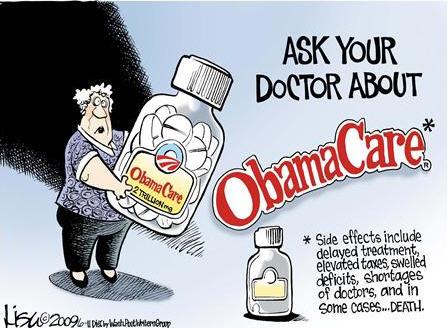 I’ve read today – far too often today – that Chief Justice of the United States Supreme Court John Roberts is a cross between Judas Iscariot, Pontius Pilate and Benedict Arnold. Or maybe something worse. Although I doubt Chief Justice Roberts needs me to come to his defense (or that he even cares, to be honest), I’m going to give it a shot. Let’s look into what the Supreme Court ruling on the PPACA actually means before passing judgement, shall we?
The Supreme Court ruled that the government cannot compel anyone to buy anything. Ever.
Big? You bet this is huge. We’ve heard for two years from academicians and progressives that under the Commerce Clause, Congress has the ability to force us to buy stuff. Their theory was that because everyone needs health care at some point, we all engage in commerce related to the health industry and the very act of not purchasing health insurance was an action. Well, not so fast.
“The individual mandate, however, does not regulate existing commercial activity. It instead compels individuals to become active in commerce by purchasing a product, on the ground that their failure to do so affects interstate commerce. Construing the Commerce Clause to permit Congress to regulate individuals precisely because they are doing nothing would open a new and potentially vast domain to congressional authority…The Framers gave Congress the power to regulate commerce, not to compel it, and for over 200 years both our decisions and Congress’s actions have reflected this understanding. There is no reason to depart from that understanding now.”
So, the Obama administration’s argument (echoed by the same academicians above) got the royal smack-down. Chief Justice Roberts may as well have wrote, “What are you, a bunch of moe-rons?”. The result is the same. Rarely does a published opinion go this far (nearly 16 pages) to explain why an argument is so plainly stupid.
The Supreme Court ruled that ObamaCare is the biggest tax hike in US history.
Yes, they ruled the PPACA can move forward, but that the government can no longer try and hide behind the facade of an individual mandate. No, they ruled: ObamaCare is actually a tax increase. Or more precisely, a combination of 21 different tax increases that total $1.2 trillion in new revenue annually. How big is that? It amounts to new taxes that consume 8% of the nation’s economic output. With only a little over 4 months until the election, I’m not sure how either the President or his minions in Congress feel about running for election on a platform of delivering the biggest tax increase in history. I doubt they’re relishing the chance to find out. Already the cries are being raised about the impending sequestration, with it’s 1.5% tax increase and strong possibility of pulling the economy back into recession. ObamaCare represents a tax increase more than 5 times that impact. By ruling as they did, the Court hand-delivered a gift-wrapped campaign theme for the Republicans this Fall. “If you thought the economy was bad before, just wait until ObamaCare sinks it forever.”
States cannot be forced to participate in ObamaCare.
A big part of how ObamaCare delivers affordable insurance to the masses is through a massive expansion in Medicaid, by enrolling anyone at 133% of the federal poverty line or below in the program. A big part of how the administration covers up the cost of that expansion is by removing federal subsidies for it by 2017, but still compelling the states to pick up the tab. As of right now, 13 states are balking at the idea of pushing their budgets into the red to make good on this mandate. The Supremes issued another smack-down on this, ruling that unfunded mandates are unconstitutional, even if the mandate is to an existing program.
“It is enough for today that wherever that line may be, this statute is surely beyond it. Congress may not simply “conscript state [agencies] into the national bureaucratic army,” and that is what it is attempting to do with the Medicaid expansion.”
Either the administration can relent and pick up the entire tab for the Medicaid expansion, or live with fact that the original goal of covering more than 95% of Americans in some form of health plan is by the boards.
So, is this really a win for Team Obama? Only in Pyrrhic sense. Yes, the PPACA stands for now – but not all of it. The Medicaid smack-down means that a very large part of the administration’s base of support won’t see any benefit from the law. As for the rest of it, Team Obama is now left to campaign on the largest tax hike in history, in the middle of the worst economy in 80 years. It is also already galvanizing support for the Republican challenger as nothing else could have – especially given Mr. Romney’s own dubious record on health reform.
The President may be heading to bed this evening with a smile on his face. But I bet the one on the Chief Justice’s face come November 6th will be a bit bigger.
ObamaCare Constitutional (Sort of)!
 The Supreme Court issued their ruling on the Patient Protection and Affordability Care Act earlier this morning. The short story is, the act stands. But there is much in the ruling that I can see making the President and entire Federal government wishing they had never taken this up to begin with.
For staters, the Individual Mandate is completely unconstitutional. No ifs, ands, or buts.
“Construing the Commerce Clause to permit Congress to regulate individuals precisely because they are doing nothing would open a new and potentially vast domain to congressional authority. Congress already possesses expansive power to regulate what people do. Upholding the Affordable Care Act under the Commerce Clause would give Congress the same license to regulate what people do not do. The Framers knew the difference between doing something and doing nothing. They gave Congress the power to regulate commerce, not to compel it. Ignoring that distinction would undermine the principle that the Federal Government is a government of limited and enumerated powers. The individual mandate thus cannot be sustained under Congress’s power to “regulate Commerce.'”
Instead, the Court ruled that Congress can impose a “health tax” as part of the individual tax code, but again, it cannot apply a penalty to persons who refuse to participate in the insurance market. They can only impose the tax uniformly – on everyone – and then refund or credit people who do buy insurance.
But the biggest bombshell coming from this ruling is the Court’s take on unfunded federal mandates. They’ve basically eviscerated one of Washington’s favorite ploys – requiring the states to do something, but not paying for it. In this instance, it is the expansion of Medicaid to cover all persons up to 133% of the federal poverty line. Although Congress offers short-term relief for the increased expenditure, that ends in 2017 and the states eventually pick up most of the tab – or face losing all of their federal funding for Medicaid. The Court ruled that if the Feds want to expand Medicaid that way, they need to pick up the full tab – permanently.
“The Medicaid expansion thus violates the Constitution by threatening States with the loss of their existing Medicaid funding if they decline to comply with the expansion. The constitutional violation is fully remedied by precluding the Secretary from applying §1396c to withdraw existing Medicaid funds for failure to comply with the requirements set out in the expansion.”
Taken broadly, this opens a Pandora’s box of mandates to legal challenges, in everything from education (“No Child Left Behind”) to transportation (Federal Highway Funding). Fun times lie ahead, I’m sure.
I’ll have more in a few days, once I’ve fully digested all 193 pages of the decision. If interested, you can read the full thing here.
Another Take on the College Conundrum
You may recall that earlier this month I did a two-part series on the issue of college costs. Apparently, I’m not the only person who believes the underlying cause for skyrocketing tuition and housing costs is the sheer number of undergraduate students currently enrolled in two- and four-year programs.
I came across this a rticle last night by Richard Vedder, Professor of Economics at Ohio University. Professor Vedder describes in much more detail than I allotted the cause-and-effect of increased enrollment, and also goes into quite a bit of detail about how the federal government’s subsidies only exacerbate the situation, not alleviate it. Given that word broke yesterday that the Senate did what everyone expected and came to an agreement about how to use creative accounting to extend the student loan program at current interest rates, I thought it made sense to revisit the topic. Feel free to hit the link and post your comments.
Social Conservatism and Libertarianism can co-exist
This morning’s post about being a Libertarian raised questions among the readership (thanks for the feedback, by the way) and I thought one in particular needed addressing. It came from a Twitter follower who wanted to know how I, an unabashed Christian and social conservative, can also be an unabashed Libertarian. On first blush, I understand how there is a seeming dichotomy in the two philosophies. The confusion, I think, stems from not understanding how classical liberalism and classic Protestantism influence Libertarian thinking.
 As defined today, liberalism invokes the idea that government is the only organization capable of providing social cohesion. Religion, family and community each play a role, but in the end it is the government that must be the glue that keeps society from coming apart. This view – call it modern liberalism – is currently the predominant one in western society. The “enlightened oligarchy” of this model actually isn’t far removed from the “enlightened monarchy” that dominated that dominated European governments in the latter half of the 18th century. It also hews closely to various themes that come to bear in the mid-20th century, in which government control over most or all aspects of social order were encouraged: Socialism, fascism and communism.
However, classical liberalism as practiced in the upper-echelon salons of Western Europe and mainstream American life in the same period held that each institution worked in combination to create a stable society. In this model, government is just another player along with religion, family and community in creating a just and stable society. Classical liberalism, as opposed to modern liberalism (or perhaps, “progressivism” is a more apt term), holds that individual rights outweigh those of the society – provided the individual is a just and moral being. If not, then each of the various factions that comprise a society; the churches, the schools, the community organizations, the family and friends and yes, the government, has a role to play in returning the individual to that place of moral rectitude.
“The foundation of our national policy will be laid in the pure and immutable principles of private morality; the propitious smiles of Heaven can never be expected on a nation that disregards the eternal rules of order and right which Heaven itself has ordained… While just government protects all in their religious rights, true religion affords government its surest support.” –George Washington, First Inaugural Address, April 20, 1789
Although the nation’s creation included the indispensability of a moral citizenry, the founders further outlined the necessity for religion and governance playing separate yet equal roles in public life by purposely cleaving the two. Government would have no role in determining religious affairs and (other than informing the moral character of the citizenry) religion would have no say in the body politic. They codified the principle in the First Amendment to the Constitution, which forbids the government from establishing a national religion or interfering in any religious activity. Moral character may be important, but it is not so important that the government should decide that which is moral. Rather, the government should be informed of that which is moral by the decisions of plebiscite, which in turn should be informed by the communities’ religious institutions.
This reliance on indirect morality in government is how I can be both a Libertarian and socially conservative. It is not the government’s job to dictate morality; that is best left to me, my personal relationship with Jesus Christ and my spiritual mentorship from my church. The moral and religious beliefs I hold will, by nature, play a part in how I vote and participate in the political theater. But the place to make the arguments for those positions is not in the political arena, but the spiritual: in the pews and pulpits, not the halls of Congress.
To put it more plainly: it is not the role of religion to decide the affairs of government and it is not the role of government to decide the affairs of religion. This principle has been a cornerstone of the American Republic since the founding. As JFK said, “I believe in an America where the separation of church and state is absolute.” That many of my fellow social conservatives see fit to now overthrow this essential precept of American republicanism speaks more to their insecurity and unwillingness to engage the populace in true debate over morality – rather, they would impose it by means of government impression. That is antithetical to the teachings they claim to uphold. Christ wants a conversion of souls, not an enslaved people. In the same way, we should look to create a nation of free minds, not coerced opinions.
Libertarianism and social conservatism are more than compatible. Since both teach that the best way to a society that can absorb the worst while coming through with our individual best, they are mutually supportive.
Why I’m a Libertarian
When I announce my political affiliation, the usual responses range from subdued chuckle to loud guffaw. “Oh no,” people say. “You’re not one of those crazies, are you? An anarchist, ready to abolish the government?”
Well, I am a Libertarian and have been for a quite a long time. And the reason is pretty simple: if I’m crazy, then so were men like Thomas Jefferson, Samuel and John Adams, Patrick Henry, George Washington, James Madison and Benjamin Franklin. All, excepting Madison, signed the Declaration of Independence. You might have noticed that these men, the original Libertarians, while unafraid to fight for liberty – to give their lives in the cause of liberty, if needed – were hardly anarchists. In fact, when their first attempt at organized government yielded something much closer to anarchy than we even want to dream of today, they organized the first Constitutional Convention.
So, if that’s crazy, feel free to count me in.
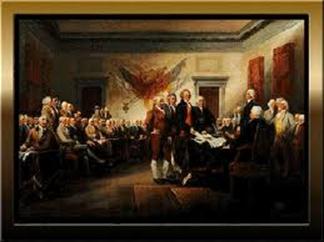
“The Presentation of the Declaration of Independence” by John Trumbull
To put it simply, Libertarians believe that government exists solely to protect individual freedom. But our views on where those freedoms derive are much different than that of the typical Republican or Democrat; in fact, they are diametrically opposed. Ask yourself this question: is government the final arbiter of what constitutes essential liberty? If you answered yes, then you hold the same world view as the vast majority of Republicans and Democrats.
Before you answer that the idea of a government not being responsible for deciding what freedoms we should enjoy is the definition of anarchy, consider the very document that founded our great country, the Declaration of Independence. It is more than a 236 year old piece of parchment that hangs in the National Archives. It is the very embodiment of what makes America, and Americans, unique among other nations and nationalities.
“We hold these truths to be self-evident, that all men are created equal, that they are endowed by their Creator with certain unalienable rights, that among these are Life, Liberty and the Pursuit of Happiness. — That to secure these rights, governments are instituted among Men, deriving their just powers from the consent of the governed…”
Now consider the Preamble to the document that created the federal government, the Constitution for the United States of America. It is 11 years the junior to the Declaration, yet in it the nation’s founding principles are given their equal due – prior to prescribing the methods used to preserve Liberty.
“We the People of the United States, in Order to form a more perfect Union, to establish justice, provide for the common defense, promote the general Welfare, and secure the Blessings of Liberty to ourselves and our Posterity, do ordain and establish this Constitution for the United States of America.”
When you actually read the words, two things immediately become clear:
- The essence of Liberty, of Freedom, is not something that comes from any government. It comes from a Higher Authority.
- Government exists to protect those rights, not corrupt them.
Understanding the first point is essential to truly understanding the American concept of Liberty and freedom. The only way individual freedoms are absolute is if they come from an authority higher than that of either men or their institutions. Otherwise, individual freedoms are a caprice, something to be given or withheld as determined by the fancy of others. Governments, rather than working to protect those freedoms, become dishonest arbiters of disputes. Eventually, governments (and the people governing) no longer see themselves as members of the general society, bound by contract and convention to uphold liberty. They become oligarchs; a separate class that believes itself superior to the rest of society.
Does that last paragraph give you pause? It should, because we are witnesses to that very transformation. It is not a sudden transformation that occurred in the past two or three years, either – it’s been underway for most of my lifetime. Is it beginning to snowball, accelerating in pace and breadth? Certainly, and the quickening pace over the past few years makes anyone concerned about preserving liberty queasy.
Now, as to why I identify as a Libertarian and not a Democrat or Republican: the proponents of the two major parties are our modern oligarchs, who see themselves as more fit to determine which liberties are essential and which can be abridged by the government. There truly isn’t much of a difference between them, in that both see distinctions in liberties; the difference is only in which liberties they deem more essential. The things they spend their time arguing over are actually further limitations on those essential liberties and freedoms, disguised as concern for safety of the overall society. The reason they feel secure in their deliberations is that the Nation, once enamored of Liberty, is today concerned less with freedom than safety – or at least, the illusion of safety. The people fear deprivation of material desires than the loss of freedoms. They are convinced the loss of freedom for one party will not result in a curtailing of freedom for themselves – when the reality is that any loss of freedom for any American necessitates that all Americans lose some aspect of their Liberty.
Terrific examples come from exchanges I had this week with unabashedly partisan Democrats and Republicans. I fed the same quote to both, and their reactions were remarkably similar. The quote, from Ben Franklin, is “Those who would give up essential Liberty, to purchase a little temporary safety, deserve neither.” The Democrat’s response was that Franklin has been dead 200 years, and his ideals with him. The Republican’s response was that changing times require changing mores.
That’s the final point that our founding document makes, that most Americans either forgot or were never taught.
“—And for the support of this Declaration, with a firm reliance on the protection of Divine Providence, we mutually pledge to each other our Lives, our Fortunes and our Sacred Honor.”
The nation’s founding principle is that the Liberty and the ideals of freedom supersede anything else. Liberty takes precedence over personal comfort, over wealth, over safety and even life itself, if necessary. The very ideal is worth fighting and dying for, as in the case of the American Revolution and the Civil War. What is more, if this principle is derived from an act of Divine Providence, then it does not disappear with the death of individuals nor the passage of time. It is an everlasting, eternal truth.
Because I am a free man and believe my freedom is not negotiable: That is why I am a Libertarian. Because I believe that the government is my servant, not my master: That is why I am a Libertarian. Because I believe that no man has the right to subject another to his will: That is why I am a Libertarian.
And if you believe these things, so are you.
Obama’s Amnesty: Two More Cents
On Friday, President Obama shocked most of the country with his latest Executive Order. You know, the one that lit up the blogoshpere – his unilateral decision to stop deporting illegal immigrants who are attending school or served in the military. I figured as long as everyone else was chiming in on the topic, I might as well, too.
Let me begin by admitting that my thoughts on the illegal immigration issue run counter to most people on my side of the political fence. I think it is impractical and probably impossible to deport every single person who migrated to the US outside of the approved immigration policy. Did they break a book full of laws by settling here in that fashion? Sure, and for that I cannot see how any form of reward is proper. I certainly think that anyone who emigrated to the US (legally or otherwise) who engages in unlawful activity should be deported. I’m all for strengthening our border security, up to and including deploying the Army and Air Force with orders to shoot first.

Courtesy: Conservative Jokes
What we do with those who are already here, though, is a much trickier proposition. A big part of the problem is that there really isn’t a way of finding them all: they live mostly in the shadows. There isn’t even reliable data on how many immigrants are here illegally; news reports I’ve read over the past few days use numbers anywhere from 600,000 to 4 million. It’s as much a crap shoot as any statistic you will ever come across. I’ve decided that, essentially, the status quo is probably the best that can be done in their case. Unless they run afoul of the law or ask for social services, we can’t find them. Of course, if they do they should simply be sent packing. But otherwise, I’m content to allow them to stay in their shadow communities.
Often, when thinking in terms of immigration policy and standards, I look at things through my mother and grandmother’s eyes. They arrived here in1959, fresh from the Soviet bloc. As immigrants, they fully understood the challenges faced by other immigrants, regardless of origin, native tongues or anything else. They were both adamantly against illegal immigration, and understandably so. Even as political refugees, they had to go through a battery of tests and pre-qualifications before being allowed into the country. They thought it eminently unfair that anyone should just walk across the border and set up camp, without any need to prove they were willing to fully assimilate into American culture – or even demonstrate they had the skills to contribute to society.
What did they think about the children of illegal immigrants? They both felt that the Constitution should be amended or clarified to ensure that the children of illegals, even if born in the US, should not be granted citizenship. They and their parents should be returned to their home nations and sent to the back of the line, so to speak, and await their turn.
So, extrapolating (there’s your big word for the day, folks!) from that premise, I cannot abide allowing those children to stay here on any sort of amnesty program. I realize the people the President’s order targets didn’t arrive here of their own accord. I’m even willing to let them return to their home countries with a preference on the waiting list. But if anyone thinks this is the beginning of meaningful immigration reform, they are seriously deluded. After all, even under the executive order those illegals affected won’t be granted residency status – only an act of Congress can do that.
We need to recognize this for what it is: an act of political pandering from the President Who Perfected Pandering. The EO signed on Friday only remains in effect until rescinded, either by a new President in 2013 or by the current one when he realizes it costs him more votes than it gains. It wasn’t a grand statement on the mess our immigration policy turned into after Ronald Reagan’s own bit of pandering in 1986 (the Immigration Reform and Control Act). Had Obama actually wanted to enact some type of meaningful reform, he would have combined the EO with a legislative proposal – not a Rose Garden speech asking Congress to do something. You’ll also note that in that speech, the President didn’t outline what he wanted as a result of the reform he demanded, a curious lack of leadership that is in keeping with his style.
What should be of greater concern to all, regardless of where you live, is this fits a pattern of flaunting the Constitution in order to score a cheap political point. In addition to this latest EO, we have other extra-constitutional power grabs that seem derived of partisan political maneuvering. Things like indefinite detention, refusing to support DOMA, international assassinations – the list is growing daily. The President, any President, does not have the prerogative of deciding which laws to enforce. His job is to enforce the law of the land and if he finds one unacceptable, he can request Congress rescind it. This latest EO actually requires a variety of law enforcement agencies, from the FBI and INS to Homeland Security, to willfully ignore the law. Such a situation should never be tolerated by the citizens of our republic.
The College Conundrum: An Alternative
Yesterday, I dissected the underlying problem with higher education, as it currently exists. A college education costs far more than it is actually worth.

At least Bluto wasn’t $500,000 in debt
Today’s students pay far too much and receive far too little benefit to justify the expense. What’s more, in most cases they are strapping themselves with insane amounts of debt in the process. It is a debt that hampers their ability to fully function in modern society. The resulting lack of disposable income for the first decade or more after graduation results in a generation that is incapable of financially supporting themselves. If there is an economic downturn (like now), that lack of spending power means that upwards of 40% of the labor force is unable to do those things which define a middle class lifestyle: own a home, own a car, start a family. Instead of college leading to the middle class, college results in poorly educated people (who mistakenly believe they’re highly educated) reliant on the government or their extended families for support.
So, what’s the solution? We constantly hear that without college, young people have no hope of starting in a good career, that their prospects for future advancement are limited and they will be limited in their ability to fully participate in the American Dream. And so we end up focusing on ways to make college more affordable, without actually looking at the reasons for the high costs involved.
As I pointed out, the principle reason for the inflated cost of higher education boils down to the number of people enrolled. There are 3 times as many college students today as there were 30 years ago – are we really surprised that tuition and fees are also three times higher than 30 years ago? The real question is why we are funneling so many people into colleges. If it is to prepare them for post-academic life, then there can be little doubt that we’re failing in a big way.
I’ve always felt the primary purpose of education – whether primary, secondary or post-secondary – should be a dual mission: first, basic facts and skills (the “3 R’s”) and second, developing critical thinking skills. In American education, we’ve focused primary and secondary education on the former while nearly ignoring the latter. This trend is now extending into post-secondary education. A prime example is the dreaded research paper. I shudder at the memory of writing exhaustive, well-researched papers on a weekly basis while in college. The amount of time I spent developing a final paper for each class was measured in weeks, not days. Yet, today’s students often are tasked with only one paper at term’s end and drilled in preparing for weekly quizzes – an approach similar to the high school experience. The original purpose of higher education in the American system, developing one’s mind to sift through tons of data, determine which pieces are relevant and create a cohesive argument from them, is being lost. In other words, we’re graduating millions of kids prepared for an extended stay on “Jeopardy!” but not ready for the types of jobs that traditionally require a college degree.
This is also a result of herding high school students into college. I think the best way to tackle the costs associated with college stem from rethinking the way we handle primary and secondary education. Current elementary and secondary school curricula are leftovers from the days when the United States was principally an agricultural society, and recent reforms have done little to address that fundamental flaw. If anything, the recent and increasing emphasis on standardized testing and evaluation of student and teacher achievement is a step backward and fails to address the real world situations most young people face after graduating from high school. Because our education system now deemphasizes critical thinking skills in favor of rote memorization and socialization, most kids enter into adulthood knowing a set of facts that are essentially meaningless – unless preparing for life as a game show contestant.
The best course of action, I believe, is to reintroduce vocational training during high school and reemphasize critical thinking skills, beginning in primary school.
Vocational education programs, where they do exist, are often maligned, snubbed and underfunded. However, I see nothing wrong with providing basic education in critical skills developing courses (math, the sciences, history, English) while also providing 2-3 hours per day of vocational instruction to those students who prefer that track. This is a similar education structure to the German model, essentially – only instead of four tracks of study, I would streamline it to two and I wouldn’t begin the vocational track until the age of 13 or 14, not 10. Along with making vocational education an acceptable option, though, we need to reconsider the courses available. Traditional “vo-tech” professions such as auto mechanic and machinist should continue to be included, certainly. But many professions that currently require a bachelor’s degree only require it because it signifies the holder has developed basic critical thinking skills, along with the basic technical skills required. Professions like LPN or Network Engineer do not require the job holder to have in-depth conversations on the merits of St. Thomas Aquinas’ views of married clergy; there is no reason that learning how to create such a dissertation should be part of the education process to enter those fields.
As I said, the current emphasis on standardized testing results in less classroom time devoted to developing critical thinking skills. In extreme cases, it is turning our teachers into nothing more than room monitors and test graders. The practice grew from concerns that education standards in the US lagged other first-world nations in education achievement. While the goal was and remains laudable, the prescribed cure is making things worse. As a nation, we’ve fallen further behind in academic achievement. Somebody, somewhere decided that rather than measuring academic achievement in terms of how well students think, measuring how many arcane facts and figures they memorized was important. Don’t get me wrong, a basic knowledge set is important. But without the ability to turn those facts and figures into a thought, they are nothing more than bytes of data. We need to empower teachers to create thinking students and reward those students for developing their thought processes. The notion that those skills can wait until college to fully develop is proving wrong-headed.
Of course, there are challenges associated with this type of program. The biggest is probably changing the mindset we currently have regarding education. That requires buy-in from multiple stakeholders. Teachers unions, who’ve proven resistant to change in the past. School administrators, beholden as they are to current power structures. The federal government, still trying to figure out how “No Child Left Behind” left so many kids behind. Most importantly, it requires not only acceptance but a demand from parents, who likely will be confused by the changes.
The other option is to simply continue on the current course and leave another generation of kids ill-prepared for adulthood, in three phases of their development: their academic achievement, their career preparation and the amount of debt they’re saddled with before they ever earn a dime.
The College Conundrum
This is an unusual time of year to discuss the state of higher education in America. After all, May is usually the end of the academic year for most universities. The senior classes at most have already received their sheepskins and incoming freshman won’t arrive on campus until August. We’re well into June and most folks thoughts are on summertime fun.
But as with everything in this topsy-turvy year, higher education is taking up space on the front pages of major newspapers. There are two reasons for this. The first is that federal student loan interest rates are set to double in July, a situation that will make the already insane tuition costs even more unbearable for many. The second is the re-emergence of Peter Thiel, the founder of PayPal and his entrepreneur initiative. The first has, as with everything this election cycle, devolved into a partisan fight. Not a fight over the idea of maintaining the current interest rate – both Republicans and Democrats agree they should – but a fight over how to pay for the increased subsidy. (As usual, Democrats want to raise taxes on the upper middle class, while the Republicans want to gut a Democrat sacred cow). The second highlights a more critical discussion and the one I want to focus on here: how much is a college degree worth?

Peter Thiel
For those of you who aren’t familiar with Peter Thiel, he is undeniably one of the world’s brightest individuals, something of a Libertarian lighting rod and as an immigrant, the prototypical American success story. He became something of a Web 2.0 wiz kid, when he co-founded PayPal in 1999 with Elon Musk and Max Levchin. He then founded Clarium Capital and created the Founder’s Fund in 2005. Among his noteworthy achievements, he is a chess grand master. He provided early funding for Facebook and still sits on the Board of Directors. (That initial $500,000 investment is now worth an estimated $9.2 billion, based on yesterday’s market close). Thiel also foresaw the financial crash of 2008 as early as 2004, when he correctly noted that the dot-com bubble of the late 1990’s had simply transferred to real estate.
The reason Thiel is a controversial figure in higher education is his creation of the Thiel Fellowship, whose sole purpose is to find students with great product and/or business ideas, have them drop out of school, and award them with $100,000 grants to launch their businesses. Additionally, business and engineering leaders mentor Thiel Fellows. The goal is to bypass college entirely and get right to work.
Why would Thiel, who holds BACP and JD degree from Stanford, work on a project that is popularly seen as undercutting the value of higher education? Simply put, he doesn’t believe that the way the college experience is currently constructed holds real value for most students.
And it’s easy to understand why. Stop to consider my home state’s primary public university, Rutgers. Students in the 2017 class can expect to pay about $96,000 for their four years – provided they’re a New Jersey resident (that cost balloons to $154,000 for out-of-state students). A New Jersey student from a median income family can fully expect to have to pay $84,000 after state and federal grants. Assuming they don’t receive any scholarships, that hefty price tag will come primarily from loans. This is just an illustration, of course. There are other fine universities that carry lower tuitions and fees, but the point remains: why so much? Well, the answer is actually simpler than the very public teeth gnashing might lead you to believe. Nationwide, tuition is about 300% what it was 30 years ago. Over that same time, student enrollment rose 315%. This is simple supply-and-demand economics. There hasn’t been a commensurate increase in the number of colleges and you have more students competing for the same amount of resources. Everything else (capital improvements, staff, etc.) stems from that simple fact.
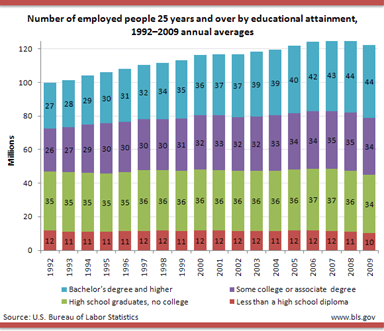 But has the intrinsic value of a Bachelor’s degree risen by a similar value over that time? Probably not. You can make several solid arguments that if anything, the value of a Bachelor’s degree is less than it was when I graduated in 1989. First, there’s the sheer number of college graduates now in the work force. In 1992, BLS estimated there were 27 million college graduates, comprising about 25% of the work force. (See chart to the left).By 2009, that number reached 44 million, comprising 36% of the work force. And for our 2017 graduate, those figures are estimated to be 58 million and 45%. Where once a Bachelor’s degree separated you from the rest of your age group (and therefore put you near the head of the pack for advancement, promotion and salary), by 2009 there were more people sporting a Bachelor’s degree than people with only a high school diploma in the workforce. The BA or BS after your name has become what the high school diploma was a generation ago: a sign of basic academic achievement.
Then there’s the question of what a student learns during their course of study. Certainly, some practical workplace knowledge is gained, but most work skills are acquired as a result of internships and part-time employment. Quite a few students graduate without even the rudimentary skills required – a fact that many hiring managers are well aware of. I have a humorous anecdote that highlights the point: in 2007, I started a paid internship program at a company I ran. One of the interns was a very bright and driven kid attending one of the better business schools in New York. After he graduated in 2008, I offered him a full time position as an assistant site manager at our premier location. I was assisting during one particularly hectic event and asked him to create a pivot table in Excel. After what must have been 15 of the most frustrating minutes in his young life, he looked at me (nearly crying) and admitted he had never learned how to create one. As it turned out, he was an honors graduate who was horribly unprepared to work in his chosen field of study (Business Management). A short while later, he left both the company and the business world behind and decided to follow a vocation more to his liking (Entertainment). I doubt that young man today would say the money he spent on his degree was worth it.
There’s also the question of how much a degree actually prepares you for the life-long learning required in today’s economy. The courses I studied as a young electrical engineering major seem almost quaint by today’s needs. Hardware has changed and so has the software that drives every gadget in our possession. I received a well-grounded (pun intended) theory of how electricity works, but as for specific knowledge related to my field now – that part of my education is useless. The computer languages I use on a daily basis didn’t exist in 1988. The circuits I work with involve components that weren’t dreamt of then – and the gadgets of today do things that could only be found in episodes of Star Trek. The study habits I use to learn these new technologies aren’t the result of a well-honed college experience, otherwise my house would be littered with half-eaten pizzas and empty beer cans. I’ve probably made more use of several of the liberal arts courses I was required to take over the past decade than the ones directly related to my degree.
So, if Peter Thiel is right, what then is the alternative? We’ll look at that tomorrow.
Help a Jarhead (or maybe a million)

Two Marines affected by contaminated Lejeune water
Undoubtedly, most of you have heard about Love Canal, NY. But what would you say if I told you there was a place where contamination levels were worse, with a population 500 times greater? And what would you say if that place was owned by your government? And that while acknowledging the contamination since 1984, the government has done nothing in the intervening 28 years to assist those affected by it?
This is the situation for the more than 1 million Marines and sailors who served aboard Camp Lejeune, NC between 1957 and 1987. During that time, the wells used for drinking water at the base were contaminated by more than 200 known toxic substances. Nobody can say with any certainty what the effects of ingesting this many poisons, in the volumes and combinations by anyone who lived on the base for any length of time, might be. What is known that there has been a rash of strange diseases in people who lived and worked on the base: male breast cancers, digestive diseases and cancers, brain diseases and cancers. While they cannot be 100% conclusively linked to the contaminated wells and ground water, the unusual rate of incidence of these diseases certainly suggests more than a casual causal probability. In some cases, the incidences are more than 1000x what is found in the general population!
But the government understands that actually taking care of the men, women and children who ingested these chemicals is an expensive proposition. And so, rather than live up to the Marine Corps motto of “Semper Fidelis,” your government has seen fit to lie, obfuscate and deny assistance to them. Rather than display faith and fidelity to the Marines who were assigned to duty at Camp Lejeune, the government has decided it better suits their needs to shun us and pray we all die off before they need to do anything. The Obama administration has decided that rather than lend a hand, more study is required. Congress has allowed legislation aimed at helping languish in committee, despite having bipartisan support and 42 co-sponsors.
There is something you can do to help, though. First, sign the petition to let the President and Congress know that you, the taxpayer and citizen, support the Marines fighting what may be the most desperate battle of our lives.
Second, the Janey Ensminger Act would classify any Marine or sailor, or their dependents, who lived at Lejuene as having a 100% service-connected disability. That would allow them to receive free, lifetime medical care through the Veteran’s Health Administration. As mentioned above, the bill is currently stuck in the Veterans Affairs Committee. The committee rules allow the committee chairman, Rep. Jeff Miller (R-FL 1), to pass the bill out of committee without a vote. So, write Rep. Miller and urge him to send the bill to the full House of Representatives for a vote. You can also message him through Facebook.
Let’s get it done, people. When duty calls, the Marines are the first to answer. Now it’s your turn to do the same for them.
A Soldier Died Today (Orig. posted Memorial Day, 2011)
Thanks to my friend and fellow Marine Howard Cooper for passing this along. Neither of us know who the author is, so I can’t properly attribute this poem. But while everyone else is still nursing hangovers or trying to get back in the flow of normal life, there are some of us who will not forget…

He was getting old and paunchy and his hair was falling fast,
And he sat around the Legion, telling stories of the past
Of a war that he had fought in and the deeds that he had done,
In his exploits with his buddies; they were heroes, every one.
And tho’ sometimes, to his neighbors, his tales became a joke,
All his Legion buddies listened, for they knew whereof he spoke. But we’ll hear his tales no longer for old Bill has passed away, And the world’s a little poorer, for a soldier died today.
He will not be mourned by many, just his children and his wife,
For he lived an ordinary and quite uneventful life. Held a job and raised a family, quietly going his own way, And the world won’t note his passing, though a soldier died today.
When politicians leave this earth, their bodies lie in state,
While thousands note their passing and proclaim that they were great. Papers tell their whole life stories, from the time that they were young, But the passing of a soldier goes unnoticed and unsung.
Is the greatest contribution to the welfare of our land
A guy who breaks his promises and cons his fellow man?
Or the ordinary fellow who, in times of war and strife,
Goes off to serve his Country and offers up his life?
A politician’s stipend and the style in which he lives Are sometimes disproportionate to the service that he gives.
While the ordinary soldier, who offered up his all,
Is paid off with a medal and perhaps, a pension small.
It’s so easy to forget them for it was so long ago, That the old Bills of our Country went to battle, but we know It was not the politicians, with their compromise and ploys, Who won for us the freedom that our Country now enjoys.
Should you find yourself in danger, with your enemies at hand,
Would you want a politician with his ever-shifting stand?
Or would you prefer a soldier, who has sworn to defend
His home, his kin and Country and would fight until the end?
He was just a common soldier and his ranks are growing thin,
But his presence should remind us we may need his like again.
For when countries are in conflict, then we find the soldier’s part Is to clean up all the troubles that the politicians start.
If we cannot do him honor while he’s here to hear the praise,
Then at least let’s give him homage at the ending of his days.
Perhaps just a simple headline in a paper that would say,
Our Country is in mourning, for a soldier died today.
I Shed a Tear (orig. posted Memorial Day, 2010)
I originally posted this on Memorial Day, 2010, but the sentiment is the same. As you head out to the beach, the barbecue or the ballgame today, please take a moment to remember why you have this particular Monday off from school or work.
And although it’s been two years since I originally wrote this and the little boy at the end is now not quite so little, I still want to thank him and his parents. Whenever I need affirmation that this nation still has good and just people, I think of them.

I awoke this morning to thoughts of old friends who left us too soon. It’s not an unusual occurrence; most mornings I wake thinking of the same men. When they died, they did not give in to fear; cowardice was not these men’s forte. Some died in battle, some preparing for battle. Two very good friends of mine died not in battle, but the wounds they sustained in defense of liberty hastened their untimely departure from our world. One man was known simply as Tank. He was a large man, but in his later years his body had been ravaged by the effects of two bullet wounds and prolonged exposure to Agent Orange during his two tours of duty in Vietnam. Today, I celebrate not only Memorial Day but the tenth anniversary of his passing. Although Tank never spoke of it, he was awarded a Bronze Star during his second tour. It wasn’t until his funeral that I learned how as a 23 year old platoon sergeant he ran back onto a hot LZ, taking a bullet in the back and one in the shoulder, in order to pull one of his men to the relative safety of a tree line. But anyone who knew the man wasn’t surprised to hear of his courage under fire.
This morning, as I thought of him, I shed a tear.
The other day, I watched my town’s annual Memorial Day parade. In addition to the Korean War and Vietnam vets, a detachment from the local Marine Corps reserve unit marched. As I looked at their eager young faces, I realized that most of those kids weren’t born when I earned my EGA in 1983. In fact, most of them hadn’t been born when I mustered out. Realizing that most of these young men will be shipped to Iraq or Afghanistan, I reflected on my own service. I joined to fight Communism, and like most of the world, I rejoiced when the Berlin War crashed to the ground. I truly thought my service had proven, in some small way, invaluable to the defense of the American way of life. Yet here I was, watching a new generation of Marines preparing to fight a new enemy. Had my service not been as valuable as I once thought? Had the men I had known during my service, men who had fought and died in battles around the world – had they died in vain? I decided that no, our service – their service – had been as important in our time as these brave young men’s service is today. And then I realized that none of those young men will return from their combat tours the same. Even if not scarred on the outside, even if they survive to return home physically intact, they will carry the memories of what they see and feel and endure for the rest of their lives.
And as I watched, I shed a tear.
Last night I watched the National Memorial Day Concert, broadcast from the National Mall on PBS. I listened as Gary Sinise and Dennis Haysbert recounted the final moments of Charlie Johnson’s life. I watched as a new generation of war widows were celebrated. I enjoyed the stylings of Brad Paisley. Like plenty of others, I rose to attention and sang the Marine Corps hymn during the Salute to the Services, and I rose to attention and sang again during “America the Beautiful.”
But many times during the concert, I stopped to shed a tear.
And I wondered, as I prepared to try and sleep, will anyone awake on Tuesday and remember the sacrifices of the men who have fought and died to preserve the United States? It’s terrific that we have a day set aside to pay tribute to those men. And I don’t mind that we celebrate by doing uniquely American things – backyard barbecues, trips to the beach, baseball games. But I wondered, when Tuesday comes will my fellow countrymen remember those who ensured that the backyard barbecues could continue?
A little earlier today, I went to the neighborhood bodega. It was a routine trip to pick up a few items needed for my own backyard barbecue. Like many veterans, I have a “Pride Hat.” You may have seen one perched on a veteran’s head – a military baseball cap on which are pinned his campaign ribbons. Mine is nearing retirement. It’s 14 years of service are evidenced by its faded color and the only thing keeping it together are years of starch used to block it. As a result, I only wear it on special occasions. Today being one of those occasions, I wore it on my walk to the bodega. On my return trip, a neighborhood kid – maybe 6 or 7 years old – stopped me and said, “Were you really in the Army?” I smiled and said, no, I am a Marine and we’re better than the Army. The little boy sat on his bike for a minute, seeming to take in this bit of information. The he stood, and said “Thank you” before pedaling off down the street.
I shed a tear. In fact, I’m still shedding a few as write this. Because I have my answer. For as long as children like this can find my service honorable, they will keep the flame of liberty alive. In so doing, the most important thing we can do as Americans is to remember and honor the sacrifices that so many brave men have and will endure. We will continue to live as Americans, preserving our republic as the beacon of freedom and liberty for the rest of the world.
Divide and Conquer
 “Increasingly, the Democratic Party feels the need to match the Republican right in stridency and hardball tactics. I am convinced that whenever we exaggerate or demonize, oversimplify or overstate our case, we lose.” – Barack Obama, The Audacity of Hope.
“Elections have consequences. And at the end of the day, I won.” – Barack Obama (discussing economic policy with Eric Cantor), January 23, 2009.
One of the things my liberal friends have trouble digesting is Barack Obama’s inability to sustain the “Hope and Change” ideology of the 2008 campaign during his Presidency. I would invite them to ponder those two quotes above the next time they try to figure it out.
Obama campaigned, beginning with his convention speech in 2004, as being a new, “post-partisan” politician. A politician who would put his party aside for the sake of compromise, a man whose principle ambition was “to get things done.” He won, by and large, because he convinced large numbers of people who had no prior electoral experience of that narrative. This was despite the fact that in his brief time as a sitting representative, he didn’t have one example of a compromise solution he had worked on. He did have one bipartisan bill he worked on with Sen. Tom Coburn – S. 2590, the Federal Funding Accountability and Transparency Act of 2006. But that particular piece of legislation passed the Senate 98-2, and Obama was one of 47 co-sponsors. It wasn’t a compromise, none was needed to pass. Coburn noted during the 2008 election, in discussing this one example of post-partisanship, that “It’s easy to work across the aisle on consensus items. It’s when you demonstrate that you’ll stand in between — in no man’s land between the two trenches of the Democratic and Republican base, and you’ll take the heat. We haven’t seen that from Barack. As much as I like him, he’s not ever rejected anything of his party to be able to stand in the middle.”
More than anything else, this is the reason Obama cannot mobilize the people who propelled him to victory in 2008. The carefully crafted image of a post-partisan politician was with one move after assuming office, destroyed forever. Obama, the man who convinced millions who distrusted politicians and the political system that he was somehow different, revealed himself to be as partisan as anyone who’s ever held elective office. He tried to recapture that theme after the 2010 midterms, but quickly reverted to being a partisan hack. The evolution has left those millions who were cynical about the political process before his candidacy even more cynical in the aftermath.
The genie is out of the bottle and it won’t go back in, just as those millions won’t be coming back to support the President this time around. This realization that Obama can’t reclaim the throne of preeminent post-partisan is well understood by Campaign Obama and they’ve gone to the only option the President’s words and actions have left them: divide and conquer. They’re praying they can mobilize enough of the left wing to win reelection. But to do that, they need to abandon all pretense of being anything other than the highly partisan; they need to attack and denigrate any position not in line with leftist theology.
That this type of campaign will accentuate the differences in the nation, polarizing us more than any time since the Civil War, is of little consequence. The only thing that matters is that Barack Obama wins – even if the nation loses.
The Narcissistic Liar-in-Chief
It doesn’t come as a surprise to readers of this blog that I am not a fan of Barack Obama. I never have been. I’ve never seen in him the things the media generally transposes onto the Obama persona. I’ve always seen him as nothing more than another cold, calculating politician. Just another in a long line of despotic Chicago politicians; a man after whom Bill Daley would find more in common than the typical working stiffs that populate the Windy City. And like all politicians, I always figured he was more than a bit narcissistic.
But then today came word that the Obama White House is attempting to actually rewrite history, to include one Barack Hussein Obama in some of our country’s greatest Presidential moments. If you’ve heard about this already, then it was probably the rewrite of the Reagan Presidency that got your attention:
“In a June 28, 1985 speech Reagan called for a fairer tax code, one where a multi-millionaire did not have a lower tax rate than his secretary. Today, President Obama is calling for the same with the Buffett Rule.”

Reagan speaking at Northside HS, 6/6/1985
It’s actually beyond narcissistic to rewrite this bit of history. Reagan was not arguing for higher tax rates on anyone, as Obama contends with his historical rewrite. Rather, the Gipper was proposing a complete revamping of the tax code – lowering rates for everyone and eliminating loopholes. You can read the full text of the speech here, but I figured I would give you the portions where he talks about the need for a simpler, fairer tax code. Keep in mind, this speech was given at the commencement for Northside High School in Atlanta. The main thrust of the speech was celebrating the students achievement in turning their once failing school into one of the ten-best in the nation, while also lauding the nation’s economic turnaround. Neither of these are accomplishments that the Obama administration can even hope to match.
“We’ve already come a long way. Just 5 years ago, when some of you were in junior high, America was in bad shape, mostly bad economic shape. Rising prices were making it harder for your parents to buy essentials like food and clothing, and unemployment was rising; there were no jobs for seniors in high school and college to graduate into. It was as if opportunity had just dried up, and people weren’t feeling the old hope Americans had always felt. And that was terrible because hope was always the fuel that kept America going and kept our society together.
Just a few years later everything’s changed. You and your parents are finally getting a breather from inflation. And if you graduate and go out into the work force in June, there will be jobs waiting for you. Hope has returned, and America’s working again.
Now, you know how all this came about, how we cut tax rates and trimmed Federal spending and got interest rates down. But what’s really important is what inspired us to do these things. What’s really important is the philosophy that guided us. The whole thing could be boiled down to a few words—freedom, freedom, and more freedom. It’s a philosophy that isn’t limited to guiding government policy. It’s a philosophy you can live by; in fact, I hope you do…
As you know, that last week I unveiled our proposal to make the Federal tax system fairer, clearer, and less burdensome for all Americans. Now, someone might say it’s odd to talk about tax policy with young people in their teens. But I don’t think so. You not only understand what taxes are, what effect they have in the average person’s life, but if you don’t understand, you will pretty soon when you get your first job. I know some of you already have part-time jobs, and I know you keep your eye on the part of the check that shows what Uncle Sam is taking out.
What we’re trying to do is change some of those numbers. We want the part of your check that shows Federal withholding to have fewer digits on it. And we want the part that shows your salary to have more digits on it. We’re trying to take less money from you and less from your parents…
We’re going to close the unproductive tax loopholes that have allowed some of the truly wealthy to avoid paying their fair share. In theory, some of those loopholes were understandable, but in practice they sometimes made it possible for millionaires to pay nothing, while a bus driver was paying 10 percent of his salary, and that’s crazy. It’s time we stopped it.”
Of course, Warren Buffet was already a successful investor by the time President Reagan assumed office in 1981. And he was one of those millionaires Reagan was referring to, the ones who were paying nothing while bus drivers were paying 10% of their salary. The only difference is now, Warren Buffet still pays nothing, but that bus driver (assuming he’s still employed) is paying over 1/3 of his salary in taxes. And do you know who was at the forefront, leading the charge against the type of tax reform Reagan advocated? Yep, the same Warren Buffet who today is still against tax reform – instead opting for the Obama option of the “Buffet Rule.” And the reason for that is as simple as can be. Today, there are even more loopholes in the tax code than there were in 1985. Guys like Warren Buffet will still pay nothing. Note the difference in approaches: Reagan supported eliminating loopholes to equalize the tax rates. Obama just wants to raise rates.
So, yes, Warren Buffet is being disingenuous with his chicanery. But Barack Obama is, once again, flat-out lying to the American people – and all to make his ego feel better.
UPDATE: GDP Growth IS a result of government spending
I’ve heard from some of you, insisting I MUST have my facts wrong. After all, government spending has gone down over the past 3 years – not up. You know this because the esteemed Paul Krugman drills on this in every other column he writes and blogs about it daily. Besides, The Annointed One of 1600 Pennsylvania Avenue would NEVER LIE!!!
Funny, but I think those of you following that line of thinking are either (a) hoodwinked by the President or (b) Obama sycophants. The chart below was compiled by the Federal Reserve, and like most FEBR data, excludes inflation. But you’ll note that the increase in government spending as a share of GDP (and therefore, the commensurate reduction in GNP) eerily match the curve I developed.
So…..phhhhbbt. Stop listening to the liar-in-chief and his apologists. Learn how to do a little basic research on your own, people.
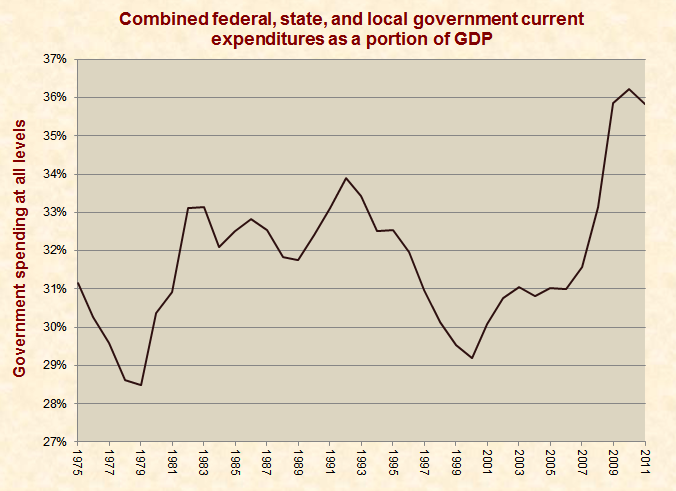
Oh, my…this IS the reason the economy hasn’t recovered!
GDP Growth & Government Spending

Obama’s Economic Hero
There are many things that puzzle me. For instance, why is the cold water tap always on the right-hand side of the faucet? It’s as if the guy who invented indoor plumbing arbitrarily decided to that cold water should come from the right and everyone since has followed suit. There’s no real reason for it. We could just as easily have cold water coming from the left and nobody would be any wiser for it.
A similar thought process seems to have occurred in regards to including government spending as part of a nation’s economic health, currently expressed as GDP. Once upon a time, we didn’t calculate GDP. We calculated GNP; the gross national product. That figure didn’t include government spending – because economists were interested in determining the productivity of a country’s economy. Governments simply do not produce anything; no goods, no services. In fact, government spending used to be regarded as a negative economic indicator. After all, the more governments spent, the more they had to raise revenue by confiscation (and yes, taxation is still confiscation – just with a prettier name). That pulled capital from the real economy – which lowers a nation’s GNP.
GNP remained the way the government and most economists measured economic output until 1993. The Clinton administration, swept to power on the mantra of “It’s the economy, stupid” was looking for a way to juice up the headlines. By switching from GNP to GDP, they found their way to reinforce the perception that the economy was improving. It didn’t matter that actual economic output barely increased from 1992 to 1993. By including government spending in the measure of the nation’ economic health, it seemed as if the economy had rebounded.
The Obama administration is relying on similar hocus-pocus to fool the American public in 2012. Yes, GDP is growing – but only because government consumes more of the national economy than at any time in history. Yes, more than during the New Deal of the 1930’s, more than the war spending of the 1940’s and more than during the profligate 80’s. In 2011, the US Treasury spent in excess of $6 trillion dollars and accounted for 41% of all economic activity recorded in the US GDP. By comparison, at the peak of World War II spending in 1944, the Treasury only accounted for 28% of GDP. Even at the height of the last major recession in 1983, the Reagan treasury only accounted for 36% of GDP. Yet, during the Obama administration, we’ve jumped from 36% in 2008 to 40% in 2009 – and haven’t fallen below that mark since.
Of course, there’s a flip-side to this coin: if government spending is what is driving perceived economic expansion, the reality must be that the real economy is shrinking. And after adjusting for inflation, that’s exactly the case: in 2008, GNP totaled $9.1 trillion dollars (that represented a $31 billion drop from 2007). But economic activity has continued to decline under the current administration’s tutelage. In 2009, GNP totaled $8.9 trillion and it has continued to drop since, all the way to $8.4 trillion in 2011.
This is the principle reason why job growth remains a real negative. The Obama team loves to pat itself on the back for “creating 4 million jobs over the past 18 months.” The sad truth is that the economy should have produced about 4.3 million jobs over the past 18 months just to keep pace with population growth. But the jobs picture makes sense when you compare it to actual economic growth. As the economy continues to contract, the demand for workers continues to decline. The only difference between 2012 and 2008 is that businesses don’t need to lay off workers to accommodate the reduced demand. They just simply don’t hire new employees.
I can summarize this with a very simple statement: if it seems to you that the recovery we hear so much about hasn’t ended the Great Recession, that’s because it hasn’t. There hasn’t been a recovery, except for those with direct ties to government spending. That’s the one component of GDP that has increased: by over $1 trillion over the past three years.
So, the next time you see a GDP number that trumpets economic growth, remember to dig into the numbers a bit. And remember, this is White House that replaced managing economic growth with managing spin.
Dreams of Julia

Yep, that’s what he thinks of you, America.
If you’re a political wonk (or wannabe wonk), odds are you are already intimately aware of the mythical Julia. For the rest of you, “Julia” is an Obama campaign creation; a mythical middle-class woman who cannot survive without the government largesse championed by the President and the modern Democratic Party. (You can catch her life story here).
It’s a good bit of salesmanship. In one tidy slideshow, the President and his minions manage to tie together the themes of his candidacy. It defends the classic socialist cradle-to-grave view of patriarchal government as the only answer to the nation’s ills not by explaining how such policies work, but by fear-mongering. And it frames the defense by portraying Republicans as determined to wage war on (liberal) women.
That fully half of the show is dedicated to defending Obamacare is purely inconsequential, I suppose. That the Supreme Court now seems certain to rule the PPACA unconstitutional in June will undoubtedly have major political ramifications, not the least of which is that attacking Republicans for wanting to repeal it will simply be a moot point. I mean, the President and his henchmen could try to mount some sort of defense of an unconstitutional law – but that would certainly seem to point up Republican claims that the President is willing to take extra-constitutional measures, if that’s what it takes to pass his agenda.
The real question is how the Republicans in general, and Mitt Romney in particular, will respond to Julia. The Democrats have opened with the classic, neo-progressive view of a patriarchal cradle-to-grave government. Not pure socialism, but close enough. They haven’t mentioned how, in an era of runaway deficits and national debt figures that exceed the total wealth of the nation, this vision of government-centric society is paid for. And they’ve laid any alternative view as the bogeyman. A smart strategist would explain how a government that’s large enough to decide when and where you go to school, when you can marry, when (and how many) children you can have, when you can go to the doctor, what food you eat, what professions you can pursue – even when you’re too sick to live, is essentially the Chinese model of democracy.
The problem for the Republicans is their view isn’t terribly different than the President’s. And the chosen standard-bearer is as much a statist as Obama. Remember, this is the guy who created RomneyCare. The only real difference between the two candidates is not whether they favor government power over liberty or even whether they favor Wall Street and K Street over Main Street. Their only point of contention, really, is which side of Wall Street they prefer to walk down, the left or the right.
And America, that’s just not a good enough choice.
 Political Baseballs